
TL;DR:
- Most organizations see a positive wellness ROI of six dollars for each dollar invested, mainly from healthcare savings and reduced absenteeism. Sustainability requires tracking multiple data streams over several years, emphasizing participation, engagement, and long-term outcomes. Effective measurement depends on establishing baselines, selecting the right metrics, and maintaining consistent reporting and communication.
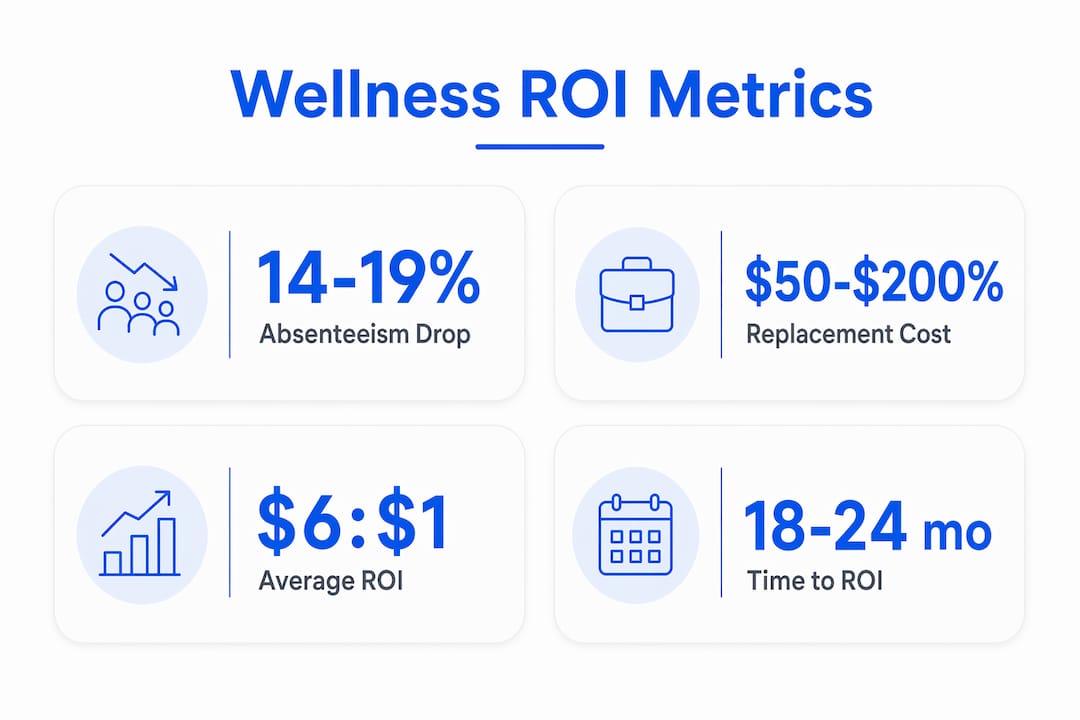
Corporate wellness ROI is defined as the measurable financial return an organization earns from investing in structured employee health programs. The numbers are compelling: 95% of organizations that measure wellness program ROI report a positive return averaging $6 in savings for every $1 invested. That $6 breaks down into $3.27 in healthcare savings and $2.73 in reduced absenteeism. For HR professionals building a business case for wellness investment, these benchmarks are the foundation. The return comes from multiple financial levers, and understanding each one separates programs that deliver from programs that just look good on paper.
What are the financial components driving corporate wellness ROI?
Wellness program ROI is not a single number. It is the sum of several distinct savings streams, and treating it as one figure misrepresents the full picture.
Healthcare cost reduction is the most visible lever. Preventive care and chronic disease management reduce the frequency and severity of claims. Employers with structured programs see measurable drops in per-employee healthcare spending, particularly when programs address conditions like diabetes, hypertension, and obesity before they escalate into high-cost interventions.
Absenteeism reduction is the second major driver. Wellness programs reduce absenteeism by 14–19% within two years. Mental health programs specifically reduce stress-related absenteeism by 25%. Every day an employee misses work costs the organization in lost output and replacement labor. Cutting those days directly improves the bottom line.

Employee retention is a lever that HR professionals often underestimate. Replacing a single employee costs 50–200% of their annual salary. Employees satisfied with wellness benefits are five times more likely to stay with their employer. A program that increases retention by even 10% can generate savings that rival healthcare cost reductions.
Productivity gains round out the financial case. Productivity improvements from wellness programs can exceed both healthcare savings and absenteeism reductions. Employees with healthy habits outperform peers by 15–25%. Reduced presenteeism, where employees show up but perform below capacity due to health issues, is a significant and often undercounted cost.
Beyond these quantifiable returns, wellness programs also generate what practitioners call Value on Investment, or VOI. VOI captures softer outcomes like employee engagement scores, employer brand strength, and morale. These metrics do not show up directly in a financial ledger, but they influence recruiting costs, team cohesion, and long-term organizational performance.
- Healthcare cost reduction through preventive care and chronic disease management
- Absenteeism reduction, including mental health-driven absences
- Retention improvement and turnover cost avoidance
- Productivity gains from reduced presenteeism
- VOI metrics: engagement, morale, and employer brand
Pro Tip: Track presenteeism separately from absenteeism. Most HR teams measure days missed but ignore the cost of employees who show up sick or burned out. Presenteeism typically costs more than absenteeism over a full year.
How do employers effectively measure wellness program impact?
Accurate measurement starts before the program launches. Without a baseline, you cannot prove what changed.
Setting your baseline
Establish baseline data across four categories before day one: healthcare claim costs per employee, absenteeism rates, voluntary turnover, and employee engagement scores. These four numbers become your comparison points at 12, 24, and 36 months. HR teams that skip this step often find themselves unable to demonstrate ROI even when the program is working.
Selecting the right metrics
Top metrics tracked by HR leaders are participation rates at 53%, retention increases at 52%, and productivity gains at 49%. Participation rate matters because low engagement is the single biggest reason programs fail to deliver financial returns. A program no one uses cannot reduce claims or absenteeism.
The standard ROI formula is straightforward: (total financial benefits minus total program costs) divided by total program costs. A result of 3:1 is the break-even benchmark. A result of 5:1 or higher indicates a high-performing program.
Avoiding common measurement pitfalls
- Measuring too early. Most programs take 18–24 months to show positive ROI. Evaluating at six months produces misleading results and can kill a program that would have paid off.
- Using only activity metrics. Counting gym visits or app logins does not demonstrate ROI. Counting activity metrics alone fails to capture financial impact. Pair activity data with claims data and productivity metrics.
- Ignoring qualitative evidence. Employee testimonials and manager observations add context that numbers alone cannot provide. A composite picture is more credible to leadership than a single ratio.
- Short measurement windows. Full ROI unfolds over 3–5 years. Organizations that evaluate programs annually and cut funding after year one consistently underperform those that commit to multi-year measurement.
Pro Tip: Build a quarterly reporting cadence from the start. Quarterly snapshots let you spot engagement drops early and adjust program design before they erode your ROI trajectory.
What are typical timelines and benchmarks for wellness investment returns?
Employers should expect a clear timeline before committing budget. The data on this is consistent across multiple studies.
Most organizations see their first positive ROI signal at the 18–24 month mark. That is when healthcare claim reductions and absenteeism savings begin to outpace program costs. Full financial returns, including productivity gains and retention savings, typically materialize over a 3–5 year horizon.
| Program type | Typical ROI ratio | Time to positive ROI |
|---|---|---|
| Basic wellness (fitness, screenings) | 2:1–3:1 | 18–24 months |
| Multi-modal (physical, mental, financial) | 4:1–6:1 | 12–18 months |
| High-engagement, evidence-based | 6:1+ | 12 months |
Programs with diverse offerings covering physical, mental, financial, and social health achieve ROI returns exceeding 150% when paired with high employee engagement. The breadth of the program matters as much as its quality. A fitness-only program leaves mental health costs and financial stress costs untouched.
Key factors that accelerate ROI:
- High participation rates driven by accessible, varied program offerings
- Leadership modeling of wellness behaviors
- Integration with existing benefits rather than standalone add-ons
- Regular communication about program value and results
What are the challenges and best practices for sustaining wellness ROI?
Sustaining returns over time is harder than generating them initially. Most programs plateau or decline in ROI after year two if the design does not evolve.
Common barriers to ROI realization include low employee engagement, high implementation costs, difficulty measuring impact, and unclear ROI perception among leadership. These barriers feed each other. Low engagement produces weak data. Weak data makes it hard to justify budget. Reduced budget cuts program quality. Lower quality drives engagement down further.
Breaking this cycle requires a deliberate approach to program design and communication.
Best practices that sustain wellness ROI:
- Design for breadth. Programs covering physical, mental, financial, and social wellness reach more employees and address more cost drivers than single-dimension programs.
- Make participation easy. Barriers like inconvenient timing, complex enrollment, or limited digital access suppress participation. High accessibility directly correlates with higher ROI.
- Use both data types. Combining quantitative financial data with qualitative evidence creates a more compelling case for continued investment. Testimonials and manager feedback matter to leadership audiences.
- Align with organizational culture. Programs that feel disconnected from company values get treated as optional extras. Programs embedded in daily work culture become part of how the organization operates.
- Report results regularly. 91% of HR leaders report that wellness programs improve productivity. Sharing that data internally builds leadership confidence and protects program budgets during cost-cutting cycles.
Pro Tip: Segment your ROI data by department or demographic group. A program delivering strong ROI in one division but weak results in another signals a design or access problem, not a program failure. Targeted fixes cost less than full redesigns.
Key Takeaways
Corporate wellness ROI is a composite metric requiring multi-year measurement across healthcare costs, absenteeism, retention, and productivity to reflect its true financial value.
| Point | Details |
|---|---|
| ROI averages $6 per $1 invested | Healthcare savings and absenteeism reductions together drive the bulk of this return. |
| Baseline data is non-negotiable | Set healthcare, absenteeism, turnover, and engagement baselines before launch to prove impact. |
| Expect 18–24 months for initial returns | Programs evaluated too early produce misleading results and risk premature cancellation. |
| Multi-modal programs outperform | Programs covering physical, mental, financial, and social health achieve the highest ROI ratios. |
| Retention is an underrated driver | Employees satisfied with wellness benefits are five times more likely to stay, cutting turnover costs significantly. |
Why HR leaders should stop treating wellness ROI as a single number
After years of watching organizations launch wellness programs with real potential and then abandon them after one disappointing annual review, I have come to a firm conclusion. The biggest mistake HR leaders make is not choosing the wrong program. It is measuring the wrong thing.
Wellness ROI is not a single ratio you calculate once and present to the CFO. It is an aggregate of savings streams that mature at different rates. Healthcare cost reductions show up first. Productivity gains take longer. Retention savings are the slowest to appear but often the largest in dollar terms. Collapsing all of that into a single year-one number will almost always look underwhelming, and that underwhelming number kills programs that would have paid off significantly.
The organizations I have seen get this right share one habit. They treat wellness ROI as a multidimensional metric aligned with long-term workforce planning, not a short-term budget justification. They report quarterly, they track multiple data streams, and they tell the story with both numbers and human evidence. That combination is what keeps leadership committed through the years it takes to see full returns.
HR leaders who champion data-driven wellness investments are not just improving employee health. They are building the financial case for a workforce strategy that compounds over time. That is worth protecting.
— Gene
How Hadaco supports employers in measuring and achieving wellness ROI
Employers who want measurable returns from their wellness investment need more than a program. They need accountability, data, and a structure that complements their existing benefits without disruption.
Hadaco delivers evidence-based wellness programs that target chronic disease, preventive care, and employee engagement across all dimensions of health. In their first year, companies working with Hadaco see an average savings of $451 per employee. Hadaco's transparent savings estimator and quarterly reporting give HR teams the exact data they need to demonstrate ROI to leadership. There are no upfront fees, and the program integrates with existing health plans rather than replacing them. For employers ready to build a measurable wellness program, Hadaco provides the structure and accountability to make it work.
FAQ
What is a good ROI for a corporate wellness program?
A 3:1 ratio is the standard break-even benchmark for wellness programs. High-performing programs with broad offerings and strong employee engagement achieve 5:1 or higher.
How long does it take to see a return on wellness investment?
Most organizations see their first positive ROI signal within 18–24 months. Full financial returns, including productivity and retention savings, typically unfold over 3–5 years.
What metrics should HR track to measure wellness program ROI?
The top metrics are participation rates, retention increases, productivity gains, and healthcare claim costs. Tracking all four against a pre-program baseline gives the most accurate picture of financial impact.
Why do some wellness programs fail to deliver ROI?
Low employee engagement is the primary cause. Programs with limited access, single-dimension design, or poor communication consistently underperform. Holistic program design and regular reporting address both engagement and measurement gaps.
What is the difference between ROI and VOI in wellness programs?
ROI measures direct financial returns like healthcare savings and absenteeism costs. VOI, or Value on Investment, captures softer outcomes like employee engagement, morale, and employer brand strength that influence long-term organizational performance.