
A workplace flu vaccination program is a targeted health initiative that brings influenza immunization directly to employees, protecting workforce health and maintaining productivity during flu season. On-site vaccination coverage reaches 73.0% among organizations that offer it, compared to significantly lower rates when employees must seek vaccines independently. That gap represents thousands of sick days, missed deadlines, and avoidable healthcare claims. For employers and HR professionals, the case for a structured employee flu vaccine policy is not theoretical. It is measurable, repeatable, and financially sound.
What delivery models work for flu vaccination at work?
Three core models exist for delivering flu vaccines to employees, and the right choice depends entirely on your workforce structure.
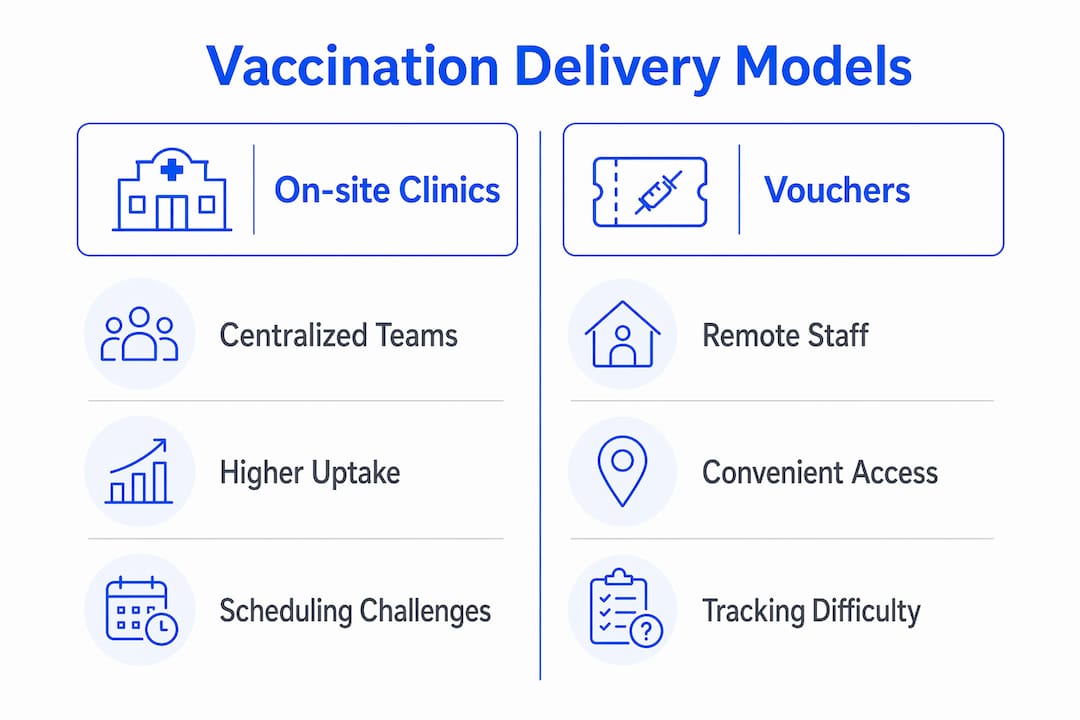
On-site flu vaccine clinics bring a licensed healthcare provider directly to your facility on a scheduled date. This model works best for centralized teams with 50 or more employees in one location. Visibility is the main advantage. When employees see a clinic set up in the break room or lobby, participation rises without extra effort from HR. The logistical requirements include a private space, a refrigeration unit for vaccine storage, and a qualified vaccinator operating under the appropriate legal framework.

Flu vaccination vouchers give employees a code or card redeemable at a local pharmacy or clinic. This model fits remote workers, hybrid teams, and employees spread across multiple sites. Vouchers eliminate the need for a central event and let employees get vaccinated on their own schedule. The tradeoff is lower visibility and slightly harder participation tracking.
Combined vaccination programs using on-site clinics plus vouchers are the most effective solution for modern hybrid workforces. This approach captures office-based employees through the clinic event while extending access to remote staff through vouchers.
| Model | Best for | Key advantage | Main challenge |
|---|---|---|---|
| On-site clinic | Centralized teams (50+ employees) | High visibility, high uptake | Requires space and scheduling |
| Voucher program | Remote or dispersed teams | Flexible, no event logistics | Lower participation visibility |
| Combined model | Hybrid or multi-site workforces | Maximum reach | Higher coordination effort |
Pro Tip: If more than 30% of your workforce is remote or hybrid, build the voucher component first. The clinic is the anchor event, but the voucher is what closes the gap.
How to design and implement a successful flu vaccination program
A well-run workplace flu shot program requires planning that starts at least eight weeks before flu season, which typically peaks between october and february.
Step-by-step implementation
- Set your dates early. Advance booking is critical for large or multi-site organizations. Vaccination providers fill their calendars quickly in september and october. Secure your clinic date before summer ends.
- Confirm your legal framework. Work with your healthcare provider to verify they operate under the correct authorization structure. In the US, this means confirming the provider holds the appropriate standing orders or protocols required by your state.
- Book a digital scheduling platform. Manual sign-up sheets create friction. A digital booking tool lets employees choose their appointment time in under two minutes, which directly increases uptake.
- Designate a private vaccination space. Employees need a confidential area. A conference room works well. Avoid high-traffic open areas that compromise privacy.
- Assign an internal coordinator. One HR contact should own the program, manage vendor communication, track participation, and handle exemption requests.
- Launch communications four weeks out. Send a calendar invite, a brief explainer email, and a poster for common areas. Follow up one week before the event.
Common mistakes to avoid
- Scheduling the clinic with less than three weeks' notice
- Failing to offer multiple time slots that cover shift workers
- Sending a single email and assuming employees will act
- Neglecting to communicate the voluntary nature of the program
- Skipping a post-event participation report
Pro Tip: Offer at least three time slots across morning, midday, and afternoon. Shift workers and part-time employees are the most likely to miss a single-window event.
What are the legal considerations employers must know in 2026?
Federal law generally permits flu vaccination mandates for private employers, but approximately 12 states restrict or ban such mandates, with variation in how those laws apply to public versus private sector workers. That patchwork makes a blanket mandate policy legally risky for any multi-state employer.
Employers may ask about vaccination status but must comply with the Americans with Disabilities Act and Title VII of the Civil Rights Act. Both laws require employers to consider medical and religious exemptions before taking any adverse action. Voluntary programs avoid this complexity almost entirely.
The practical guidance from employment law experts is consistent: encourage participation rather than require it. Incentives, convenience, and visible leadership support produce high uptake without the litigation exposure that mandates create.
"Employers should encourage voluntary vaccination programs that respect medical and religious exemptions. Mandatory policies expose organizations to complex litigation risks that voluntary programs largely avoid." — Vaccine mandate litigation guidance, Ogletree Deakins, 2026
Key compliance actions for HR teams:
- Confirm your state's current mandate laws before drafting any employee flu vaccine policy
- Document all exemption requests and responses in writing
- Never store vaccination records in an employee's general personnel file. Keep health records separate under ADA requirements
- Verify that your vaccination provider carries appropriate liability coverage
- Ensure clinical governance standards are met when outsourcing to a third-party provider
How to engage employees effectively to maximize flu vaccine uptake
Convenience is the single strongest predictor of employee participation. Schedule compatibility matters to 66.1% of employees, and digital booking platforms matter to 56.9%. Those two factors alone explain most of the participation gap between high-performing and low-performing programs.
Leadership visibility amplifies everything else. When a senior leader gets vaccinated publicly and shares a brief message about why they did it, participation rates climb. This is not about pressure. It is about social proof. Employees follow the behavior of people they respect.
Communication strategies that work
Multi-channel campaigns with visible leadership endorsement consistently increase participation. Build your communication plan around these channels:
- Email: Send a personal message from the CEO or HR director, not a generic HR blast. Include the date, location, and booking link in the first two sentences.
- Posters: Place them in break rooms, near elevators, and at building entrances two weeks before the event.
- Team meetings: Ask managers to spend two minutes mentioning the program in their weekly team calls.
- Reminders: Send a calendar reminder 48 hours before the clinic and a same-day Slack or Teams message.
Incentives work when they are simple. A small gift card drawing, an extra 30 minutes of break time on clinic day, or a team recognition post on your intranet all reduce friction without creating coercion concerns.
Pro Tip: Address vaccine hesitancy directly in your communications. A one-page FAQ that answers common concerns, written by your occupational health provider, removes the most common barrier before employees even raise it.
Cultural sensitivity matters in diverse workforces. Translate key materials into the primary languages spoken in your workforce. Offer a private appointment option for employees who prefer not to be vaccinated in a shared space.
What challenges arise during workplace flu vaccination programs?
Scheduling conflicts are the most common operational problem. Shift workers, part-time employees, and employees on leave all create gaps that a single clinic day cannot fill.
Solving the most common problems
- Shift worker access: Run two clinic sessions on the same day, one at the start of the morning shift and one at the end of the afternoon shift. This covers the widest range of schedules without requiring overtime.
- Multi-site logistics: For organizations with multiple offices, rotate the on-site clinic across locations in consecutive weeks. Pair each location's clinic with a voucher option for employees who miss their site's date.
- Remote workforce gaps: Issue vouchers redeemable at national pharmacy chains. Set a clear redemption deadline and send two reminder emails before it expires.
- Data privacy: Collect only the minimum necessary data. Record participation rates by department, not by individual, unless your program requires individual records for compliance purposes.
Common participation barriers and how to counter them:
- "I never get the flu anyway." Share your organization's actual sick day data from the previous flu season. Real numbers from your own workforce are more persuasive than national statistics.
- "The vaccine gave me the flu last year." Your occupational health provider can address this directly. The flu vaccine cannot cause influenza. It contains inactivated virus.
- "I don't have time." A properly run clinic appointment takes under 10 minutes. State that clearly in all communications.
- Apathy: Make the default action participation, not opt-in. Pre-schedule all employees for a time slot and let them cancel or reschedule rather than requiring them to sign up.
Key Takeaways
A workplace flu vaccination program delivers measurable health and financial returns when it combines the right delivery model, early planning, legal compliance, and convenience-driven employee engagement.
| Point | Details |
|---|---|
| On-site clinics drive uptake | Organizations offering on-site vaccines reach 73.0% coverage, far above self-directed rates. |
| Combined models serve hybrid teams | Pairing on-site clinics with vouchers extends access to remote and dispersed employees. |
| Voluntary programs reduce legal risk | Approximately 12 states restrict mandates; voluntary programs avoid ADA and Title VII litigation. |
| Convenience is the top engagement driver | Schedule compatibility and digital booking are the two factors employees cite most. |
| Early planning is non-negotiable | Securing clinic dates and launching communications at least eight weeks out prevents last-minute failures. |
Why flu vaccination programs are worth more than most HR teams realize
Most HR teams treat flu vaccination as a checkbox. They run one clinic in october, send two emails, and call it done. That approach misses the real opportunity.
A well-designed flu shot program is one of the highest-return workplace health initiatives you can run. The cost per employee is low. The logistics are manageable. And the downstream impact on absenteeism, healthcare claims, and team morale is real and repeatable year after year.
What I have seen work consistently is treating the flu vaccination program as a communication event, not just a medical one. The organizations that get 70%+ participation are not the ones with the best vaccines. They are the ones with the best internal marketing. They get a senior leader to send a personal email. They put up posters that actually say something. They make booking take two minutes, not ten.
The legal piece trips up more HR teams than it should. The answer is almost always the same: run a voluntary program, respect exemptions, and document everything. Mandatory flu vaccination policies create litigation exposure that no participation gain is worth. The Fourth Circuit's 2026 guidance on vaccine mandate litigation reinforced this. Voluntary programs with strong incentives routinely outperform mandates in actual uptake anyway.
The teams that get this right also connect their flu vaccination program to a broader employee wellness strategy. They track participation data, report it to leadership, and use it to improve the program each year. That continuous improvement loop is what separates a one-time event from a genuine workplace health initiative.
— Gene
How Hadaco supports your workplace health programs
Hadaco helps employers build evidence-based health programs that reduce healthcare claim costs without upfront fees. Companies working with Hadaco see an average savings of $451 per employee in their first year, with measurable improvements in engagement and retention. Flu vaccination is one piece of a larger preventive care strategy, and Hadaco's quarterly reporting gives HR teams the data they need to prove program value to leadership. If you want to connect your flu vaccination efforts to a broader health program that delivers real financial results, explore Hadaco's solutions or visit the Hadaco wellness hub to see what a full-year health program looks like in practice.
FAQ
What is a workplace flu vaccination program?
A workplace flu vaccination program is an employer-organized initiative that brings flu vaccines directly to employees through on-site clinics, vouchers, or both. The goal is to increase vaccination rates and reduce flu-related absenteeism.
Can employers require employees to get a flu shot?
Federal law generally permits flu vaccine mandates, but approximately 12 states restrict or ban them. Voluntary programs are the lower-risk approach for most employers.
What vaccination rate can employers expect from on-site clinics?
On-site flu vaccination reaches 73.0% coverage in organizations that offer it, significantly higher than rates achieved when employees seek vaccines independently.
How do employers handle remote workers in a flu vaccination program?
Flu vaccination vouchers redeemable at pharmacies or local clinics are the standard solution for remote and hybrid employees. A combined model pairing vouchers with on-site clinics covers both groups effectively.
When should HR start planning a workplace flu vaccination program?
Start planning at least eight weeks before flu season begins. Securing clinic dates in late summer gives your organization the scheduling flexibility needed to accommodate all employee groups.