
Finding a workplace health program that reduces claims and fits with existing health plans is complex for benefits teams. Many options require up-front costs, skip integration with current insurance, or lack transparent clinical outcome data. Comparing these top MoveSpring alternatives lets you match program features, risk structure, and reporting models to your organization's benefits strategy without contacting every vendor separately.
Table of Contents
Hadaco Health Solutions
At a Glance
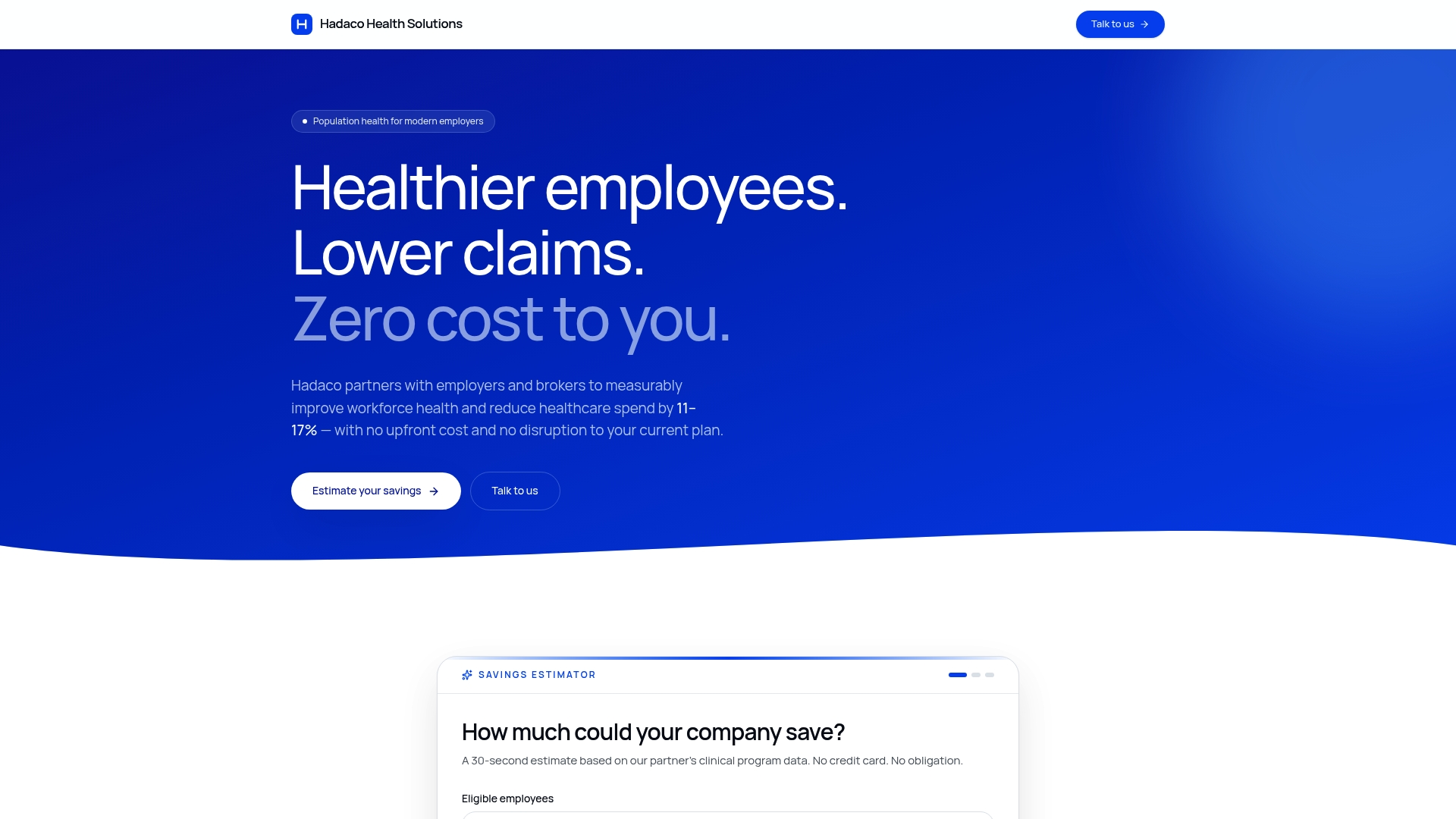
Hadaco's materials claim 11–17% reductions in healthcare claims for participating employers. The vendor also states companies often see an average savings of $451 per employee in the first year. Hadaco targets population health improvements while working alongside existing health plans and brokers.
Core Features
Hadaco delivers evidence-based clinical programs that publish outcome data and run alongside current insurance arrangements. The service carries no upfront cost to employers and includes quarterly reporting on engagement, outcomes, and claim trends. Support and reporting are tailored to employer needs and to benefits teams and brokers.
Key Differentiator
Hadaco centers its model on clinically validated programs offered with zero upfront employer cost. That structure ties clinical interventions to measurable claim reductions and makes financial risk fall outside the employer's initial budget.
Pros
Published clinical outcomes back program design and give benefits teams measurable signals to act on. The lack of upfront or net employer cost lowers procurement hurdles for HR and finance. Integration with existing health plans and broker relationships preserves current vendor contracts while adding targeted population health services. Regular reporting helps benefits leaders and brokers track engagement, preventive care use, and claim trends over time.
Cons
- Limited public detail on specific program components and customization options makes it hard for HR teams to map exact workflows before engagement.
Who It's For
Benefits directors, HR leaders, and brokers in medium to large employers seeking population health solutions without initial expense. This fits teams that want to reduce claim spend while keeping current insurers and brokers in place. Organizations that need documented clinical outcomes and regular program reporting will find this model relevant.
Unique Value Proposition
A transparent savings estimator paired with quarterly outcome reports lets employers see projected savings and then follow matched clinical results. That combination shifts vendor conversations from promises to measurable financial and health metrics. Finance and benefits teams can present modeled savings to leadership and then validate progress through the reports.
Real World Use Case
Hadaco's case example reports a 15% reduction in healthcare costs for a medium-sized company while improving engagement and retention. The program worked without changing the employer's existing insurance plan and supported HR with ongoing reporting and implementation assistance.
Pricing
There are no public pricing tiers. The offering reports no upfront or net employer cost and is presented as informational only. Procurement should ask Hadaco how savings are modeled and how any shared-savings or administrative arrangements are structured.
Website: https://hadaco.com
SelectWell
At a Glance
The vendor advertises advanced biomarker testing that claims to detect current and future chronic health risks. SelectWell pairs those lab results with lifestyle change support aimed at lowering health plan expenses and improving workplace productivity. That focus makes early detection the program's most specific selling point for employer health programs.
Core Features
SelectWell uses predictive lab analysis to flag metabolic and chronic risk markers, and it couples those results with behavior-change coaching and education for employees. The program targets reduced claims and higher health awareness by combining screening data with employer-directed interventions. The feature set centers on testing, employee engagement, and cost containment for employer health plans.
Key Differentiator
That use of predictive biomarker testing for workforce screening is the product's primary distinction. It shifts employer health strategy from reactive care to preemptive identification of risk. For HR teams focused on metabolic health awareness, that targeted testing provides a clear starting point for interventions.
Pros
SelectWell offers concrete predictive insights through lab-based screening, which helps employers identify at-risk employees earlier than wellness surveys alone. The program aligns clinical indicators with behavior-change support, so health coaching directly follows testing results. That pairing makes it easier for benefits teams to translate a screening event into measurable follow-up actions and program referrals.
Cons
- Limited public documentation and broken links make it difficult to verify detailed features or technical workflows.
- The program requires sustained employer commitment to follow-up interventions and employee engagement. Low participation will reduce program value.
- Specifics about technology vendors, data handling, and program cadence are not clearly listed.
When It May Not Fit
If your plan needs a turnkey digital wellness platform with visible integrations and admin portals, SelectWell may feel incomplete. Organizations that cannot sustain ongoing engagement or follow-up outreach will not realize the screening benefits. If you require transparent vendor technical specs and published program metrics, this offering may not match that procurement need.
Who It's For
HR teams and benefits managers at medium and large employers seeking proactive ways to control medical costs will find SelectWell relevant. It fits groups willing to fund screening events and follow through with coaching or referral programs. Buyers must plan for participation campaigns and internal coordination with health plan vendors.
Real World Use Case
An employer runs onsite biomarker screening across multiple locations and uses those results to prioritize employees for targeted coaching. Benefits staff work with managers to schedule follow-up sessions and refer high-risk individuals to clinical resources. After six months of outreach, the company documents clearer referral pathways and better employee awareness of metabolic risks.
Pricing
Not applicable — informational only. SelectWell appears to position itself as a vendor-driven program rather than a self-serve software subscription, and public pricing is not listed.
Website: https://selectwell.com
Workplace Options
At a Glance
Workplace Options reports serving over 88 million employees across more than 50 countries. That figure signals a very large global reach and a client base that includes many Fortune 500 companies, according to the vendor. The offering combines counseling, critical incident response, physical coaching, and digital services into a single employer program. The breadth of services makes it a full service option for large employers with dispersed teams.
Core Features
Workplace Options bundles holistic employee support programs with counseling and critical incident response, and it adds practical and physical health coaching. The platform connects human clinicians and local providers with digital tools and offers professional coach training for internal teams. These combined capabilities let employers run mixed model programs that include digital, in person, and clinician delivered services.
Key Differentiator
Workplace Options positions itself as the largest independent provider offering an integrated blend of in person care, digital systems, and coach training at global scale. That integrated mix and the vendor reported global footprint set it apart from vendors that focus only on digital engagement or only on local EAP services. The model targets employers who want a single supplier to cover mental health, physical health, and organizational resilience across multiple countries.
Pros
The vendor reports a wide global presence that helps employers standardize wellbeing programs across regions while still using local providers when needed. The service suite covers clinical counseling, practical support, critical incident response, and coach training, which reduces the number of separate vendors HR must manage. Strong membership and accreditation credentials support consistent program governance and quality control. The vendor emphasizes digital integration so employers can combine human care and digital tools without building that capability internally.
Cons
- Pricing is not published and is tailored to each organization, which lengthens procurement cycles for buyers who need quick vendor comparisons.
- Service complexity requires dedicated program management from HR or benefits teams to coordinate providers and digital tooling.
- Reviews and local delivery quality vary by location, so outcomes can depend on local partners rather than a single standardized service.
When It May Not Fit
If your organization needs fixed, transparent pricing for immediate budgeting, this offering may not match your procurement timeline. If you run a small, single country company with no internal program management capacity, the multi component model could add overhead. If you require strictly uniform clinical delivery everywhere, local provider variation means the service may not deliver identical experiences in every market.
Who It's For
HR and organizational leaders managing large or dispersed workforces who need a single vendor to coordinate mental health, physical health, and organisational wellbeing programs. Procurement teams looking to consolidate EAP, coaching, and digital services into one contract will find that consolidated model useful. Teams that can dedicate program management resources will get the most value.
Real World Use Case
A multinational company used Workplace Options to centralize its employee assistance program, critical incident response, and coach training across subsidiaries. Local delivery was handled by regional partners while the digital layer provided reporting and employee access. The setup reduced vendor count and created a single escalation path for cross border incidents.
Pricing
Not applicable informational only. Pricing is tailored to organizational needs and is not published online, so you must contact the vendor for a proposal and a quote. That procurement step typically involves scope, country coverage, and service level discussions.
Website: https://workplaceoptions.com
Comparison of alternatives
Employers seeking a solution that aligns with clinical validation and cost efficiency while complementing existing workflows will find multiple options available. Evaluating these alternatives based on distinctive offerings and operational needs reveals specific areas of leadership: Hadaco Health Solutions provides cost-effective clinical validation; SelectWell focuses on early risk detection; and Workplace Options excels in global service reach.
Comparing integration methodologies
Hadaco Health Solutions works as an enhancement to existing employee health plans and benefits brokerage structures, appealing to organizations that lack dedicated internal program management resources. By requiring no upfront costs and offering structured reporting, it reduces hurdles in the decision-making process.
Comparatively, SelectWell introduces costs at the screening stage but leverages biomarker evaluations to identify health risks early. This proactive approach suits organizations willing to invest in employee engagement campaigns and sustain follow-ups effectively.
Workplace Options manages large-scale service delivery through its global partner network, providing tailored support in over 50 countries. This flexibility is advantageous for multinational enterprises, despite requiring dedicated internal teams to oversee program operations effectively.
Provider strengths relevant to scalability
SelectWell's focus on metabolic and chronic health markers serves predictive and preventive employer health plans, though it depends on employee participation for success. Workplace Options, however, supports a breadth of services—EAP, coaching, digital platforms—but at the cost of unclear fixed pricing.
In contrast, Hadaco Health Solutions supports financial decision makers needing evidence-based outcomes. Its of adoption—namely the absence of upfront costs—simplifies financial considerations for HR and benefits leaders.
Best fit
- Employers prioritizing cost reduction without sacrificing current health plan structure will find Hadaco Health Solutions practical and accessible.
- Organizations aiming to address metabolic health priorities might benefit from SelectWell, which utilizes biomarker screening for proactive health interventions.
- Large or multinational companies requiring providers with a proven track record in counseling, training, and global reach should explore Workplace Options.
Our pick
For employers desiring an impactful, cost-effective, and clinically validated workplace health solution to integrate with existing employee benefits, Hadaco Health Solutions stands as the recommended choice. However, organizations with unique needs, such as on-site biomarker testing or expansive geographic healthcare management, might find other options better suited to their priorities.
For businesses evaluating workplace health programs, this table outlines choices grounded in targeted features and cost structures.
| Product | Core Feature | Key Differentiator | Best For | Pricing | Notable Limitation |
|---|---|---|---|---|---|
| Hadaco | Evidence-based clinical programs | Zero upfront employer cost | Medium to large employers | Price not published | Limited detail on program customization options |
| SelectWell | Predictive biomarker testing | Early chronic risk detection | Medium to large employers | Price not published | Requires sustained employer commitment |
| Workplace Options | Global employee support services | Largest independent multi-service provider | Large and international organizations | Price not published | Tailored pricing complicates quick comparisons |
Choosing the right MoveSpring alternative to control healthcare costs
Employers, benefits directors, and HR leaders often face challenges managing healthcare claim expenses while improving employee health engagement. Hadaco addresses these issues by offering evidence-based clinical programs that reduce healthcare claims by up to 17% and deliver an average first-year savings of $451 per employee. Unlike other options, Hadaco works alongside your current insurance plans with no upfront cost, making it easier to lower costs without disrupting existing benefits.
Key advantages include:
- Transparent savings estimator with quarterly outcome reports
- Support tailored to benefits teams and brokers
- Focus on chronic disease management, preventive care, and employee engagement
Learn more about Hadaco’s approach and see how your company can start measuring real financial and health outcomes today.
Hadaco shows that measurable claim reductions and improved workforce wellbeing can happen together. Take the next step by visiting Hadaco’s site to understand how to integrate these programs with your current health benefits.
FAQ
How does Hadaco support workplace health programs?
Hadaco delivers evidence-based clinical programs that run alongside existing health plans and brokers. This approach allows employers to reduce healthcare claims by 11–17%, enhancing workplace health without upfront costs.
What is the difference between Hadaco and SelectWell?
SelectWell provides advanced biomarker testing that focuses on detecting current and future chronic health risks, giving it a unique edge for organizations emphasizing early detection. For employers seeking an engagement strategy that also reduces claims without initial expenses, Hadaco is the superior option.
Which platform offers quarterly reporting on health outcomes?
Hadaco includes quarterly reporting on engagement, outcomes, and claim trends, making it easier for benefits teams to track progress. This evidence-based approach is vital for organizations wanting to measure the effectiveness of their health initiatives.
Can Hadaco fit organizations with existing health plans?
Yes, Hadaco can integrate with current health plans and broker relationships, allowing employers to enhance population health services without changing their existing vendor contracts. This makes it ideal for organizations looking to improve health outcomes without flipping their entire benefits structure.
Does Hadaco have any upfront costs for employers?
Hadaco operates with no upfront costs to employers, which significantly lowers procurement hurdles for HR and finance teams. This unique pricing model allows easier entry for organizations looking to improve their health programs.