
Stop-loss carriers transfer catastrophic claim risk away from self-funded employers. The short recommendation: choose carriers that combine transparent underwriting, clinical high-cost-claim support, and genuine data-sharing. Then pair that coverage with a population-health program to reduce the expected retained claims that stop-loss never touches.
Swiss Re describes stop-loss as protection against both individual catastrophic claims and aggregate plan losses, with tailored solutions for employer risk tolerance. Meanwhile, Milliman's 2024 market observations show that carriers using predictive modeling tend to deliver more stable pricing and clearer renewal explanations. Neither finding changes the core reality: stop-loss caps your worst-case exposure, but it does not lower the everyday claims that eat your budget year after year. That is where a population-health partner like Hadaco comes in.
Your immediate next steps:
- Collect 12 months of detailed claims data before approaching any carrier
- Short-list carriers that score on underwriting transparency, AM Best/S&P ratings, and clinical-review capability
- Ask every carrier how they share data with employer-side health programs
- Engage a population-health partner to reduce expected retained claims before your next renewal
Table of Contents
- What do specific and aggregate stop-loss actually cover?
- Key policy terms and contract clauses you must compare
- What should you actually look for in a stop-loss carrier?
- How to score carriers on every selection dimension
- What drives stop-loss premiums and how does the timeline work?
- How do stop-loss carriers and population-health programs work together?
- What questions should you ask carriers and brokers?
- Key Takeaways
- The selection process most benefits leaders get wrong
- Hadaco helps you lower the claims stop-loss never covers
- Useful sources for benefits teams doing stop-loss due diligence
What do specific and aggregate stop-loss actually cover?
Stop-loss insurance comes in two forms, and most self-funded employers need both.
Specific stop-loss (also called individual stop-loss) reimburses the employer once a single member's claims exceed a set dollar threshold in a plan year. If your attachment point is $150,000 and one employee's cancer treatment hits $400,000, the carrier covers the $250,000 above that line. Aggregate stop-loss works at the plan level. It kicks in when total plan claims exceed a corridor above expected costs, typically 125% of projected annual spend. Together, they cap both the single-claim disaster and the year where everything goes wrong at once.
| Coverage type | What it protects | Trigger |
|---|---|---|
| Specific (individual) | One member's claims | Claims exceed the per-person attachment point |
| Aggregate | Total plan claims | Plan-wide claims exceed the aggregate attachment |
A few plan-design details matter here. Plan mirroring means the stop-loss policy mirrors your medical plan's covered benefits exactly, avoiding gaps where a claim is covered by the plan but excluded by the carrier. Voya documents flexible stop-loss features including plan mirroring, advanced funding, and pooled-renewal approaches that help mid-market employers manage volatility. Carve-outs for specific high-cost conditions or pharmacy benefits are common but require careful negotiation to avoid coverage surprises.
Key policy terms and contract clauses you must compare
Before signing any stop-loss contract, your legal and benefits team should review these terms closely:
- Attachment point/deductible: The per-member dollar threshold (specific) or plan-wide percentage (aggregate) above which the carrier pays. Lower attachment points mean more protection but higher premiums.
- Corridor: The gap between expected claims and the aggregate attachment. A 125% corridor means the employer absorbs the first 25% of adverse deviation before aggregate coverage activates.
- Reinstatement: Whether the specific attachment point resets mid-year for a member who hits the limit. Without reinstatement language, a member with a second catastrophic event in the same year may not be covered again.
- Exclusions: Pre-existing condition exclusions, experimental therapy carve-outs, and late-reported claim exclusions are the most common. Vague exclusion language is a red flag.
- Lifetime vs. annual limits: Most modern plans use annual limits per the ACA framework, but stop-loss contracts can still impose separate lifetime maximums. Verify these align with your plan document.
- Claims run-out: The period after policy expiration during which claims incurred during the policy year can still be submitted. A 12/15 or 12/18 run-out is standard; shorter windows create gaps.
Pro Tip: Negotiate reinstatement language explicitly. Ask the carrier to confirm in writing whether the specific attachment point resets after a member's first catastrophic claim. Carriers that resist this conversation are often the ones whose contracts create the most disputes at renewal.
What should you actually look for in a stop-loss carrier?
The difference between a good and a mediocre stop-loss carrier shows up at renewal, not at binding. Here is what separates them.

Underwriting transparency. Milliman's survey data shows that carriers using predictive analytics tend to offer more stable pricing and can explain renewal changes with actual data rather than market-wide adjustments. Ask every carrier how they build their rates and what data they use.
Financial strength. Swiss Re highlights AM Best ratings as a front-line trust signal for claims-payment confidence. Require an AM Best rating of A or better and check S&P as a second opinion. A carrier that cannot pay a $2 million claim is not a carrier.
Clinical services. Sun Life positions stop-loss as a strategic asset that includes clinical oversight and high-cost claim review. Carriers with credentialed medical directors and active case management influence outcomes rather than just reimbursing after the fact. This is the feature most employers underweight.
Data and reporting. Quarterly claim-level reporting is the minimum for any employer running a population-health program. Ask whether the carrier will share data via API or structured feeds, not just PDF summaries.
Service model. Milliman notes that ASO carriers often show higher persistency and close ratios versus MGUs and third-party writers. Direct writers tend to have more consistent underwriting standards. MGUs can offer flexibility but vary widely in rigor.
| Carrier capability | What to ask | Why it matters |
|---|---|---|
| Underwriting transparency | Do you disclose predictive model inputs? | Reduces renewal surprises |
| Financial strength | AM Best/S&P rating? | Claims-payment confidence |
| Clinical services | Do you have credentialed medical directors? | Active case management vs. passive reimbursement |
| Data sharing | Quarterly claims feeds available? | Enables population-health integration |
| Service model | Direct writer or MGU? | Consistency of underwriting and claims handling |
How to score carriers on every selection dimension
Use this matrix in your RFP scoring worksheet. Rate each carrier response as best-in-class, standard, or limited.
| Dimension | Best-in-class | Standard | Limited |
|---|---|---|---|
| Coverage type | Specific + aggregate, plan mirroring | Specific only or basic aggregate | No plan mirroring, carve-outs unexplained |
| Attachment point flexibility | Negotiable, corridor options | Fixed tiers | Take-it-or-leave-it |
| Reinstatement | Explicit mid-year reset language | Annual reset only | No reinstatement provision |
| Exclusions | Narrow, defined, negotiable | Broad but disclosed | Vague or buried in definitions |
| Financial ratings | AM Best A+ or A, S&P AA | AM Best A- | Unrated or below A- |
| Clinical services | Medical directors, case management SLAs | Basic claim review | Reimbursement only |
| Predictive underwriting | Disclosed model, stable pricing history | Some analytics, limited disclosure | Manual underwriting only |
| Pricing structure | Transparent, experience-rated | Blended/pooled, limited explanation | Black-box pricing |
| Renewal transparency | Experience-rated with data | Market-adjusted with some data | Market-rate only |
| Claims reporting cadence | Quarterly, claim-level data feeds | Semi-annual summaries | Annual only |
Carriers that score "limited" in financial ratings, clinical services, or claims reporting should be dropped from your short-list regardless of price.
What drives stop-loss premiums and how does the timeline work?
Premium is not a mystery, but most employers do not know which levers move it most.
The biggest drivers are plan size (lives covered), attachment point selection, historical claim volatility, and high-cost pharmacy. Milliman's market notes specifically flag gene therapies and specialty pharmacy as growing underwriting concerns. A single gene therapy claim can exceed $3 million, and carriers price that risk into every group's premium whether or not the employer has ever had such a claim.
Predictive analytics change this dynamic. Carriers that model your specific population's risk profile rather than applying broad pooled rates can offer more accurate, stable pricing. That is a real financial advantage at renewal.
Typical underwriting and quote timeline:
- Collect 24 months of detailed claims data (12 months minimum, 24 preferred)
- Submit RFP to carriers 90–120 days before renewal
- Carriers return initial quotes within 2–4 weeks
- Negotiate attachment points, exclusions, and reinstatement terms (2–3 weeks)
- Bind coverage 30–45 days before the effective date
- Confirm data-sharing and reporting setup before the policy start date
Starting this process late is the single most common employer mistake. Carriers that receive last-minute RFPs with incomplete claims data often apply more conservative pricing.
How do stop-loss carriers and population-health programs work together?
Stop-loss handles the tail. Population-health programs shrink the body of the distribution. Both are necessary, and they work best when the carrier and the health program share data.
Sun Life and Swiss Re both emphasize combining carrier clinical support with employer-side proactive health management to reduce both expected and catastrophic spend. The logic is straightforward: a carrier's medical director reviewing a high-cost oncology case and a population-health program's care-gap closure work are not competing activities. They are complementary. One manages the claim in progress; the other prevents the next one.
Integration checklist:
- Require quarterly claims data feeds from your carrier in the RFP
- Share population-health program enrollment and engagement data with the carrier at renewal
- Align case management: carrier case managers and your health program's care coordinators should not be working the same member in isolation
- Build incentive alignment into the carrier contract: ask whether the carrier will credit population-health program participation in renewal pricing
Pro Tip: Add this language to your RFP: "Carrier must provide quarterly claim-level data feeds compatible with employer-designated population-health program platforms. Refusal to share data in structured format is a disqualifying condition." Carriers that object to this clause are telling you something important about how they view the relationship.
What questions should you ask carriers and brokers?
RFP underwriting questions:
- What claims data do you require, and in what format?
- How do you set the specific attachment point for our group?
- Do you use predictive modeling? Will you disclose the inputs?
- What is your reinstatement policy for specific claims?
- List all standard exclusions and identify which are negotiable.
Operational questions:
- What is your claims-reporting cadence, and can you provide claim-level data feeds?
- Do you have credentialed medical directors involved in high-cost claim review?
- What is your appeal timeline for disputed claims?
- How do you handle late-reported claims near the run-out deadline?
Broker vetting questions:
- How many stop-loss carriers do you actively place business with?
- Do you receive contingent commissions from any carrier on our short-list?
- Can you provide renewal history for three comparable groups you placed?
Key Takeaways
The most effective stop-loss strategy pairs a financially strong, data-sharing carrier with an active population-health program that reduces the expected retained claims stop-loss never covers.
| Point | Details |
|---|---|
| Start the RFP early | Submit to carriers 90–120 days before renewal with at least 12 months of claims data. |
| Prioritize clinical services | Carriers with credentialed medical directors actively manage outcomes, not just reimburse claims. |
| Require data transparency | Quarterly claim-level feeds are non-negotiable for employers running population-health programs. |
| Validate financial strength | Require AM Best A or better and S&P confirmation before finalizing any carrier short-list. |
| Hadaco reduces retained claims | Hadaco's evidence-based programs target the everyday claims stop-loss never touches, delivering measurable savings per employee in year one. |
The selection process most benefits leaders get wrong
Most benefits leaders treat stop-loss as a commodity purchase and hand it entirely to their broker. That is a mistake, and it usually shows up as a 20–30% renewal spike they did not see coming.
The broker relationship matters, but you need to be in the room. Ask your broker directly whether they receive contingent commissions from any carrier on your short-list. That single question changes the dynamic of every subsequent conversation. Brokers who are uncomfortable answering it are telling you something.
On timing: the 90-day RFP window is not a suggestion. Carriers that receive complete, clean data packages with 24 months of claims history price more competitively than those working from incomplete submissions. Your TPA can pull this data. Make it a standing request every September if your renewal is January 1.
The red flags in carrier proposals are usually not in the premium. They are in the exclusion definitions, the claims run-out language, and the reporting section. A carrier that offers quarterly reporting only as a paid add-on, or whose exclusion language includes phrases like "as determined by the carrier in its sole discretion," is not a partner. Watch for attachment points that look attractive but include corridor language that effectively raises your aggregate threshold by 30%.
Finally, align your CFO and HR leadership before you go to market. Attachment-point decisions are financial decisions, not just insurance decisions. A CFO who understands that a lower attachment point costs more in premium but reduces budget variance will make a better call than one who sees only the premium line.
Hadaco helps you lower the claims stop-loss never covers
Stop-loss protects against catastrophic claims. What it does not do is reduce the chronic-condition management gaps, preventive care misses, and engagement failures that drive your everyday claims volume. That is exactly where Hadaco's population-health programs deliver.
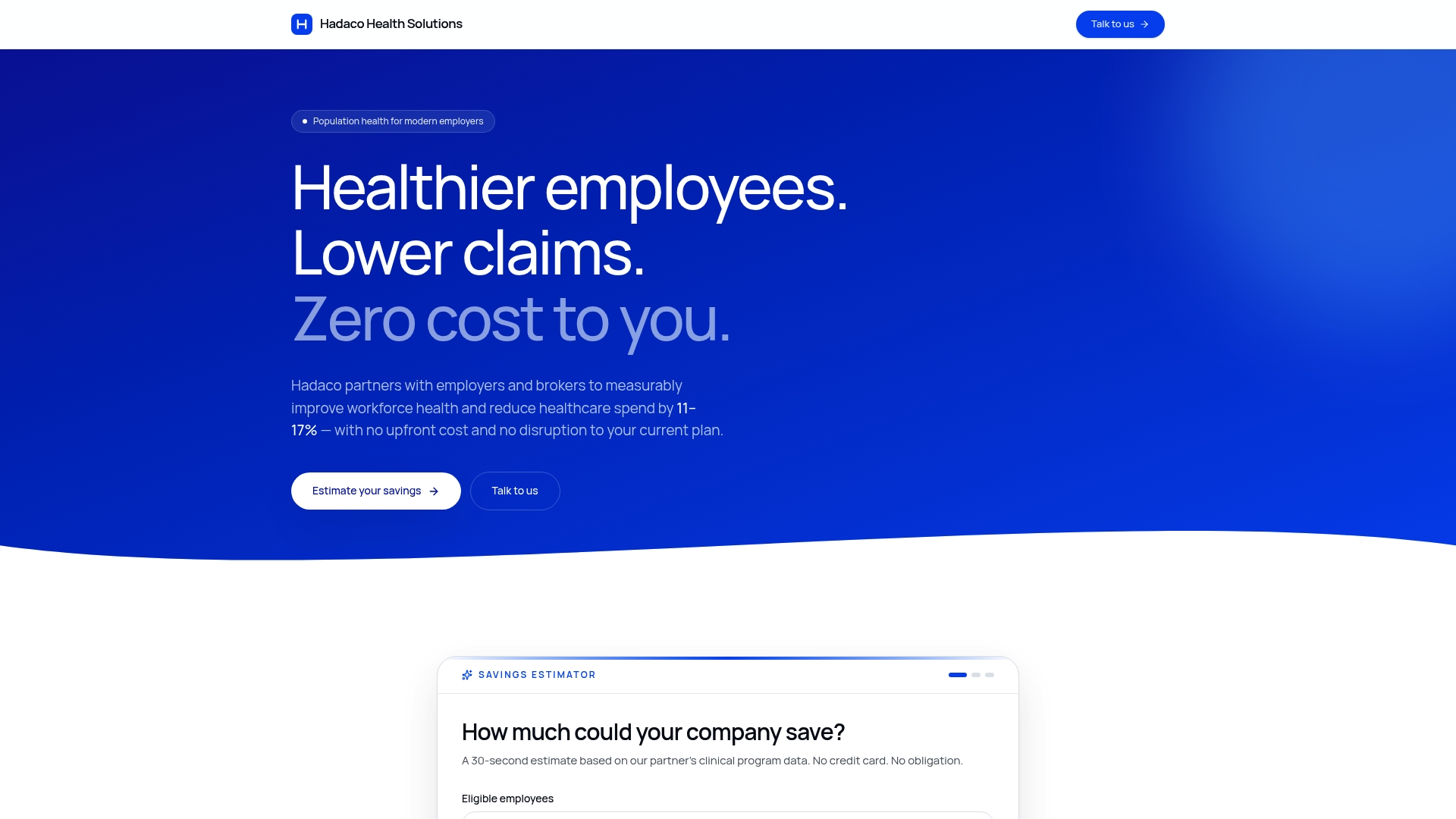
Hadaco runs evidence-based interventions for chronic disease, preventive care, mental health, and employee engagement, all integrated with your existing benefit plan and with no upfront fees. Employers typically see savings per employee in the first year, tracked through quarterly reporting that gives you the claim-level data your stop-loss carrier will want at renewal. Hadaco's savings estimator shows you the projected impact before you commit. When you go to market for stop-loss coverage, you can show carriers an active population-health program, which signals lower expected claims and supports a stronger negotiating position. Request your savings estimate at Hadaco and bring that data into your next RFP.
Useful sources for benefits teams doing stop-loss due diligence
- Swiss Re: Accident and Health Stop Loss Solutions in North America — Reinsurer-level perspective on tail-risk transfer, financial strength ratings, and tailored employer solutions. Use this to understand how reinsurance capacity backs carrier claims-payment ability.
- Sun Life U.S.: Stop-Loss Insurance — Carrier product page covering clinical oversight, high-cost claim review, and strategic stop-loss positioning. Useful for benchmarking clinical-service expectations.
- Voya: Stop Loss Insurance — Documents flexible product features including plan mirroring, advanced funding, and pooled approaches for mid-market employers.
- Milliman: Observations on the Employer Stop-Loss Market, 2024 Survey — The most current independent market survey on underwriting trends, predictive modeling adoption, carrier type comparisons, and pricing drivers including gene therapy. Required reading before any RFP.
- USBenefits Insurance Services — A national MGU focused on disciplined underwriting and transparent pricing. Useful reference for understanding how MGUs operate and what to expect from a hands-on stop-loss partner.
- AM Best and S&P Global Ratings — Verify carrier financial-strength ratings directly on these platforms before finalizing any short-list. Never rely on a carrier's self-reported rating without independent confirmation.