
Stress management at work is the practice of identifying distinct workplace stressors and applying evidence-based strategies to reduce their negative effects on well-being and performance. The World Health Organization recognizes workplace stress as a leading contributor to poor mental health globally, and the American Psychological Association links chronic work stress to reduced productivity, higher absenteeism, and burnout. Research from february 2026 confirms that excessive workload and work-family conflict are the strongest predictors of employee stress. The good news: targeted, practical strategies work. This guide gives you a clear framework to recognize what is driving your stress and act on it fast.
What are the main types of workplace stress?
Workplace stress is not one problem. It is five distinct problems, and treating them as one is why most generic advice fails.
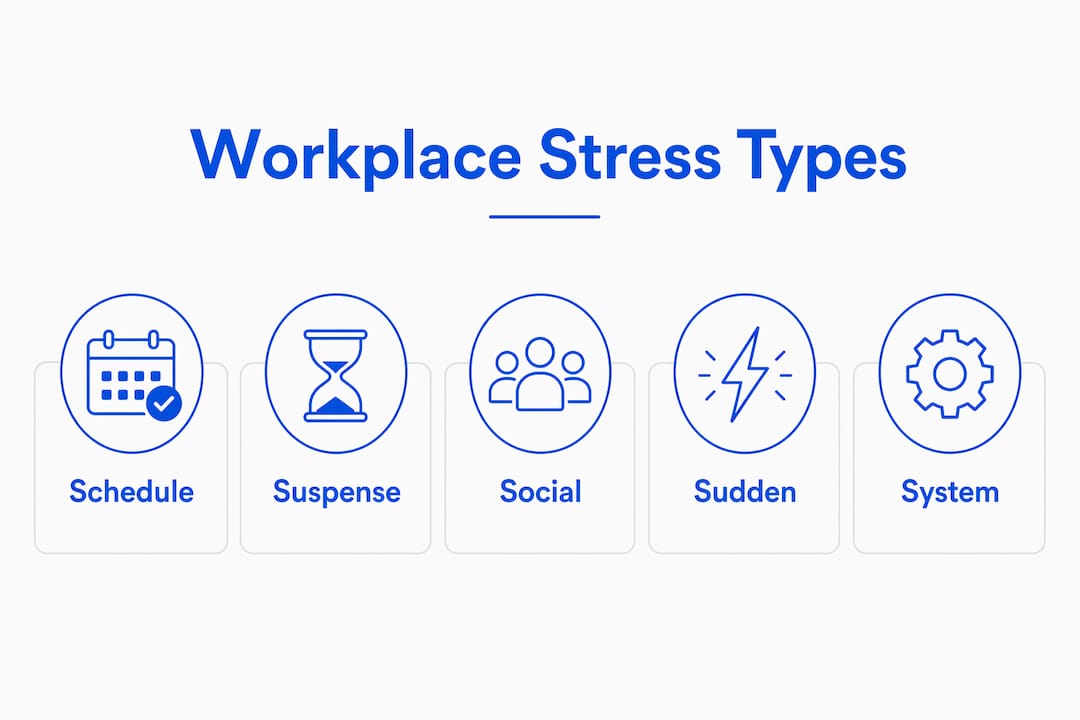
Experts classify workplace stress into five categories: Schedule, Suspense, Social, Sudden, and System stress. Each category has different triggers, symptoms, and solutions. Applying a breathing exercise to a conflict with a coworker, for example, treats the symptom but not the source.

| Stress Type | Trigger | Common Symptom |
|---|---|---|
| Schedule stress | Too many tasks, too little time | Constant rushing, missed deadlines |
| Suspense stress | Waiting on decisions or outcomes | Anxiety, difficulty concentrating |
| Social stress | Conflict, poor communication | Tension, avoidance behaviors |
| Sudden stress | Unexpected crises or changes | Shock, reactive decision-making |
| System stress | Broken processes, unclear roles | Frustration, low motivation |
Schedule stress hits when your to-do list grows faster than your capacity to act. Suspense stress builds when you are waiting on a promotion decision or a client response you cannot control. Social stress comes from difficult colleagues, unclear expectations, or feeling invisible in meetings. Sudden stress is the emergency that lands in your inbox at 4:45 PM. System stress is the slow burn of working inside broken processes that nobody fixes.
Recognizing which type you are dealing with changes everything. A targeted response beats a generic one every time.
Pro Tip: Keep a simple stress log for one week. Write down what triggered your stress and which of the five categories it fits. Patterns will surface faster than you expect.
How do you assess and prioritize your workplace stressors?
Most people try to fix everything at once. That approach leads to paralysis, not progress.
The most effective method is a decision matrix. List your current stressors, assign each one to a stress type, then rank them by two factors: how often the stressor occurs and how much control you have over it. Start with the stressor that is both frequent and within your control. Ignore the rest for now.
Here is a practical four-step process to get started:
- List your stressors. Write down every source of stress you experienced in the past two weeks. Do not filter. Include small irritants and major pressures.
- Categorize each one. Assign each stressor to one of the five types: Schedule, Suspense, Social, Sudden, or System. This step alone breaks the feeling that everything is equally urgent.
- Score by frequency and control. Rate each stressor from 1 to 3 on how often it happens and how much influence you have over it. Multiply the scores. The highest number gets your attention first.
- Assign one action per stressor. One small, targeted action per stressor is more effective than a sweeping plan. "Block 30 minutes each morning for deep work" beats "be less stressed about deadlines."
Watch for warning signs that stress has crossed into burnout territory: persistent exhaustion that sleep does not fix, emotional detachment from your work, and a drop in the quality of your output. These signals mean the stressor has been active too long without intervention.
Pro Tip: Revisit your stress log every Friday for five minutes. Adjust your priority stressor as conditions change. Consistency beats intensity here.
What stress management techniques actually work?
The most effective techniques are brief, frequent, and matched to the stress type driving your reaction.
Breathing and body-based techniques
Diaphragmatic breathing is the fastest tool for Schedule stress. Breathe in for four counts, hold for four, exhale for six. Practiced 2–3 times daily for 3–5 minutes, this technique measurably reduces physiological stress responses and improves emotional regulation. You can do it at your desk before a difficult meeting or after a high-pressure call.
Mindfulness and cognitive reframing
Mindfulness works best for Suspense stress, where the trigger is something you cannot control. A two-minute body scan, done at your desk with eyes closed, interrupts the rumination loop that makes waiting unbearable. Cognitive reframing targets Social and System stress. Ask yourself: "Is my interpretation of this situation the only possible one?" Writing down two alternative explanations for a colleague's behavior, for example, reduces the emotional charge of a conflict.
Grounding for sudden stress
The 5-4-3-2-1 grounding technique works fast when a crisis hits. Name five things you can see, four you can touch, three you can hear, two you can smell, and one you can taste. This pulls your nervous system out of fight-or-flight and back into the present. It takes under two minutes and requires no equipment.
Here is a quick reference for matching techniques to stress types:
| Stress Type | Recommended Technique | Time Required |
|---|---|---|
| Schedule | Diaphragmatic breathing | 3–5 minutes |
| Suspense | Mindfulness body scan | 2–3 minutes |
| Social | Cognitive reframing | 5–10 minutes |
| Sudden | 5-4-3-2-1 grounding | Under 2 minutes |
| System | Structured problem-solving | 15–20 minutes |
The key insight here is that micro-practices compound. Three five-minute sessions spread across a workday produce better results than one long session at the end of the week. Consistency is the mechanism, not duration.
How does organizational support affect employee stress?
Individual techniques only go so far. The environment you work in either amplifies or buffers your stress response.
Research confirms that supportive organizational climates and clear career advancement structures act as protective factors against workplace stress. When employees know where they stand and where they can go, uncertainty drops. Uncertainty is one of the most potent stress amplifiers in any workplace.
The CDC states that managers can reduce job stress by shaping the work environment, spotting stress signs early, and providing adequate resources. This is not a soft finding. It is public health guidance backed by occupational research.
You can engage your manager constructively without framing the conversation as a complaint. Try these approaches:
- Name the stressor specifically. "I am managing five concurrent deadlines this week with no buffer" is more useful than "I am overwhelmed."
- Propose a solution. Managers respond better to "Can we reprioritize X?" than to a general request for help.
- Ask for clarity on expectations. Ambiguity drives System and Suspense stress. A 15-minute conversation about priorities can eliminate days of anxiety.
- Request workload flexibility when possible. Manager-supported workload flexibility increases employee participation in stress programs and reduces stress more effectively than individual effort alone.
Transparent career pathways matter too. Employees who understand how their performance connects to advancement report lower stress and higher engagement. If your organization does not offer this clarity, ask for a direct conversation about your development path.
What are the most common mistakes in managing work stress?
The biggest mistake is treating all stress as one undifferentiated problem and trying to fix everything at once. Solving all stressors simultaneously leads to paralysis. The brain cannot execute on ten priorities at once.
Other common pitfalls include:
- Ignoring early warning signs. Mild irritability, disrupted sleep, and reduced focus are early signals. Waiting until burnout arrives means a much longer recovery.
- Avoiding the conversation out of fear. Employees often hesitate to discuss stress with managers due to stigma. Stress programs succeed when leaders openly model healthy behaviors and normalize seeking support. If your manager does not model this, you can still raise the issue professionally.
- Chasing perfection in your stress management routine. Missing a day of mindfulness practice does not erase progress. Small, consistent steps outperform perfect plans that collapse under pressure.
- Relying only on individual coping. Personal techniques reduce symptoms. Organizational change reduces causes. You need both.
The fix for most of these mistakes is the same: pick one stressor, assign one action, and execute it this week. Progress builds confidence, and confidence builds momentum.
Key Takeaways
Effective stress management at work requires categorizing your stressors by type, applying matched techniques consistently, and engaging organizational support to address root causes.
| Point | Details |
|---|---|
| Categorize before acting | Identify which of the five stress types you face before choosing a technique. |
| Use the decision matrix | Rank stressors by frequency and control, then address the highest-scoring one first. |
| Match technique to type | Diaphragmatic breathing fits Schedule stress; grounding fits Sudden stress. |
| Engage your manager | Specific, solution-focused conversations reduce stress more than general complaints. |
| Prioritize consistency | Brief daily practice outperforms occasional long sessions every time. |
What I have learned about stress at work after years of watching it up close
Most employees I have observed do not lack motivation to manage their stress. They lack a framework. They try everything at once, burn out on the effort, and conclude that stress management does not work. It does work. The framework just has to match the problem.
The five-category model changed how I think about this. Once you can name your stress type, you stop feeling like a victim of a vague force and start seeing a specific problem with a specific solution. That shift in perception is more powerful than any breathing exercise.
The part that surprises most people: the organizational factors matter more than the individual techniques in the long run. You can meditate every morning and still burn out if your workload is unmanageable and your manager is disengaged. Employee well-being is a shared responsibility, not a personal project.
My strongest advice: have the conversation with your manager before you hit the wall. Most managers want to help and do not know there is a problem. Give them the specific information they need to act. You will be surprised how often that one conversation changes the trajectory.
— Gene
How Hadaco supports healthier, less stressed teams
Chronic workplace stress drives up healthcare costs and drives down retention. Hadaco addresses both sides of that equation with evidence-based programs that complement your existing health plan without disrupting it.
Hadaco's approach covers preventive care, chronic disease management, and employee engagement, giving organizations the tools to build a culture where well-being is measurable, not aspirational. Companies working with Hadaco report an average savings of $451 per employee in their first year, alongside stronger engagement and lower turnover. Quarterly reporting and a transparent savings estimator mean you always know what the program is delivering. If you are ready to see what that looks like for your team, explore Hadaco's health solutions and get a clear picture of the impact.
FAQ
What is stress management at work?
Stress management at work is the practice of identifying specific workplace stressors and applying targeted, evidence-based strategies to reduce their impact on mental health and performance.
What are the five types of workplace stress?
The five types are Schedule, Suspense, Social, Sudden, and System stress. Each requires a different management approach rather than a single generic solution.
How do I reduce stress at work quickly?
Diaphragmatic breathing practiced for 3–5 minutes reduces physiological stress responses fast. The 5-4-3-2-1 grounding technique works in under two minutes for sudden or acute stress.
Can my manager help reduce my workplace stress?
The CDC confirms that managers can reduce job stress by adjusting the work environment, identifying stress signs early, and providing adequate resources. A specific, solution-focused conversation with your manager is one of the most effective steps you can take.
How does organizational culture affect employee stress?
Supportive organizational climates and transparent career pathways act as protective factors against stress. Employees in organizations with clear advancement structures and flexible workloads report significantly lower stress levels.