
TL;DR:
- Integrated population health programs that focus on high-risk employees and combine disease management with behavioral care can significantly reduce employer healthcare costs.
- Employers should request verified baseline reports, integrate data feeds, and opt for performance-based vendor fees to ensure measurable savings.
The most effective benefits administration software for employers is not an enrollment platform. It is an integrated population-health program that combines chronic disease management, utilization management, telehealth behavioral care, and employee engagement, all tied to measurable claim reductions. If you are evaluating options right now, the single best move is to run a targeted pilot on your highest-risk cohort with a vendor that charges no upfront fees and delivers quarterly transparent reporting.
Three things separate programs that actually move the needle from those that look good in a proposal:
- They focus resources on high-risk employees, not the whole population equally.
- They combine disease management with coaching and telehealth behavioral care.
- They report savings against a verified baseline, not projected estimates.
Pro Tip: Before signing any vendor contract, ask for a sample quarterly report showing baseline versus current claims per member per month (PMPM). If they cannot produce one, that tells you everything.
Table of Contents
- Why do integrated population-health programs lower employer healthcare costs?
- What components should every employer health program include?
- Who benefits and what KPIs should CFOs and HR leaders track?
- What do these programs cost and what ROI should you expect?
- How should you evaluate vendors before signing?
- How should vendor reporting be structured?
- Key Takeaways
- Why Hadaco recommends integrated, performance-based programs
- Hadaco helps you lower claims without upfront risk
- Useful sources
Why do integrated population-health programs lower employer healthcare costs?
The evidence is clear: disease management drives most of the measurable short-term savings in employer health programs. RAND's analysis found that disease management accounted for the large majority of measured cost savings in employer wellness programs, while lifestyle-only components produced little immediate medical-cost reduction. The PepsiCo seven-year program study confirmed the same pattern: disease management reduced healthcare costs substantially, while lifestyle management improved absenteeism but not near-term medical spend.
The mechanism is straightforward. High-risk employees with chronic conditions, such as diabetes, hypertension, and cardiovascular disease, generate a disproportionate share of employer claims. Targeting them with structured disease management, medication adherence support, and care coordination reduces hospital admissions, emergency room visits, and avoidable specialist referrals.
Telehealth behavioral care adds another layer of savings. A peer-reviewed cost-effectiveness model targeting cardiometabolic disease progression found net savings of $6,403 per treated member over five years and an ROI of 6.53. That kind of return does not come from a step-challenge app.
The Commonwealth Fund adds a structural point: shifting toward primary-care-first designs and value-based care plans reduces unnecessary ER and hospital use at the plan level, compounding the savings from disease management programs.
What components should every employer health program include?
The CDC's framework for workplace health programs defines them as population-health strategies combining programs, policies, benefits, environmental supports, and community links. That framing matters because it shifts evaluation away from single-feature vendors toward integrated program design.
The components that materially affect claims and ROI:
- Utilization management and case management: Per Forbes Human Resources Council guidance, these should be integrated functions, not separate administrative silos.
Pro Tip: Bundle disease management with behavioral coaching rather than offering them as separate opt-in programs. Combined programs consistently show higher engagement and larger claim reductions than either component alone.
Who benefits and what KPIs should CFOs and HR leaders track?
Different stakeholders care about different outcomes, and your measurement plan should reflect that.
| Stakeholder | Primary interest | Key metrics |
|---|---|---|
| CFO | Claims cost and ROI | PMPM claims, PEPY program cost, total savings vs. baseline |
| HR / Benefits leader | Engagement and retention | Program participation rate, employee satisfaction, turnover |
| CHRO | Health outcomes and culture | Clinical risk scores, chronic condition prevalence, absenteeism |
For quarterly tracking, focus on: PMPM claims against a verified baseline, ER utilization rate, hospital admissions and readmissions, pharmacy spend, and program engagement rate. Annual reviews should add clinical risk score trends and PEPY program delivery costs.
A meaningful quarterly signal is a 3–5% reduction in PMPM claims for the engaged cohort versus the control group. Admissions and ER utilization tend to move more slowly; expect 12–18 months before those figures show statistically meaningful change. Engagement rate above 40% of the eligible population is a reliable leading indicator that clinical outcomes will follow.
What do these programs cost and what ROI should you expect?
Pricing models fall into four categories: per-participant per-year (PEPY) flat fee, per-engaged-member fee, subscription plus performance fee, and fully performance-based with no upfront cost. The last model aligns vendor incentives with employer outcomes most directly.
Transamerica Institute research puts comprehensive diabetes and hypertension programs at a moderate per participant per year cost (excluding incentives). Lower-cost awareness-only programs run well below that range, but RAND's evidence suggests they produce proportionally smaller claim reductions.
| Program type | Typical PEPY cost | Expected ROI horizon |
|---|---|---|
| Awareness / lifestyle only | — | Minimal near-term claim impact |
| Disease management + coaching | $451 | 3–6× in strong DM cases; 12–24 months to breakeven |
| Telehealth behavioral care (high-risk) | $6,403 savings per treated member over five years | ROI of 6.53 over five years (modeled) |
| Performance-based (no upfront) | $0 upfront; fee tied to savings | Aligned with employer outcomes |
$6,403 net savings per treated member over five years in a telehealth behavioral care model targeting cardiometabolic risk, with an ROI of 6.53. (Source)
The time to breakeven on a well-designed disease-management program is typically 12–24 months. Employers who see the strongest returns combine disease management with coaching, target the top 10–15% of their risk population first, and measure against a verified claims baseline from day one.
How should you evaluate vendors before signing?
Start with these non-negotiable requirements in your RFP:
- Documented outcomes guarantees tied to a verified baseline, not projected savings.
- A transparent savings estimator you can run with your own population data.
- Integration APIs for your HRIS, payroll, and claims data feeds.
- A sample quarterly executive report showing PMPM, admissions, ER utilization, and engagement.
- References from employers of similar size and industry with auditable results.
- Clear data ownership and privacy terms (HIPAA-compliant, employee data never sold).
Must-ask commercial questions: What triggers your performance fee? Who owns the baseline methodology? What are your audit rights if savings are disputed? What is the escalation path if engagement targets are missed?
Red flags to walk away from: ROI claims with no baseline comparison group, no integration with your claims feed, vague engagement metrics ("we sent emails"), and no pilot option before a multi-year commitment.
Pro Tip: Require a pilot of 6–12 months before any multi-year contract. A vendor confident in their outcomes will agree. One that resists should raise immediate concern.
How should vendor reporting be structured?
A credible quarterly executive summary should include: baseline PMPM claims versus current period, admissions and ER visits per 1,000 members, pharmacy spend trend, program engagement rate, projected versus realized savings, and a methodology note explaining how the comparison group was constructed.
| Reporting element | Cadence | Audience |
|---|---|---|
| PMPM claims vs. baseline | Quarterly | CFO, benefits leader |
| Admissions / ER utilization | Quarterly | CHRO, benefits leader |
| Engagement rate | Monthly | HR, program manager |
| Pharmacy spend trend | Quarterly | CFO, pharmacy benefit manager |
| Projected vs. realized savings | Quarterly | CFO, executive team |
For independent validation, consider asking your stop-loss carrier or a third-party actuary to review the savings methodology annually. Monthly operational dashboards keep the program team accountable between executive reviews. The ROI measurement approach matters as much as the program design itself.
Key Takeaways
Integrated population-health programs that target high-risk employees, combine disease management with telehealth coaching, and tie vendor fees to verified savings deliver the most reliable claim reductions for mid-sized to large U.S. employers.
| Point | Details |
|---|---|
| Target high-risk first | Focus disease management resources on the top 10–15% of your risk population for near-term claim impact. |
| Disease management drives ROI | RAND and PepsiCo data confirm DM produces most measurable short-term savings; lifestyle-only programs do not. |
| Require performance-based fees | No-upfront, outcome-tied pricing aligns vendor incentives with your claims reduction goals. |
| Demand quarterly reporting | Insist on PMPM baseline comparisons and a defined methodology before signing any contract. |
| Hadaco as a starting point | Hadaco reports first-year average savings of $451 per employee with no upfront fees and transparent quarterly reporting. |
Why Hadaco recommends integrated, performance-based programs
The case for integrated population-health programs is not theoretical. The RAND, PepsiCo, and telehealth ROI evidence all point in the same direction: disease management combined with behavioral coaching and utilization management moves claims in ways that lifestyle incentives alone cannot.
Hadaco structures every engagement on that principle. No upfront fees. Performance tied to verified savings. Employers in their first year see an average savings of $451 per employee, with quarterly reporting that shows exactly where those savings come from. The savings estimator lets you model expected outcomes against your own population before committing to anything.
The employers who see the strongest results tend to share a few traits: they have a meaningful chronic disease burden in their workforce, they are willing to share claims data for baseline measurement, and they want a program that fits alongside their existing benefits without replacing them. Hadaco integrates with current plans rather than disrupting them, which removes the internal resistance that kills most wellness program rollouts before they produce results. For employers also evaluating mental health platform ROI, Hadaco's behavioral care component addresses that need within the same integrated framework.
Hadaco helps you lower claims without upfront risk
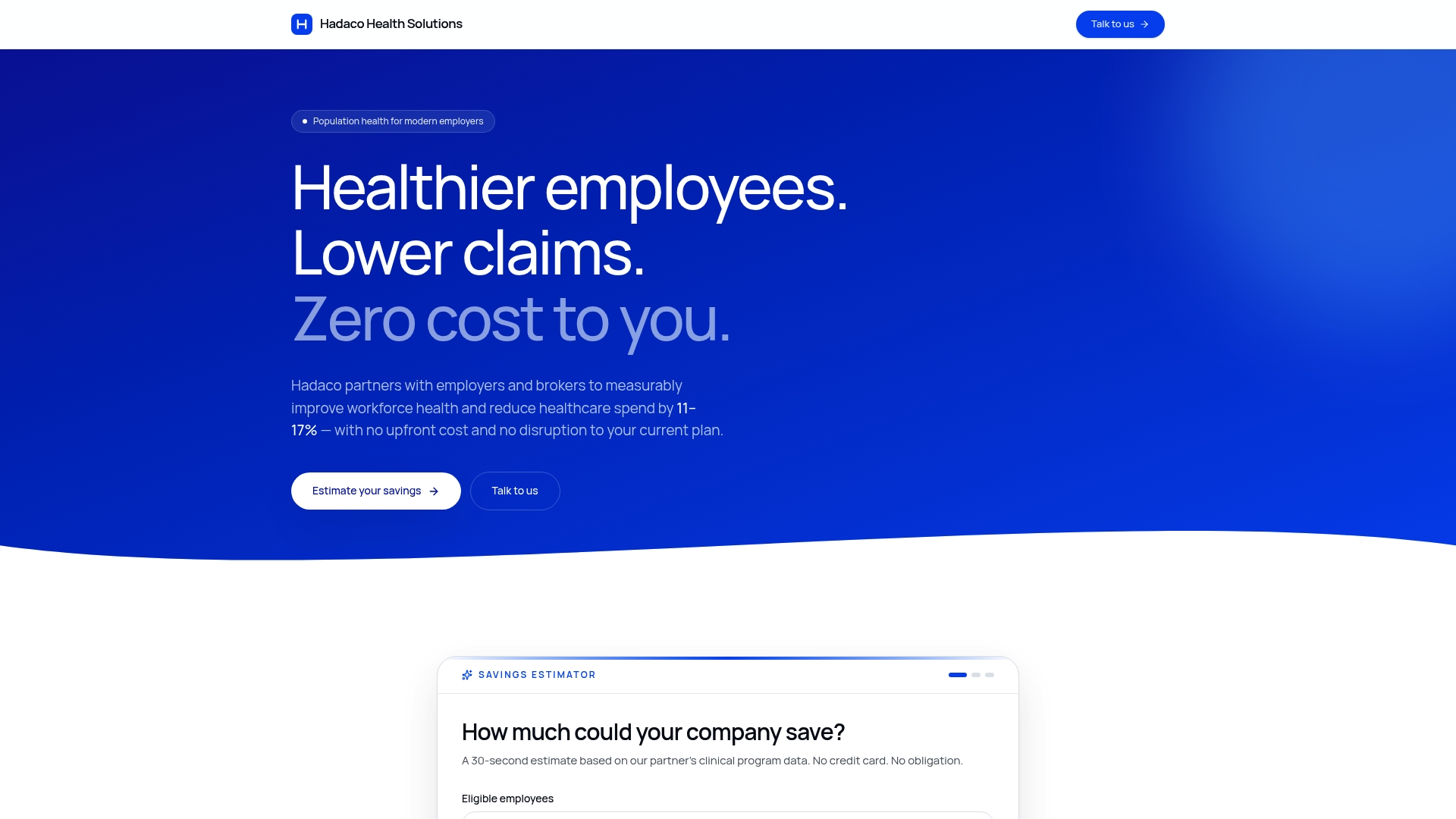
Hadaco delivers population-health programs that work alongside your existing benefits plan, targeting the chronic disease and behavioral health costs that drive the largest share of your claims. The model is fully performance-based: you pay from demonstrated savings, not from budget. First-year average savings of $451 per employee, quarterly reporting against a verified baseline, and a transparent savings estimator you can run before you commit.
The next step is straightforward. Book a pilot evaluation or run your numbers through the savings estimator at Hadaco.com. Before you finalize any vendor, ask for a sample quarterly report and a clear explanation of their baseline methodology. If they cannot produce both, keep looking.
Useful sources
The following sources informed this article and are worth consulting directly for program design, ROI modeling, and procurement decisions:
- Cost-Effectiveness of a Lifestyle and Behavioral Care Model Targeting Cardiometabolic Disease Progression
- What is the Value on Investment (VOI) for Diabetes and Hypertension Programs at the Workplace?
- Building an effective workplace health program
- Do Workplace Wellness Programs Save Employers Money?
- The Benefit Leader’s Guide To Promoting Population Health Management
- Hadaco Health Solutions — Healthier employees, lower claims