
For employers evaluating population-level mental health support, the strongest choice is a platform built on a layered care model: digital wellbeing tools for prevention, a clear escalation path to licensed therapy and psychiatry, quarterly outcome reporting, and performance-based pricing with no upfront fees. That combination is what actually moves the needle on healthcare claims. Hadaco Health Solutions is built around exactly this model, with an average reported savings of $451 per employee in the first year.
TL;DR: Choose a platform that reports quarterly on clinical escalation rates and claim-cost trends, not just app engagement. Start with a pilot of 50–200 employees, request a savings estimator demo before signing, and require a performance-based payment trigger tied to measurable outcomes.
Immediate action list:
- Contact a population health vendor (start with Hadaco) and request a savings estimate based on your employee count and top claim categories
- Ask for a sample quarterly outcome report showing engagement, escalation rates, and estimated claim reduction
- Propose a 90-day pilot with pre-agreed success metrics before committing to full deployment
Table of Contents
- What should the best mental health platforms actually include?
- How do mental health platforms actually reduce healthcare costs?
- Implementation checklist: how to roll out a mental health platform without disrupting existing benefits
- How to choose a mental health platform: the vendor questions HR should ask
- What Hadaco Health Solutions delivers for employers
- Key Takeaways
- Why population-health-first mental health programs define the employer standard in 2026
- See what Hadaco's savings estimator projects for your workforce
- Useful sources for validating vendor claims
What should the best mental health platforms actually include?
The feature set that matters for population health is more specific than most vendor demos suggest. A platform that only offers meditation content or single-session talk therapy is not a population health program. It is a benefit perk.
A genuine mental health support platform for employers needs two distinct tiers. The first is self-service digital wellbeing: mood tracking, guided exercises, psychoeducation, and low-acuity coaching. The second is a layered clinical care pathway: licensed therapists, psychiatry, and medication management for employees whose needs exceed what an app can address. Both tiers must connect. An employee who starts with a wellbeing app and hits a clinical threshold should reach a licensed provider without friction.
Beyond clinical structure, require these from any vendor:
- Population-level outcome reporting: Aggregate engagement data, clinical escalation rates, and estimated claim-cost impact, delivered quarterly at minimum
- Savings estimator: A methodology-transparent tool that projects first-year savings based on your workforce size, demographics, and top claim categories
- Benefit-plan integration: Compatibility with your existing health plans, HRIS, and payroll systems without disrupting current coverage
- HIPAA compliance plus: BAA execution, SOC 2 attestation, data minimization practices, and a clear employee consent flow
- Low-friction enrollment: SSO support, multi-channel access (app, web, video, messaging), and multilingual options for diverse workforces
Pro Tip: When a vendor says they "accept insurance," verify it. Ask them to map their provider network to your employees' specific plan IDs and carriers. A vendor statement about insurance acceptance is not the same as confirmed in-network coverage for your population — members can face unexpected out-of-pocket costs if this step is skipped.
How do mental health platforms actually reduce healthcare costs?
Cost reduction comes from early intervention, not app downloads. When employees access behavioral health support before a crisis, high-acuity utilization drops: fewer ER visits for mental health emergencies, fewer inpatient behavioral health admissions, and better management of comorbid chronic conditions like diabetes and hypertension that worsen under untreated stress.
A tiered approach consistently outperforms single-tool strategies because it reserves clinical resources for the employees who genuinely need them, while keeping lower-acuity employees engaged through self-service tools. Engagement metrics appear within the first 90 days of a pilot; claim-level changes typically require 6–12 months of data to surface clearly.

The metrics employers must demand from vendors:
| Vendor-reported metric | Employer data to cross-check | Reporting cadence |
|---|---|---|
| Platform engagement rate | HRIS active enrollment vs. logins | Monthly |
| Clinical escalation rate | Behavioral health claim counts | Quarterly |
| Estimated claim-cost savings | Medical/pharmacy claim trends | Quarterly |
| Reduction in high-acuity utilization | ER and inpatient behavioral health claims | Semi-annual |
| Absence/disability change | Short-term disability and absenteeism data | Quarterly |
Hadaco reports an average savings of $451 per employee in the first year. Validate this figure against your own claims data during the pilot period — the estimator Hadaco provides is the starting point, not the final number.
Implementation checklist: how to roll out a mental health platform without disrupting existing benefits
A realistic rollout runs in three phases. Vendor selection and contracting takes 30–60 days. Pilot deployment with a defined employee cohort runs 30–90 days. Full deployment and the first quarterly reporting cycle follows over the next 3–9 months.
Integration tasks to complete before launch:
- Map the vendor's provider network to your employees' health plan IDs and confirm in-network status
- Execute a Business Associate Agreement (BAA) and review the vendor's SOC 2 report
- Configure SSO and identity management for low-friction employee enrollment
- Set up secure data feeds or bridging between the platform and your claims/HRIS systems
- Build a communications plan: manager briefings, employee-facing launch messaging, and a FAQ for privacy concerns
Adoption is where most programs stall. Manager enablement is the single highest-leverage adoption tactic: managers who understand the program and can speak to it without stigma drive utilization far more effectively than email campaigns alone. Pair that with early-adopter incentives and a clear escalation channel so employees know exactly how to reach a licensed provider when they need one.
Pro Tip: Require a pilot with pre-agreed success metrics written into the contract. Tie the performance-based payment trigger to those metrics, not to enrollment numbers. Enrollment is easy to inflate; clinical engagement and claim-trend movement are what matter.
How to choose a mental health platform: the vendor questions HR should ask
The difference between a platform that reduces claims and one that just adds a wellness perk often comes down to five areas.
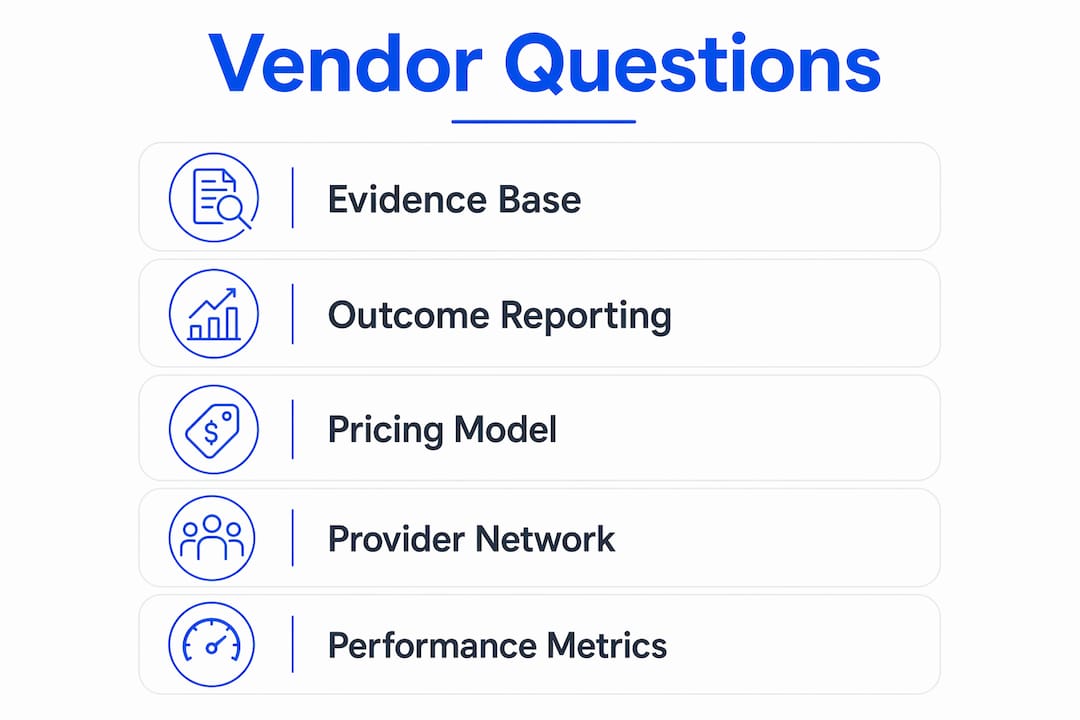
Evidence base and clinical model: Ask for peer-reviewed citations or outcome studies behind the platform's interventions. A vendor that cannot name the clinical frameworks underpinning their program is selling software, not population health. Confirm whether the model is tiered (preventive tools plus clinical escalation) or single-service (talk therapy only). Single-service platforms have a narrower ROI ceiling.
Outcome reporting and savings methodology: Require a sample quarterly report before signing. Ask how the savings estimator calculates projected reductions and what assumptions it uses. Quarterly outcome reporting is the minimum cadence for ROI conversations with finance leadership.
Pricing and contract terms: Performance-based pricing tied to measurable outcomes is the model that aligns vendor incentives with yours. Clarify what triggers fees, what happens if targets are missed, and what your data portability rights are at contract end.
Network and coverage verification: Confirm how the vendor handles out-of-network members and high-deductible employees. Ask for a network mapping exercise against your top three carrier plans before finalizing terms.
Operations and procurement artifacts to request:
- Sample quarterly outcome report (de-identified)
- Savings estimator demo with your employee count and claim categories as inputs
- BAA template and SOC 2 Type II attestation
- References from employers of similar size and industry
- Pilot MOU with defined success metrics and a no-upfront-fee payment structure
For employers building a whole-person health model, mental health is one component of a broader population health strategy that includes chronic disease management, preventive care, and financial wellness.
What Hadaco Health Solutions delivers for employers
Hadaco's model is built around the features that actually drive claim reduction. Evidence-based interventions address chronic disease, preventive care, and behavioral health within a single program that integrates with existing benefit plans without disrupting coverage. The pricing model is performance-based with no upfront fees, meaning Hadaco's revenue is tied to your outcomes.
The reported average savings is $451 per employee in the first year. That figure is a starting benchmark; your actual results depend on workforce size, demographics, and baseline claim profile. The savings estimator Hadaco provides during procurement is designed to model your specific situation before you commit.
Each quarter, Hadaco delivers reporting that covers:
- Engagement metrics (enrollment, active utilization, feature-level usage)
- Clinical escalation rates (employees moving from digital tools to licensed care)
- Estimated claims reduction tied to behavioral health utilization trends
- Recommended program adjustments for the next quarter
During procurement, Hadaco will provide a savings estimator demo, sample quarterly reports, pilot terms with defined success metrics, and a BAA. The ROI methodology is transparent and designed to hold up in a CFO conversation.
Pro Tip: Bring your top three claim categories and your current behavioral health utilization rate to the first Hadaco consultation. The estimator output will be far more specific and useful than a generic projection.
Key Takeaways
Population-health-first mental health platforms with layered care, quarterly reporting, and performance-based pricing are the most defensible choice for employers focused on measurable claim reduction.
| Point | Details |
|---|---|
| Layered care is non-negotiable | Digital wellbeing tools alone won't reduce high-cost claims; require a clear escalation path to licensed therapy and psychiatry. |
| Quarterly reporting is the minimum | Demand engagement, escalation, and estimated claim-cost data every quarter to justify program spend with finance leadership. |
| Pilot before full deployment | A 30–90 day pilot with pre-agreed success metrics protects budget and validates vendor claims before full rollout. |
| Verify insurance coverage independently | Map the vendor's provider network to your employees' specific plan IDs; vendor statements about insurance acceptance are not sufficient. |
| Hadaco's reported savings | Hadaco reports an average savings of $451 per employee in the first year, with performance-based pricing and no upfront fees. |
Why population-health-first mental health programs define the employer standard in 2026
The mental health benefits market has fragmented badly. Employers can choose from standalone meditation apps, direct-to-consumer therapy platforms, EAP bolt-ons, and full population health programs. The problem is that most of those options are evaluated on the wrong metric: employee satisfaction scores instead of claim-cost trends.
High utilization of mindfulness apps does not reliably reduce high-cost medical claims. That finding keeps surfacing in practitioner guidance, and it tracks with what benefits leaders see in their own data. An employee who meditates daily but never connects with a licensed provider when they need one is still a high-cost claimant waiting to happen. The hybrid model that pairs accessible digital tools with a genuine clinical escalation pathway is what separates a population health program from a wellness perk.
The other misconception worth naming: "evidence-based" on a vendor website often means the platform uses CBT-informed content. It should mean the vendor can show you outcome data from comparable employer populations, with claim-level validation. Ask for it. If they cannot produce it, the evidence base is marketing copy.
See what Hadaco's savings estimator projects for your workforce
Most employers evaluating mental health support platforms spend months in demos before realizing the vendor cannot produce a quarterly report that means anything to their CFO. Hadaco is built differently: performance-based pricing with no upfront fees, a savings estimator that models your specific workforce, and quarterly reporting that maps directly to your claims data.
To get a projection specific to your organization, bring your employee count, workforce demographics, and top three claim categories to a consultation. Hadaco will run the estimator live and walk you through what a pilot would look like, including the success metrics and contract terms. No commitment required to see the numbers.
Request a savings estimate or schedule a pilot consultation directly through Hadaco's landing page. If you want to understand how this fits into a broader employer wellness strategy, that context is worth reviewing before your first vendor conversation.
Useful sources for validating vendor claims
Use these during RFPs and demos to pressure-test vendor responses:
- HelpGuide: Best Online Therapy — Use to validate tiered care model claims and rebut vendors who position apps as clinical replacements
- Eleanor Health: Best Apps for Mental Health — Useful for understanding where app-based tools fit in a layered model and where they fall short
- Verywell Mind: Top Online Therapy Options — Reference for quarterly reporting standards and what differentiates platforms by clinical depth
- Healthline: Online Therapy and Insurance — Use to verify insurance acceptance claims and understand network mapping requirements
- Hadaco: How Wellness Programs Reduce Healthcare Costs — Primary reference for ROI methodology, estimator assumptions, and reporting cadence
- Hadaco: Employee Mental Health Programs HR Guide — Adoption tactics, manager enablement strategies, and pilot design guidance
This article is general information for benefits decision-makers, not legal, medical, or financial advice. Confirm program details, coverage terms, and compliance requirements with qualified professionals and your specific plan administrators.