
TL;DR:
- Most financial wellness programs fail due to poor design, lack of integration, and biased coaching. Hadaco offers evidence-based, unbiased solutions that connect financial and physical health with measurable ROI without upfront fees. Companies see an average annual savings of $451 per employee by adopting Hadaco's integrated, outcome-driven approach.
Hadaco delivers what most financial wellness programs miss
The best financial wellness programs don't just teach employees to budget. They connect financial health to physical health, integrate with existing benefits, and give employers measurable proof that the investment is working. Hadaco Health Solutions does exactly that, and it does it without charging upfront fees.
Here's what sets Hadaco apart from generic employee financial education resources:
- Evidence-based interventions covering chronic disease, preventive care, mental health, and financial stress simultaneously
- No disruption to existing benefit plans — Hadaco layers on top of what you already offer
- Unbiased financial coaching with no product sales or commissions attached
- Transparent savings estimator and quarterly outcome reporting so you always know your ROI
- Performance-based pricing tied to demonstrated healthcare savings, not hours delivered
- Industry recognition as one of the Top 4 Best Corporate Wellness Programs Agencies 2026
Hadaco clients see average annual savings of $451 per employee in their first year, backed by quarterly reporting that makes the number verifiable, not theoretical.
Table of Contents
- Why financial wellness belongs in your population health strategy
- What makes a financial wellness program actually work?
- How to choose and implement the right program for your workforce
- How Hadaco Health Solutions cuts healthcare costs through financial wellness
- Key Takeaways
- The case for treating financial wellness as a clinical intervention
- Hadaco: no upfront cost, measurable savings, starting now
Why financial wellness belongs in your population health strategy
Financial stress isn't a personal problem employees leave at home. It follows them to work, shows up in their health claims, and costs employers real money. Financial stress among frontline employees costs employers approximately $28.9 million annually per 10,000 workers. That figure alone reframes financial wellness from a nice-to-have perk into a population health priority.
The connection runs deeper than productivity. Employees under financial pressure delay preventive care, skip medications, and use emergency services for conditions that could have been managed earlier. That pattern drives up healthcare claims directly. Effective money management programs interrupt that cycle by reducing the anxiety that leads to avoidance behavior.
The business case for top financial wellness plans includes:
- Reduced absenteeism linked to stress-related illness and mental health days
- Lower healthcare claims as employees engage earlier with preventive care
- Improved retention — financially secure employees are less likely to job-hop for marginal pay increases
- Higher morale and engagement across teams, particularly among frontline and deskless workers whose financial vulnerability is disproportionately high
Financial wellness also maximizes the value of your entire compensation package, helping employees actually use the benefits you're already paying for. That alone boosts retention and reduces the anxiety that erodes productivity.
What makes a financial wellness program actually work?
Most programs fail not because of bad content but because of poor design. Here's what separates programs that move the needle from ones that collect dust in an HR portal:
- Unbiased, non-sales-driven coaching. Unbiased financial coaching increases employee trust and participation. The moment a coach has a product to sell, employees disengage.
- Personalized, life-stage guidance. A 28-year-old managing student debt needs different support than a 52-year-old planning retirement. Programs that treat all employees identically underserve most of them.
- Benefits integration. Employees who can see their 401(k), health savings account, and financial coaching in one connected experience are far more likely to act on guidance.
- AI tools paired with human coaches. Combining AI-driven personalization with credentialed financial coaches produces higher trust and engagement than either approach alone.
- Active change management. Targeted employee communications significantly increase program participation and outcomes. A program no one knows about helps no one.
Pro Tip: Don't evaluate financial wellness programs as standalone perks. Ask vendors specifically how their program connects to your existing health plan, 401(k), and EAP. Integration is the single biggest predictor of utilization.
How to choose and implement the right program for your workforce
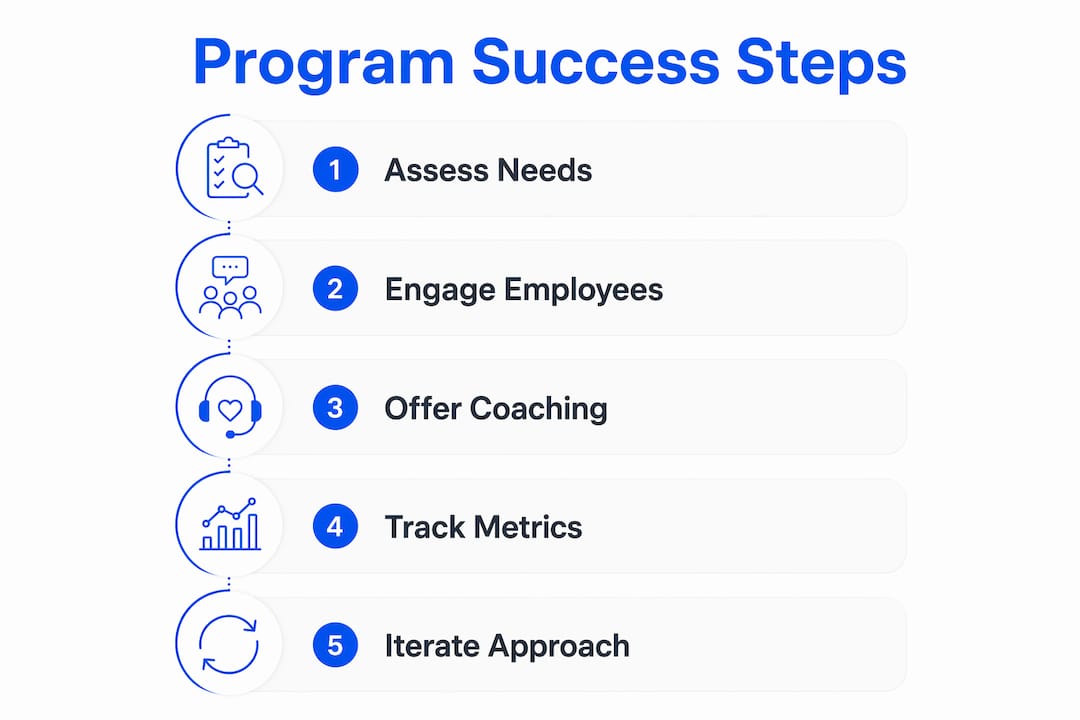
Start with your workforce demographics, not a vendor's feature list. A manufacturing company with 80% frontline workers has different financial wellness needs than a professional services firm. Frontline and deskless workers face unique financial pressures that, when unaddressed, cause disproportionate productivity losses and healthcare cost spikes.
When evaluating programs, focus on these criteria:
- Coaching access: Can employees reach a credentialed coach on demand, or only during scheduled webinars?
- Toolset breadth: Does the platform cover budgeting, debt management, retirement planning, and benefits navigation, or just one category?
- Benefits integration: Does the program connect to your specific health plan and retirement offerings, or does it operate in isolation?
- Transparent ROI tracking: Does the vendor provide a savings estimator and regular outcome reports, or do you have to take their word for it?
- Implementation support: Does the vendor handle communications and change management, or does that fall entirely on your HR team?
Programs that lack engagement support are consistently underutilized, regardless of how strong the content is. Budget for a vendor that treats launch as the beginning of the work, not the end.
Pro Tip: Ask every vendor for a sample quarterly report before you sign anything. If they can't show you exactly what data you'll receive and how it ties to healthcare cost outcomes, that's your answer.

How Hadaco Health Solutions cuts healthcare costs through financial wellness
Hadaco's approach is built around one premise: financial health and physical health are inseparable, and employers who treat them together get better outcomes on both.
The program delivers:
- Integrated population health management covering chronic disease, preventive care, mental health, and financial wellness in a single coordinated model
- No upfront fees with performance-based pricing tied to actual healthcare savings and engagement outcomes
- Average first-year savings of $451 per employee, tracked through transparent quarterly reporting
- A savings estimator tool that lets employers see projected ROI before committing
- Zero disruption to existing plans — Hadaco complements your current benefits rather than replacing them
- Recognition as a Top 4 Best Corporate Wellness Programs Agency in 2026, reflecting consistent, measurable client outcomes
The $451 per employee annual savings figure comes from Hadaco's own client outcome data, reported quarterly. It reflects reduced healthcare claims, not projected estimates.
Employers who have implemented Hadaco's evidence-based population health programs report improved retention alongside the cost reductions, which compounds the ROI beyond what shows up in claims data alone. The wellness program ROI case is strongest when financial wellness is treated as a clinical intervention, not a benefit add-on.
Key Takeaways
The most effective financial wellness programs reduce healthcare costs and improve retention when they integrate with existing benefits, deliver unbiased coaching, and provide employers with transparent, measurable outcomes.
| Point | Details |
|---|---|
| Financial stress drives healthcare costs | Frontline employee financial stress costs employers approximately $28.9 million per 10,000 workers annually. |
| Integration determines utilization | Programs disconnected from existing benefits are consistently underutilized, regardless of content quality. |
| Unbiased coaching builds trust | Non-sales-driven coaching is the single strongest predictor of employee engagement in financial wellness programs. |
| Transparent ROI is non-negotiable | Employers should require a savings estimator and quarterly outcome reports before selecting any program. |
| Hadaco delivers measurable results | Hadaco clients average $451 per employee in annual healthcare savings, with no upfront fees and zero disruption to existing plans. |
The case for treating financial wellness as a clinical intervention
Most employers still think of financial wellness programs as a benefits checkbox. That framing is the problem. When you position financial coaching as a perk alongside free gym memberships, you get perk-level engagement: sporadic, surface-level, and forgotten by Q2.
The employers seeing real reductions in healthcare claims are the ones who've made a different decision. They've recognized that an employee who can't cover a $500 emergency expense is also the employee who delays a diabetes screening, skips a follow-up appointment, and ends up in the ER six months later. Financial instability is a clinical risk factor. Treating it as one changes how you design, fund, and measure the program.
What I find consistently underestimated is the compounding effect. The first-year savings from reduced claims are real, but the second and third-year gains from improved retention, lower absenteeism, and better chronic disease management are where the math gets genuinely compelling. Employers who exit a program after year one because the ROI "wasn't dramatic enough" are cutting the investment right before it pays off most.
The other thing worth saying plainly: unbiased coaching is not a feature, it's a prerequisite. Employees have been burned by financial "education" that turned into a sales pitch. One bad experience poisons the well for every future program you try to run. The vendors who separate coaching from product sales aren't just being ethical. They're protecting your program's long-term participation rate.
Hadaco: no upfront cost, measurable savings, starting now
Employers who've read this far already know the problem. Financial stress is inflating your healthcare claims, and most financial wellness programs either don't integrate with your existing benefits or can't prove their ROI. Hadaco solves both.
Hadaco's population health programs deliver evidence-based financial wellness alongside chronic disease management, preventive care, and mental health support, all without touching your current benefit structure. You pay nothing upfront. Savings are tracked quarterly, reported transparently, and tied directly to healthcare claim reductions. The average first-year result across Hadaco clients is $451 per employee in documented savings.
This isn't a pilot program or a portal employees forget about. It's a performance-based partnership built around outcomes your CFO can verify. See how Hadaco works and book a consultation to get a savings estimate specific to your workforce.