
What are medication adherence programs and why do they matter?
Medication adherence programs are coordinated, evidence-based initiatives designed to help patients take prescribed medications consistently, at the right dose, and on schedule. For employers and benefit advisors, that definition carries real financial weight. Nearly 50% of patients do not take medications as prescribed, driving preventable hospitalizations, emergency visits, and downstream complications that land directly on your claims ledger.
The business case is straightforward:
- Reduced hospitalizations: Consistent medication use prevents acute events, particularly for employees managing chronic conditions like hypertension, diabetes, or heart disease.
- Lower total claims cost: Untreated or undertreated chronic illness generates far more expense than the medications themselves.
- Better productivity: Employees who manage their conditions effectively miss fewer days and perform better.
- Improved retention: Health benefits that actually work build loyalty.
Clinical pharmacy services, particularly Medication Therapy Management (MTM), sit at the core of most high-performing programs. MTM involves comprehensive medication reviews to resolve drug conflicts, reduce regimen complexity, and counsel patients on adherence. Hadaco Health Solutions delivers these evidence-based programs to employers, with documented savings averaging $451 per employee in the first year.
Table of Contents
- Core components of an effective adherence support program
- Patient-centered best practices that actually improve compliance
- How to integrate adherence programs with your existing benefit plans
- Documented outcomes: what the data shows
- Hadaco delivers measurable adherence outcomes for employers
- Key Takeaways
Core components of an effective adherence support program
Strong adherence programs don't rely on a single tactic. They layer clinical, pharmaceutical, and behavioral strategies to address the full range of reasons patients skip or stop medications.
Clinical components:
- MTM and comprehensive medication reviews to catch interactions and simplify regimens
- Ongoing pharmacist-led monitoring and follow-up counseling
- Integration with primary care and specialist workflows
Pharmaceutical innovations:
- Fixed-dose combination therapies that reduce pill burden
- Modified-release and long-acting formulations that cut dosing frequency
- Taste masking and improved delivery formats for patients with tolerability issues
Integrative adherence strategies that combine clinical pharmacy with these pharmaceutical tools are consistently more effective than education alone. The American Pharmacists Association recognizes pharmacists as central integrators in this model, connecting drug formulation expertise with direct patient counseling.
Behavioral and digital tools:
- Automated medication reminders for patients via SMS, app, or phone
- Motivational interviewing techniques to address patient concerns
- Peer support and care coaching
The WHO's guidance on service delivery confirms that reminders, peer support, and counseling together improve adherence more reliably than any single intervention. For employers, that means programs built on multiple behavior-change strategies outperform point solutions.

Patient-centered best practices that actually improve compliance
The most common mistake in adherence programs is treating all non-adherence the same. NICE guidance draws a clear line between two barrier types: perceptual barriers (doubts about the medication's necessity, fear of side effects) and practical barriers (cost, complex schedules, forgetfulness). An intervention that addresses one type often fails entirely for the other.
Practical best practices for patient-centered adherence support:
- Triage early. Early, high-touch contact in the first months after diagnosis or a treatment change dramatically reduces drop-off. This is when habits form or break.
- Use motivational interviewing. Open-ended questions surface real concerns that standard education misses.
- Support, don't police. NICE explicitly warns that framing adherence as monitoring rather than support drives disengagement. Employees who feel judged stop participating.
- Align digital tools with consent. Digital adherence tools work when patients opt in and understand how their data is used. Pairing reminders with clear privacy safeguards maintains trust.
- Train your coaches. Health coaches and adherence specialists need structured training in motivational interviewing, chronic illness medication plans, and cultural competency to serve diverse employee populations effectively. For employees managing conditions like dementia, specialized medication approaches require additional coaching skills.
Pro Tip: Segment your employee population by risk level before launching. High-risk employees with multiple chronic conditions or recent prescription changes need intensive, personalized outreach. Lower-risk employees can be served through automated reminders and self-service tools. Tiered deployment stretches your program budget without sacrificing outcomes.
How to integrate adherence programs with your existing benefit plans
Employers rarely need to tear out their current benefits to add adherence support. The most effective approach layers adherence programs on top of existing health plans without disrupting carrier relationships or employee workflows.
| Integration Component | Role | Expected Outcome |
|---|---|---|
| MTM via pharmacy benefit | Clinical medication review | Fewer drug conflicts, simplified regimens |
| Digital reminder platform | Patient engagement tool | Improved daily adherence rates |
| Health coach or pharmacist | Personalized counseling | Barrier identification and resolution |
| Data analytics and reporting | Outcome tracking | Measurable ROI, quarterly accountability |
| Privacy compliance framework | HIPAA-aligned data handling | Employee trust, legal protection |
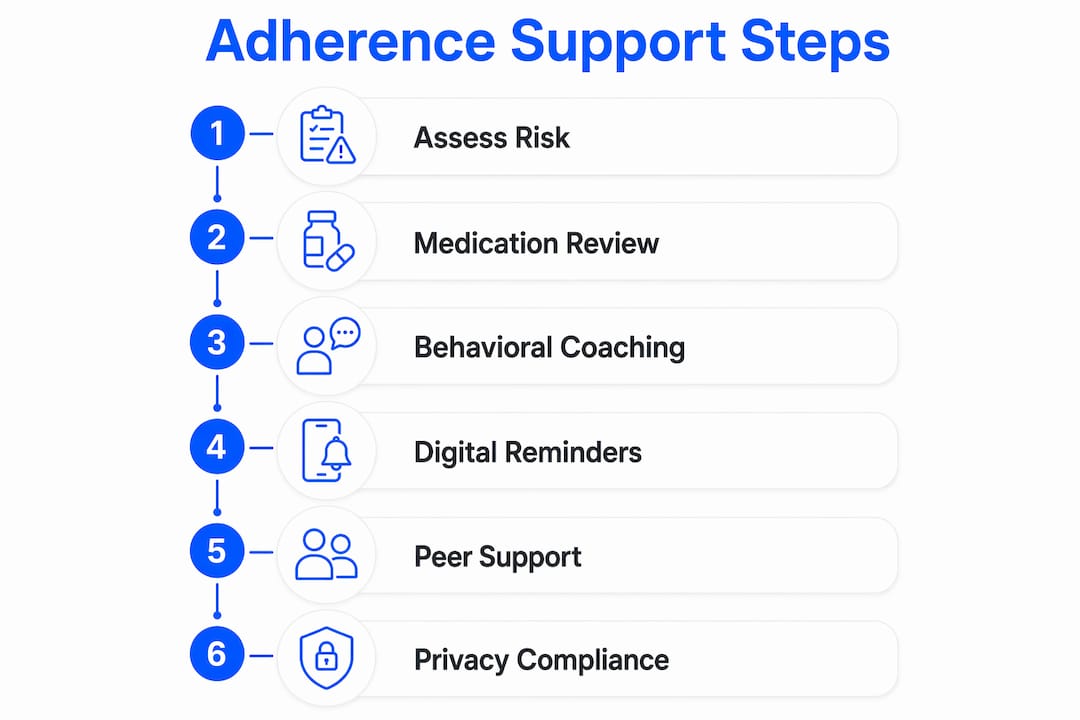
Pharmacy-based interventions aligned with existing benefit structures are cost-effective and reduce cardiovascular disease events, one of the highest-cost categories on most employer claims reports.
Hadaco's model is built specifically for this integration challenge. It operates on a performance-based structure with no upfront fees, meaning employers don't pay unless the program delivers. A transparent savings estimator and quarterly reporting give benefit advisors the accountability data they need to justify the program internally. For employees who struggle with medication-taking behavior, resources like practical resistance strategies can complement clinical coaching within the program.
Privacy compliance deserves explicit attention. Any program that tracks employee medication data must operate within HIPAA guidelines, use de-identified aggregate reporting for employer-facing dashboards, and obtain individual consent for personalized outreach.
Documented outcomes: what the data shows
The financial case for employer-sponsored adherence programs is well-supported.
$451 average savings per employee in the first year — Hadaco Health Solutions client outcomes
Key findings from clinical and employer program data:
- Pharmacy-led interventions for chronic disease management produce measurable reductions in cardiovascular events and associated hospitalization costs.
- Simplified medication regimens and pharmacist-delivered counseling show consistently positive effects on adherence across multiple systematic reviews, per Frontiers in Pharmacology research.
- Programs that combine MTM, digital reminders, and behavioral coaching outperform single-intervention approaches on both adherence rates and cost outcomes.
- Employees who adhere to chronic illness medication plans report higher satisfaction with their benefits, which ties directly to retention.
- Reduced absenteeism and presenteeism from better-managed chronic conditions add productivity value beyond direct claims savings.
The long-term picture matters too. Employers who invest in adherence support early, particularly for newly diagnosed employees or those starting new regimens, prevent the cost spiral that comes from undertreated conditions compounding over years.
Hadaco delivers measurable adherence outcomes for employers
Most adherence programs ask employers to take on risk upfront. Hadaco takes the opposite position: no upfront fees, performance-based pricing, and quarterly reporting that shows exactly what the program is delivering.
Hadaco's population health programs address chronic disease, preventive care, mental health, and employee engagement within a single framework that sits alongside your current benefits without replacing them. The average first-year savings of $451 per employee comes from reduced claims, fewer hospitalizations, and better-managed chronic conditions across the workforce. Employers and brokers get a transparent savings estimator before committing, so the ROI conversation starts with real numbers, not projections.
If you're advising clients on benefit design or managing a workforce with rising healthcare costs, see what Hadaco delivers and request a savings estimate for your specific population.
Key Takeaways
Medication adherence programs that combine MTM, behavioral coaching, and digital tools consistently reduce employer healthcare costs while improving employee health outcomes.
| Point | Details |
|---|---|
| Non-adherence is costly | Many patients skip medications, driving preventable hospitalizations and higher employer claims. |
| MTM is the clinical anchor | Medication Therapy Management resolves drug conflicts and simplifies regimens, improving adherence for complex cases. |
| Barrier type determines strategy | Perceptual and practical barriers require different interventions; generic education alone rarely moves the needle. |
| Integration requires no disruption | Adherence programs layer onto existing benefit plans without replacing carriers or changing employee workflows. |
| Hadaco's model | Performance-based, no upfront fees, with average first-year savings of $451 per employee and quarterly outcome reporting. |