
What is nurse health coaching, and how do you become certified?
Nurse health coaching is a specialized nursing practice where registered nurses use advanced communication strategies, behavioral science, and whole-person care principles to help clients set and achieve meaningful health goals. Unlike traditional clinical roles, the nurse coach partners with clients rather than directing their care. The client is treated as the expert on their own life; the nurse coach provides structure, accountability, and evidence-based guidance.
The American Holistic Nurses Credentialing Corporation (AHNCC) developed the formal nurse coach certification framework establishing the NC-BC (Nurse Coach Board Certified) and HWNC-BC (Health and Wellness Nurse Coach Board Certified) credentials. The American Nurses Association (ANA) recognizes nurse coaching as a distinct nursing specialty, and The Nurse Coach Collective is one of the most active training communities supporting nurses through the certification process.
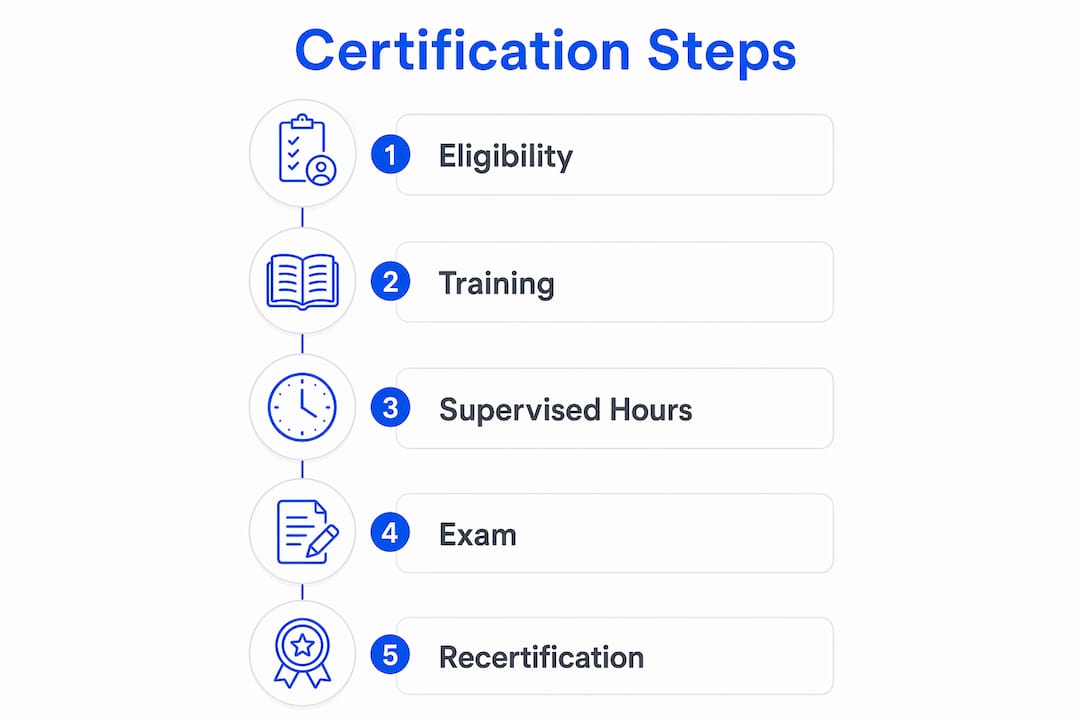
Steps to become a certified nurse health coach:
- Hold an active, unrestricted RN license (required baseline for all certifications)
- Complete a minimum of 60 CNE hours accrued over the past three years, covering content aligned with Nurse Coach Core Values and Competencies
- Log 60 hours of supervised coaching practice, mentored by a Certified Nurse Coach Supervisor, with a validation letter from a certified nurse coach
- Choose between the NC-BC credential or the HWNC-BC credential for nurses with holistic nursing certification
- Apply through the Center for Nursing Education and Testing (C-NET), AHNCC's testing organization
- Prepare using primary study resources: Core Essentials for the Professional Nurse Coach Role and The Art and Science of Nurse Coaching, Second Edition
- Maintain certification by renewing every five years with 100 CNE contact hours and an active RN license
Coaching sessions can be delivered in person or virtually. Telephone and online coaching are among the most common formats, giving both coaches and clients genuine flexibility.

Roles, responsibilities, and benefits of working as a nurse coach
The nurse coach role looks different from bedside nursing in one fundamental way: you stop being the expert who fixes the problem and start being the partner who helps the client fix it themselves. That shift is harder than it sounds for nurses trained in directive clinical care, but it is also what makes the work so rewarding.
Core responsibilities of a nurse health coach:
- Establish a therapeutic coaching relationship and assess the client's readiness for change
- Identify client opportunities, challenges, and self-defined health goals
- Use motivational interviewing and evidence-based conversations to support self-directed behavior change
- Structure purposeful coaching interactions using the six-step nurse coaching process defined by the American Holistic Nurses Association (AHNA)
- Support client self-efficacy by building on strengths rather than correcting weaknesses
- Facilitate whole-person care that integrates body, mind, emotion, spirit, and environment
- Maintain professional boundaries, confidentiality, and ethical practice when clients disclose sensitive personal information
Benefits for nurses who make the transition:
- Relief from bedside burnout while staying in a patient-centered, holistic care role
- Greater professional fulfillment by aligning daily work with personal values
- Flexibility to set your own schedule, especially in private practice
- Deeper, longer-term relationships with clients compared to acute care settings
- Opportunities to work across hospitals, corporate wellness programs, clinics, and private practice
- Development of leadership, critical thinking, and communication skills that transfer across nursing specialties
Pro Tip: If you find yourself frustrated by the lack of time for real patient education in your current role, nurse coaching may be the outlet you are looking for. The entire model is built around the conversations traditional nursing rarely has time for.

How does the certification process actually work?
The path to board certification is structured but manageable, especially for nurses already working full-time. Most accredited programs are designed specifically for working professionals, offering self-paced coursework combined with live group sessions and supervised practicum hours.
Certification requirements at a glance:
- NC-BC credential: 60 CNE hours, 60 supervised coaching hours, active RN practice (two years full-time for BSN-prepared nurses or 4,000 part-time hours within five years)
- HWNC-BC credential: Same exam as NC-BC, but requires active AHNCC holistic nursing certification; this is the only nationally accredited nurse health coaching credential that is also ANCC Magnet recognized
- Exam cost: The certification examination fee is $425, with a $50 discount for AHNA members; minimum required study materials cost around $40
- Recertification: Every five years, requiring 100 CNE contact hours and maintenance of an unrestricted RN license
Several AHNCC-approved programs provide both the CNE hours and supervised coaching hours in a single package. The Nurse Coach Collective offers the Transformative Nurse Coach Certificate Program. The Integrative Nurse Coach Academy provides its Integrative Nurse Coach Certificate Program, which covers both CNE and supervision requirements. The National Society of Health Coaches offers a nurse-specific program that includes all 60 CNE hours and 60 supervised hours needed for the NC-BC exam. Huntington Meditation and Imagery provides a transpersonal nurse coaching track with 60 CE hours. The National Institute of Whole Health includes nurse coach training within a 400-hour whole health curriculum.
Training formats vary by program. Expect a mix of online self-paced modules, live Zoom sessions, and one-on-one or group supervision with a certified nurse coach supervisor. Most nurses complete the coursework in six months to one year while continuing to work clinically.
Pro Tip: Before enrolling, confirm that the program you choose is listed on AHNCC's approved provider page. Not every program that markets itself as "nurse coach training" meets the specific CNE and supervision criteria for board certification.
Where do nurse coaches work, and what can you earn?
Career settings for nurse health coaches are wider than most nurses expect. The role fits naturally into any environment where chronic disease management, prevention, or behavior change is a priority.
Common work settings:
- Hospitals and health systems (staff wellness, patient coaching programs)
- Outpatient clinics and primary care practices
- Corporate wellness programs, where nurse coaches are increasingly employed to reduce employer healthcare costs
- Insurance companies focused on disease management and cost reduction
- Functional medicine and integrative health practices
- Private practice, either solo or in group settings with other health professionals
- Telehealth platforms offering virtual coaching services
Salary ranges vary considerably by setting, certification level, and geography. Nurse health coaches working in employed positions can expect annual salaries ranging from $37,500 to $66,000, with an average around $48,790. Board-certified RN nurse health coaches in more specialized or senior roles can earn over $91,000 annually, according to ZipRecruiter data cited by the ANA. Nurses in private practice who charge by the session typically earn $100–$400 per hour, with income scaling based on client volume and niche specialization.
Nurses with backgrounds in pediatrics, psychiatry, or functional medicine tend to command higher rates because their clinical expertise adds a layer of credibility that general health coaches cannot replicate. The Centers for Disease Control and Prevention reports that 6 in 10 Americans have at least one chronic disease, which drives sustained demand for nurses who can bridge clinical knowledge and behavioral coaching. Related fields are projected to grow by 7% between 2023 and 2033, according to the U.S. Bureau of Labor Statistics.
How do you know if nurse coaching fits your career goals?
The honest answer is that nurse coaching is not for every nurse, and figuring that out before you invest in certification saves time and money.
Signs the role may be a strong fit:
- You feel more energized by patient education and goal-setting conversations than by acute procedures
- Burnout from shift work, short patient contact windows, or documentation overload is affecting your well-being
- You want flexibility, including the option to build a private practice or work remotely
- You are drawn to whole-person care that addresses lifestyle, mental health, and environment alongside physical symptoms
- You are comfortable sitting with ambiguity, since clients set the pace and the agenda
Challenges to consider honestly:
- Letting go of the directive clinical mindset is genuinely difficult. Nurse coaches do not prescribe or treat; they guide. Nurses who struggle to step back from the "fix it" role often find the transition frustrating.
- Building a private practice requires business skills, including marketing, client acquisition, and potentially obtaining a business license, that nursing school does not teach.
- Certification takes time and money. Budget several months of coursework, supervision hours, and exam fees before you see a return.
- Ethical boundaries in coaching are different from clinical nursing. Clients may disclose deeply personal information about family dynamics, addiction, or mental health. Knowing when to refer out and how to maintain confidentiality in a coaching context requires deliberate attention.
Nurses who thrive in coaching roles tend to share one trait: they are genuinely curious about what makes each client tick, not just what the chart says. If you find yourself wanting more time with patients and less time reacting to acute crises, nurse wellness coaching is worth a serious look. Resources like the Institute for Functional Nurses can help you explore integrative approaches before committing to a full certification program.
What does the evidence say about nurse coaching outcomes?
The research on nurse-led health coaching is strong enough to take seriously. A systematic review published in Patient Education and Counseling found that health coaching by registered nurses improves patient self-care, reduces mental distress, and decreases pain and fatigue, particularly for people managing chronic conditions. Telephone and virtual coaching formats showed consistent results across studies.
A separate study confirmed that nurse coaching improves self-efficacy, quality of life, and reduces depression and fatigue in patients with chronic illness. These are not marginal gains. For patients who have cycled through standard care without lasting behavior change, a structured coaching relationship with a nurse often produces the sustained shift that clinical visits alone cannot.
| Outcome | Standard care | Nurse health coaching |
|---|---|---|
| Patient self-efficacy | Limited improvement | Measurably improved |
| Depression and fatigue | Inconsistent management | Reduced in chronic illness populations |
| Lifestyle behavior change | Mixed results | Improved with structured goal-setting |
| Quality of life | Baseline maintenance | Enhanced through whole-person approach |
| Self-care adherence | Dependent on patient motivation | Supported by ongoing coaching relationship |
Nurse coaching also addresses a structural gap in healthcare. Lifestyle factors affect over 60% of health outcomes, yet standard clinical encounters rarely have the time or framework to address them systematically. Nurse coaches fill that gap by combining clinical credibility with behavioral change methodology, which is exactly what neither a general health coach nor a time-pressured clinician can do alone.
The evidence also supports nurse coaching as a complement to traditional nursing, not a replacement. Nurses who coach retain their clinical identity and licensure. The coaching role extends their scope rather than abandoning it, which is why the ANA and AHNCC both frame nurse coaching as a nursing specialty rather than a separate profession.
How Hadaco supports nurse-led wellness at scale
Nurse health coaches working in corporate wellness settings operate within a larger ecosystem of employer-sponsored health programs. Hadaco builds and manages those programs for employers, using evidence-based interventions for chronic disease, preventive care, mental health, and employee engagement. For nurse coaches entering the corporate wellness space, understanding how employer health programs are structured and measured is a practical career advantage.
Hadaco's model complements the work nurse coaches do directly with clients. Employers using population health programs see measurable reductions in healthcare claim costs, and nurse coaches embedded in those programs are often the frontline professionals driving behavior change at the individual level. If you are exploring corporate wellness as a career path, Hadaco's approach to wellness program ROI illustrates the kind of outcomes employers expect and how nurse coaching contributes to them.
Key Takeaways
Nurse health coaching is a board-certified nursing specialty that requires 60 CNE hours, 60 supervised coaching hours, an active RN license, and a passing score on the AHNCC certification exam.
| Point | Details |
|---|---|
| Certification baseline | All nurse coach credentials require an active RN license plus 60 CNE hours and 60 supervised coaching hours. |
| Two primary credentials | NC-BC is for nurses without holistic certification; HWNC-BC requires active AHNCC holistic nursing certification and is the only ANCC Magnet-recognized nurse coaching credential. |
| Salary range | Employed nurse coaches earn $37,500–$66,000 annually; board-certified coaches in specialized roles can exceed $91,000. |
| Evidence base | Research shows nurse coaching reduces depression, fatigue, and improves self-efficacy in chronic illness patients across telephone and virtual formats. |
| Recertification | Certification renews every five years and requires 100 CNE contact hours plus an unrestricted RN license. |