
Yes. Employers should offer or cover an evidence-based diabetes prevention program for eligible employees, delivered through the CDC's National DPP framework. It reliably improves exercise habits and weight management within months, but medical claims savings usually take years, not quarters, to show up. A partner like Hadaco helps employers screen, launch, and track outcomes without disrupting existing benefit plans.
TL;DR:
- The CDC-recognized diabetes prevention program consistently reduces prediabetes risk by about 58%, with even higher risk reduction among adults over 60.
- Behavior improvements such as increased exercise and weight management are evident within months, but substantial healthcare savings typically take years to materialize.
- Programs should run for a full year with a mix of virtual and in-person sessions, involving standardized curriculum, trained coaches, and clear participation goals.
- Successful program launch requires careful planning of referral pathways, cohort design around shift schedules, and protecting employee privacy by external outcome reporting.
- Employers should set realistic expectations, focusing on behavior change outcomes first, as immediate claims savings are unlikely in the initial year.
Table of Contents
- What Does the Evidence Say About Prediabetes Programs and Employers?
- How Is a Workplace DPP Program Structured?
- How Do You Launch a Workplace Prediabetes Program?
- What Actually Increases Enrollment and Completion?
- How Should You Measure Results and Set ROI Expectations?
- How Hadaco Approaches Workplace Prediabetes Programs
- Why Most Employers Get the Timeline Wrong
- Get Started With a No-Cost Prediabetes Program Assessment
- Sources
What Does the Evidence Say About Prediabetes Programs and Employers?
The clinical case for offering a prediabetes program is stronger than the case for almost any other workplace health benefit. The National DPP lifestyle change program reduces a person's risk of developing type 2 diabetes by roughly 58% in randomized trials, a figure that has held up since the original Diabetes Prevention Program study and now anchors CDC recognition standards for every certified provider. That recognition matters because it is the quality bar employers should require from any vendor before signing a contract.
Workplace-specific research tells a more nuanced story than the marketing decks suggest. A randomized clinical trial published in JAMA found employees in a workplace wellness program reported meaningfully more exercise and better weight-management behavior than a control group. But the same trial found no significant difference in clinical biomarkers or health care spending after 18 months. That gap between behavior change and bottom-line savings is the single most important thing HR leaders get wrong when they pitch these programs internally.
Eligibility is straightforward, which is part of why the model scales well in a workforce setting.
- A substantial proportion of American adults have prediabetes, and most don't know it.
- The DPP trial showed even stronger risk reduction, close to 71%, among adults over 60.
- Systematic reviews of workplace interventions find multicomponent programs, education plus active coaching, outperform education-only approaches.
- Employer scheduling and space support correlate with better weight and risk-factor outcomes in the same review.
Both facts are true at once, and planning around only one of them is how programs get killed in year two.
How Is a Workplace DPP Program Structured?
A CDC-recognized program runs on a fairly fixed template, and understanding that structure helps you evaluate vendors on substance instead of sales pitch. The core cadence is a full year: roughly 16 weekly sessions for the first six months, tapering to monthly sessions for the remaining six. That length is not arbitrary. Habit change around diet and activity takes sustained reinforcement, and shorter programs consistently show weaker completion and weaker outcomes.
Curriculum components are standardized across recognized providers:
- A trained lifestyle coach who leads each session and tracks individual progress.
- Small-group cohorts, typically 10 to 20 participants, built for peer accountability.
- Structured goals around 5% to 7% body weight loss and 150 minutes of moderate activity per week.
- Ongoing tracking of weight, activity minutes, and session attendance reported back to the sponsoring employer.
Delivery format is where employers have real decisions to make, and the right answer depends heavily on your workforce composition. Fully virtual delivery removes scheduling friction for remote and desk-based staff. Employer-based clinic models, where a coach or health partner runs sessions on-site, work well for concentrated workforces like manufacturing or logistics. Qualitative research on workplace DPP delivery found that hybrid formats, mixing virtual convenience with periodic in-person sessions, reduced participation barriers while still building the social accountability that keeps people showing up for a full year.
Before signing with any vendor, confirm they hold CDC recognition and ask what they report. At minimum, you should receive cohort-level attendance, mean weight change, and the percentage of participants who hit CDC-defined completion thresholds. A vendor unwilling to share that data at the cohort level is not one worth paying for.
How Do You Launch a Workplace Prediabetes Program?
Rolling out a program well is mostly a sequencing problem; employers can find practical approaches to improve referral and participation with Integrated Clinical Diagnostics for CROs & Pharma to support implementation and screening logistics. Employers who skip steps, especially the ones around privacy and referral flow, end up with high screening numbers and embarrassingly low enrollment. Here's the order that works.
- Establish baseline risk with a voluntary health risk assessment. Use aggregate, de-identified estimates of prediabetes prevalence across your population rather than trying to track individual results centrally. This protects you legally and still gives you the sizing data you need.
- Build a low-friction referral path before you screen anyone. Screening without an immediate program offer wastes the moment; implementation guidance from workplace health specialists is blunt about this, screening is the doorway, not the intervention. Wire the referral link directly into your screening results, whether that's an EHR-based handoff, a vendor referral portal, or an on-site clinic connection.
- Pick a delivery model that matches your actual workforce, not your ideal one. A remote-heavy team needs virtual-first with live coaching. A shift-based team needs multiple cohort start times and an on-site or hybrid option.
- Confirm outcome reporting before you sign. CDC recognition or equivalent verified outcome tracking should be a contract condition, not a nice-to-have you ask about later.
- Sort logistics. Protect work time for sessions, offer multilingual cohorts where your workforce needs them, coordinate shift coverage for hourly staff, and keep cohorts in the 10 to 20 range recommended by the CDC model.
- Design incentives and legal safeguards together. Frame any incentive as an access enabler, not a reward for hitting a health outcome, keep participation voluntary under wellness program rules, and make sure individual health data stays with the vendor rather than flowing into HR systems.
- Set a launch checklist. A leadership message that names the program and states why it matters, a defined enrollment window, and baseline KPIs, enrollment rate, projected cohort size, current activity levels, captured before day one.
Pro Tip: Don't centralize individual screening results in HR's hands, even with good intentions. Keeping raw health data with a CDC-recognized vendor and receiving only aggregate reports back protects you from ADA and GINA compliance headaches later, and it removes a real barrier to honest employee participation.
Cohort design deserves a specific mention because it's where a lot of programs quietly fail hourly and field workforces. Research on workplace interventions recommends building multiple cohort times around shift patterns and offering asynchronous make-up sessions, paired with supervisor-level support, rather than assuming a single 6 p.m. session works for everyone.
What Actually Increases Enrollment and Completion?
Program design matters less than program access. That's the uncomfortable truth buried in most engagement research, and it's why two employers running the identical vendor contract can see wildly different completion rates.
The structural levers move the needle more than communications ever do. Data from the U.S. Department of Labor's RAND analysis shows participation varies enormously by employer size, and incentives influence reported uptake but real design and accessibility drive actual behavior. Protected work time for sessions, a visible endorsement from a direct manager, and a frictionless on-site referral consistently outperform a bigger cash incentive attached to a clunky sign-up process.
- Give managers a script to endorse the program in team meetings, not just an email forward.
- Build the referral into existing touchpoints like annual biometric screenings or benefits enrollment.
- Offer hybrid delivery so remote convenience doesn't come at the cost of social accountability.
- Segment your messaging: hourly staff need shift-coverage assurances, salaried staff need calendar-blocked time.
- Provide multilingual program materials if your workforce needs them, and say plainly that individual results stay private.
Incentive design deserves particular care because it's the piece employers most often get backwards. RAND's analysis for the DOL suggests monetary incentives alone rarely overcome scheduling and cultural access barriers. Pairing a modest incentive with shift coverage and manager-level support beats a larger incentive offered without either.
Pro Tip: If your workforce includes both hourly and salaried employees, run two separate communication tracks from day one. A single all-staff email about "wellness benefits" reads as irrelevant to a warehouse worker on a rotating shift, and low relevance is the fastest way to kill enrollment before it starts.
How Should You Measure Results and Set ROI Expectations?
Set your KPIs before the first cohort starts, because the metrics you choose determine whether year one looks like a win or a disappointment. The near-term numbers to track are enrollment rate against your eligible population, session attendance across the 16-week core phase, and completion against CDC-defined thresholds, generally participation in at least nine core sessions plus achievement of the weight and activity goals.
- Enrollment rate: percentage of screened, eligible employees who join a cohort.
- Attendance: average sessions attended per participant during the intensive phase.
- Behavior outcomes: percentage reaching 5% weight loss and percentage hitting 150 weekly activity minutes.
- Completion rate: percentage meeting full CDC program thresholds.
Financial expectations need a reality check baked in from the start. The same JAMA randomized trial cited earlier found no significant claims difference at 18 months despite real behavior improvement. Vendor savings estimators are useful for budgeting and directional planning, not as guaranteed 12-month returns.
The real value of these programs compounds over multiple years, as sustained behavior change slows or prevents disease progression that would otherwise show up as claims cost down the road. Require raw cohort-level reporting quarterly rather than a single annual summary, run year-over-year trend comparisons instead of judging one cycle in isolation, and treat behavior metrics as your leading indicator while claims data lags behind by design.
How Hadaco Approaches Workplace Prediabetes Programs
Hadaco builds prevention programs around the same evidence base covered above, structured for employers who want measurable results without disrupting the benefit plan they already have. The model runs on performance-based fees rather than upfront cost, and everything integrates with existing coverage instead of replacing it.
- No upfront fees; program cost is tied to demonstrated outcomes.
- Integration with current benefit plans, no plan redesign required.
- A transparent savings estimator for budget planning before you commit.
- Quarterly reporting that gives HR and finance real accountability.
- Support for screening, cohort formation, and hybrid delivery logistics across distributed workforces.
| What Hadaco Provides | Why It Matters for HR |
|---|---|
| Performance-based fees, no upfront cost | Removes budget risk before results are shown |
| Plan integration, no disruption | Avoids re-negotiating existing carrier contracts |
| Savings estimator | Sets realistic year-one and multi-year projections |
| Quarterly outcome reporting | Gives finance real numbers to validate, not marketing claims |
Companies working with Hadaco have reported average savings of $451 per employee in the first year, alongside stronger engagement and retention numbers that echo the behavior-change data covered in the sections above.
Why Most Employers Get the Timeline Wrong
The biggest mistake I see in how companies talk about prediabetes programs internally is promising the wrong kind of win to leadership. The behavior data is genuinely strong, and it shows up fast. Exercise habits and weight-management behaviors improve within months of a program launching. The claims-cost story is a different animal entirely, and pretending otherwise sets a program up to get cut after one disappointing budget review.

Conventional wellness-program advice still leans on the promise of fast financial ROI, mostly because that's what gets a program approved in the first place. That's backwards. The programs that survive past year two are the ones where HR set expectations honestly from the start, sold leadership on behavior change and multi-year risk reduction, and used the 58% risk-reduction figure as what it actually is, a clinical benchmark, not a claims forecast.
If you take one thing from this guide, prioritize the referral pathway over the vendor selection process. A mediocre program with a frictionless, immediate referral will beat a perfect program that makes employees hunt for the enrollment link.
— Gene
Get Started With a No-Cost Prediabetes Program Assessment
Hadaco removes the two biggest obstacles that keep employers from launching a prediabetes program: upfront cost and vendor-shopping fatigue. There's no fee to get started, the program layers onto your existing benefit plan without a redesign, and you get a transparent savings estimator before committing to anything, so you're negotiating from real numbers instead of a vendor's projection.
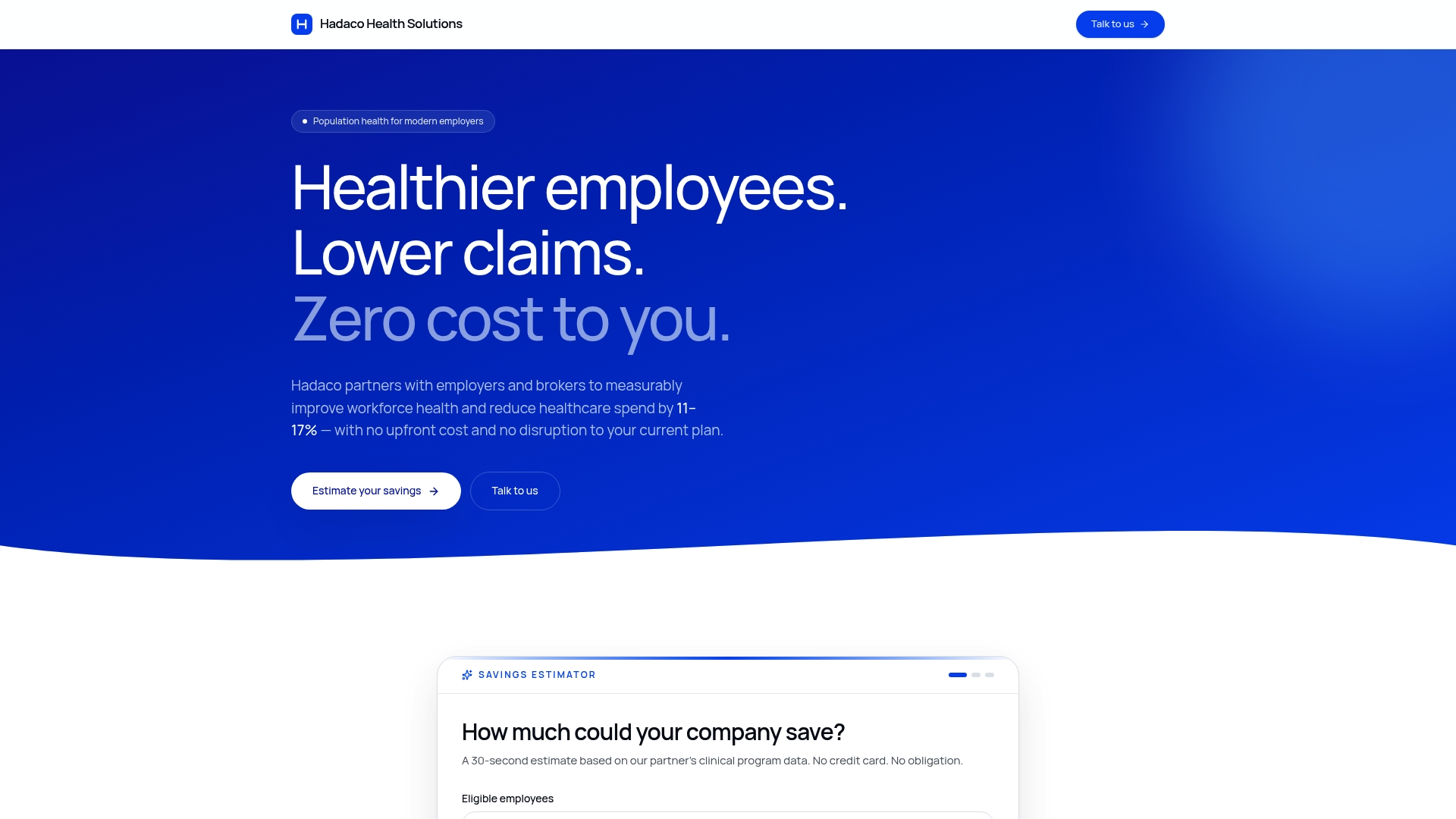
Before booking a consult, pull together three things: your total eligible employee count, a summary of your current benefit structure, and a high-level view of recent claims trends. With that in hand, Hadaco's team can run your numbers through the savings estimator and show you what a program could realistically look like for your workforce, quarter by quarter, with the kind of reporting your CFO will actually trust. Visit Hadaco's employer program page to request that consult.
Sources
- Information for Employers and Insurers | National Diabetes Prevention Program
- Effect of a Workplace Wellness Program on Employee Health and Economic Outcomes: A Randomized Clinical Trial | JAMA
- Moving Diabetes Prevention Programs to the Workplace: A Qualitative Exploration of Barriers and Facilitators to Participant Engagement
- Workplace wellness programs report (RAND analysis) | U.S. Department of Labor
This article is general information, not a substitute for advice from a qualified doctor. Consult a qualified healthcare professional about your own circumstances before acting on anything here.