
TL;DR:
- Care gap closure involves identifying and addressing overdue healthcare services among employees to improve health outcomes and reduce costs. Employers who integrate data, coordinate outreach, and prioritize equity can significantly lower claims and improve workforce health. Successful programs track time-to-closure, validate data before outreach, and embed structural supports for high-risk groups.
Care gap closure is the process of identifying and addressing missed or overdue healthcare services among a defined population to improve health outcomes and reduce costs. For employers and HR professionals, this process is the difference between a reactive benefits plan and one that actively protects workforce health. Quality frameworks like HEDIS and NCQA standards define which preventive services, screenings, and chronic disease checkups qualify as care gaps. Closing those gaps reduces emergency claims, lowers absenteeism, and directly cuts employer healthcare spending. Hadaco reports that companies in their first year of a structured health program save an average of $451 per employee.
What is care gap closure and why does it matter for employers?
Care gap closure, known in clinical quality management as "gap in care remediation," refers to the systematic identification and resolution of overdue preventive services, screenings, or chronic disease management steps. HEDIS measures, maintained by NCQA, define the specific clinical benchmarks that determine whether a gap exists. These include annual diabetic eye exams, colorectal cancer screenings, blood pressure monitoring, and medication adherence checks.
For employers, unresolved care gaps translate directly into higher claims. An employee who misses a diabetes management visit is more likely to experience a costly complication within 12 to 24 months. Addressing those gaps before complications occur is the core logic behind improving patient care access as a cost control strategy.
Healthcare disparities compound the problem. Employees in lower income brackets, rural zip codes, or minority demographic groups face more barriers to healthcare access, which means their care gaps accumulate faster and stay open longer. Addressing care inequities within your workforce is not just an ethical priority. It is a financial one.
What data and tools do you need to identify care gaps?
Effective gap identification requires three primary data sources: electronic health records (EHRs), payer claims data, and health risk assessments (HRAs). Each source captures a different slice of the picture. EHRs reflect what happened in the clinical encounter. Claims data shows what was billed. HRAs reveal what employees self-report about their own health behaviors and risks.

The biggest operational challenge is fragmentation. These data sources rarely talk to each other without deliberate integration work. A gap flagged in claims data may already be clinically resolved but simply undocumented. 25–40% of payer-flagged gaps are false positives that require administrative documentation rather than new clinical visits to close. That statistic means a significant share of your outreach budget could be wasted chasing gaps that no longer exist.
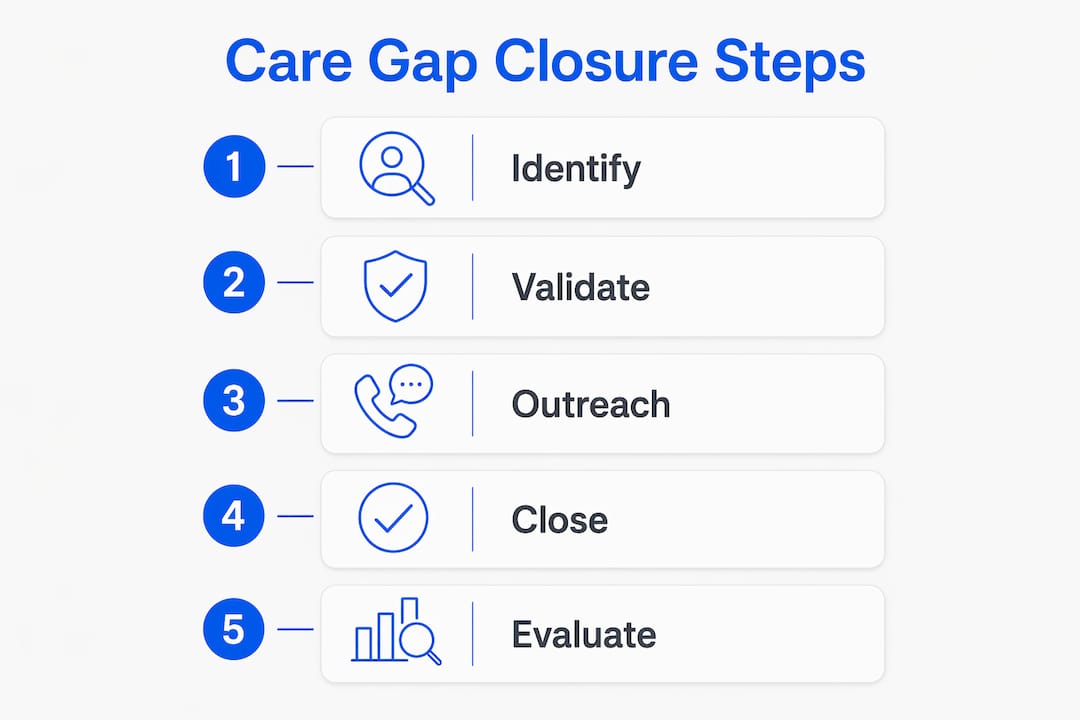
Data reconciliation and clinical validation are the corrective steps. A unified master patient index, which links records across systems under a single patient identifier, reduces duplicate flags and false positives. Care gap closure at scale fails unless managed as a system-level model with integrated data and standardized workflows.
Pro Tip: Run a Last-10 Patient Chart Audit before launching any outreach campaign. Pull the ten most recent patient records for your top gap category and check whether the gap is genuinely open or already addressed but undocumented. This single step can redirect your outreach budget toward real gaps.
Once data is clean, outreach tools determine whether you actually reach employees. Single-channel outreach is insufficient at scale. Multi-channel programs combining phone, text, email, and app notifications consistently outperform single-channel approaches on contact rates and gap closure rates.
| Data source | Primary role | Key limitation |
|---|---|---|
| Payer claims | Identifies billed services and gaps | Lags 30–90 days; misses undocumented care |
| EHR records | Reflects clinical encounters in detail | Siloed by provider; requires integration |
| Health risk assessments | Captures self-reported behaviors and risks | Relies on employee participation and honesty |
| Pharmacy data | Tracks medication adherence | Does not capture non-medication gaps |
How do you design an effective care gap closure strategy?
A care gap closure program does not run itself. It requires a cross-functional team, a defined workflow, and a feedback loop that catches what is not working.
Build the right team first
The team must include HR leadership, benefits administrators, a clinical advisor or nurse case manager, and a data analyst. Each role serves a distinct function. HR owns employee communication and engagement. Benefits administrators connect the program to plan design. The clinical advisor validates which gaps are genuinely open. The analyst tracks closure rates and flags workflow breakdowns.
Prioritize gaps by workforce impact
Not all gaps carry equal weight. Prioritize based on three factors: prevalence in your workforce, cost of the downstream complication, and feasibility of closure. Colorectal cancer screening and diabetes management visits typically rank high on all three. Use your HRA data and claims history to rank gaps specific to your employee population rather than relying on generic national benchmarks.
Design the workflow around three closure modes
- Opportunistic closure happens at the point of care. When an employee visits a provider for any reason, the care team checks for open gaps and addresses them during that visit.
- Outreach campaigns target employees with open gaps through proactive contact. Booking an appointment during initial outreach is 2–3 times more effective than scheduling a callback. Train your outreach staff to offer a specific appointment slot on the first call, not a promise to follow up.
- Administrative closure resolves gaps that are already clinically addressed but not yet documented. This requires chart review and proper coding, not a new patient visit.
Pro Tip: Use Plan-Do-Study-Act (PDSA) cycles to test workflow changes in small batches before rolling them out workforce-wide. Run a 30-day pilot on one gap category, measure the closure rate, adjust the workflow, then scale.
| Closure mode | Best use case | Key requirement |
|---|---|---|
| Opportunistic | High-visit populations, primary care | Provider training and EHR prompts |
| Outreach campaign | Low-engagement employees, preventive gaps | Multi-channel contact and scheduling tools |
| Administrative | Documented but uncoded services | Chart audit process and coder training |
Securing executive buy-in early determines whether the program gets the budget and cross-department cooperation it needs. Present the program in financial terms: projected claims reduction, cost per closed gap, and expected ROI within 12 months.
How do healthcare disparities affect care gap closure efforts?
Health disparities are not background noise in a care gap program. They are the primary reason gaps stay open for certain employee groups. Socioeconomic factors alone create a 7–10 year life expectancy gap in high-income countries. That gap shows up in your claims data as higher rates of preventable hospitalizations among lower-wage employees.
Stratified analytics reveal where disparities concentrate. Analyzing quality measures in isolation misses the compounded effect of race, income, geography, and language barriers on gap rates. Break your gap data down by demographic subgroup before designing outreach. A one-size approach will close gaps for employees who were already engaged and leave the highest-risk employees behind.
Interventions with low agentic demand, such as transportation assistance, childcare support during appointments, and on-site health screenings, reduce health inequities more reliably than programs that require employees to take multiple independent steps. Structural supports remove barriers rather than asking employees to overcome them alone.
Culturally tailored outreach matters at the contact level. Employees who receive communications in their preferred language and from culturally familiar messengers respond at higher rates. Health Care Equity Consult (HECS) services, which embed equity specialists in clinical encounters, improve bias mitigation and patient communication for employees who have historically disengaged from care.
Practical steps for HR teams:
- Segment gap data by income band, zip code, race, and primary language before outreach planning.
- Offer transportation reimbursement or on-site screenings for employees in low-access zip codes.
- Partner with community health workers who share cultural backgrounds with high-gap employee subgroups.
- Translate all outreach materials and appointment reminders into the top three languages spoken in your workforce.
Pro Tip: Ask your health plan or TPA for a demographic breakdown of open gaps by zip code. If certain zip codes show gap rates two or three times higher than the workforce average, those employees need structural support, not just more reminder texts.
What challenges arise, and how do you measure success?
The three most common obstacles in care gap programs are false positives, fragmented outreach, and poor documentation. Each has a specific fix.
False positives waste outreach resources and frustrate employees who receive reminders for services they have already completed. The solution is clinical validation before outreach, not after. Fragmented outreach happens when HR, the health plan, and the clinical team each run separate campaigns without coordination. Employees receive duplicate contacts and disengage. A single coordinated outreach calendar owned by one accountable team member eliminates this.
Poor documentation is the silent gap killer. A service completed but not coded correctly stays open in the payer's system indefinitely. Regular chart audits and coder training close this loop.
Time-to-closure under 60 days is the benchmark for mature care gap programs on preventive measures. Track this metric monthly by gap category. Cost per closed gap is the companion metric. Divide total program spend by the number of gaps closed in a reporting period. As workflows mature, this number should fall.
The ultimate measure is shared savings. Compare your total healthcare claims in the 12 months before the program to the 12 months after. Segment by gap category to identify which closures drove the most cost reduction. This is the number that earns continued executive support.
| Challenge | Root cause | Solution |
|---|---|---|
| False positives | Uncoded completed services | Chart audits before outreach launch |
| Fragmented outreach | Multiple uncoordinated teams | Single outreach calendar with one owner |
| Slow closure rates | Callback-based scheduling | Immediate appointment booking on first contact |
| Documentation gaps | Coder training deficits | Regular coding audits and staff training |
Key Takeaways
Effective care gap closure requires integrated data, coordinated outreach, and equity-focused design to reduce workforce healthcare costs and improve employee health outcomes.
| Point | Details |
|---|---|
| Validate data before outreach | Run chart audits to eliminate false positives before contacting employees. |
| Book appointments immediately | Immediate scheduling on first contact is 2–3 times more effective than callbacks. |
| Stratify by demographics | Break gap data by income, zip code, and language to find where disparities concentrate. |
| Track time-to-closure | Mature programs close preventive gaps within 60 days as a performance benchmark. |
| Measure shared savings | Compare claims 12 months before and after the program to calculate true ROI. |
Why care gap closure belongs at the center of your benefits strategy
Most HR leaders treat care gap closure as a compliance exercise or a health plan vendor's job. That framing costs money. The employers who see the largest claims reductions are the ones who own the process internally, assign a named accountable leader, and treat gap closure as a year-round operational priority rather than an annual report card.
The data integration challenge is real, but it is not a reason to wait. Start with the data you have. Your payer's claims file and a basic HRA give you enough to identify the top five gap categories in your workforce. From there, a PDSA cycle lets you test a workflow in 30 days without committing to a full program build.
The equity piece is where most programs leave the most value on the table. Closing gaps for already-engaged employees is relatively easy. Closing them for employees who face language barriers, transportation constraints, or distrust of the healthcare system requires structural support. That investment pays off in claims reduction for the highest-cost employee subgroups, which is exactly where the biggest savings live.
Leadership engagement is not optional. A corporate wellness ROI conversation with your CFO, framed around cost per closed gap and projected claims reduction, is the fastest path to sustained program funding. The programs that survive budget cycles are the ones with a clear financial story, not just a health story.
— Gene
How Hadaco helps employers close care gaps and lower claims
Employers who want to move from identifying care gaps to actually closing them need more than a spreadsheet. Hadaco works alongside your existing health plan to build a structured, evidence-based program that targets chronic disease management, preventive care, and employee engagement without disrupting your current benefits setup.
Hadaco's quarterly reporting gives HR teams a clear view of gap closure rates, cost per closed gap, and total claims impact. The transparent savings estimator shows projected savings before you commit. Companies using Hadaco's programs report an average savings of $451 per employee in the first year. If you are ready to turn your benefits plan into a measurable health and cost management tool, explore Hadaco's solutions and see what your workforce could save.
FAQ
What is care gap closure in employee health benefits?
Care gap closure is the process of identifying and resolving missed or overdue healthcare services, such as screenings or chronic disease checkups, within a defined employee population. It reduces preventable complications and lowers employer healthcare claims.
How do you identify care gaps in a workforce?
Care gaps are identified by combining payer claims data, EHR records, and health risk assessments, then validating open gaps against HEDIS or NCQA quality measures to remove false positives before outreach.
What percentage of flagged care gaps are false positives?
Between 25% and 40% of payer-identified care gaps are false positives that require administrative documentation rather than new clinical visits to close.
How long should it take to close a care gap?
Mature care gap programs target a time-to-closure of under 60 days for preventive measures. Programs that exceed this benchmark typically have workflow or outreach coordination problems worth investigating.
How does addressing healthcare disparities improve care gap closure rates?
Stratified analytics reveal which employee subgroups carry the highest gap burden. Structural supports like transportation assistance and culturally tailored outreach close gaps for high-risk employees who do not respond to standard reminder campaigns.