
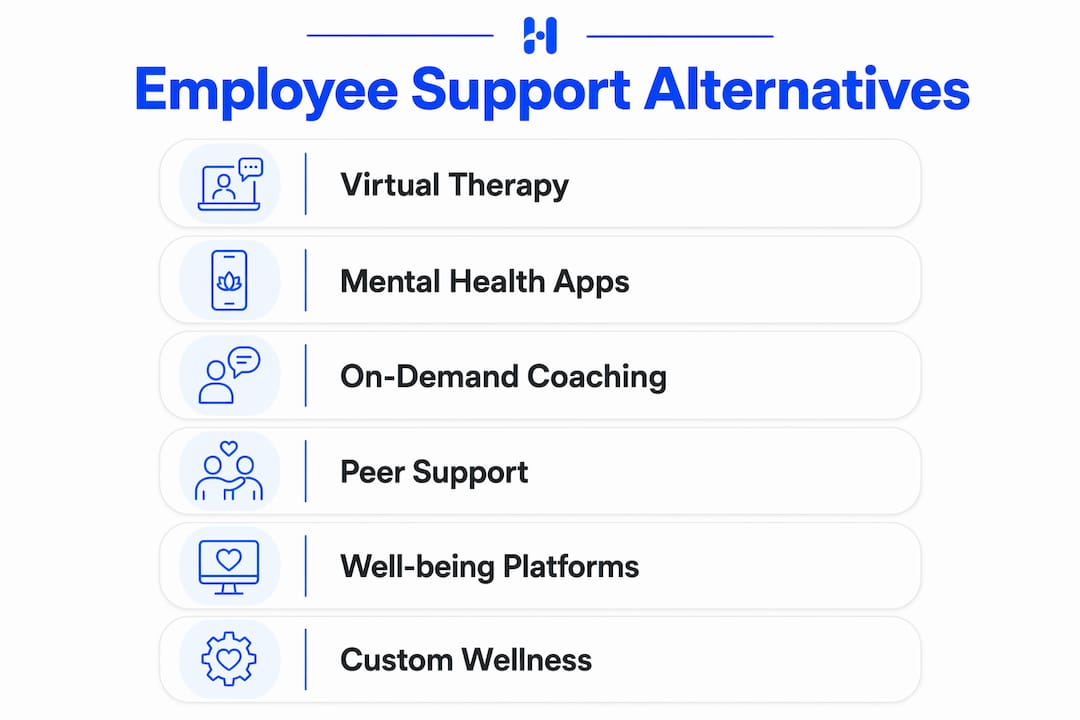
Traditional Employee Assistance Programs were built for a different era of work. The best EAP alternatives available to US employers address multiple specific gaps left open by conventional programs, commonly grouped into several key categories.
- Virtual therapy platforms connect employees to licensed clinicians within hours, not weeks
- Mental health apps and digital tools provide always-on, stigma-free support at scale
- On-demand coaching services deliver personalized guidance for stress, burnout, and leadership challenges
- Peer support networks and employee resource groups (ERGs) build community around shared experience
- Integrated well-being platforms combine clinical care, preventive tools, and benefits navigation in one place
- Customized wellness programs are built around a company's specific workforce demographics and culture
These categories are not mutually exclusive. Many organizations layer two or three together, and the most effective deployments tie each option to measurable clinical and financial outcomes rather than treating mental health support as a checkbox benefit.
Why traditional EAPs fall short for most workforces
The core problem with conventional Employee Assistance Programs is not that they lack value. It is that almost nobody uses them. Utilization rates for traditional EAPs consistently sit between 2% and 5% in the US, which means that for every 100 employees enrolled, roughly 95 to 98 never access the benefit at all.
Several factors drive that gap:
- Stigma and privacy fears. Employees worry that calling an EAP hotline will flag them to HR or affect their job standing, even when confidentiality is guaranteed.
- Lack of personalization. A standard EAP typically offers a fixed number of short-term counseling sessions with no continuity of care and no matching based on clinical need or provider fit.
- Limited accessibility. Phone-based intake processes, narrow provider networks, and wait times measured in weeks push employees toward doing nothing.
- Crisis-only framing. Traditional EAPs focus on crisis intervention rather than proactive, longitudinal care, which means they reach employees only after a problem has escalated.
The "status quo tax" is the organizational cost of untreated mental health issues that a low-engagement EAP fails to prevent. It shows up in absenteeism, turnover, reduced productivity, and rising healthcare claims, none of which appear on the EAP vendor's invoice.
The research on outpatient behavioral health spending adds another layer. More generous EAP visit allowances correlate with lower use of regular outpatient behavioral health services, suggesting that when EAP coverage is meaningful, it does reduce downstream costs. The problem is that most employers never get there because utilization stays too low to generate that substitution effect.
The six modern employee support alternatives, explained
Understanding each category in depth is what separates a benefits decision that looks good on paper from one that actually moves the needle on workforce health.
Virtual therapy platforms
These platforms connect employees to licensed therapists, psychologists, and psychiatrists through video, phone, or text, typically within 24 hours of a request. The provider networks are far larger than what a traditional EAP vendor maintains, and matching algorithms pair employees with clinicians based on specialty, language, cultural background, and presenting concern. For HR leaders, the practical advantage is coverage depth: virtual platforms can serve a distributed workforce across every US time zone without the geographic constraints of an in-person provider network.
Mental health apps and digital tools
Apps built around cognitive behavioral therapy (CBT), mindfulness, and mood tracking give employees a private, always-available entry point to mental health support. Because there is no intake call and no human gatekeeper, the stigma barrier drops considerably. These tools work best as a first layer of support, catching employees who would never call a hotline but will open an app during a stressful commute. The limitation is clinical depth: apps are well-suited to mild-to-moderate stress and anxiety but are not appropriate for acute or complex mental health needs.
On-demand coaching services
Coaching sits between self-help tools and clinical therapy. Employees book sessions with certified coaches who specialize in areas like stress management, work-life balance, career transitions, and leadership development. Unlike therapy, coaching is goal-oriented and forward-looking, which makes it easier for employees to frame as professional development rather than mental health treatment. That reframing alone tends to increase uptake, particularly among managers and senior contributors who resist the idea of "needing help."

Peer support networks and employee resource groups
Peer support networks provide structured, culturally diverse community support that most traditional EAPs cannot replicate. ERGs organized around shared identity or experience, whether that is parenthood, chronic illness, or military service, create a sense of belonging that clinical programs rarely achieve. Virtual group support formats extend this to remote and hybrid workforces, building relationships across locations. The key distinction from clinical care is that peer support is not a substitute for therapy; it is a complement that increases the likelihood employees will seek professional help when they need it.
Integrated well-being platforms
These are the most operationally complex option and, when implemented well, the most comprehensive. An integrated platform brings together mental health care, physical health resources, financial wellness tools, and benefits navigation under a single employee-facing interface. The HR advantage is consolidation: instead of managing five separate vendor relationships, benefits teams work with one platform that produces unified utilization data. The tradeoff is that integration requires more upfront coordination with existing benefit plan structures.

Customized wellness programs
Off-the-shelf programs rarely fit the actual demographics of a workforce. A customized wellness program starts with population health data, identifying the chronic conditions, risk factors, and engagement patterns specific to that employee group, and then builds interventions around those findings. This approach is particularly effective for employers with a high prevalence of specific conditions like diabetes, hypertension, or musculoskeletal issues, where targeted programming can generate measurable reductions in healthcare claims. Hadaco's model is built on exactly this logic: evidence-based interventions designed around a company's actual population, integrated with existing benefit plans without disrupting them.
Pro Tip: When evaluating any of these six categories, ask vendors for utilization data from clients with a workforce profile similar to yours, not aggregate platform averages. A platform that reports strong overall engagement may perform very differently for a manufacturing workforce versus a tech company.
How to choose the right employee assistance program substitute
The right choice depends on four variables that vary significantly across organizations.
Company size and workforce distribution. A 200-person company with employees in one city has different access needs than a 5,000-person organization spread across 30 states. Virtual platforms and apps scale without geographic friction; in-person or locally networked programs do not.
Employee preferences and demographics. Survey your workforce before selecting a platform. Younger employees often prefer app-based tools; employees dealing with complex clinical needs require platforms with licensed clinicians and continuity of care. A benefits decision made without employee input tends to replicate the same low-utilization problem it was meant to solve.
Budget and total cost of ownership. Per-employee-per-month pricing varies widely across categories. Apps and peer networks typically carry lower price points than integrated clinical platforms, but the relevant comparison is not sticker price. It is cost per engaged employee, which requires knowing utilization rates upfront.
Integration with existing benefits. The best employee assistance program substitutes complement rather than duplicate what you already offer. Before adding a new vendor, map your current benefit stack and identify the specific gaps: is the problem access, stigma, clinical depth, or personalization? The answer determines which category to prioritize.
Data privacy and compliance. Any platform handling employee mental health data must comply with HIPAA. For organizations with international employees, GDPR compliance and transparent security practices are non-negotiable. Require vendors to provide their security documentation, not just a checkbox on a sales slide.
Pro Tip: Prioritize platforms that offer real-time ROI dashboards and quarterly outcome reporting. If a vendor cannot show you utilization trends, clinical improvement metrics, and cost impact in a format you can present to leadership, you will have no way to justify the investment or course-correct if engagement drops.
What the evidence says about modern alternatives
The utilization gap between traditional EAPs and modern alternatives is not marginal. Traditional EAP utilization sits at 2%–5%, while modern precision-matched platforms report utilization rates up to 25%. That is a five-to-tenfold difference in the share of your workforce actually receiving support.
The financial picture is equally concrete. Research on EAP benefit generosity confirms that more accessible EAP coverage reduces outpatient behavioral health spending, which means the substitution effect is real when employees actually engage. The challenge has always been getting them there.
| Metric | Traditional EAP | Modern alternatives |
|---|---|---|
| Average utilization rate | 2%–5% | Up to 25% |
| Care model | Crisis-focused, short-term | Proactive, longitudinal |
| Provider matching | Limited, geography-based | Specialty, language, and clinical need |
| ROI visibility | Minimal reporting | Real-time dashboards, quarterly outcomes |
| Integration with benefits | Standalone | Embeds in existing plan structure |
Hadaco's approach addresses this directly. By building evidence-based programs around a company's actual population health data, including chronic disease prevalence, preventive care gaps, and engagement patterns, Hadaco helps employers achieve measurable reductions in healthcare claim costs. Companies in their first year report an average savings of $451 per employee, with quarterly reporting that makes the financial impact visible to leadership. That kind of accountability is what separates a wellness investment from a wellness expense.
One important caveat on the evidence base: many newer digital mental health tools lack peer-reviewed long-term effectiveness studies. Platforms that report strong engagement metrics do not always demonstrate equivalent clinical outcomes. When evaluating vendors, look for programs with published clinical validation, not just user satisfaction scores.
How to implement an EAP alternative: steps and timeline
Most organizations can move from decision to full deployment in 90–120 days if the process is structured. Here is a realistic sequence.
Weeks 1–4: Needs assessment. Pull your current EAP utilization data, healthcare claims by category, and any employee survey data on mental health or benefits satisfaction. Identify the top two or three gaps you are trying to close. This step is often skipped, which is why so many replacements replicate the same problems.
Weeks 5–8: Vendor evaluation. Issue a structured RFP to platforms in the categories that match your gaps. Require utilization data from comparable clients, HIPAA compliance documentation, integration specs for your current HRIS and benefits administration system, and a clear pricing model. Evaluate clinical depth alongside technology, particularly if your workforce includes employees with complex or acute mental health needs.
Weeks 9–12: Contracting and integration. Finalize vendor selection, negotiate contract terms including performance guarantees and reporting cadence, and begin technical integration with your existing benefits infrastructure. Coordinate with your benefits broker or advisor throughout this phase.
Weeks 13–16: Launch and communication. Roll out the program with a communication plan that addresses stigma directly. Employees are more likely to engage when messaging normalizes mental health support rather than framing it as a crisis resource. Manager training on how to refer employees to the program without overstepping is a high-return investment at this stage.
Ongoing: Measure and adjust. Set a 90-day review cadence. Track utilization by department, clinical outcome trends, and any downstream impact on healthcare claims. Platforms with real-time dashboards make this straightforward; those without them require manual data pulls that rarely happen consistently.
What organizations have learned from switching
The pattern across organizations that have moved away from traditional EAPs is consistent: the shift works when it is driven by data and communicated well, and it stalls when it is treated as a vendor swap.
A mid-size manufacturing company that replaced its legacy EAP with an integrated well-being platform found that utilization tripled within the first six months, primarily because the new platform integrated with the company's existing health plan and required no separate enrollment step. Removing friction mattered more than adding features.
A professional services firm that added on-demand coaching to its existing benefits package saw the strongest uptake among managers, a group that had historically avoided the EAP entirely. Framing coaching as a leadership development tool rather than a mental health resource was the deciding factor in adoption.
A healthcare employer that implemented a customized wellness program built around its workforce's chronic disease profile, including high rates of hypertension and type 2 diabetes, generated measurable reductions in related healthcare claims within the first year. The key was starting with population health data rather than a generic program template. Hadaco's population health approach follows this same logic, using evidence-based interventions tied to a company's actual claims data rather than industry averages.
The common thread in each case is specificity. Generic programs produce generic results. Programs built around what your workforce actually needs, and measured against outcomes your leadership actually cares about, produce the kind of ROI that justifies continued investment.
Hadaco works with employers and benefits advisors to build exactly this kind of program, with no upfront fees and quarterly reporting that makes the financial impact clear from day one. If you want to see what a performance-based approach to workforce health looks like for your organization, explore Hadaco's solutions or use the savings estimator to get a baseline estimate before any commitment.
Key Takeaways
Modern EAP alternatives consistently outperform traditional programs on utilization, clinical outcomes, and measurable cost impact when selected based on workforce data and implemented with clear accountability structures.
| Point | Details |
|---|---|
| Utilization gap is wide | Traditional EAPs reach 2%–5% of employees; modern alternatives can reach up to 25%. |
| Six categories cover different needs | Virtual therapy, apps, coaching, peer networks, integrated platforms, and customized programs each address distinct gaps. |
| Data privacy is non-negotiable | Any platform handling employee mental health data must comply with HIPAA at minimum. |
| Implementation takes 90–120 days | A structured four-phase process from needs assessment to launch keeps adoption on track. |
| Specificity drives ROI | Programs built on actual workforce population data outperform generic templates in both engagement and claims reduction. |