
TL;DR:
- Employee mental health programs integrate psychological support into organizational culture, improving well-being and productivity.
- Organizations treating mental health as core infrastructure see higher engagement, reduced costs, and better work design outcomes.
Employee mental health programs are structured workplace initiatives that embed psychological support directly into organizational culture, operations, and leadership practices. 95% of global HR and benefit professionals view mental health as critical to their organizations, yet only 9% effectively reduce health plan spend through current strategies. That gap is the real problem. Mental health costs U.S. businesses an estimated $300 billion annually in stress, burnout, and productivity losses. The organizations closing that gap treat mental health not as a benefit add-on but as core business infrastructure.
What are the essential components of employee mental health programs?
Effective programs share one defining trait: they are built into how work happens, not bolted on afterward. The industry term for this approach is "integrated workplace mental health," and it covers far more ground than a traditional Employee Assistance Program (EAP) alone.

EAPs remain a foundational layer. They provide confidential counseling referrals, crisis support, and access to licensed therapists. The problem is that EAPs alone rarely move the needle on workforce well-being. Utilization rates stay low when employees do not know the program exists or fear stigma from using it.
The components that separate high-performing programs from average ones include:
- Manager training on psychological safety. Managers are the primary contact point for employee distress. Training them to recognize warning signs, hold supportive conversations, and model healthy behavior is the single highest-leverage investment an organization can make.
- Mental health embedded in leadership practices. When senior leaders openly discuss mental health, utilization of support resources rises across the workforce.
- Financial wellness integration. 56% of employees spend 3+ hours per week on financial concerns during work hours. Financial stress is a direct mental health driver, and programs that ignore it leave a major gap.
- Employee-centered design. Salutogenic principles that prioritize employee choice and resilience building outperform purely risk-reduction models in both engagement and long-term outcomes.
- Peer ambassador networks. Trained peer supporters normalize mental health conversations and reduce the stigma that keeps employees from seeking help.
Pro Tip: Before launching any new program component, survey employees anonymously about their top stressors. Programs designed around real data see significantly higher participation than those built on assumptions.
How do integrated mental health programs improve organizational outcomes?
The business case for integrated mental health support is no longer theoretical. Companies that embed mental health into leadership and organizational design report 20–25% higher productivity and measurably reduced burnout costs. That is not a marginal improvement. It represents a structural shift in how organizations perform.
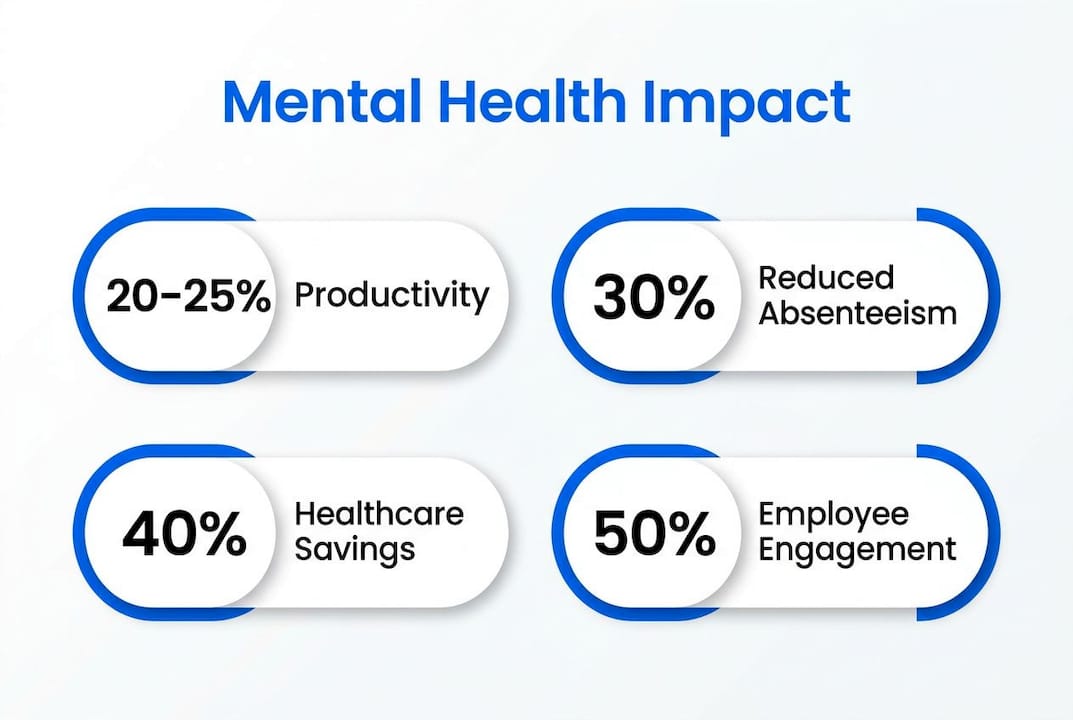
The evidence from corporate case studies is equally clear. Atlassian's adaptive mental health model achieved 52% employee registration, with 94% of participants reporting well-being improvements and 63% reaching clinical recovery or measurable improvement. Those numbers reflect what happens when mental health support is woven into daily work rather than offered as a separate, optional service.
Shell's experience reinforces the same point. Shell's Global Mental Wellbeing Programme reached 90% employee awareness of its EAP and 77% who knew how to access it, driven by targeted training. Since 2023, 21% of line managers completed psychological safety training. Awareness alone does not produce outcomes, but awareness combined with manager capability does.
"Effective mental health programs embed well-being into culture and business practices rather than treating it as an add-on benefit. Organizations that treat mental health as infrastructure, not a perk, see the strongest returns on engagement, retention, and healthcare spend."
The financial connection runs deeper than most HR leaders initially expect. Integrated approaches that treat financial, social, and emotional health as interconnected produce greater impact than programs addressing each dimension separately. When an employee is distracted by debt, no amount of mindfulness app access will restore their focus.
| Outcome | Evidence |
|---|---|
| Productivity increase | 20–25% higher in organizations with integrated mental health design |
| EAP awareness | Shell reached 90% employee awareness through targeted training |
| Well-being improvement | 94% of Atlassian participants reported improved well-being |
| Clinical recovery rate | 63% of Atlassian participants achieved clinical recovery or improvement |
| Financial distraction | 56% of employees lose 3+ hours weekly to financial stress |
What practical strategies can employers use to implement mental health programs?
Designing a program is straightforward. Getting employees to use it, and sustaining that use over time, is where most organizations struggle. The following sequence reflects what works in practice.
- Conduct a baseline assessment. Survey employees on stress levels, awareness of existing resources, and barriers to use. This data shapes every decision that follows and gives you a benchmark to measure progress against.
- Train managers first. Managers trained in stress reduction show stronger workforce retention and engagement. Launch manager training before any employee-facing program rollout. Employees take cues from their direct supervisors.
- Run an awareness campaign. Shell's 90% EAP awareness rate did not happen by accident. It required deliberate, repeated communication across multiple channels. Use team meetings, internal newsletters, and manager conversations to make resources visible.
- Reduce stigma through leadership modeling. When a senior leader shares their own experience with stress or burnout, utilization of mental health resources rises. Program engagement improves when stigma reduction is led from the top, not delegated to HR alone.
- Redesign workflows where possible. Workplace policies that reduce excessive demands and support flexible scheduling prevent burnout more effectively than any counseling program. Structural stressors require structural solutions.
- Integrate financial wellness. Add financial counseling, debt management resources, or emergency savings tools to your program. Given that 60% of workers report financial stress, this is not optional for a complete program.
- Measure and report quarterly. Programs without data drift. Track utilization, employee-reported well-being, and healthcare claim trends. Share results with leadership to maintain organizational commitment.
Pro Tip: Appoint two or three peer mental health ambassadors per department. These are employees who volunteer to be visible, approachable contacts for colleagues who are not ready to speak with a manager or HR. Peer networks consistently outperform top-down communication in reducing stigma.
How do AI and economic uncertainty affect mental health program design?
The workforce entering 2026 carries a specific set of anxieties that programs designed five years ago were not built to address. AI-driven job security concerns are raising workforce anxiety at scale. Employees in roles perceived as automatable report higher baseline stress, lower engagement, and greater reluctance to invest in their own development.
Economic volatility compounds the problem. When household budgets are under pressure, financial stress spills directly into work performance. The connection between financial health and psychological health is not incidental. It is structural, and programs that treat them as separate domains miss the point.
The current environment demands that programs address:
- Resilience and readiness building. Employees need skills to adapt to change, not just resources to cope with distress. Programs should include workshops on change management, career adaptability, and uncertainty tolerance.
- Psychosocial risk frameworks. ISO 45003, the international standard for psychological health and safety at work, provides a structured method for identifying and managing workplace psychosocial hazards. Organizations adopting this framework move from reactive support to proactive risk management.
- Work intensification as a systemic risk. Burnout in 2026 is not primarily a personal resilience failure. It is a product of work design. Programs must address workload, role clarity, and autonomy at the organizational level, not just offer individual coping tools.
- Systemic variables over individual interventions. The most durable mental health gains come from changing the conditions of work, not from providing more apps or hotlines. Redesigning workflows and enabling employee control improves mental health significantly and at scale.
The organizations that will lead on workforce mental health in 2026 are those treating it as a corporate wellness ROI question, not a compliance checkbox.
Key Takeaways
Integrated employee mental health programs, built into leadership, culture, and work design, deliver measurably better outcomes than standalone benefit offerings.
| Point | Details |
|---|---|
| Integration beats add-ons | Embedding mental health into leadership and workflows produces 20–25% higher productivity gains. |
| Manager training is the priority | Train managers in psychological safety before launching any employee-facing program. |
| Financial wellness belongs in the program | 56% of employees lose work time to financial stress, making financial support a core component. |
| Stigma reduction requires leadership | Senior leaders modeling openness drives utilization far more effectively than HR campaigns alone. |
| Measure outcomes quarterly | Track utilization, well-being scores, and healthcare claims to sustain organizational commitment. |
What I've learned from watching mental health programs succeed and fail
Most mental health programs fail for the same reason: they are launched as benefits, not built as systems. I have watched organizations spend real money on counseling apps, EAP upgrades, and wellness days, then wonder why engagement stays flat and burnout rates do not move. The answer is almost always the same. The program exists beside the work, not inside it.
The organizations that get this right do something uncomfortable. They ask managers to change their behavior, not just their vocabulary. They redesign workflows instead of offering coping tools for broken ones. They share data with leadership every quarter, even when the numbers are unflattering. That kind of transparency is what keeps programs from becoming shelf-ware.
The stigma problem is real, but it is also solvable. When a VP talks openly about their own anxiety in an all-hands meeting, utilization of mental health resources typically spikes within weeks. That is not anecdotal. It is a pattern I have seen repeat across industries. Leadership modeling works faster than any awareness campaign.
The future of workplace mental health is not more apps. It is better work design, trained managers, and organizations willing to treat psychological safety as seriously as physical safety. The wellness programs that reduce healthcare costs are the ones built on that foundation.
— Gene
How Hadaco supports your mental health program goals
Hadaco works with employers who are serious about connecting workforce health to measurable business results. Its evidence-based programs address chronic disease, preventive care, and employee engagement as a unified system, not separate initiatives. Organizations in their first year with Hadaco average $451 in savings per employee, without upfront fees and without disrupting existing health plans. Hadaco's transparent savings estimator and quarterly reporting give HR leaders the data they need to demonstrate ROI to leadership and sustain program investment over time. For employers ready to move from intention to outcomes, Hadaco's health solutions provide the structure to get there.
FAQ
What are employee mental health programs?
Employee mental health programs are structured workplace initiatives that provide psychological support, mental health resources, and systemic work design changes to improve workforce well-being. They go beyond traditional EAPs to include manager training, financial wellness, and psychological safety practices.
How do you measure the ROI of mental health programs?
Track utilization rates, employee-reported well-being scores, absenteeism, and healthcare claim trends on a quarterly basis. Companies integrating mental health into organizational design report 20–25% higher productivity as a measurable outcome.
What is psychological safety at work?
Psychological safety is the belief that employees can speak up, ask questions, and admit mistakes without fear of punishment or humiliation. It is a foundational condition for mental health program effectiveness and is built primarily through manager behavior.
How does financial wellness connect to mental health programs?
Financial stress is a direct driver of distraction and reduced productivity, with 56% of employees spending 3+ hours weekly on financial concerns during work. Programs that include financial counseling and debt management tools address a root cause that purely emotional support cannot reach.
What is ISO 45003 and why does it matter?
ISO 45003 is the international standard for psychological health and safety at work. It gives organizations a structured framework for identifying psychosocial hazards and managing them proactively, shifting mental health strategy from reactive support to systemic risk management.