
TL;DR:
- Financial wellness programs help employees manage debt, savings, and stress to improve overall health. Employers benefit from reduced healthcare costs, higher engagement, and lower absenteeism through tailored, ongoing initiatives. Measuring progress with validated tools and leadership support enhances long-term effectiveness and sustainability.
What are financial wellness programs and why do they matter?
Financial wellness programs are employer-led initiatives that address employees' financial knowledge, skills, behaviors, and stress in a coordinated way. Unlike a standalone 401(k) or a one-time seminar, they treat an employee's entire financial life as interconnected: debt, savings, emergency funds, retirement, and day-to-day budgeting.
The employer case is direct. Financial stress correlates strongly with reduced productivity, higher absenteeism, and increased healthcare utilization. When workers are preoccupied with money problems, chronic disease risk climbs and benefit costs follow.
Key employer benefits include:
- Reduced presenteeism and absenteeism tied to financial anxiety
- Lower healthcare claim costs as financial stress decreases
- Higher engagement and retention, especially among younger workers
- Stronger participation in existing benefits like HSAs and 401(k) plans
The CFPB's financial well-being scale gives employers a validated, 10-question tool to measure workforce financial health before and after program interventions. Starting with a baseline score is the single most important step before designing any program.
Table of Contents
- Key components of effective financial wellness programs
- How do you measure financial wellness program success?
- How financial wellness connects to population health and chronic disease management
- What do successful financial wellness programs look like in practice?
- Legal and compliance considerations for financial wellness programs
- What does it cost to implement these programs, and what is the ROI?
- Key Takeaways
- What employers get wrong about financial wellness trends
- Hadaco gives employers a measurable path to lower healthcare costs
Key components of effective financial wellness programs
Effective money management programs share a common structure, but the best ones go well beyond handing out brochures. The International Foundation of Employee Benefit Plans is clear: financial education is an ongoing process, not a one-time event.
Core components employers should build in:
- Financial literacy training covering interest compounding, investment diversification, inflation, and early retirement saving
- Budgeting and saving workshops delivered repeatedly across the year, not just at open enrollment
- One-on-one wellness financial coaching from certified, conflict-free advisors
- Emergency savings accounts and employer-sponsored hardship funds
- Student loan repayment assistance, now incentivized by SECURE 2.0 legislation, with growing employer adoption
- Digital tools for spending tracking, goal-setting, and benefits discovery
Personalization is where most programs fall short. A program built for a 55-year-old nearing retirement lands differently for a 24-year-old carrying student debt. Tailoring offerings to distinct employee demographics, starting at onboarding and continuing through career milestones, drives meaningfully higher engagement.
Pro Tip: Unbiased financial coaching builds far more trust than product-linked advice. Employees disengage quickly when they sense a coach is steering them toward a financial product. Conflict-free coaching, where no sales occur, produces the behavior change that actually moves financial wellness scores.

How do you measure financial wellness program success?
Measurement is where most employer programs lose momentum. Without tracking, you cannot prove ROI, and without ROI data, leadership support erodes. The CFPB's financial well-being scale provides a repeatable, validated baseline.
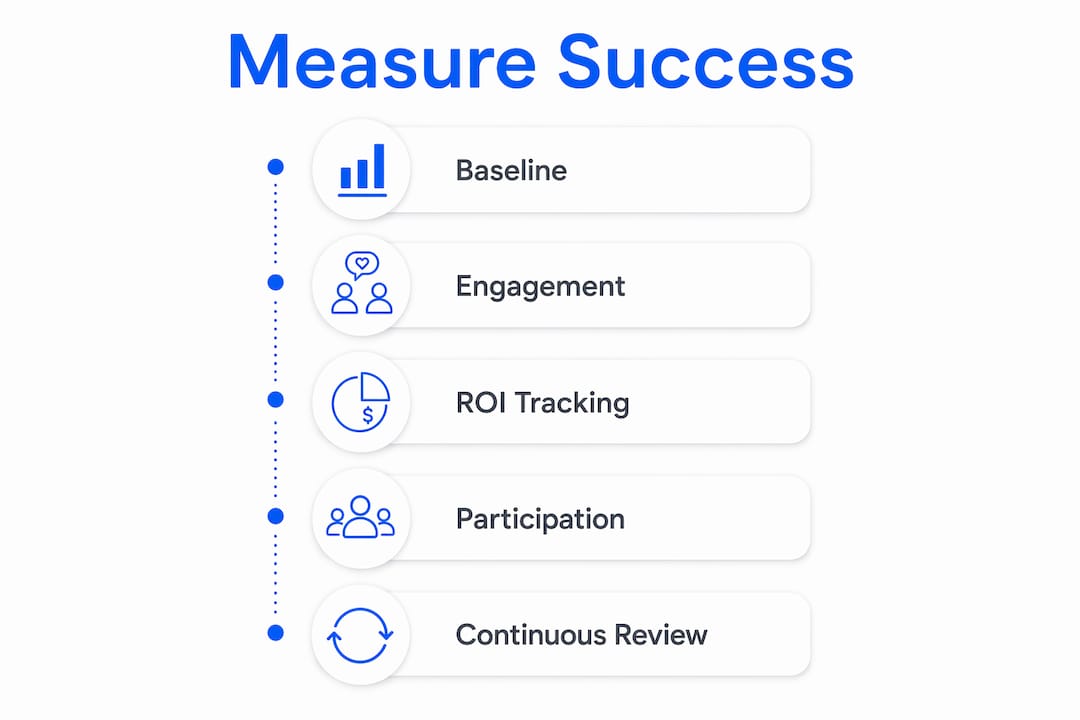
| Metric | What to track | Evaluation cadence |
|---|---|---|
| Financial wellness score | CFPB 10-question survey results | Annually, with mid-year pulse |
| Participation rate | Percentage of eligible employees engaging | Quarterly |
| Healthcare cost change | Claims data before and after program launch | Annually |
| Absenteeism rate | Unplanned absences per employee | Quarterly |
| Employee feedback | Satisfaction and perceived usefulness | Post-program survey |
Employees with access to financial wellness benefits show improved productivity, fewer absences, and better focus. Linking those outcomes to claims data gives HR leaders the quantitative story that keeps executive sponsors engaged.
Key finding: The IFEBP identifies leadership buy-in and data-driven justification as prerequisites for program sustainability. Present ROI projections before launch, not after.
Continuous evaluation also reveals which program elements are underused. Low participation in budgeting workshops, for example, often signals a communication gap rather than a content problem.
How financial wellness connects to population health and chronic disease management
Financial stress and chronic disease share a feedback loop. Employees under persistent money pressure skip preventive care, delay prescriptions, and avoid mental health treatment. Those deferred costs show up later as expensive acute claims.
Embedding financial health resources inside a broader population health strategy closes that gap. Practical steps for employers:
- Align financial wellness program launch with open enrollment to connect money education directly to healthcare plan choices
- Use aggregate financial wellness scores to identify high-risk employee segments for targeted outreach
- Integrate financial coaching referrals into employee assistance programs (EAPs)
- Coordinate with healthcare staffing partners in sectors like healthcare where financial stress and burnout intersect acutely
- Track whether financial wellness improvements correlate with reductions in chronic disease-related claims
Hadaco's approach layers financial wellness alongside preventive care, mental health support, and chronic disease management without replacing existing benefit plans. That integration matters because employees rarely separate their financial anxiety from their physical health decisions. Addressing both in one coordinated program produces outcomes neither can achieve alone.
Pro Tip: Do not launch financial wellness as a standalone HR initiative. Anchor it to your population health data. When you can show leadership that financially stressed employees generate higher chronic disease claims, the program stops being a "nice benefit" and becomes a cost-reduction strategy.
What do successful financial wellness programs look like in practice?
Real-world programs that work share a few consistent traits. They start at onboarding, they communicate year-round, and they meet employees where financial decisions actually happen.
One pattern that appears repeatedly across employer case studies: companies that integrate financial coaching into life events, such as a promotion, a new child, or a change in health plan, see higher engagement than those that schedule annual workshops and call it done. The Journal of Financial Literacy and Wellbeing found that timely reminders tied to career milestones increase retirement plan participation and contribution rates.
Employers in healthcare and manufacturing, where shift workers often lack access to traditional financial planning resources, have seen strong results from mobile-first financial education tools paired with on-site workshops. The combination of digital access and human coaching addresses both convenience and trust.
For corporate wellness ROI, the programs that generate the clearest returns are those with defined metrics from day one, not programs that measure participation alone and assume engagement equals impact.
Legal and compliance considerations for financial wellness programs
Employers need to navigate several regulatory boundaries when designing these programs. The primary areas of concern are:
ERISA implications. If a financial wellness program includes advice on plan assets, such as 401(k) investment guidance, it may trigger fiduciary obligations under ERISA. Using certified, conflict-free coaches who provide education rather than investment advice keeps programs on the right side of that line.
SECURE 2.0 Act. This legislation created new incentives for student loan repayment matching, allowing employers to treat employee student loan payments as elective deferrals for matching purposes. Employers adding this benefit should confirm plan document amendments are in place.
HIPAA and data privacy. Financial wellness assessments that collect personal financial data require clear data governance policies. Aggregate reporting protects employee privacy while still giving employers actionable workforce-level insights.
Tax treatment. Most financial education benefits are tax-free to employees under IRS rules, but employer-paid financial counseling can have different treatment depending on program structure. Legal review before launch prevents surprises.
What does it cost to implement these programs, and what is the ROI?
Program costs vary widely. Workshops and digital resources represent the low end; one-on-one coaching, savings incentives, and student loan matching sit at the higher end. The right investment level depends on workforce size, existing benefit infrastructure, and target outcomes.
The ROI case rests on three levers: reduced healthcare claims, lower turnover, and productivity gains. Hadaco clients see an average savings of $451 per employee in their first year, driven by reduced claims and improved engagement. That figure compounds when financial wellness improvements reduce chronic disease-related utilization.
Employers who track wellness program ROI systematically, using pre- and post-program claims data alongside CFPB financial wellness scores, build the evidence base needed to sustain and expand these programs over time. Programs that skip measurement rarely survive the next budget cycle.
Key Takeaways
Financial wellness programs deliver measurable employer ROI when they combine ongoing education, personalized coaching, and integration with broader population health strategies.
| Point | Details |
|---|---|
| Start with a baseline | Use the CFPB's 10-question financial well-being scale before launching any program. |
| Personalize by demographic | Tailor content to employee life stages, from new hires carrying student debt to workers nearing retirement. |
| Measure what matters | Track participation rates, healthcare cost changes, and absenteeism quarterly, not just annually. |
| Integrate with health strategy | Embed financial wellness inside population health programs to reduce chronic disease-related claims. |
| Hadaco's model | Hadaco delivers evidence-based financial and population health programs with no upfront fees, averaging $451 in savings per employee in year one. |
What employers get wrong about financial wellness trends
The loudest trend in financial wellness right now is AI-powered coaching, and it is genuinely useful. But the employers who will see the biggest gains in the next few years are not the ones chasing the newest technology. They are the ones who finally fix the communication problem that has existed for decades.
Most employers already have financial wellness benefits buried inside their carrier and EAP contracts. Employees do not use them because they do not know they exist. Before adding a new platform, audit what you already pay for. The gap between available resources and employee awareness is where most of the ROI is hiding.
The generational dimension matters too. Gen Z employees entering the workforce now have different financial stress triggers than Boomers approaching retirement. A single program cannot serve both well. The employers building segmented communication strategies, where a 26-year-old receives student loan resources and a 58-year-old receives retirement income planning content, will outperform those running one-size-fits-all annual campaigns.
Leadership buy-in remains the variable that determines whether any of this actually happens. Financial wellness programs that live inside HR without executive sponsorship get cut when budgets tighten. Frame the ask in claims data and turnover costs, not employee satisfaction scores, and the conversation changes.
Hadaco gives employers a measurable path to lower healthcare costs
Employers who want financial wellness integrated with population health, chronic disease management, and preventive care without rebuilding their entire benefits stack should look at what Hadaco delivers. The model is straightforward: evidence-based programs layered onto your existing plans, no upfront fees, and quarterly reporting that shows exactly what is working.
Hadaco clients report measurable healthcare savings per employee in year one, with improvements in engagement and retention that compound over time. The savings estimator on the Hadaco site lets you see projected outcomes for your specific workforce before committing to anything.
If your organization is ready to connect financial wellness to real health outcomes and measurable cost reduction, see how Hadaco works and book a consultation to get your workforce-specific savings estimate.