
Workplace wellness challenges are organized, time-bound activities that encourage employees to build healthier habits together, whether that means hitting a daily step count, practicing mindfulness, or drinking more water. They work because they make health feel social and achievable rather than personal and daunting. About one-third of U.S. employees are actively trying to reduce stress and burnout, and nearly half at large companies want better work-life balance. That demand is already sitting inside your workforce. The right challenge gives it somewhere to go.
What sets effective wellness challenges apart from generic perks:
- They target specific, measurable behaviors (steps per day, glasses of water, minutes of meditation) rather than vague aspirations.
- They run on a defined timeline, which creates urgency and a natural finish line.
- They work across physical, mental, nutritional, and lifestyle dimensions, meeting employees where their needs actually are.
- They build social connection by design, through team formats, shared tracking, and peer recognition.
- They complement existing benefits rather than replacing them, fitting into the workday without adding friction.
Why wellness challenges pay off for employees and employers
The benefits split cleanly into two columns, and both sides are compelling.
For employees, structured wellness activities reduce stress, improve physical fitness, and create a sense of belonging that isolated remote work often strips away. Peer encouragement during a team walking challenge at work, for example, produces a kind of accountability that a gym membership never does. Employees who feel their employer invests in their health also report higher morale and stronger loyalty.
For employers, the math is straightforward. Poor employee health drives absenteeism, presenteeism (showing up but underperforming), and turnover. Research from Brigham Young University links unhealthy eating habits to a 66% drop in productivity. Wellness challenges that address root health behaviors directly chip away at those costs before they become claims.
Key benefits at a glance:
- Reduced absenteeism from fewer sick days tied to preventable conditions
- Lower healthcare claims as employees manage chronic disease risk factors earlier
- Higher retention because employees who feel supported stay longer
- Stronger talent attraction as wellness programs signal a culture that cares
- Improved team cohesion through shared goals and friendly competition
- Better mental health outcomes from stress-reduction and mindfulness activities
Stat to know: Hadaco clients see an average savings of $451 per employee in their first year, driven by evidence-based programs that address chronic disease, preventive care, and engagement without disrupting existing benefit plans.
What the data says about wellness challenges in U.S. workplaces
The participation gap is the most important number in this space. Many U.S. worksites with over 500 employees offered health promotion activities, yet participation in digital challenges tends to be low. That gap is not a sign that employees do not care. It is a design problem.
The same data shows that sustainability depends on strong program design and genuine employer commitment, not just access. Offering a challenge is not the same as running one well.
| Metric | Finding | Source |
|---|---|---|
| Stress/burnout reduction goal | About one-third of U.S. employees | American Heart Association CEO Roundtable |
| Work-life balance goal (large companies) | Nearly half of employees | American Heart Association CEO Roundtable |
| Simultaneous lifestyle goals (average) | 5 per employee | American Heart Association CEO Roundtable |
| Worksites offering health promotion (500+ employees) | 92% | Workplace wellness participation data |
| Average digital challenge participation rate | ~20% | Workplace wellness participation data |
The takeaway: Most large U.S. employers already have a wellness program on paper. The ones that actually move the needle close the gap between offering and engaging.
Employees are not pursuing one health goal in isolation. The average employee is juggling five simultaneous lifestyle goals, which means a single-focus challenge (steps only, nutrition only) will miss a large portion of your workforce. Variety across challenge categories is not a nice-to-have. It is how you reach more people.
18+ workplace wellness challenge ideas organized by category
The best company fitness challenges cover more than just steps. Here are proven ideas organized by health dimension, with notes on what makes each one work.
Physical fitness challenges
- 30-day step challenge: Teams compete to log the most daily steps using a shared tracker like Fitbit or Apple Health. A step count challenge at work produces measurable cardiovascular benefits even in sedentary office populations.
- Stair challenge: Replace elevator use with stair climbing for a set period. Duke University's employee wellness program notes that taking the stairs burns calories, strengthens the heart, and requires zero equipment.
- Lunchtime walk club: A 20-minute group walk at lunch costs nothing and builds social bonds alongside physical health.
- Desk stretch breaks: Scheduled two-minute stretch prompts sent via Slack or Teams at set intervals throughout the day. Low effort, high consistency.
- Active commute challenge: Employees log points for walking, cycling, or using public transit. Sustainable commuting also reduces environmental impact, which resonates with purpose-driven employees.
- Monthly fitness milestone: Each employee sets a personal goal (run a 5K, swim ten laps, complete a yoga class) and shares progress in a team channel.
Mental and emotional wellbeing challenges
- Mindfulness minutes: Employees log five minutes of guided meditation daily using apps like Calm or Headspace. Track streaks on a shared leaderboard.
- Digital detox hour: One hour per day with no non-essential screens. Particularly effective for remote teams experiencing screen fatigue.
- Gratitude journal challenge: Employees write three things they are grateful for each morning and share one per week in a team channel. Simple, low-cost, and backed by positive psychology research.
- Work-life balance week: A structured challenge where employees commit to logging off on time, taking full lunch breaks, and using at least one PTO day. Pair this with resources from a work-life balance guide to give employees practical tools.
- Stress audit challenge: Employees track their top three stressors for two weeks, then share anonymized themes with HR to inform future support.
Nutrition and healthy eating challenges
- Hydration challenge: Log eight glasses of water per day for 21 days. Simple to track, and the habit tends to stick.
- Meatless Monday: One plant-based lunch per week for a month. Share recipes in a dedicated Slack channel to build community around it.
- Meal prep challenge: Employees share photos of home-cooked lunches. Nutritional psychiatry research from Harvard shows that diet quality directly affects mood and cognitive performance, which gives this challenge a mental health angle too.
- Sugar-free week: Employees cut added sugar for five days and journal how they feel. Short enough to be manageable, long enough to notice a difference.
- Fruit and vegetable tracker: Log five servings per day for 30 days. Use a simple shared spreadsheet or a free app like MyFitnessPal.
Holistic and lifestyle challenges
- Sleep hygiene challenge: Employees track sleep duration and quality for two weeks using a wearable or phone app, then share tips in a team debrief.
- Screen-free morning challenge: No phone for the first 30 minutes after waking. Employees journal how it affects their focus and mood.
- Random acts of kindness challenge: One intentional kind act per day for a week, logged in a shared channel. Builds psychological safety and team warmth.
- Financial wellness check-in: Employees complete a free financial health assessment (many EAPs offer one) and set one savings goal. Financial stress is a major driver of workplace anxiety.
- Learning challenge: Read or listen to one non-work-related book or podcast per month and share a takeaway with the team.
Pro Tip: Design at least one challenge per quarter that requires no physical ability, no special equipment, and no cost to participate. Gratitude journals, hydration tracking, and mindfulness minutes all qualify. When every employee can join without barriers, participation rates climb and the culture signal is stronger.
14 tips for designing workplace wellness challenges that actually work
Most wellness challenges fail not because the idea was bad but because the design was. Here is what separates programs that sustain engagement from ones that fizzle after week two.
- Start with a pulse survey. Ask employees what health goals they are already working on before you design anything. Baseline data from a short survey prevents you from building a challenge nobody asked for.
- Make participation voluntary. Mandatory or invasive programs reduce engagement and create resentment. Frame every challenge as an invitation, not a requirement.
- Get visible leadership buy-in. Leadership engagement is the single most significant factor in wellness program success. When the CEO logs their steps publicly, participation follows.
- Set specific, measurable goals. "Walk more" fails. "Log 8,000 steps per day for 21 days" works. The NIH's habit formation research shows that concrete targets drive behavior change far more reliably than vague intentions.
- Run team formats alongside individual ones. Team challenges create accountability and social connection that solo challenges cannot replicate.
- Keep the time commitment low. A challenge that requires 30 minutes of daily admin will lose people by day three. Aim for five minutes or less of tracking effort per day.
- Use existing tools. Slack, Microsoft Teams, and Google Workspace all support challenge tracking through polls, channels, and shared docs. You do not need a dedicated wellness app to run an effective program.
- Offer meaningful but non-cash incentives. Extra PTO, flexible hours, or a team lunch tend to outperform gift cards because they signal that the company values time, not just transactions.
- Communicate early and often. Send a kickoff email, a mid-challenge reminder, and a closing recap. Three touchpoints is the minimum for sustained awareness.
- Address common barriers upfront. Cost, scheduling, and workload are the top organizational barriers to wellness program uptake. Acknowledge them in your launch communications and offer solutions.
- Pilot before you scale. Run a challenge with one department first, collect feedback, and refine before rolling it out company-wide. The McKinsey Health Institute recommends data-driven pilots as the most reliable path to sustainable wellness programs.
- Collect feedback after every challenge. A three-question survey at the end tells you what to keep, what to drop, and what employees want next.
- Rotate challenge categories. Physical, mental, nutritional, and lifestyle challenges should cycle across the year so every employee finds something that resonates.
- Tie challenges to a broader wellness narrative. Employees engage more when they understand why the company is investing in their health. Share outcomes, celebrate wins, and connect the dots between participation and organizational support.
Pro Tip: The most durable wellness habits form when the behavior fits naturally into an existing routine rather than requiring a separate time block. Attach new challenges to existing anchors: a stretch break right after the morning standup, a hydration reminder at the top of every hour. This is the core principle behind habit formation research applied to workplace settings.
How wellness challenges strengthen company culture and lower healthcare costs
Wellness challenges do something that most HR initiatives cannot: they create shared experiences. A team that completes a walking challenge together has a story. That story becomes part of how employees describe the company to friends, candidates, and each other. Peer encouragement and visible recognition through mechanisms like "Wellness Wins" channels consistently outperform rewards-only models for sustaining participation and building a positive culture.
The financial case is just as strong. Chronic diseases account for a disproportionate share of employer healthcare claims, and most are preventable or manageable through the exact behaviors wellness challenges target: physical activity, nutrition, stress management, and sleep. When employees build those habits at work, the downstream effect on claims is measurable.
Cost impact: The CDC's workplace health promotion model identifies physical activity and chronic disease prevention as two of the highest-leverage areas for reducing employer healthcare costs. Programs that address both simultaneously compound the savings.
Cultural and financial benefits for organizations running sustained wellness programs:
- Reduced turnover costs as employees who feel supported stay longer and refer stronger candidates
- Lower absenteeism tied to improved physical and mental health outcomes
- Decreased healthcare claims from earlier intervention on chronic disease risk factors
- Stronger employer brand that attracts health-conscious, high-performing candidates
- Higher psychological safety as wellness challenges normalize conversations about health and stress
- Better team cohesion from shared goals and friendly competition
For employers looking to connect wellness investment to measurable return, the ROI of wellness programs analysis from Hadaco breaks down how healthcare cost reductions translate to bottom-line savings across different workforce sizes.
Research-backed strategies for maximizing participation in wellness programs
The 20% average participation rate in digital challenges is not a ceiling. It is a baseline for programs that have not yet applied what the research actually shows.
Start with data, not assumptions. Pulse surveys before a challenge launches tell you which health goals employees are already pursuing, which formats they prefer, and which barriers they face. Programs built on that foundation consistently outperform ones designed by committee based on what HR thinks employees want.
Make leadership participation visible, not just verbal. There is a meaningful difference between a manager sending an email about a wellness challenge and a manager posting their step count in the team channel every morning. Visible leadership participation is the single strongest predictor of program success across the research literature.
- Use daily low-lift prompts rather than weekly reminders. A short Slack message or calendar nudge keeps the challenge present without feeling like a burden, especially for remote and hybrid teams.
- Create social proof mechanisms. A "Wellness Wins" Slack channel where employees share small victories builds momentum and normalizes participation.
- Protect autonomy. Stigma and privacy concerns are the two fastest ways to kill participation. Never share individual health data publicly, and always frame challenges as optional.
- Celebrate completion, not just winning. Recognizing everyone who finishes a challenge, regardless of rank, keeps the focus on behavior change rather than competition.
- Layer complementary programs. A step challenge running alongside a mindfulness series and a nutrition tracker gives employees multiple entry points, which is how you move past that 20% baseline.
Engagement signal: Social proof and peer encouragement consistently outperform monetary rewards alone in sustaining wellness challenge participation over time.
Pro Tip: Run a "challenge champion" program where one volunteer per department serves as the local advocate for each wellness initiative. Champions post updates, answer questions, and celebrate teammates. This peer-to-peer layer costs nothing and dramatically increases visibility without adding to HR's workload.
Building wellness challenges that work for every employee
Diversity, equity, and inclusion considerations are not an afterthought in wellness challenge design. They are a prerequisite for reaching the employees who need these programs most.
Physical challenges are the most common category, and they carry the most risk of exclusion. A step challenge that does not account for employees with mobility limitations, chronic pain, or disabilities will quietly signal to those employees that the program was not designed for them. The fix is straightforward: offer equivalent alternatives for every physical challenge. A step challenge becomes a "movement minutes" challenge where any form of physical activity counts.

Socioeconomic equity matters too. Challenges that require a wearable device, a gym membership, or a paid app create a participation gap along income lines. Every challenge in your rotation should have a free, no-equipment option as the default, not a workaround.
Cultural competency shapes nutrition challenges in particular. A "clean eating" challenge built around one cultural food tradition will alienate employees whose diets look different. Frame nutrition challenges around principles (more vegetables, less added sugar, more home-cooked meals) rather than specific foods or cuisines.
Language access is often overlooked. If a portion of your workforce speaks English as a second language, challenge materials in English only will reduce their participation. A translated one-page summary costs almost nothing and signals genuine inclusion.
Finally, scheduling equity affects shift workers and employees in different time zones. A lunchtime walk club works for a 9-to-5 office but excludes night-shift manufacturing employees and remote workers in different regions. Build asynchronous participation options into every challenge from the start, and you will reach a far broader slice of your workforce. For employers building out a broader corporate wellness program, DEI-informed design is one of the clearest differentiators between programs that achieve wide adoption and ones that serve only the already-healthy.
Key Takeaways
Well-designed workplace wellness challenges reduce healthcare costs, improve retention, and build a culture of shared health when they are voluntary, data-informed, and inclusive by design.
| Point | Details |
|---|---|
| Design drives participation | The average digital challenge participation rate is ~20%; strong design and employer commitment close that gap. |
| Leadership visibility matters most | Visible leadership participation is the single strongest predictor of wellness program success across research studies. |
| Variety reaches more employees | Employees average five simultaneous health goals, so rotating challenge categories across physical, mental, nutritional, and lifestyle dimensions is necessary. |
| Autonomy protects engagement | Mandatory or invasive programs reduce participation; voluntary, privacy-respecting challenges consistently outperform them. |
| Financial returns are measurable | Hadaco clients average $451 in savings per employee in year one through evidence-based, claims-reducing wellness programs. |
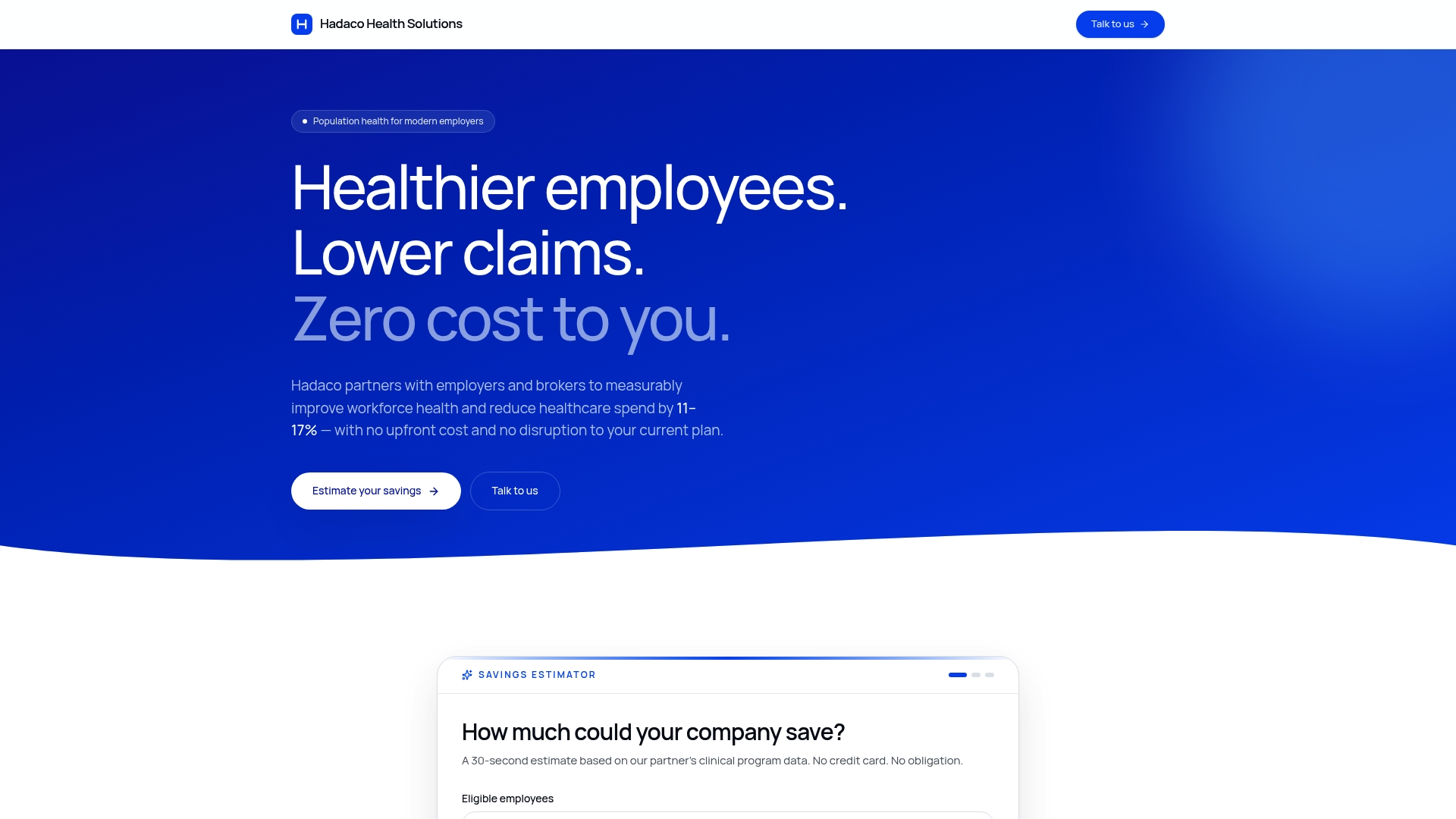
See what a structured wellness program can do for your workforce
Workplace wellness challenges work best when they sit inside a broader health strategy, not as standalone events. Hadaco builds evidence-based population health programs that address chronic disease, preventive care, mental health, and employee engagement, all integrated with your existing benefit plans and with no upfront fees.
The average first-year savings of $451 per employee comes from a model built on quarterly reporting, a transparent savings estimator, and programs that actually change health behaviors rather than just checking a compliance box. If you want to see what that looks like for your specific workforce size and claims profile, explore Hadaco's approach and run the numbers yourself.