
The ADA applies to a wellness program only when the program asks disability-related questions or requires a medical exam, such as a biometric screening or a health risk assessment with medical content. Once that trigger is met, the program must be voluntary, reasonably designed to promote health, backed by clear notice, and paired with accommodations for employees who can't meet the standard as written. GINA and HIPAA layer on additional rules, and incentive limits remain legally unsettled since 2019.
TL;DR:
- Employers must ensure wellness programs asking disability-related questions or involving medical exams are voluntary and accompanied by clear notice of data use and confidentiality measures.
- Incentives must be modest, justified, and documented, as no current federal cap exists following legal challenges to 2016 rules.
- Reasonable accommodations require pre-built templates for alternative standards, like modified activity plans or documentation, to be in place before program launch.
- Wearables and biometric data collection devices can trigger ADA restrictions; vendor contracts must enforce data minimization, purpose limitation, and breach notification.
- HR teams should classify activities against legal frameworks, document decisions, and include legal, benefits, and IT input before implementing or updating wellness programs.
Table of Contents
- When Does the ADA Cover Wellness Programs?
- Voluntariness, Incentives, and a Regulatory Timeline Still in Flux
- What Reasonable Accommodations Look Like in Practice
- Data, Wearables, and Vendor Risk You Can't Ignore
- A Practical Compliance Checklist for HR Teams
- How Employers Meet Outcomes Without Tripping ADA Wires
- What HR and Legal Teams Should Prioritize Right Now
- A Compliant Path to Measurable Savings
- Where to Read the Primary Sources
- Sources
When Does the ADA Cover Wellness Programs?
The ADA restricts two specific things: disability-related inquiries and medical examinations. A disability-related inquiry is any question likely to reveal a disability, like asking about current medical conditions or medications on a health questionnaire. A medical examination is a procedure that produces information about physical or mental health, like a blood draw or a body composition scan.
Once either shows up, the ADA governs the program. That's true whether the tool is a paper form or an app. Legal analysis of how the ADA interacts with employer wellness programs confirms that activities without those elements generally fall outside ADA restrictions, though they still need to be accessible to employees with disabilities.
Programs that typically trigger ADA scrutiny:
- Health risk assessments that ask about diagnoses, medications, or symptoms
- Biometric screenings measuring blood pressure, cholesterol, glucose, or BMI
- Blood draws or lab panels administered as part of the program
- Continuous glucose monitors or other devices that capture medical readings
Programs that usually don't:
- Generic nutrition or stress-management education with no personal health data collected
- Voluntary step challenges or fitness classes that track activity, not medical status
- Gym membership discounts offered without a health questionnaire attached
That line matters because employers often assume "wellness" is a single legal category, but programs offering employee satisfaction snack amenities usually do not trigger ADA concerns. It isn't. A step challenge and a biometric screening can sit in the same benefits packet and answer to completely different rules.
Voluntariness, Incentives, and a Regulatory Timeline Still in Flux
The EEOC's final rules on employer wellness programs set four voluntariness requirements a program must meet before it can ask disability-related questions:
- The employer can't deny access to group health plan benefits for declining to participate.
- The employer can't take adverse employment action against an employee who opts out.
- The employer must give notice about what health information is collected, how it's used, and how confidentiality is maintained.
- The program must be reasonably designed to promote health or prevent disease, not just to shift costs.
Here's where it gets messy. The 2016 rule tied to those requirements set specific incentive caps, but the Federal Register's 2016 rule text was challenged in AARP v. EEOC, and a court vacated the incentive provisions. No replacement incentive limit has taken effect since 2019, leaving employers to guess at defensible thresholds.
Practical takeaway: since no hard number exists, document why your incentive level is reasonable, keep it modest relative to total compensation, and pair it with a strong reasonable-design rationale. Litigation over incentive size almost always turns on documentation, not the raw dollar figure.
What Reasonable Accommodations Look Like in Practice
Employees who can't meet a program's standard because of a disability are entitled to a reasonable accommodation, usually delivered as an alternative standard. This isn't optional generosity. It's a baseline ADA obligation tied to the ACA's own wellness accessibility guidance, which treats wellness incentives as fringe benefits subject to accommodation rules just like any other perk.
Common alternatives include:
- A walking log or adapted activity plan instead of a step-count target
- A doctor's verification form instead of a biometric threshold
- Written or audio-format materials for employees using assistive technology
- A modified timeline for employees managing a chronic condition flare-up
Pro Tip: Build your alternative-standard templates into the wellness policy before launch, not after the first accommodation request lands on your desk. Pre-built templates for mobility limitations, sensory needs, and biometric exceptions cut response time from weeks to days.
Undue hardship analysis only applies in rare cases, usually when an alternative would require a fundamental redesign of the program's core health goal.
Data, Wearables, and Vendor Risk You Can't Ignore
Fitness trackers, CGMs, and biometric apps have quietly become the biggest ADA exposure point in modern wellness programs. The EEOC's guidance on wearable technologies warns that a device collecting heart rate variability, glucose readings, or sleep-disorder data can amount to a medical examination, triggering the same voluntariness and confidentiality rules as a clinical screening.
Vendor contracts need to lock down:
- Data minimization: collect only what the program design requires
- Purpose limitation: no repurposing health data for underwriting or performance reviews
- Access controls limiting who inside HR or the vendor can see raw results
- Breach notification obligations spelled out with specific timelines
- Storage separate from personnel files, meeting the same standard HIPAA applies to group health plan data
Run an IT security review before signing, not after a breach.
A Practical Compliance Checklist for HR Teams
Before launch, classify every wellness activity against the ADA/GINA/HIPAA framework and inventory exactly what data each one collects, including through your health risk assessment questions.
- Map each activity: does it ask disability-related questions or require a medical exam?
- Draft notice language covering data collected, use, and confidentiality protections.
- Write the reasonable-design rationale in plain language tied to a health outcome.
- Set incentive levels with a documented justification, not a round number picked for simplicity.
- Build alternative-standard templates for common accommodation scenarios.
- Vet vendor contracts for data minimization and breach terms.
- Separate wellness medical records from personnel files, in storage and access.
- Schedule an annual audit tied to plan renewal or vendor contract review.
| Compliance area | What to check | Owner |
|---|---|---|
| Voluntariness | No benefit denial, no adverse action, notice given | HR + legal |
| Reasonable design | Program ties to a documented health goal | HR |
| Incentives | Rationale documented, modest relative to pay | HR + finance |
| Accommodations | Alternative standards pre-built and communicated | HR |
| Data handling | Vendor contract meets minimization and separation standards | IT + legal |
How Employers Meet Outcomes Without Tripping ADA Wires
Compliance and results aren't opposing goals. Hadaco builds population health programs that complement existing benefit plans rather than replacing them, using evidence-based interventions for chronic disease and preventive care with no upfront fees. Employers have reported average savings per employee in the first year, alongside stronger engagement.
That kind of outcome depends on the same discipline this article covers: alternative standards built into program design, confidentiality maintained around health data, and quarterly reporting that documents why the program is reasonably designed, not just that it exists.
What HR and Legal Teams Should Prioritize Right Now
Document every voluntariness and reasonable-design decision as you make it, not months later when a complaint arrives. Inclusive design isn't a compliance afterthought. Telewellness research shows accommodations for functional limitations genuinely improve outcomes, not just optics. Loop in benefits, IT, and legal before you adopt a new wearable or incentive structure, not after.
— Gene
A Compliant Path to Measurable Savings
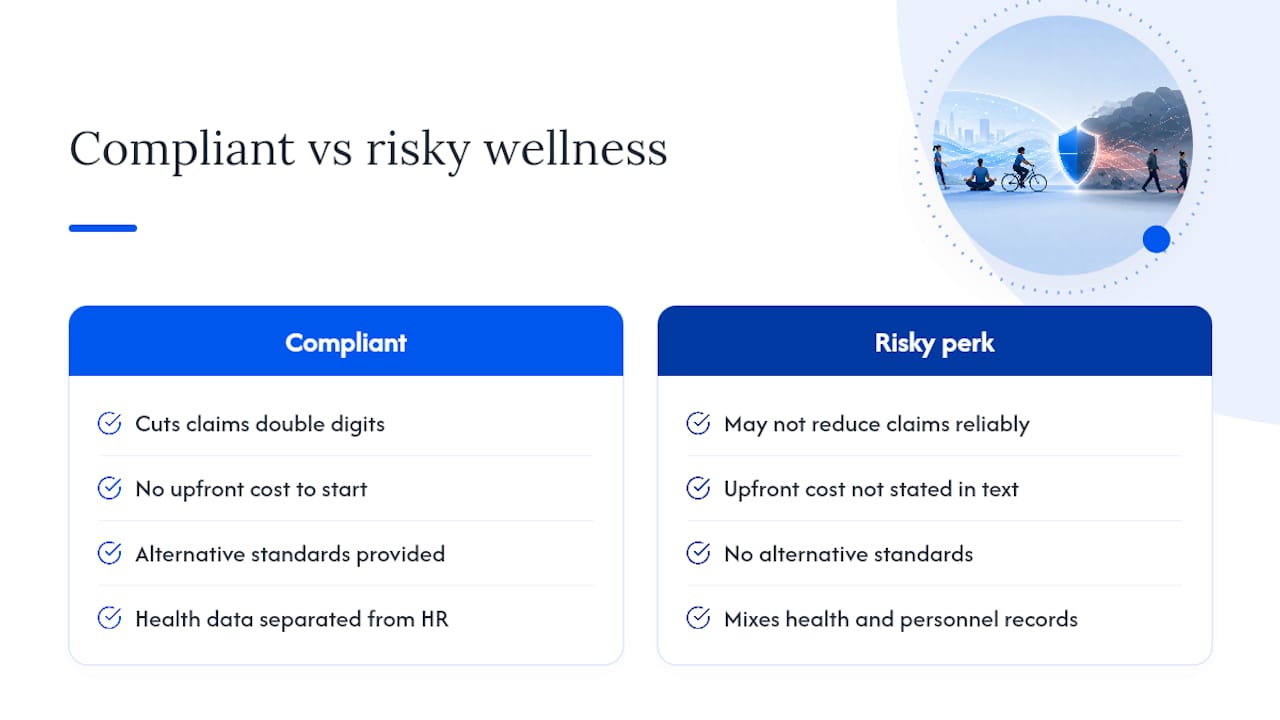
Employers have access to programs designed to cut healthcare claim costs by double digits without disrupting the benefit plans already in place, and without paying anything upfront to get started.
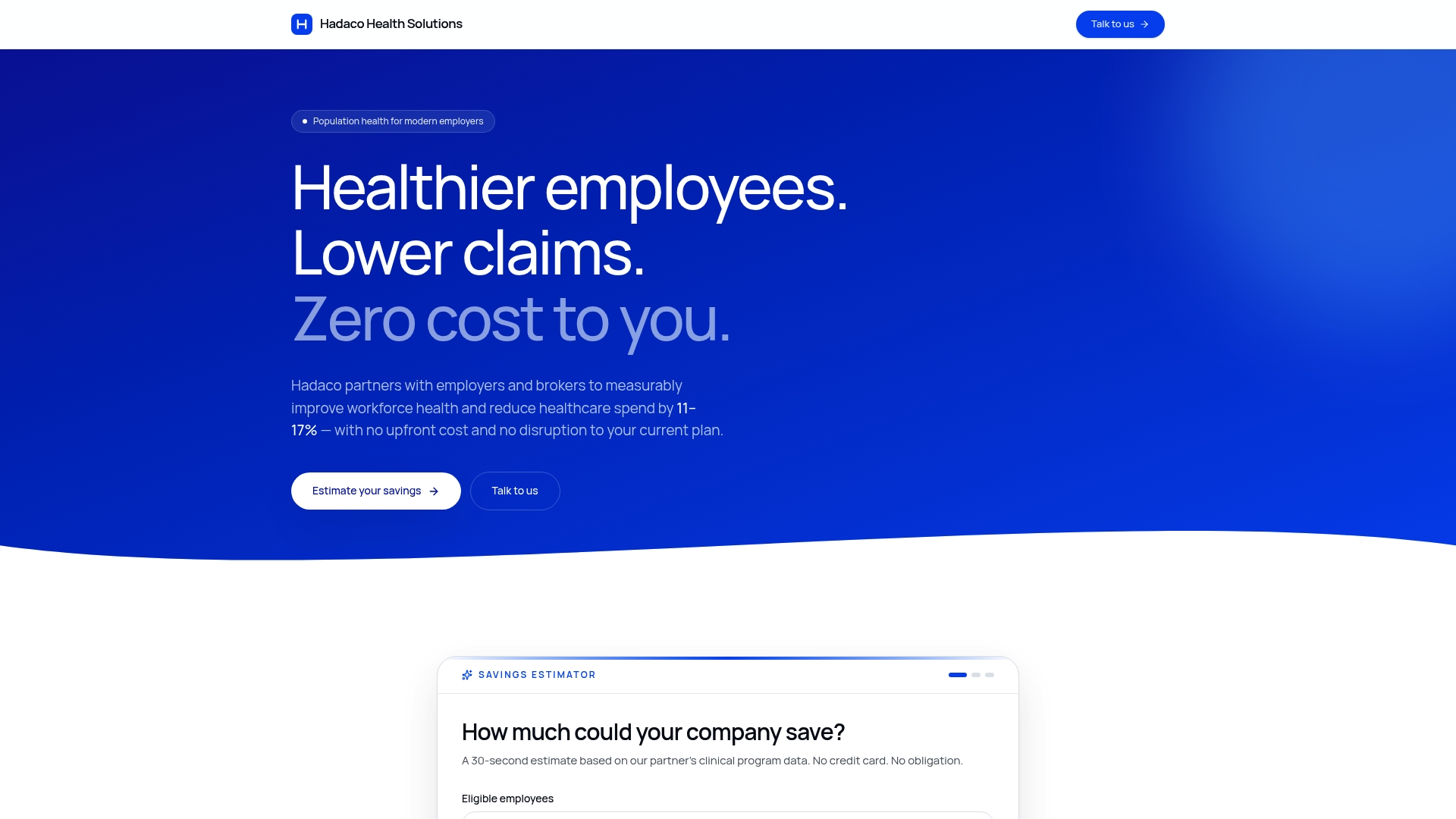
Program design incorporates safeguards such as alternative standards for employees who can't meet a specific metric, strict separation of health data from personnel records, and quarterly reporting that documents outcomes instead of just promising them. That's the difference between a wellness perk that invites an ADA complaint and one that survives an audit while still moving the needle on claims.
If you're evaluating your current program or building one from scratch, request a savings estimate from Hadaco and see what a compliant, evidence-based approach could save your organization in year one.
Where to Read the Primary Sources
Start with the EEOC's fact sheet for enforcement positions and the Federal Register rule text for the legal baseline.
Sources
- EEOC Issues Final Rules on Employer Wellness Programs
- Regulations Under the Americans With Disabilities Act (Federal Register)
- MENTOR 2.0 evaluation: telewellness program for people with physical disabilities (CDC)