
TL;DR:
- Integrated continuous-listening platforms linking engagement data with HRIS and claims information enable targeted interventions that reduce healthcare costs. They help identify burnout and support gaps within specific employee cohorts, driving proactive mental health, chronic disease management, and retention strategies. Using automation and manager action workflows, these tools translate survey insights into measurable health outcomes and ROI.
For employers focused on cutting healthcare costs, the right choice is an integrated continuous-listening platform that connects directly to your HRIS and benefits or claims data. That linkage is what turns survey scores into targeted interventions and measurable savings.
Your shortlist by use case:
- Enterprise continuous-listening suites — best when you need deep HRIS integration, benefits/claims data sync, and executive-level ROI dashboards
- Manager-action-first platforms — best when manager accountability and closed-loop workflows are the primary gap
- Lightweight pulse tools — best for faster deployment and quick signal capture, especially in smaller populations
The logic is straightforward: platforms that filter engagement scores by department, tenure, or role can pinpoint where burnout or low manager support is concentrated. Those are the same populations driving disproportionate healthcare utilization. Fix the hotspot, and the claims data follows.
Table of Contents
- Which employee engagement platform category fits your health-focused goals?
- How continuous listening actually drives down healthcare costs
- How to choose the right engagement vendor for health outcomes
- A practical implementation timeline for integrated programs
- What HR and legal need to know about data privacy and HIPAA
- How to measure the ROI of engagement programs on healthcare costs
- Common mistakes that kill engagement program results
- Platform shortlist: Qualtrics, Culture Amp, Lattice, and 15Five
- Key Takeaways
- Why the engagement-to-health connection is still underused
- Hadaco pairs with your engagement platform to deliver measurable savings
- Useful sources and further reading
Which employee engagement platform category fits your health-focused goals?
| Category | Best for | Continuous listening & triggers | Action-planning workflows | HRIS + benefits/claims integration | Segmentation (tenure/dept/level) | Benchmarking & ROI reporting | HIPAA readiness | Pricing model |
|---|---|---|---|---|---|---|---|---|
| Enterprise continuous-listening suites | Mid-to-large employers, complex benefit structures | Automated event triggers (90-day, post-promotion, return-from-leave) | Manager dashboards, AI-assisted recommendations | Deep HRIS sync + benefits/claims API | Full multi-variable filtering | Industry benchmarks, validated question banks | Typically available; confirm BAA | Seat-based or tiered annual |
| Manager-action-first platforms | Employers with manager accountability gaps | Pulse + annual cadence, some event triggers | Built-in goal-setting, progress tracking, 1:1 integration | HRIS sync; benefits integration varies | Department and level | Performance-linked benchmarks | Varies; ask explicitly | Seat-based, per-manager tiers |
| Lightweight pulse tools | Smaller employers, fast time-to-value | High-frequency pulse, limited event triggers | Basic action suggestions; limited closed-loop | Basic HRIS; limited benefits data | Department and team | Peer benchmarks | Limited; verify before signing | Per-employee-per-month |
When to pick each:
- Enterprise suites fit employers running population-health programs who need claims data alongside engagement scores to prove ROI to a CFO.
- Manager-action-first platforms work when your biggest problem is managers not acting on feedback, not the feedback collection itself.
- Lightweight pulse tools get you listening fast, but plan for an upgrade path once you need benefits data integration.
How continuous listening actually drives down healthcare costs
The mechanism is specific: pulse survey software that filters by tenure, department, or level surfaces concentrated burnout or support gaps that correlate with higher healthcare utilization. That segmentation is what separates a useful engagement program from a morale exercise.
Several pathways connect engagement data to lower claims:
- Early mental health intervention — elevated stress signals in a department trigger outreach to a mental health program before a crisis claim occurs; mental health platforms tied to engagement data can route employees proactively
- Chronic disease outreach — low well-being scores in a cohort flag candidates for preventive care programs, reducing high-cost ER visits
- Presenteeism reduction — employees who report low manager support show higher presenteeism rates, which drives pharmacy and specialist costs upward
- Retention improvement — disengaged employees leave at higher rates, and turnover carries direct healthcare cost spikes from onboarding and coverage gaps
Platforms that automate event-triggered surveys — at 90 days, post-promotion, or return-from-leave — catch morale gaps before they become clinical ones. The key is automation and consistency, not survey frequency alone.
Manager Assist features that translate survey signals into prioritized, contextual actions give managers a clear path from data to change without waiting on HR. That speed matters: a manager who acts within two weeks of a signal produces measurably better outcomes than one who waits for a quarterly review.

How to choose the right engagement vendor for health outcomes
Must-have capabilities checklist
- Native HRIS integration with your current system (no manual CSV exports)
- Benefits or claims data sync, or a documented API for your TPA or carrier
- Automated event triggers: 90-day, post-promotion, return-from-leave, and exit
- Technically enforced anonymity — PII stripping before storage, not just a policy promise
- Manager action-planning dashboards with progress tracking
- Validated question libraries and industry benchmarks for peer comparison
- Role-based access controls and documented SOC 2 Type II certification
- HIPAA Business Associate Agreement (BAA) availability
Demo questions to ask every vendor
| Question | What you're testing |
|---|---|
| "Show me how a 90-day trigger fires and routes to a manager." | Automation depth and manager workflow |
| "How does your platform connect to our HRIS without a manual export?" | Integration maturity |
| "Can we filter results by tenure and department simultaneously?" | Segmentation capability |
| "What does your BAA cover, and who signs it?" | HIPAA readiness |
| "Show us a pre/post utilization report from a comparable client." | ROI measurement capability |
| "What happens to our data if we cancel?" | Data portability and deletion rights |
Pricing red flags
Watch for per-survey fees layered on top of seat costs, implementation fees that exceed one month's license, and contracts that lock data in proprietary formats. Vendors that integrate with HRIS and payroll data typically offer faster time-to-insight, which lowers the real total cost of ownership even when the license price looks higher.
Red flags to walk away from: survey-only tools with no manager workflows, vague "enterprise-grade security" language without a named certification, no API documentation, and no documented BAA process.
A practical implementation timeline for integrated programs
- Discovery (weeks 1–2): Map current HRIS fields, benefits data sources, and existing survey tools. Assign an HR lead, IT contact, benefits team liaison, and vendor CSM.
- Integration and data mapping (weeks 3–5): Connect HRIS, configure segmentation filters, and test benefits/claims data sync. IT owns the API work; vendor CSM owns the configuration.
- Pilot (weeks 6–9): Launch with one department or location. Target a 70% response rate as the go/no-go threshold for full rollout.
- Manager training and action-planning launch (weeks 10–12): Train managers on dashboards and action-plan workflows. Measure action-plan completion rate; 60% within 30 days of survey close is a healthy baseline.
- Scale and optimize (month 4 onward): Roll out automated triggers, connect wellness program ROI tracking, and schedule quarterly executive reporting.
Responsibility matrix: HR owns survey design and communications; IT owns integrations; benefits team owns claims data mapping; managers own action-plan execution; vendor CSM owns configuration and training support.
Pro Tip: Embed survey links directly in Slack or Microsoft Teams rather than sending standalone emails. Platforms integrated into daily collaboration tools consistently produce higher response rates and more accurate signals than portal-based surveys.
What HR and legal need to know about data privacy and HIPAA
Engagement data can cross into protected health information (PHI) territory when it captures health-related signals — stress levels, leave reasons, or well-being scores tied to identifiable employees. That triggers HIPAA obligations and requires explicit contract controls.
The practical rule: if your engagement platform receives data that could identify an employee's health status or condition, treat it as PHI. Request a Business Associate Agreement before any data flows, and confirm the vendor's architecture strips PII before storage rather than relying on access controls alone.
Security certifications and controls to require:
- SOC 2 Type II audit report (request the full report, not a summary)
- ISO 27001 certification for vendors handling international employee data
- Zero-knowledge or PII-stripped anonymity architecture
- Encryption at rest (AES-256) and in transit (TLS 1.2+)
- Role-based access controls with audit logging
Contract clauses to insist on:
- Data-use limitations: vendor may not use your employee data for product training or benchmarking without explicit consent
- Breach notification within 72 hours
- Data deletion within 30 days of contract termination, with export in a portable format
- Named subprocessors listed and subject to the same obligations
How to measure the ROI of engagement programs on healthcare costs
Start with a baseline claims analysis before any intervention. Identify your highest-utilization cohorts using HRIS filters — department, tenure band, and role level — then map those cohorts against engagement scores. The overlap is your intervention target.
| Engagement signal | Health outcome to watch | KPIs for vendor contracts |
|---|---|---|
| Low manager support score | Elevated stress claims, EAP utilization | EAP referral rate, mental health claim frequency |
| High burnout index | ER visits, musculoskeletal claims | ER visit rate |
| Low well-being score | Preventable chronic condition costs | Preventable admission rate, pharmacy spend |
| High intent-to-leave score | Turnover-related coverage gaps | Turnover rate, COBRA enrollment |
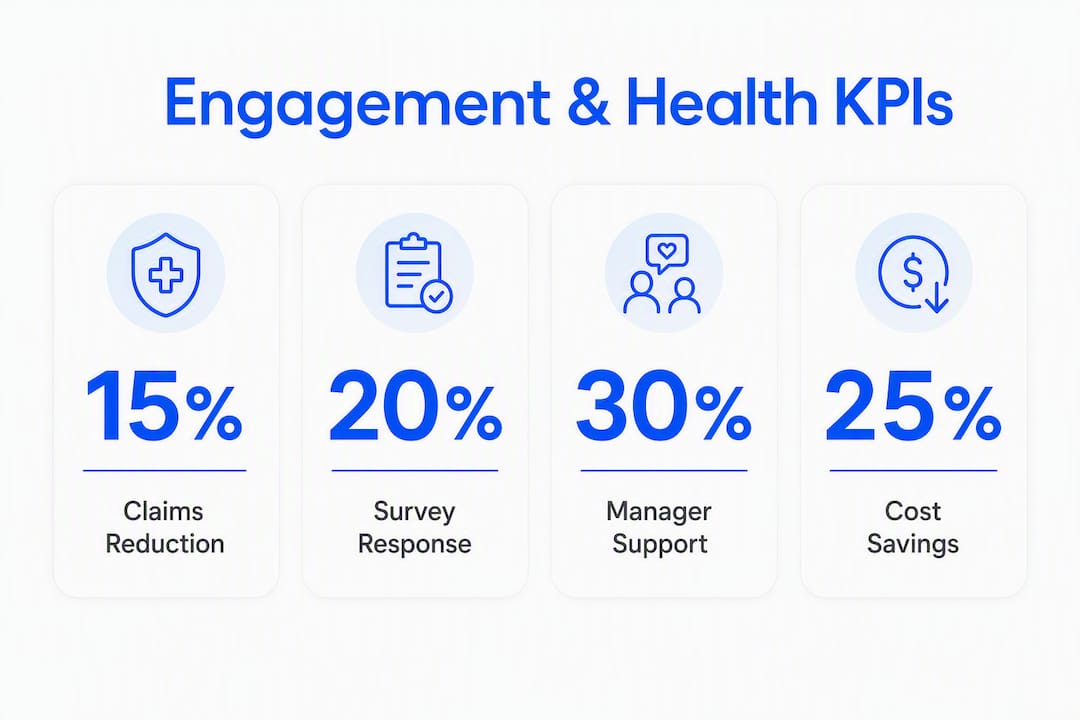
For executive reporting, structure your quarterly review around three numbers: engagement score change, claims cost per employee (pre vs. post), and action-plan completion rate. Vendors who can't produce a pre/post utilization comparison tied to a specific cohort are not ready for a health-outcomes contract.
Health risk assessment data layered on top of engagement scores sharpens cohort identification considerably. The combination of self-reported well-being and clinical risk flags is more predictive than either alone.
Common mistakes that kill engagement program results
| Mistake | Fix |
|---|---|
| Surveys run once a year with no follow-up | Automate pulse surveys on a monthly or quarterly cadence with event triggers |
| No manager accountability for results | Require action-plan completion rates in manager performance reviews |
| Feedback tool buried in an HR portal | Embed surveys in Slack or Teams for in-flow participation |
| Anonymity promised but not enforced technically | Require PII-stripped architecture, not policy-only anonymity |
| ROI reported as engagement scores only | Connect claims data to show cost impact, not just sentiment |
Pro Tip: Close the loop visibly. When employees see that their feedback changed something specific — a manager behavior, a benefit offering, a scheduling policy — participation rates on the next survey climb. Publish a "You said, we did" summary within 30 days of every survey close.
Treating surveys as a one-off exercise is the single most common failure mode. Data without automated action planning rarely drives change, and employees who see no response stop participating within two cycles.
Platform shortlist: Qualtrics, Culture Amp, Lattice, and 15Five
Qualtrics is the strongest choice for employers who need enterprise-grade analytics and a direct path to ROI reporting. Its pulse survey capabilities include validated question banks, industry benchmarks, and Manager Assist features that push prioritized actions to managers automatically. The platform's segmentation depth — filtering by tenure, department, level, and compensation — makes cohort-based claims analysis feasible. It's the most complex to implement, and pricing reflects that.
Culture Amp leads on manager-facing workflows and culture analytics. Its engagement platform includes pre-built communication templates and integrations with Slack and Microsoft Teams, which raises participation without extra HR effort. It's particularly strong for mid-sized employers who want fast time-to-insight and a platform their managers will actually use.
Lattice combines engagement, performance, and goals in one platform, which matters when you want manager accountability tied directly to engagement outcomes. Its engagement module surfaces AI-powered insights and connects survey results to performance data, giving HR a fuller picture of where disengagement is affecting output and health simultaneously.
15Five is the lightest of the four and the fastest to deploy. It's built around weekly check-ins and manager-employee dialogue rather than large-scale survey programs. For employers who want to close the manager accountability gap quickly, it's a practical starting point — though its benefits/claims integration capabilities are limited compared to Qualtrics or Culture Amp.
Key Takeaways
Integrated continuous-listening platforms that connect engagement data to HRIS and benefits/claims information are the most direct path to measurable healthcare cost reduction for employers.
| Point | Details |
|---|---|
| Integration is the differentiator | Platforms with native HRIS and benefits/claims sync let you filter by cohort and prove ROI without manual exports. |
| Automate triggers, not just surveys | Event-based triggers (90-day, post-promotion, return-from-leave) catch morale gaps before they become clinical claims. |
| Manager workflows drive outcomes | Platforms with built-in action-planning dashboards produce faster, measurable improvements than data-only tools. |
| Privacy controls must be technical | Require PII-stripped anonymity architecture and a signed BAA before any health-related data flows to a vendor. |
| Hadaco complements your platform | Hadaco's population-health programs integrate with existing benefits and generate measurable first-year savings with no upfront fees. |
Why the engagement-to-health connection is still underused
Most HR teams buying engagement platforms are still measuring success by survey response rates and eNPS scores. That's a missed opportunity. The real value of continuous listening isn't the score — it's the cohort map it creates. When you can see that a specific department has low manager support scores and above-average ER utilization, you have an intervention target, not just a talking point for a leadership offsite.
The platforms covered here all have the technical capability to make that connection. What most employers lack is the population-health layer that converts the engagement signal into a clinical program. That's the gap worth closing in 2026.
Hadaco pairs with your engagement platform to deliver measurable savings
Engagement platforms surface the signals. Hadaco acts on them. Hadaco's performance-based population-health programs integrate directly with your existing benefits plan — no disruption, no upfront fees — and target the chronic disease, preventive care, and mental health gaps that engagement data identifies. Employers achieve notable per-employee first-year healthcare savings, with quarterly reporting that ties outcomes to specific interventions.
If your engagement platform is already telling you where the health risk is concentrated, Hadaco is the program that converts that signal into a claims reduction. Request a savings estimate to see what your population's data projects, or book a consultation to walk through how Hadaco integrates with your current benefits structure.
Useful sources and further reading
- Employee Pulse Survey Software — Qualtrics
- Employee Survey Tools for Engagement and Satisfaction — Rippling
- Employee Engagement Software — Quantum Workplace
- Employee Experience and Engagement — Microsoft Viva
- Hadaco Health Solutions — Healthier employees, lower claims
- How Wellness Programs Reduce Employee Healthcare Costs — Hadaco
- Employee Health Risk Assessment: A Guide for HR Teams — Hadaco
- Best Mental Health Platforms for Employers: ROI Guide — Hadaco