
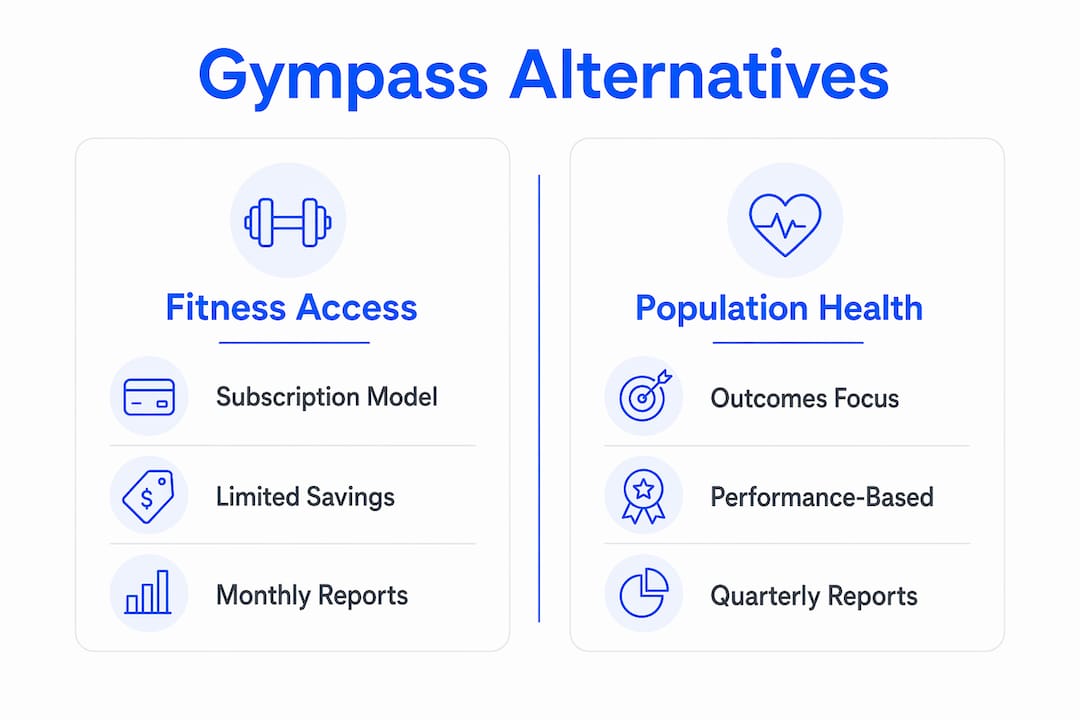
If you're evaluating Gympass alternatives, the clearest recommendation is an evidence-based population health program. Gym-access aggregators deliver perks; population health programs deliver measurable claims reduction, clinical integration, and quarterly reporting tied to real outcomes. Hadaco is the recommended option for employers who need to show finance a defensible ROI.
What employers should expect from the right alternative:
- Measurable claims reduction with pre/post cohort data, no upfront fees, and performance-based pricing
- Quarterly reporting on utilization, engagement among high-risk employees, and dollar savings per member
A fitness-access aggregator still makes sense in one narrow scenario: small, localized teams with a strong in-person studio culture where gym access is a genuine recruitment differentiator and claims management is not the primary goal.
Table of Contents
- How do the main Gympass alternatives compare?
- Why employers are moving past gym-access perks
- What questions should HR ask when vetting alternatives?
- Which metrics actually prove a program is working?
- How do you run a pilot and what does it cost?
- Key Takeaways
- The gap between wellness theater and actual claims reduction
- Hadaco delivers what gym aggregators can't measure
- Useful sources
How do the main Gympass alternatives compare?
The market for employee wellness has fragmented into several distinct categories. Each solves a different problem. The table below uses neutral category labels so you can match your objectives to the right type of vendor.

| Category | Delivery focus | Pricing model | Evidence of savings | Reporting cadence | Sustained engagement | Best fit |
|---|---|---|---|---|---|---|
| Fitness-access aggregator | Gym/studio network access | PEPM (all employees) | Weak; activity-based only | Sporadic or none | Low for high-risk cohorts | Small teams, studio-culture employers |
| Population health vendor | Chronic disease, preventive care, mental health | Performance-based or PEPM on active users | Strong; claims-based cohort data | Quarterly minimum | High when risk-stratified | Risk-bearing employers, mid-to-large |
| Digital therapeutics | Condition-specific (diabetes, MSK, mental health) | Per-program or PEPM | Moderate to strong; clinical markers | Monthly or quarterly | Moderate; condition-dependent | Employers with high chronic-condition burden |
| Integrated clinical program | Full clinical + benefits integration | Shared savings or PEPM | Strong; direct claims linkage | Quarterly | High with clinical touchpoints | Self-insured enterprise employers |
| EAP / care navigation | Mental health, care coordination | PEPM flat | Limited; utilization-based | Annual or ad hoc | Variable | All sizes; mental health focus |
Corporate wellness programs that go beyond gym access are now the baseline expectation for employers managing healthcare spend. The sheer number of vendors in this space, documented across dozens of aggregator-style platforms, makes a disciplined evaluation process non-negotiable.
Why employers are moving past gym-access perks
Fitness-access aggregators rarely produce sustained claims reduction on their own. The structural problem is who actually uses them. Industry analysis consistently shows that gym-access benefits skew toward employees who are already healthy, leaving the high-risk, high-cost cohort largely untouched.
That engagement skew has a direct financial consequence. PEPM pricing models charge for every enrolled employee, not just active users. When a significant portion of your workforce never logs in, you're paying for a benefit that delivers zero clinical value to the people driving your claims. The pricing pressure these aggregators place on boutique studios compounds the problem: a "race to the bottom" on per-session payouts erodes the provider network quality over time.
The harder conversation is with finance. Gym-access programs generate activity data, not outcomes data. When a CFO asks what the wellness spend returned in reduced claims, an aggregator cannot answer that question. Population health vendors can, and that difference is what's driving the category shift.
What questions should HR ask when vetting alternatives?
Start with outcomes, not features. Before any demo, require evidence of claims-based results from a comparable employer population.
Outcome-first criteria to validate:
- Claims reduction data: ask for pre/post or matched-cohort results, not testimonials
- Active-user definition: get the exact formula and historical active-user percentages (this materially affects your cost model)
- Reporting cadence: quarterly reporting is the minimum acceptable standard
- Integration scope: HRIS, SSO, claims data feed, and any EHR or clinical partner connectors
- Compliance: SOC 2 Type II and HIPAA attestation, written data-sharing agreements
- Pilot design: defined success gates, pre-launch baseline data collection, and a minimum 90-day engagement window before evaluation
12 questions to ask in the RFP or demo:
- What is your definition of an "active user," and what percentage of enrolled employees met that threshold in your last three client cohorts?
- Can you share claims-reduction results from a client with a similar size and industry?
- What is the typical payback timeline from pilot launch to measurable savings?
- How do you identify and engage high-risk employees who would not self-select into a wellness program?
- What clinical partners or digital therapeutics are embedded in the program?
- How do you handle employees in rural or remote locations with no local provider access?
- What does your quarterly report include, and who owns the data at contract end?
- Are any fees contingent on demonstrated savings, or is the full fee fixed?
- How do you protect boutique or local providers in your network from pricing pressure?
- What does your pilot look like, and what are the defined success gates before we scale?
- How do you integrate with our existing benefits stack and claims administrator?
- What third-party validation or peer-reviewed evidence supports your outcomes claims?
Red flags: opaque pricing that bundles inactive users into the active-user count; no third-party validation; pilots with no pre-defined success gates; revenue models that squeeze local providers.
Pro Tip: Require a contract clause that ties at least a portion of vendor fees to demonstrated savings within a defined measurement window. Any vendor unwilling to accept performance-based terms is signaling low confidence in their own outcomes data.
Which metrics actually prove a program is working?
The only evidence that moves a finance committee is claims-based data. Activity metrics (steps logged, sessions attended) are leading indicators at best. Here is the priority evidence stack to request from any vendor:
- Per-member-per-year (PMPY) claims change: the core metric; requires a pre-period baseline and a matched or controlled comparison group
- Dollar savings per employee: a single number that translates directly into budget justification; Hadaco reports an average of $451 saved per employee in the first year
- Engagement rate among high-risk cohorts: overall participation rates are misleading; insist on segmented data for the employees who actually drive claims
- Condition-specific clinical markers: A1c reduction for diabetes management, blood pressure control for hypertension, PHQ-9 scores for mental health programs
- Retention and turnover effects: secondary but increasingly requested by HR leadership
Acceptable study designs include quasi-experimental pre/post analysis, matched cohorts, and third-party evaluations. Health risk assessments at enrollment establish the baseline you need for any of these designs to be credible. Quarterly reporting is the minimum cadence; anything less frequent makes it impossible to course-correct during a pilot.
Average savings per employee in year one is $451, the figure Hadaco uses as a planning benchmark. For a 500-person employer, that projects to $225,500 in first-year claims offset.
How do you run a pilot and what does it cost?
Pilot timeline (numbered sequence):
- Weeks 1–4: Baseline data collection. Pull 12–24 months of claims history, complete health risk assessments, and define high-risk cohort segments.
- Weeks 5–8: Integration and launch. Connect HRIS, SSO, and claims feed; confirm data-sharing agreements; train HR and manager sponsors.
- Months 3–6: Engagement window. Track active-user rates, clinical conversion (how many high-risk employees engage with clinical programs), and early utilization signals.
- Months 6–12: Claims evaluation. Compare cohort claims to baseline; assess condition-specific markers; generate first formal outcomes report.
- Month 12+: Scale or renegotiate. Use pilot data to build the finance case and set performance gates for the full contract.
Comprehensive cost breakdown:
| Cost component | Typical range | Notes |
|---|---|---|
| Implementation / onboarding | — | Hadaco charges no upfront fees |
| Per-active-user fee | Varies by vendor | Clarify "active" definition before signing |
| Platform / admin fee | Varies by vendor | Often bundled; ask for line-item breakdown |
| Incentives and rewards budget | Employer-set | Target high-risk cohorts for best ROI |
| Analytics and reporting | Often included | Confirm quarterly cadence in contract |
| Potential savings offset | a benchmark savings per employee | Offsets net program cost in year one |
Workplace wellness challenges and manager sponsorship programs are low-cost engagement levers that consistently improve participation among employees who would not self-enroll. Build both into the rollout communications plan from day one.
Key Takeaways
Evidence-based population health programs outperform gym-access aggregators on every metric that matters to employers: claims reduction, engagement among high-risk employees, and defensible ROI.
| Point | Details |
|---|---|
| Claims data is non-negotiable | Require pre/post or matched-cohort claims evidence before signing any vendor contract. |
| Active-user definition drives cost | Get the exact formula and historical percentages; this single variable determines your true program cost. |
| Quarterly reporting is the floor | Any vendor offering only annual reporting cannot support mid-course corrections or finance-committee accountability. |
| Pilot before you scale | A minimum 90-day pilot with pre-defined success gates protects budget and generates the data needed for a full rollout decision. |
| Hadaco benchmark | Hadaco reports average savings of $451 per employee in year one, with no upfront fees and quarterly outcomes reporting. |
The gap between wellness theater and actual claims reduction
Most wellness program procurement mistakes share a common root: HR bought engagement and called it outcomes. A program can hit 60% participation and still show zero movement in claims if the engaged employees were never the ones driving costs. That is not a vendor failure. It is a measurement failure, and it starts at the RFP stage.
The fix is straightforward but uncomfortable: require cohort-level claims data segmented by risk tier before you sign. One employer I'm aware of ran a well-designed pilot that hit every engagement target, then found at the 12-month mark that high-risk employees had barely touched the clinical modules. The program was redesigned around targeted outreach to that cohort specifically, with incentives structured to reward clinical engagement rather than general participation. Claims moved in year two.
Aligning HR, benefits, and finance around a performance-based vendor is the structural change that makes this work. Finance needs a number: $451 per employee is a starting point, not a guarantee. HR needs a reporting cadence. Benefits needs integration that doesn't break existing plan design. A vendor who can satisfy all three simultaneously is rare. That's exactly the standard worth holding out for.
Hadaco delivers what gym aggregators can't measure
Employers who have spent years paying for fitness perks that never showed up in their claims data need a different kind of partner. Hadaco's population health programs integrate directly with your existing benefits plan, target chronic disease and preventive care with clinical-grade interventions, and charge no upfront fees. The average first-year savings of $451 per employee gives finance a concrete planning figure, and quarterly reporting keeps every stakeholder accountable throughout the year.
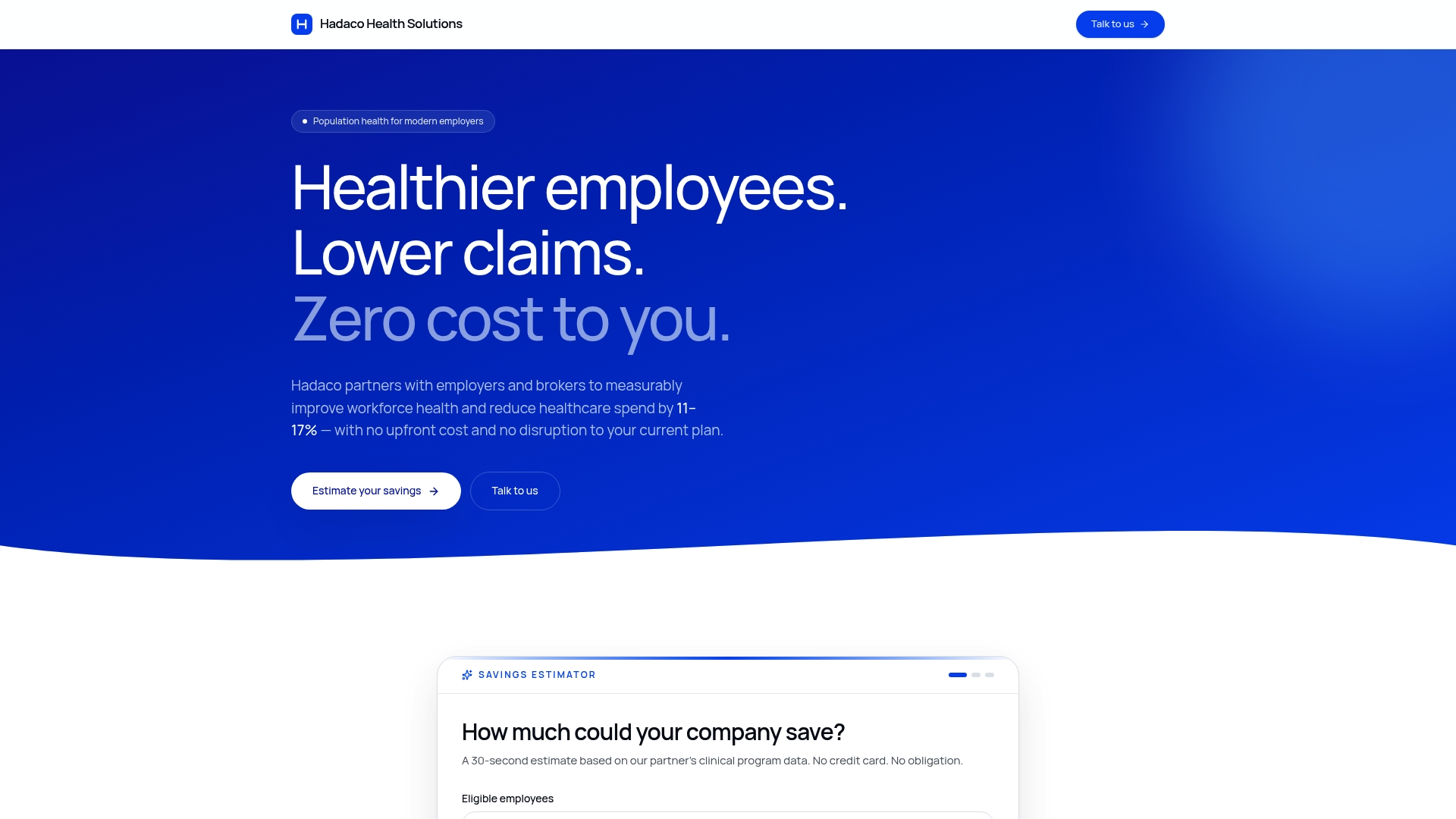
The savings estimator on Hadaco's site lets you model projected ROI for your specific workforce before any commitment. Schedule a consultation at hadaco.com to see a customized projection and review how the pilot process works for your organization.
Useful sources
- Employee wellness market shift and aggregator limitations — supports product comparison and the engagement-skew argument
- Studio sustainability and pricing integrity — red-flag discussion and provider-network quality
- Hadaco outcomes and savings benchmark — $451 per employee figure, no-upfront-fees model, quarterly reporting standard
- Hadaco ROI methodology — claims-based evidence framework
- Vendor landscape breadth — rationale for a disciplined checklist
- Clinical integration alternatives — partner analysis of software combining clinical workflows with employee health