
Yes, employers should invest in financial wellness programs for employees — specifically when those programs are integrated with population health management and measured against claims and utilization data. The evidence is clear: workplace financial education participants rate their financial knowledge highly at 85% versus 63% for non-participants, according to EBRI's 2025 analysis. PwC's 2026 workforce survey confirms financial stress is actively undermining productivity and long-term workforce stability across U.S. employers.
- Financial stress drives delayed preventive care, higher ER utilization, and chronic disease progression
- Younger workers are adopting employer-offered financial wellness services at high rates
- Hadaco delivers these programs on a performance-based model, with no upfront fees and reports substantial savings per employee in year one
Pro Tip: Before your next benefits renewal, run Hadaco's savings estimator to see your projected claims reduction — it takes under five minutes and gives you a defensible number for your executive briefing.
Table of Contents
- Why financial wellness programs belong inside your population health strategy
- What effective financial wellness programs actually include
- How to design and deploy a program aligned with population health goals
- How to measure ROI and which metrics actually matter
- Common pitfalls, privacy concerns, and compliance to watch for
- How to choose a provider: the questions that separate good vendors from great ones
- Hadaco: how a population health approach integrates financial wellness to lower claims
- Key Takeaways
- Why financial wellness belongs inside population health, not beside it
- Hadaco's population health financial wellness offering
- Sources and further reading
Why financial wellness programs belong inside your population health strategy
Financial stress does not stay in employees' wallets. It moves into their bodies. The pathway is well-documented: chronic financial pressure elevates cortisol, disrupts sleep, and correlates with delayed care-seeking. Employees under financial strain skip annual physicals, postpone prescription refills, and avoid specialist referrals until a condition becomes acute. That behavior pattern is exactly what drives high-cost claims.
PwC's 2026 survey found financial stress is widespread and directly undermines productivity, engagement, and long-term workforce stability. When an employee is mentally occupied by debt or a looming overdraft, presenteeism follows. The ASPPA's 2026 industry commentary reports most employers now view financial wellness benefits as productivity tools, and many workers say they would change employers for better financial benefits.
EBRI 2025: Employees who participated in workplace financial education programs were 22 percentage points more likely to rate their financial knowledge highly than non-participants (85% vs. 63%).
The employer benefit compounds. Reduced claims, lower absenteeism, and stronger retention all follow from a workforce that is financially stable. Treating financial wellness as a population health lever, not a standalone perk, is what separates programs that move the needle from ones that collect dust.
What effective financial wellness programs actually include
The IFEBP white paper is direct on one point: passive information distribution does not work. Handing employees a brochure about budgeting changes nothing. Effective programs combine education, tools, and ongoing behavioral support.
Core intervention types that drive measurable outcomes:
- Personalized financial coaching: one-on-one sessions, judgment-free, addressing debt, savings gaps, and benefits navigation
- Digital education modules: self-paced, accessible on mobile, covering budgeting, retirement readiness, and emergency fund basics
- Emergency savings accounts: employer-facilitated payroll deductions into liquid, penalty-free accounts
- Debt assistance and refinancing support: guidance on student loans, credit management, and payroll-deduction repayment
- Retirement readiness: 401(k) contribution guidance, employer match education, and investment basics
- Benefits navigation: helping employees actually use the benefits they already have, including HSAs and EAPs
- Targeted outreach for high-risk cohorts: employees with chronic conditions, high claims history, or low financial capability scores
Pro Tip: Anonymous digital entry points matter. PwC and ADP both emphasize that employees who feel embarrassed about their finances are far more likely to engage when the first step is private and low-pressure. Build that on-ramp before you promote the coaching.
A personalized wellness plan framework, applied to financial health, means segmenting your population by risk profile and delivering the right intervention to the right employee, not a one-size-fits-all module.

How to design and deploy a program aligned with population health goals
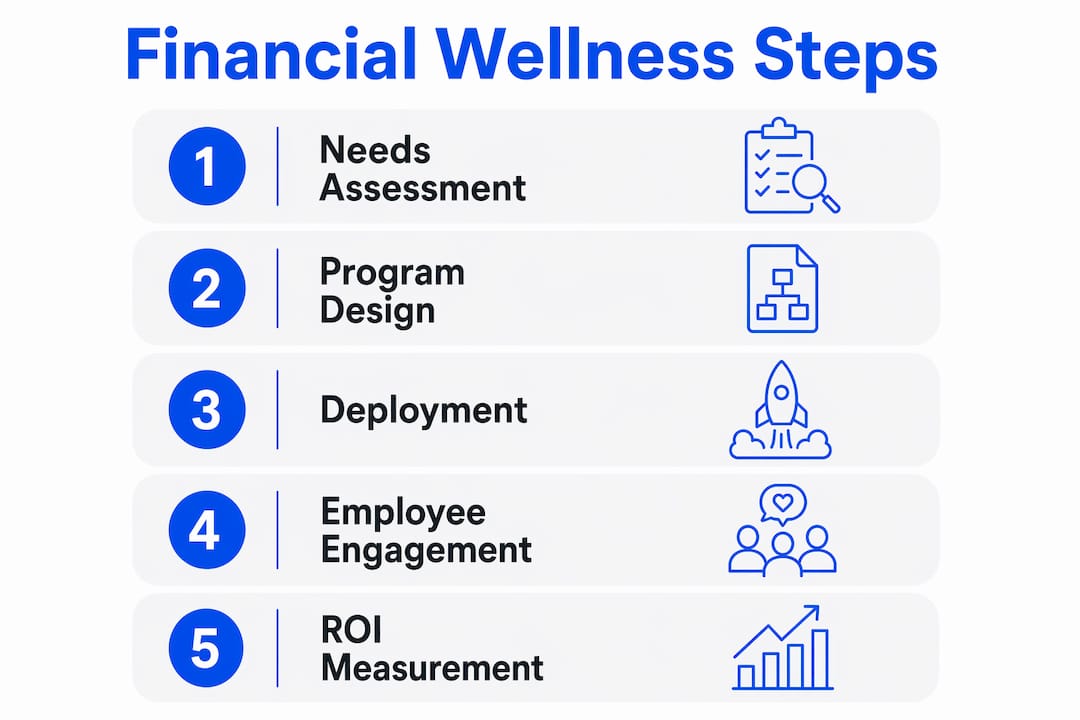
Implementation fails most often at two points: the needs assessment is skipped, and communications are weak. Here is a sequence that avoids both.
Numbered steps for a 6–12 month rollout:
- Assess needs — administer the CFPB's validated 10-question financial well-being scale to establish a baseline; segment results by department, age band, and claims tier
- Set goals and KPIs — define target reductions in ER visits, absenteeism, and claims per member; set participation rate goals
- Choose delivery model — hybrid (digital + human coaching) outperforms digital-only for high-risk cohorts
- Pilot with a segment — run a 90-day pilot with one department or location before full rollout
- Integrate with benefits and care management — connect program data to your population health platform and clinical outreach workflows
- Launch communications — use multiple channels; frame the program around financial security, not financial failure
- Full rollout and continuous improvement — quarterly vendor reporting, cohort-level outcome review, and annual program refresh
| Phase | Timeline | Owner | Deliverable |
|---|---|---|---|
| Needs assessment | Months 1–2 | HR / Benefits lead | CFPB baseline survey results, segmentation report |
| Goal-setting and vendor selection | Month 2–3 | HR, Broker, CFO | Signed vendor agreement, KPI dashboard |
| Pilot | Months 3–5 | Program manager, Vendor | Pilot engagement data, early claims signal |
| Integration | Months 4–6 | Clinical lead, IT | EHR/claims data linkage confirmed |
| Full rollout | Months 6–12 | All stakeholders | Quarterly outcome reports, ROI summary |
How to measure ROI and which metrics actually matter
Measuring corporate wellness ROI requires tracking both engagement inputs and population health outputs. Engagement alone proves nothing; claims data is what moves the CFO.
Measurement framework: Pair CFPB financial well-being scores with claims-per-member data across matched cohorts — participants versus non-participants — at 6 and 12 months.
Primary metrics to track:
- Medical claims per employee (total and by category)
- Preventive service utilization rates
- ER visit and inpatient admission rates
- Absenteeism days per employee per quarter
- Presenteeism proxies (manager-reported productivity, EAP utilization)
- Program participation and coaching session completion rates
- Retention rate, 12-month rolling
| Metric | Measurement Tool | Reporting Cadence |
|---|---|---|
| Financial well-being score | CFPB 10-question scale | Baseline + 6 months + 12 months |
| Claims per member | Claims data from carrier | Quarterly |
| Preventive care utilization | Carrier/PBM data | Quarterly |
| Program engagement | Vendor dashboard | Monthly |
| Retention | HRIS | Quarterly |
Vendor reporting should include deidentified cohort-level outcomes, raw engagement data, and transparent estimator assumptions. If a vendor cannot show you a claims impact cohort at 12 months, that is a problem.
Common pitfalls, privacy concerns, and compliance to watch for
Most programs underperform not because the interventions are wrong, but because implementation is careless.
Common pitfalls:
- Treating financial wellness as a one-time event (a lunch-and-learn is not a program)
- Poor segmentation — sending retirement content to employees drowning in short-term debt
- Weak communications that bury the program in a benefits portal nobody visits
- Vendor claims without transparent, deidentified measurement backing them up
Privacy checklist every employer should run:
- All employee financial data must be deidentified before it reaches the plan sponsor
- Participation must be voluntary; no coercion through incentive structures that penalize non-participation
- Clarify data access boundaries between the vendor and the plan sponsor in the contract
- Confirm HIPAA applicability when financial wellness data intersects with health plan data
Pro Tip: Require a data-use agreement that explicitly prohibits the vendor from selling or sharing employee financial data with third parties. Put it in the contract, not just the RFP response.
Red flags: vague outcome claims, no cohort-level reporting, and any vendor that cannot explain how they deidentify data.
How to choose a provider: the questions that separate good vendors from great ones
Start with the best financial wellness programs evaluation criteria, then pressure-test every vendor against them.
Vendor due-diligence checklist:
- Published evidence of claims impact (not just engagement metrics)
- Quarterly reporting with deidentified cohort outcomes
- Integration capability with your EHR, claims data, and benefits platform
- SOC 2 or equivalent data security certification
- Client references from employers in your industry and size range
- Pricing model: performance-based beats flat fee for accountability
Questions to ask during demos:
- Can you show me a deidentified cohort comparison of claims data at 12 months?
- How do you segment employees for targeted outreach?
- What is your participation rate benchmark for employers like ours?
- How does your program integrate with our existing care management workflows?
- What happens to employee data if we terminate the contract?
- How do you handle employees who need clinical referrals?
- What is your coaching staff's credentialing standard?
- How do you measure and report on preventive care utilization?
Pro Tip: Weight integration capability and reporting transparency above price. A cheaper vendor with opaque measurement will cost you more in unrealized savings than a performance-based partner with quarterly accountability.
Red flags: one-size-fits-all program design, vague ROI claims, and any vendor that cannot produce a savings estimator grounded in your actual claims data.
Hadaco: how a population health approach integrates financial wellness to lower claims
Hadaco's model is built around one premise: financial wellness programs for employees should reduce healthcare claims, not just improve financial literacy scores. Every intervention, from benefits navigation to emergency savings support, is designed to prevent the downstream health behaviors that drive high-cost utilization.
Hadaco proof points:
- $451 average savings per employee in the first year (brand-reported)
- No upfront fees: performance-based model means Hadaco's success is tied to your claims reduction
- Transparent savings estimator: input your baseline claims, workforce size, and participation assumptions to see projected savings before you commit
- Quarterly reporting: deidentified cohort outcomes, engagement data, and claims impact delivered on a fixed cadence
Average first-year savings: $451 per employee — with no upfront fees and quarterly reporting that holds the program accountable to real outcomes.
Hadaco integrates with existing benefit plans without disrupting them. Clinical outreach, chronic disease management, and preventive care workflows connect directly to the financial wellness layer, so high-risk employees get coordinated support rather than siloed programs. For employers and brokers ready to see the numbers, the Hadaco savings estimator is the fastest way to build an internal business case.
Key Takeaways
Financial wellness programs integrated with population health management reduce healthcare claims, improve retention, and deliver measurable ROI when built on evidence-based interventions and transparent vendor reporting.
| Point | Details |
|---|---|
| Start with a baseline assessment | Use the CFPB 10-question financial well-being scale to segment your workforce before choosing interventions. |
| Hybrid delivery outperforms digital-only | Combining anonymous digital tools with human coaching drives higher participation, especially among high-risk employees. |
| Track claims, not just engagement | Measure medical claims per member and preventive care utilization alongside program participation rates. |
| Require transparent vendor reporting | Quarterly deidentified cohort outcomes are the minimum standard; reject vendors who cannot provide them. |
| Hadaco delivers performance-based results | Hadaco's model averages $451 saved per employee in year one, with no upfront fees and a transparent savings estimator. |
Why financial wellness belongs inside population health, not beside it
The conventional framing treats financial wellness as an employee benefit, something you offer alongside dental and vision. That framing is wrong, and it explains why so many programs fail to move claims data.
Financial stress is a clinical upstream factor. It delays care, worsens chronic disease management, and drives the exact utilization patterns that inflate employer healthcare costs. When you treat financial wellness as a population health intervention, you design it differently: you segment by risk, you connect it to clinical outreach, and you measure it against claims. That is the version that delivers ROI.
Employers who pilot a targeted financial wellness program with one high-risk cohort, measure the claims impact at 12 months, and then scale based on evidence, will outperform those who roll out a generic program company-wide and hope for engagement. Start narrow, measure hard, and expand what works.
Hadaco's population health financial wellness offering
Employers who want a financial wellness program that actually reduces healthcare claims, not just one that checks a benefits box, have a direct path with Hadaco. The model is performance-based: no upfront fees, a transparent savings estimator you can run before signing anything, and quarterly reporting that shows exactly what changed in your claims data.
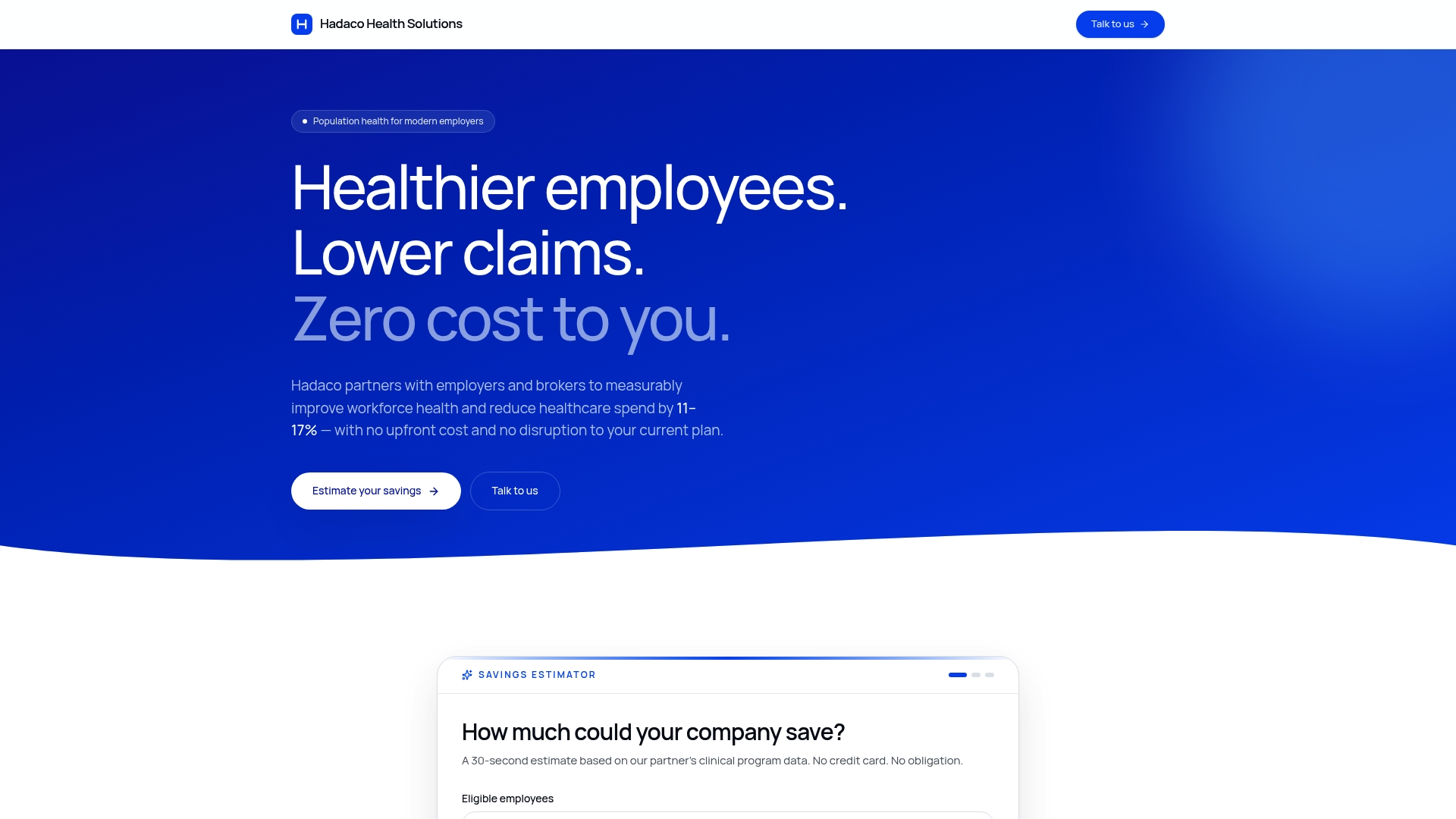
Hadaco integrates with your existing benefit plans and care management workflows, adding financial wellness interventions where they have the most clinical impact. Chronic disease management, preventive care gaps, and high-risk employee outreach are all connected to the financial wellness layer, so the program works as part of your population health strategy, not as a separate initiative your employees ignore. Book a consultation at Hadaco Health Solutions to run your savings estimate and see what a performance-based program looks like for your workforce.
Sources and further reading
Key studies and tools cited in this article:
- EBRI 2025 — Workplace Financial Education and Financial Capability: The primary source for the 85% vs. 63% financial knowledge finding; use for benchmarking program effectiveness.
- PwC 2026 Employee Financial Wellness Survey: Best source for productivity and engagement impacts of financial stress; includes younger-worker adoption data.
- CFPB Employer Resources and Financial Well-Being Scale: The validated 10-question measurement instrument; use for baseline surveys and tracking change over time.
- IFEBP — Financial Wellness and Education in the Workplace: Program design best practices and the case against passive information distribution; use for implementation planning.
- ASPPA 2026 — Are Financial Wellness Benefits Just for Employees?: Industry commentary on employer ROI, productivity, and retention outcomes.
- ADP Benefits Survey / PwC Insights 2026: Source for hybrid coaching and stigma-reduction evidence; use for delivery model decisions.
- Hadaco Health Solutions: Hadaco's savings estimator, quarterly reporting methodology, and proof points including the $451 average first-year savings figure.