
Employer population mental-health programs work. Studies show a pooled ROI of 2.3x across 19 cohort studies, and one large cohort found $164 in monthly medical claims saved per participant once they enrolled. The catch: those numbers only hold when a program gets employees into evidence-based care fast. Your next move is simple. Ask any vendor for an employer-specific claims baseline and a pilot savings estimate before you sign anything.
TL;DR:
- Higher-risk employee cohorts show larger savings, especially when programs enable rapid access to evidence-based care and avoid unnecessary medical settings.
- Vendor proof should include an employer-specific claims baseline, transparent savings estimates, and quarterly reports separating gross and net savings.
- Effective programs are characterized by strong provider matching, measurement-based care, clinical oversight, and culturally appropriate network options.
- Engagement tactics like specific messaging, manager training, peer advocates, and timed communication around stress points significantly boost utilization.
- Employers must ensure legal compliance by reviewing benefit design and claims operations, especially when expanding mental health benefits into existing plans.
Table of Contents
- What Employer Mental Health Programs Actually Do
- The Evidence: ROI, Per-Employee Savings, and Utilization Shifts
- What Should You Require From a Mental Health Vendor?
- How to Pilot and Scale a Program in 12 Months
- Legal Compliance and Mental Health Parity Laws
- Getting Employees to Actually Use the Program
- Holding Vendors Accountable for What They Promise
- Hadaco's Perspective: How We Track and Guarantee Employer Value
- Start a Pilot: What a Hadaco Discovery Call Covers
- Sources
- FAQ
What Employer Mental Health Programs Actually Do
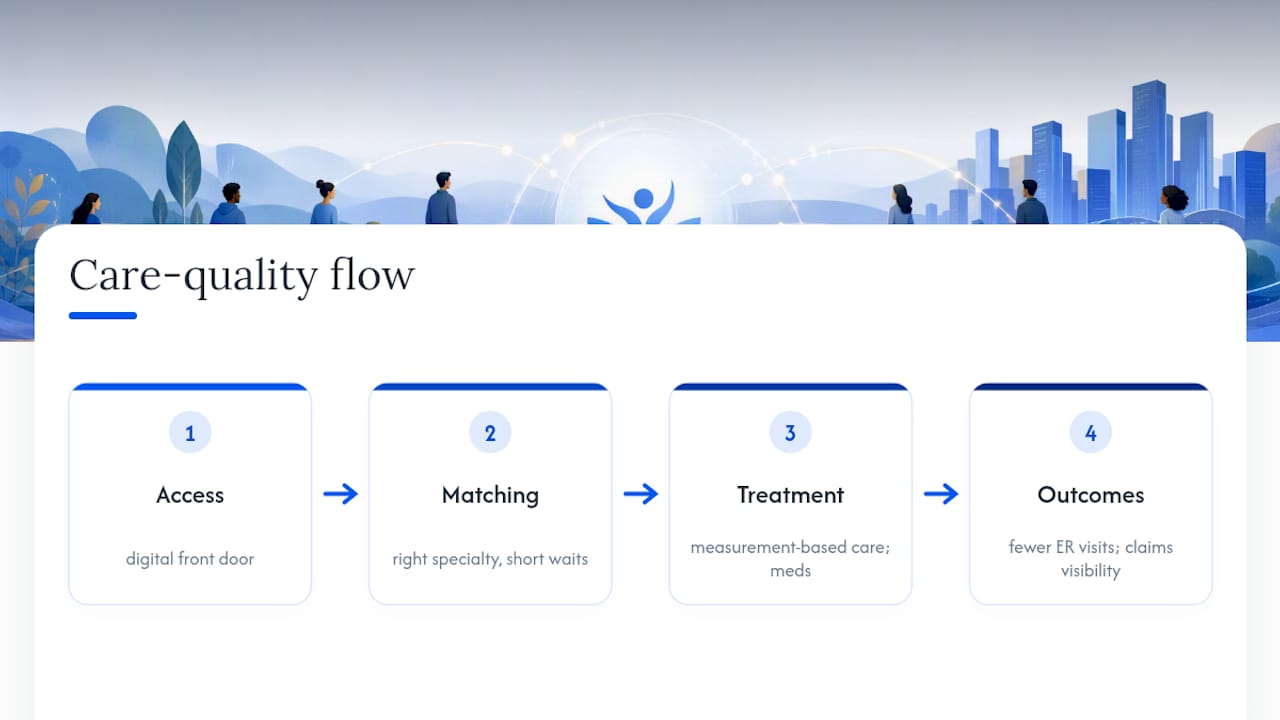
A workplace mental-health program is not a hotline and a pamphlet. The programs generating real savings combine screening, care navigation, rapid appointment matching, measurement-based therapy, medication management support, and a digital front door employees can use without calling HR first.
None of this replaces your medical plan. It sits alongside it, catching behavioral health needs before they turn into ER visits or long-term disability claims. That distinction matters for procurement: a program that duplicates your existing EAP or crisis line wastes budget, while one that fills the gap between "employee feels bad" and "employee sees a licensed clinician" is where the savings actually show up.
Provider matching quality drives most of the variance between vendors. A program that pairs a struggling employee with the wrong specialty, or makes them wait three weeks for a first session, loses the engagement war before it starts. Measurement-based care, meaning clinicians track symptom scores like PHQ-9 and GAD-7 session over session, correlates with the clinical improvements that show up later in the claims data. Supervision matters too. Programs that credential and oversee their clinical networks tend to post better outcomes than ones that simply hand employees a directory and walk away.
The Evidence: ROI, Per-Employee Savings, and Utilization Shifts
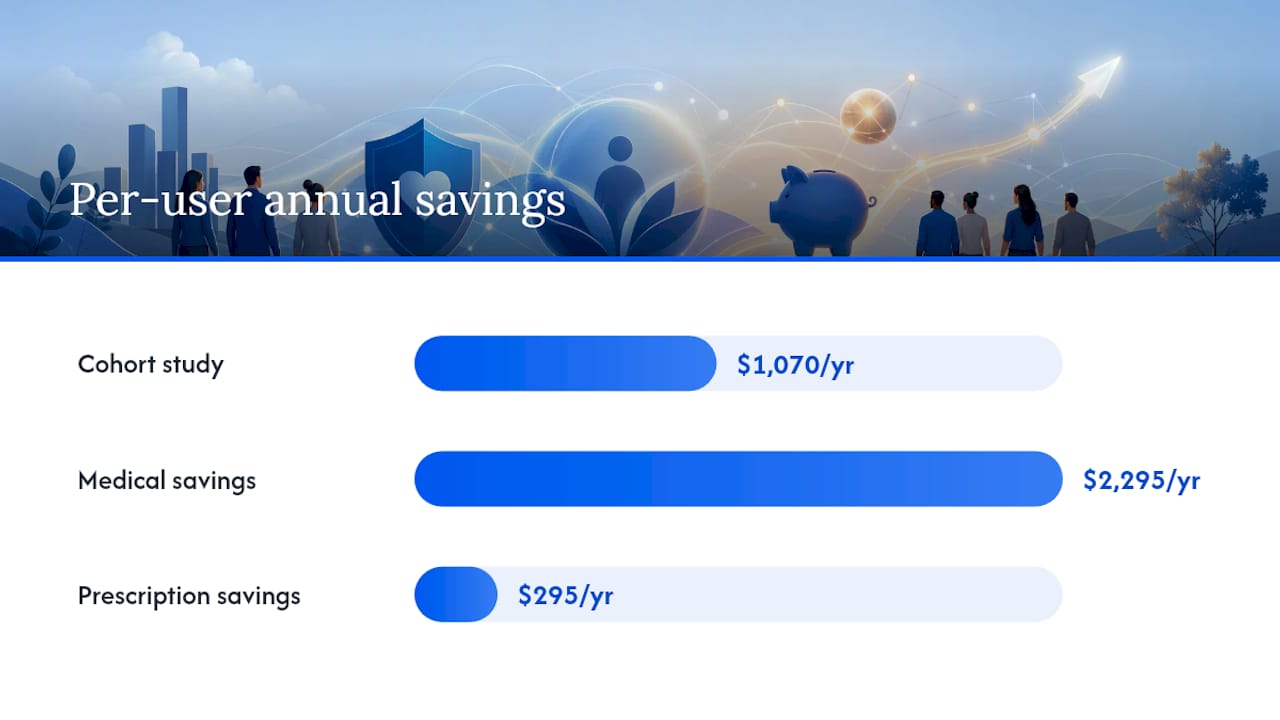
The headline number for benchmarking any vendor pitch is a pooled ROI of 2.3 (95% CI, 1.9 to 2.8), drawn from 19 employer cohort studies. A separate cohort analysis covering 2019 through 2023 found something more specific: program users saw medical claims drop by $164 per member per month compared to non-users, which works out to about $1,070 saved per participant in year one, at a 1.9x ROI. Every $100 an employer put into the program returned $190 in reduced medical claims.
A third analysis of a workforce mental health program found even sharper per-user numbers: about $2,295 in medical spending reductions and $295 in prescription savings per person per year. Program users averaged 12 visits annually versus 7 for people staying on the standard medical plan, meaning the savings came from shifting care into a cheaper, faster setting, not from denying care.
| Study | Metric | Result |
|---|---|---|
| 19-study pooled analysis | ROI multiple | 2.3x |
| Cohort study, 2019–2023 | PMPM medical claims reduction | $164 (≈$1,070/year per participant) |
| Workforce mental health program analysis | Medical + Rx savings per user/year | $2,295 + $295 |
Three things drive the spread between these numbers:
- Programs targeting higher-risk cohorts (chronic conditions, prior high utilization) post bigger savings than programs applied uniformly.
- Faster time-to-first-appointment correlates with fewer downstream ED visits and inpatient stays.
- Vendors that shift care out of expensive medical settings show gains that are real utilization changes, not just cost-shifting onto employees.
Pro Tip: Ask every vendor to separate "gross savings" (raw claims reduction) from "net savings" (after program fees and your internal admin time). The gap between those two numbers is where inflated ROI claims hide.
What Should You Require From a Mental Health Vendor?
Most RFPs focus on price per employee per month and skip the questions that actually predict ROI. Here's the order that matters:
- Employer-specific claims baseline. Insist the vendor build your savings estimate from your own claims data, not an industry average. A transparent savings estimator tied to your population is the only honest starting point.
- Total Cost of Ownership. Add implementation fees, your internal administrative hours, and vendor fees together. A low PEPM number that requires 10 hours a week of your benefits team's time isn't actually cheap.
- Clinical quality proof. Ask how they measure outcomes (PHQ-9, GAD-7 or equivalent), how they credential clinicians, and what supervision looks like.
- Access metrics. Get real numbers on time-to-first-appointment, session volume per user, telehealth coverage, and whether the provider network reflects your workforce's language and cultural needs.
- Data governance. Confirm how claims data gets shared, how PHI is protected, and whether their measurement methodology can be audited.
A few things that never make the RFP but should:
- Quarterly reporting cadence, not annual.
- Confidentiality guarantees strong enough that employees actually believe them.
- Manager training so referrals don't stall at the supervisor level.
CFOs should weight total cost of ownership heavier than sticker price. A vendor with a higher PEPM but lower admin burden and better time-to-care usually wins on net savings within 12 months.
How to Pilot and Scale a Program in 12 Months
- Pre-launch (weeks 1 to 8). Finalize data-sharing agreements, pull a baseline claims extract, align HR, benefits, and finance on success metrics, and select a pilot cohort. Stratifying that cohort by prior utilization sharpens the ROI you'll see later.
- Pilot (days 1 to 90). Launch targeted outreach to the pilot group, track onboarding completion, and measure time-to-first-appointment. This window tells you whether the vendor's access claims are real.
- Measurement (quarterly). Review PMPM or PPPY claims trends, the mix of utilization between the new program and your standard medical plan, and clinical outcome scores.
- Scale decision. Use the stratified results to decide who gets prioritized outreach next. Programs that expand into lower-risk populations without adjusting tactics usually see ROI compress.
The programs that succeed treat the pilot as a measurement exercise, not a soft launch. If a vendor resists quarterly reporting during the pilot, that's a signal worth taking seriously before you sign a multiyear contract.
Legal Compliance and Mental Health Parity Laws
Employers sponsoring these programs still operate inside a federal and state regulatory framework governing how mental health benefits get administered. Group health plans and their behavioral health carve-outs must apply comparable financial requirements and treatment limitations to mental health and substance use benefits as they do to medical and surgical benefits. That obligation extends to network adequacy, prior authorization standards, and reimbursement rates, not just copays and deductibles.
Many states layer their own requirements on top of federal rules, particularly around fully insured plans, so the specifics depend on your plan type and the states where your workforce lives. A self-funded employer in Texas and a fully insured employer with workers in New York face different compliance obligations even when both are trying to do the right thing.
None of this should scare you away from adding a population health program. A well-designed program that improves access and outcomes tends to support compliance rather than complicate it, since regulators care about comparable access and comparable limitations, and faster, better-matched care naturally moves you in that direction. What it does mean is that your legal or compliance counsel should review any new mental health benefit alongside your existing plan documents before rollout, particularly if the program touches claims adjudication or benefit design rather than sitting purely on the wellness side. Document the review. It's cheap insurance against a much more expensive problem later.
Getting Employees to Actually Use the Program
Enrollment means nothing if nobody uses the benefit. The EBRI employer survey found that 97% of large employers already offer mental health services, yet only 22% track how many employees actually use them. That gap between offering and tracking is usually the same gap between offering and using.
Stigma is still the biggest barrier, and it doesn't dissolve because HR sent an email. What moves utilization is repetition, specificity, and proof of confidentiality. Tell employees exactly what happens to their data, who sees it (almost always no one at the company), and how fast they can expect a first appointment. Vague language like "confidential support available" underperforms specific language like "book a session within 48 hours, and your manager never sees that you used it."
Manager training deserves more budget than most companies give it. A manager who notices a struggling employee and knows exactly how to point them to the program, without making it awkward, converts more referrals than any poster in the break room. Peer champions inside departments, especially in high-stress roles, tend to outperform top-down HR messaging.
Timing your communication around predictable stress points, like performance review season or seasonal slowdowns in customer-facing roles, tends to lift engagement more than generic quarterly reminders. And don't launch once and stop. Utilization decays fast when a benefit fades from memory, so plan for recurring touchpoints across the year, not a single kickoff campaign.
Holding Vendors Accountable for What They Promise
Every ROI claim a vendor makes should come with a way to check it. That means employer-specific claims reporting, not a case study from a different company's population, and it means a savings estimator built from your own baseline data rather than an industry average dressed up as a personalized number.
Quarterly reporting is the minimum cadence that actually lets you catch a problem before it compounds. Annual reporting means you find out in month 13 that utilization stalled in month 3. The report itself should separate gross claims reduction from net savings after program fees, and it should show utilization mix between the new program and your standard medical plan so you can see whether care is genuinely shifting to a cheaper setting or simply being duplicated.
Employers often lack full access to their own claims data in a usable format, which makes independent verification of vendor outcomes harder than it should be. Push for an auditable claims extract as a contract term, not a favor. A vendor confident in its numbers will not resist that request.
Hadaco's Perspective: How We Track and Guarantee Employer Value
Employers ask us the same question every time: prove it. So we built our reporting around proof instead of promises. Hadaco clients see an average of $451 saved per employee in year one, alongside double-digit reductions in claim costs, with no upfront fees required to start.
A transparent savings estimator can be built from claims data, and quarterly employer-specific reports are sent instead of annual summaries that arrive too late to act on. The program layers onto existing plan designs rather than replacing them, which is why brokers and benefits teams use it during both the pilot phase and the scale decision. You keep what works. We add what's missing.
— Gene
Start a Pilot: What a Hadaco Discovery Call Covers
This service offers an alternative to guessing whether a mental health vendor's ROI claims hold up for your specific workforce. A discovery call starts with a review of your claims baseline, a live walkthrough of the savings estimator using your own population data, and a defined pilot scope, not a generic sales deck.
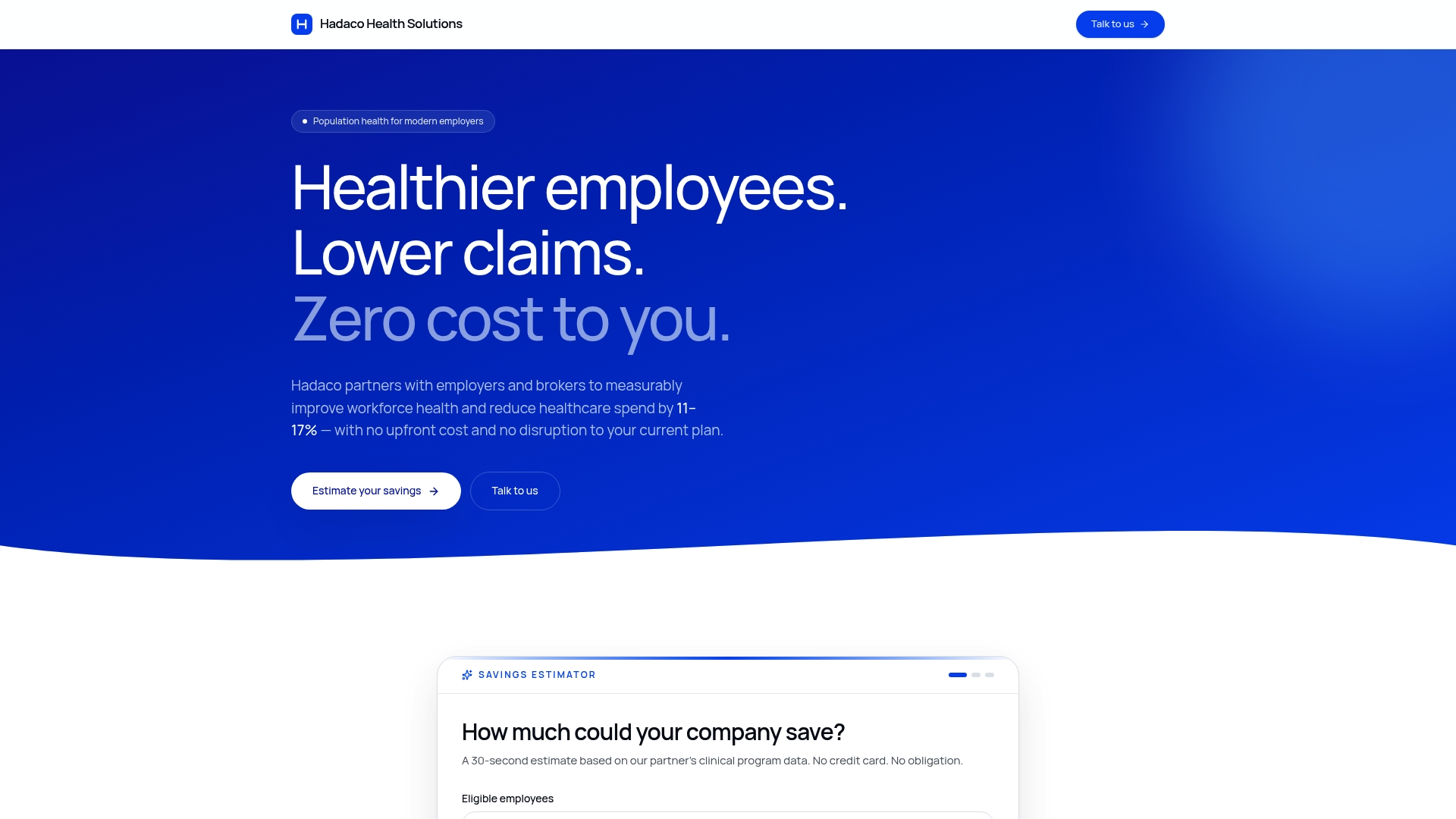
Once a pilot launches, quarterly claims reporting, utilization and clinical outcome metrics, and stakeholder checkpoints are provided so finance and HR see the same numbers at the same time. There are no upfront fees, no disruption to current plans, and no waiting a year to find out whether the program is working.
If you're evaluating vendors right now, request Hadaco's employer-specific savings estimator and book a discovery call before you sign anything else. Bring your last 12 months of claims data. That's the only thing we need to show you a real number instead of an industry average.
Sources
- The Impact of Enhanced Behavioral Health Services on Total Healthcare Costs Among US Employers: A Site-Level Analysis of 19 Cohort Studies - PMC
- Return on Investment of Enhanced Behavioral Health Services - JAMA Network Open (DOI)
- 2025 EBRI Employer Mental Health Survey
FAQ
What ROI Should Employers Expect From a Mental Health Program?
Peer-reviewed cohort studies show a pooled ROI of about 2.3x, though results vary by how targeted the program is toward higher-risk employees.
How Much Can Employers Save Per Employee?
One cohort study found $1,070 saved per participant in the first year, while Hadaco clients report an average of $451 per employee in year one alongside double-digit claim reductions.
Do These Programs Replace an Existing Medical Plan?
No. Comprehensive mental health programs are designed to complement existing medical and pharmacy benefits, not replace them, by catching behavioral health needs before they escalate into costlier care.
What Should Employers Require in Vendor Reporting?
Employers should require an employer-specific claims baseline, a transparent savings estimator, and regular reporting that separates gross claims reduction from net savings after program costs.
Why Do So Few Employers Track Utilization?
Tracking requires claims infrastructure many employers don't have in-house. The EBRI survey found only 22% of large employers track employee utilization, even though 97% offer mental health services.