
Workplace mental health integration is a systems approach built on three pillars: Protect, Promote, and Respond. It means embedding mental health into how work gets designed and managed, not bolting a benefit onto the side of it. The first move for any employer is a workplace psychosocial risk assessment using a validated instrument, because you cannot fix workload, scheduling, or management practices you haven't measured.
The urgency is not abstract. Poor working environments, marked by excessive workloads, low job control, discrimination, and job insecurity, sit among the biggest drivers of poor mental health, and the World Health Organization estimates 12 billion working days are lost annually to depression and anxiety alone, costing the global economy roughly $1 trillion a year in lost productivity.
Before you build a single program, do this:
- Run a psychosocial risk audit covering workload, autonomy, role clarity, and management behavior.
- Map current supports (EAP, benefits, training) against the Protect, Promote, Respond framework to spot gaps.
- Set a baseline for absenteeism, presenteeism, and health claims tied to mental health conditions.
Statistic to anchor your business case: a substantial proportion of working-age adults live with a mental disorder, and the resulting global productivity loss is a significant economic burden linked to workplace conditions employers can address.
Key Takeaways
Mental health integration works when organizations fix the conditions causing harm (Protect) before layering on individual-level treatment and benefits (Respond).
| Point | Details |
|---|---|
| Start with a risk audit | Assess workload, job control, and discrimination with a validated instrument before designing interventions. |
| Fund all three pillars | Balance spending across Protect, Promote, and Respond instead of concentrating on treatment benefits. |
| Embed in OSH governance | Fold mental health metrics into existing occupational safety cycles to secure durable budget. |
| Measure quarterly, not annually | Track utilization, claims, absenteeism, and engagement on a cadence fast enough to course-correct. |
| Consider Hadaco for execution | Hadaco integrates with existing plans at no upfront cost, with average first-year savings of $451 per employee and quarterly reporting. |
Table of Contents
- What Is Mental Health Integration in the Workplace?
- The Integrated Framework: Protect, Promote, Respond
- Organizational Interventions and Policy Levers
- Which Programs and Benefits Should You Actually Fund?
- How Do You Assess Needs and Choose the Right Instruments?
- How Do You Measure Outcomes and Calculate ROI?
- What Should Manager Training Actually Cover?
- Hadaco's Population Health Approach and Proof Points
- Implementation Checklist: A Phased Rollout
- Why Peer Support and Mental Health Champions Matter
- Crisis Intervention Protocols and Resources in the Workplace
- How Do You Sustain These Programs Long Term?
- Legal and Ethical Considerations in Mental Health Integration
- A Straight Take on What Actually Moves the Needle
- Start With an Assessment, Not a Benefits Overhaul
- Frequently Asked Questions
- Sources
What Is Mental Health Integration in the Workplace?
Mental health integration in the workplace means treating psychological wellbeing as a structural output of how jobs are designed, not a wellness perk layered on top of a broken system. The evidence for why this matters is blunt: workplace conditions are a leading, modifiable cause of poor mental health outcomes, and the financial exposure for employers who ignore this is large and growing.
A large number of working-age adults are estimated to have a diagnosable mental disorder, and the conditions that push people from struggling to disabled are largely environmental. The WHO fact sheet on mental health at work names the specific culprits: discrimination, excessive workloads, low job control, and job insecurity. None of those are personality problems. They are management and design problems, which is exactly why they respond to organizational intervention rather than a meditation app subscription.
The workplace conditions research keeps pointing to are consistent across industries:
- Excessive workload without corresponding staffing or deadline flexibility.
- Low job control, meaning employees have little say over how, when, or where their work happens.
- Discrimination or harassment, which compounds stress and erodes trust in leadership.
- Job insecurity, particularly during restructuring or unclear performance expectations.
- Poor management support, including managers who avoid conversations about workload or wellbeing entirely.
The business consequences show up in numbers finance teams already track. Absenteeism climbs when employees take sick days to cope with untreated stress or burnout. Presenteeism, employees who show up but function at a fraction of capacity, often costs more than absenteeism because it's invisible on a spreadsheet until productivity metrics or error rates slip. Health claims tied to depression, anxiety, and stress-related physical conditions (hypertension, GI issues, sleep disorders) climb steadily. Turnover accelerates in teams where managers are perceived as indifferent to mental load.
The $1 trillion figure isn't a global abstraction. Scale it down: if your organization has 1,000 employees and even a conservative slice of the WHO's productivity loss estimate applies proportionally, you're looking at a measurable drag on output that shows up in claims data before it shows up in an engagement survey. That's the argument for treating this as a business integration project, not an HR initiative that competes for attention with open enrollment.
The Integrated Framework: Protect, Promote, Respond
The three-pillar model gives you a way to sort every mental health initiative you already run, or should run, into one of three functions. Academic reviews describe this as a systems-level framework with three overlapping domains: prevent/Protect, promote, and respond, and the overlap is intentional. A well-designed accommodation policy touches all three.
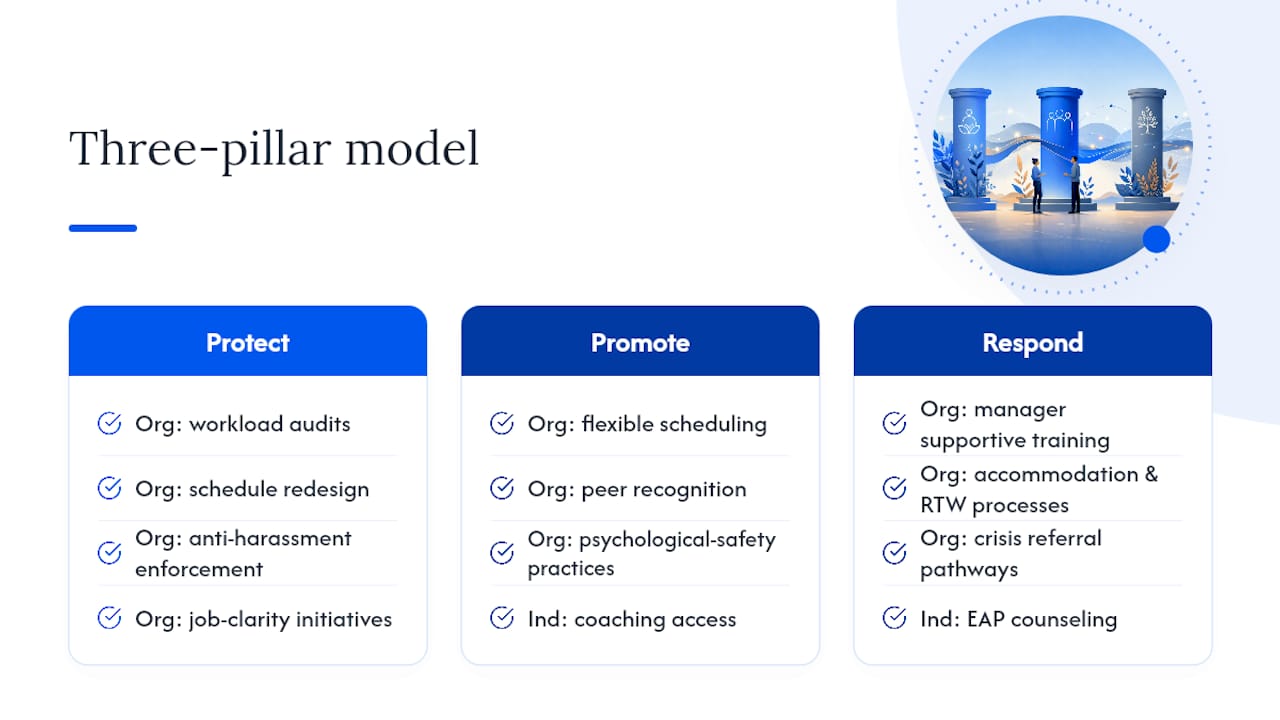
1. Protect: reduce work-related risks before they cause harm. This is primary prevention. It targets the conditions that create psychological injury in the first place, rather than treating the fallout. Organizational examples include workload audits, redesigning schedules to reduce chronic overtime, anti-harassment enforcement with real consequences, and job clarity initiatives that stop role ambiguity from becoming a stress multiplier. Individual-level protect efforts, by contrast, are things like resilience training, but those only work when paired with the organizational fixes; training people to cope with an unreasonable workload just delays the breakdown.

2. Promote: build the positive aspects of work that buffer stress. Promotion is about strengthening what's already working: autonomy, social connection, recognition, and a sense of purpose. Organizational promote interventions include flexible scheduling that gives people real control over their time, peer recognition programs, and management practices that build psychological safety into team meetings. Individual promote interventions include access to coaching, financial wellness support, and physical activity programs, all of which show measurable if modest benefit when layered on top of a healthy work structure.
3. Respond: address problems and support recovery, including return to work. This is where most employer benefit spending concentrates, often to the exclusion of the other two pillars. Organizational respond interventions include manager training on how to have supportive conversations, clear accommodation and return-to-work processes, and crisis referral pathways. Individual respond interventions include EAP counseling, short-term disability coordination, and clinical treatment access through insurance.
The mistake most organizations make is funding Respond generously while leaving Protect and Promote thin or nonexistent. That's backwards from an evidence standpoint. Guidance compiled in the WHO's NCBI Bookshelf resource on workplace mental health recommends embedding interventions directly into occupational safety and health (OSH) systems rather than running them as a parallel HR project. That distinction matters operationally: OSH systems already have audit cycles, budget lines, and compliance reporting. Piggybacking mental health integration onto that infrastructure gets it measured, funded, and reviewed the same way you'd review a workplace injury rate, instead of it living in a slide deck that gets revisited once a year during benefits renewal.
Organizational Interventions and Policy Levers
Fixing the conditions that cause harm requires policy changes and job redesign, not just awareness campaigns. This is where the Protect pillar gets operational teeth.
Start with policy. A handful of specific, enforceable policies do more for psychological safety than most training programs combined:
- Anti-harassment and anti-discrimination policy with real enforcement, including a reporting channel employees trust and consequences that are actually applied.
- Paid mental health leave, distinct from general PTO, so employees don't have to justify a mental health day as a "sick day."
- Reasonable accommodations for mental health conditions, treated with the same seriousness as physical disability accommodations under existing HR processes.
- Flexible work arrangements, including schedule flexibility and remote options where the role allows it, since autonomy over how and when work happens is one of the strongest protective factors against chronic stress.
- Clear return-to-work protocols after a mental health related absence, with a defined process rather than an ad hoc conversation between a stressed employee and an unprepared manager.
Job design is the other half of the equation, and it's the half most companies skip because it's harder than writing a policy. Role clarity matters more than most managers assume: ambiguous responsibilities create chronic low-grade anxiety that doesn't show up in engagement surveys until it becomes disengagement. Workload management means actually tracking capacity against output, not assuming people will speak up before they burn out (most won't, especially in competitive team cultures). Scheduling interventions, like predictable hours and limits on after-hours contact, address the "always on" pattern that's become normalized in many white-collar jobs and is measurably corrosive over time.
Pro Tip: Audit one job family at a time instead of trying to redesign every role simultaneously. Pick the role with the highest turnover or the most claims activity, fix the workload and scheduling issues there first, and use that as your internal proof of concept before scaling.
None of this works if it lives outside your existing HR and occupational safety processes. The integrated intervention research from PMC makes a specific point worth repeating: practitioners who embed mental health measures into existing OSH governance and procurement cycles secure budget more reliably, because it stops being framed as a discretionary perk and starts being tracked like any other safety metric. If you already have a safety committee, add psychosocial risk to its agenda. If you already run job design reviews for ergonomics, add mental workload to that same review. This is a healthcare-adjacent challenge in industries like nursing too, where scheduling and workload pressures are well documented as occupational risks, and the same design principles apply regardless of sector.
Which Programs and Benefits Should You Actually Fund?
Not every intervention deserves equal budget, and the evidence strength varies a lot by intervention type. Public health researchers sort workplace mental health programs into three tiers based on who they target: universal, selective, and indicated.
Universal interventions reach the entire workforce regardless of risk level. Think manager training, mental health awareness campaigns, and organization-wide policy changes. These have the broadest reach and the strongest case for addressing root causes, but individually they tend to produce small effects.
Selective interventions target groups at elevated risk, such as employees in high-stress roles, shift workers, or teams going through restructuring. This might mean targeted resilience training or workload adjustments for a specific department.
Indicated interventions address individuals already showing symptoms, through EAP referral, clinical treatment, or short-term accommodation. This is the most expensive tier per person and the one where privacy protections matter most.
An umbrella review of meta-analyses covering universal, selective, and indicated workplace interventions found small-to-moderate effects across the board, with evidence quality often rated low to very low individually. The review's more useful finding is directional: combining organizational-level change with individual-level intervention consistently outperforms either approach alone. A meditation app rolled out without any workload fix produces a marginal effect at best.
On delivery mode, employers generally choose among a few models:
- Employee Assistance Programs (EAPs), the traditional standby, offering short-term counseling and referral.
- Digital CBT and app-based programs, which scale cheaply but have uneven engagement rates.
- Embedded or connected care models, where mental health support is integrated with primary care. Collaborative care trials, including the COINCIDE trial published in BMJ, show that integrating mental health treatment with physical health management reduces depressive symptoms and improves management of co-occurring conditions like diabetes.
- Manager-mediated support, where trained managers act as a first point of contact and referral rather than a diagnostician.
One caution that gets underweighted in benefits planning: benefits cannot substitute for organizational change, and stigma kills utilization regardless of how generous the benefit looks on paper. If employees believe using the EAP will be noticed and held against them, utilization stays in the single digits no matter what the plan covers. For a deeper look at how digital platforms stack up on cost and engagement, see this guide to evaluating mental health platforms.
How Do You Assess Needs and Choose the Right Instruments?
You cannot manage what you haven't measured, and the instrument landscape for workplace mental health is more uneven than most benefits teams realize. The Knowledge-to-Action (KTA) framework offers a practical structure: identify gaps, design interventions matched to those gaps, then monitor and improve continuously rather than treating assessment as a one-time event.
Applying KTA to workplace mental health breaks into three repeatable activities:
- Identify gaps. Run a psychosocial risk audit and cross-reference it against your current program inventory, sorted by Protect, Promote, and Respond. Most organizations discover they're strong on Respond (EAP, insurance coverage) and thin on Protect (workload, job design) and Promote (autonomy, recognition).
- Design targeted interventions. Match specific fixes to specific gaps rather than deploying a generic wellness package. If the audit shows workload as the top driver, the intervention is staffing or deadline adjustment, not a resilience webinar.
- Monitor and improve. Set a repeat measurement cadence (annual at minimum, quarterly for high-risk teams) so you can see whether interventions actually shifted the underlying risk factors.
Choosing instruments matters more than most procurement processes treat it. A scoping review of workplace mental health instruments screened 207 tools and found 109 that met eligibility criteria, but most concentrated on the "prevent harm" and monitoring functions. Instruments that validly measure whether an organization is promoting positive work, or responding well to problems once they arise, are far fewer and less mature.
When selecting instruments, weigh three criteria:
- Coverage: does it measure workload, control, and support, or just one dimension?
- Psychometric validity: has it been tested for reliability across different industries and workforce sizes?
- Multi-domain reach: does it touch Protect, Promote, and Respond, or only one pillar?
Assessment outputs should convert directly into a prioritized action list, ranked by both risk severity and cost of intervention, so leadership sees a clear line from data to decision rather than a report that gets filed and forgotten.
How Do You Measure Outcomes and Calculate ROI?
Measurement has to satisfy two audiences at once: HR wants program-level insight, finance wants dollar-linked outcomes. The metrics that do both are utilization rate, absenteeism, presenteeism, health claims tied to mental health diagnoses, voluntary turnover, and engagement survey scores.
Utilization tells you whether people are actually using what you've built, and low utilization is itself a diagnostic signal about stigma or awareness gaps, not just a program failure. Claims data, tracked by diagnosis category where privacy rules allow, shows whether interventions are bending the cost curve on mental health related medical spend. Turnover and engagement capture the retention side of the ROI case.
The ROI logic itself is straightforward, even if the inputs require some estimation. Savings come from three sources: reduced claims costs, reduced turnover-related replacement costs (recruiting, onboarding, lost productivity during ramp-up), and reduced absenteeism/presenteeism drag on output. Conservative modeling matters here, because overpromising savings in year one is how these programs lose executive sponsorship in year two when the numbers don't land.
The scale of the underlying problem is why even modest program effects produce real dollar impact. With a very large number of working days are lost globally each year to depression and anxiety alone, a program that recovers even a small fraction of that lost time for your workforce shows up meaningfully in absenteeism and productivity metrics within a year or two.
On data sources: pull claims data from your carrier or third-party administrator, absenteeism from payroll systems, and engagement from your existing survey tool rather than building a new instrument from scratch. Report to leadership on a quarterly cadence at minimum. Annual reporting is too slow to catch a program that's underperforming before a full budget cycle has been spent on it. For a structured measurement framework, the HR guide to employee mental health programs walks through metric selection in more depth.
What Should Manager Training Actually Cover?
Manager training is the highest-leverage intervention in the entire framework, and also the most frequently done badly. The failure mode is training managers to feel like amateur therapists, which is both the wrong goal and a liability risk.
Good manager training teaches support, not diagnosis. A manager's job is to notice changes in behavior or performance, have a direct and caring conversation, and know exactly where to route the employee, whether that's the EAP, HR, or a formal accommodation request. It is never the manager's job to assess whether someone has depression or anxiety. Training that blurs this line puts both the manager and the employee at risk.
Behaviors worth normalizing through training and reinforced by leadership modeling:
- Regular one-on-one check-ins that ask about workload and capacity directly, not just project status.
- Workload adjustments made visibly and without punishment, so employees see that raising a capacity concern doesn't damage their standing.
- Facilitating accommodation requests promptly, rather than treating them as a hurdle to route around.
- Modeling boundaries themselves, including not sending after-hours messages that implicitly demand immediate responses.
Pro Tip: Tie manager training completion and team-level engagement scores into manager performance reviews. Training that has no consequence attached to it, positive or negative, gets treated as optional and quietly skipped.
Federal resources are a useful starting point rather than a full solution. The Surgeon General's workplace wellbeing framework and CDC materials offer templates for manager messaging and leadership communication, but they need adaptation to your specific industry and workforce before they'll land. Also worth building into training: worker surveys consistently show that a healthy, supportive culture is rated as more helpful than standalone treatment resources, which is a strong argument for weighting manager training investment as heavily as, or more heavily than, benefit design.
Hadaco's Population Health Approach and Proof Points
Operationalizing the Protect, Promote, Respond framework requires more than good intentions. It requires a partner who can integrate with what you already have, measure results, and report them without adding a compliance burden to your HR team. That's the specific gap Hadaco is built to close.
Hadaco layers evidence-based population health programs onto your existing benefit plans rather than replacing them, addressing chronic disease management, preventive care, mental health, and employee engagement as connected parts of the same system, mirroring the integration logic this entire framework depends on. Because it works alongside current plans, there's no disruption during a benefits renewal cycle and no re-education campaign for employees about a new carrier.
A few things worth knowing when you're evaluating any population health vendor, Hadaco included:
- No upfront fees. Programs are structured so cost is tied to demonstrated outcomes, not a speculative annual contract.
- Average first-year savings of $451 per employee, a figure companies typically see once claim-cost reductions and engagement improvements are measured across the first year of program deployment.
- A transparent savings estimator that lets finance and HR model expected impact before committing, rather than taking a vendor's projection on faith.
- Quarterly reporting, so leadership sees measured outcomes on the same cadence recommended earlier in this piece, not a single annual summary that arrives too late to course-correct.
When you're vetting any vendor against this framework, three criteria matter most: does the program produce measurable outcomes tied to claims and engagement data, does it integrate without disrupting your current plan structure, and does it report frequently enough for you to catch problems early. Hadaco was built around exactly that scorecard.
Implementation Checklist: A Phased Rollout
Trying to launch every pillar at once is the single most common reason these initiatives stall. A phased rollout lets you build credibility with quick wins before asking for budget to scale.
Phase 1 (0 to 3 months): Assessment and governance
- Conduct a psychosocial risk audit using a validated instrument covering workload, control, and support.
- Assign executive sponsorship and fold mental health metrics into an existing safety or HR governance committee.
- Fix the cheapest, highest-visibility policy gaps immediately, such as clarifying mental health leave or fixing an outdated accommodation process.
Phase 2 (3 to 9 months): Pilot and align
- Pilot manager training in one or two departments with the highest turnover or claims activity.
- Align existing benefits (EAP, insurance) against the Protect/Promote/Respond map to identify overlap and gaps.
- Launch a targeted job-design fix, like workload rebalancing, in the pilot department and track absenteeism and engagement changes.
Phase 3 (9 to 18 months): Scale and embed
- Roll successful pilot elements company-wide, prioritized by the size of the risk they addressed.
- Fold mental health metrics permanently into occupational safety and health reporting and procurement cycles.
- Move to quarterly outcome reporting to leadership, with claims, absenteeism, and engagement tracked against baseline.
Common obstacles at each phase are predictable enough to plan around: Phase 1 stalls when there's no executive sponsor to push past inertia. Phase 2 stalls when manager training gets deprioritized against other quarterly initiatives. Phase 3 stalls when early wins aren't documented well enough to justify further budget. Document everything from the pilot, even the failures, because that data is what unlocks scale funding. The HR playbook for integrating wellness benefits breaks this rollout sequence down further for teams building their first formal plan.
Why Peer Support and Mental Health Champions Matter
Peer support programs put trained, non-clinical employees in a position to notice distress early and point colleagues toward the right resource, often long before a manager or HR would catch it. The value isn't clinical. It's proximity and trust: a peer champion hears things in a break room conversation that never reaches a formal check-in.

Mental health champion programs work best when champions are volunteers, given real training (not just a title), and given explicit boundaries about what they are and aren't responsible for. A champion's job is to listen, normalize the conversation, and refer, not to counsel or diagnose. Programs that skip the boundary-setting risk burning out the champions themselves or having them dispense advice they're not qualified to give.
The organizational payoff shows up in two places. First, champions reduce the distance between "something feels wrong" and "someone got help," which matters because the gap between symptom onset and seeking support is often where preventable harm accumulates. Second, a visible peer program signals to the entire workforce that leadership takes this seriously, which chips away at stigma faster than a poster campaign ever will.
Selecting champions deserves the same care as selecting managers for a high-trust role: look for employees who are already informally trusted by peers, provide them ongoing training rather than a single session, and give them a direct line to HR or a clinical resource for anything beyond their scope. Rotate the role periodically so the responsibility doesn't concentrate on one or two people until they burn out.
Crisis Intervention Protocols and Resources in the Workplace
Every organization needs a written crisis protocol before a crisis happens, because improvising in the moment is how well-meaning managers make things worse. A basic protocol should specify exactly who an employee or coworker contacts if someone is in acute distress, what that contact person is authorized to do, and how the situation gets escalated to emergency services when needed.
At minimum, your protocol should include a designated internal contact (HR, a trained manager, or a mental health champion), a clear escalation path to emergency services for situations involving immediate risk, and a follow-up process once the acute crisis has passed, since return-to-work support after a crisis is where many organizations drop the ball entirely.
Train managers specifically on what not to do: don't promise confidentiality you can't legally guarantee, don't attempt to manage the situation alone if there's any indication of immediate danger, and don't skip the follow-up conversation once someone returns to work. That last point matters more than it gets credit for. An employee who returns from a mental health crisis to complete silence from their manager reads that silence as judgment, whether or not it's intended that way.
Make the protocol visible before it's needed: posted alongside other safety information, referenced in onboarding, and revisited annually alongside your broader psychosocial risk audit. A crisis protocol that only exists in an HR policy binder nobody has opened is functionally the same as having no protocol at all.
How Do You Sustain These Programs Long Term?
The programs that survive past year two share one trait: they're built to be revised, not launched once and left alone. Treat your mental health integration effort the same way you'd treat a safety program, with a standing review cycle rather than a one-time rollout that quietly ages out of relevance.
Sustainability starts with ownership. If the entire program lives with one HR person, it dies the moment that person changes roles. Fold governance into a standing committee, ideally the same one that owns occupational safety, so institutional knowledge survives staff turnover.
Continuous improvement requires the repeat measurement structure discussed earlier: annual risk re-assessment at minimum, with quarterly metric reviews for claims, absenteeism, and engagement. Programs that only measure once at launch have no way of knowing whether the intervention is still working two years later as the workforce and business conditions change.
Budget resilience matters just as much. Programs framed as a "wellness initiative" get cut first when budgets tighten. Programs framed as risk management, tied to claims cost trends and OSH reporting, survive budget cycles because cutting them reads as a governance failure rather than a discretionary trim.
Finally, revisit your instrument choices periodically. The tools that measured your organization well at 500 employees may not scale cleanly to 2,000, and new validated instruments continue to emerge, particularly for the underdeveloped "promote" and "respond" domains. A program that never updates its measurement approach eventually measures the wrong things well.
Legal and Ethical Considerations in Mental Health Integration
Mental health integration touches legal territory the moment you start talking about accommodations, leave, and disability, so HR and legal need to be in the room together from the start, not brought in after a policy is already drafted.
Reasonable accommodation obligations for mental health conditions generally mirror those for physical disabilities under applicable employment law, meaning a documented, consistent process for requesting and evaluating accommodations protects both the employee and the organization. Ad hoc, manager-by-manager decisions about accommodations create legal exposure and inconsistent treatment across teams.
Privacy is the other major fault line. Claims data, EAP utilization, and any information collected through a psychosocial risk assessment needs strict access controls. Aggregate reporting to leadership should never be granular enough to identify individuals, and any instrument or survey used for assessment should state clearly how responses will and won't be used.
Ethically, the biggest risk is collecting data on workplace psychosocial risk and then failing to act on it. Running an assessment, finding that workload is crushing a department, and doing nothing about it is worse for trust than never having assessed at all. Employees notice when a survey produces no visible change, and that erodes willingness to participate honestly in the next one.
Finally, be deliberate about who has access to mental health related information at all. Managers generally shouldn't have clinical details, only enough information to facilitate an accommodation or refer someone to the right resource. That boundary protects the employee and keeps the manager out of a role they're not equipped, or legally positioned, to fill.
A Straight Take on What Actually Moves the Needle
Most organizations already know they should "do something" about mental health. What they get wrong is where they put the money. Respond gets funded generously because it's easy to buy: an EAP contract, an insurance rider, a counseling app. Protect and Promote get starved because fixing workload and job design is harder, slower, and requires actual operational change rather than a purchase order.
That imbalance is backwards, and the evidence backs that up plainly. Training people to cope better with an unreasonable workload treats a structural problem as a personal failing, and it tends to show weak effects precisely because it never touches the root cause. The organizations that see real movement on absenteeism and claims costs are the ones willing to redesign a role, fix a schedule, or hold a manager accountable for team workload, not just the ones with the most generous counseling benefit.
If there's one contrarian point worth sitting with, it's this: a benefits package, no matter how well designed, cannot outrun a bad job. Measurement matters enormously here too, not as a compliance exercise but because without a baseline you're guessing at which lever to pull. Get the assessment right first. Everything downstream, from program selection to ROI reporting, depends on knowing exactly where the risk actually lives in your organization.
Start With an Assessment, Not a Benefits Overhaul
You don't need to rebuild your entire benefits stack to start integrating mental health into how your organization actually functions. Hadaco works alongside the plans you already have, layering evidence-based programs across chronic disease management, preventive care, mental health, and engagement without asking you to disrupt a single existing contract.
The proof points matter because they're measurable, not promotional: no upfront fees, an average first-year savings of $451 per employee, and quarterly reporting so your leadership team sees real numbers instead of a year-end summary that arrives too late to act on. That reporting cadence matches exactly what this article recommends for any mental health program, because a program you can't measure is a program you're funding on faith.
The next step is straightforward. Run Hadaco's savings estimator to see a modeled first-year impact for your specific workforce size and claims profile, then book an assessment conversation to walk through how the Protect, Promote, Respond framework maps onto what you're already running. There's no upfront cost to find out where the gaps are.
Frequently Asked Questions
What does mental health integration in the workplace actually mean? It means treating mental health as a function of job design, management practice, and organizational policy, using the Protect, Promote, Respond framework, rather than treating it as a standalone benefit disconnected from how work is structured.
What's the first step for an employer that hasn't started yet? Conduct a psychosocial risk assessment using a validated instrument to identify where workload, control, and support gaps exist before choosing any program or benefit.
How is this different from a typical employee wellness program? Traditional wellness programs often focus on individual behavior (fitness, nutrition, mindfulness) without touching the organizational conditions causing stress. Integration explicitly targets job design, policy, and management alongside individual support.
How long does it take to see measurable results? Pilots in a single department can show early signals in absenteeism and engagement within 3 to 9 months. Claims-cost impact typically takes a full year to measure reliably, since insurance data lags behind program deployment.
Do smaller employers need this, or is it just for large organizations? The framework scales down. A 50-person company can still run a psychosocial risk audit, fix scheduling or workload issues, and train managers on supportive check-ins, all without the infrastructure a large enterprise would need.
Sources
- Mental health at work — WHO
- Workplace mental health: developing an integrated intervention approach — PMC
- Supporting mental health in the workplace — NIOSH/CDC