
Self-funded employer wellness, done right, means population-health programs that target specific chronic conditions with clinical staff, not generic step-challenge apps. The evidence is consistent: broad, lifestyle-only wellness rarely moves the needle on spending, while targeted disease management and clinical integration do. Employers building a program in 2026 should prioritize vendors who can show claims data, attribution methodology, and quarterly outcomes, not just engagement scores.
TL;DR:
- Programs that target high-risk conditions with clinical staff and care navigation tend to produce measurable claims savings over several years, unlike generic wellness initiatives.
- Effective programs rely on claims data, transparent attribution methods, and recurring quarterly reporting to accurately assess impact and accountability.
- Larger pilot groups of over 200 employees, with measurement windows exceeding 12 months, are necessary for reliable detection of claims reductions.
- Employers should prioritize vendors with licensed clinical staff, integrated data systems, and performance-based fees aligned with demonstrated savings.
- First-year savings often average several hundred dollars per employee, with significant reductions in key claim categories occurring within 18 months.
Table of Contents
- What "Self-Funded Employer Wellness" Actually Means Here
- Does Workplace Wellness Actually Reduce Healthcare Costs?
- What Components Actually Move the Claims Number?
- How Should You Evaluate a Wellness Vendor?
- How Do You Build the Business Case for Savings?
- What's a Realistic Rollout Timeline?
- Why Measurement Discipline Beats Engagement Metrics
- Hadaco: Evidence-Based Population Health Without the Upfront Risk
- Sources
- FAQ
What "Self-Funded Employer Wellness" Actually Means Here
This article uses "self-funded employer wellness" to describe employer-funded population-health programs, not self-insured health plan financing. Those are two different subjects entirely. A self-insured plan is a risk-financing structure. A population-health program is a set of clinical and behavioral interventions layered on top of whatever plan structure already exists, insured or self-funded.
That distinction matters for who reads this piece. If you're researching stop-loss coverage or plan documents, you're in the wrong place. This is for the people who own the health outcomes and the cost curve:
- HR and benefits leaders designing the intervention strategy
- CFOs and finance executives modeling savings and approving spend
- Brokers and benefits consultants advising employer clients
Roughly 80% of employers already offer some form of wellness program, yet opinions on their cost impact stay mixed. That gap between adoption and results is exactly why scope and program design deserve more scrutiny than they usually get.
Does Workplace Wellness Actually Reduce Healthcare Costs?
Sometimes. It depends heavily on what kind of program you're running.
Broad, lifestyle-only wellness programs, the kind built around step counts, generic health coaching, and biometric screenings with no follow-up care, tend to improve self-reported behavior without touching the claims line. A widely cited JAMA analysis of large-employer wellness programs found no statistically significant reduction in healthcare spending or utilization within 18 to 36 months, despite modest gains in self-reported healthy behaviors. Similar null results showed up in randomized trials at other large employers, reinforcing that engagement alone doesn't equal cost control.
Targeted, clinically integrated programs tell a different story. A 5-year cardiovascular and diabetes risk-reduction program run through a self-insured employer produced durable improvements in LDL, HDL, and blood pressure, paired with a combined healthcare-and-productivity return of $9.64 for every dollar invested.
The pattern across the research: lifestyle-only wellness moves behavior, not spending. Pharmacist-led disease management and other clinically integrated programs move both, but the payoff builds over years, not months.
A few caveats matter before you extrapolate any of this to your own workforce:
- ROI figures like $9.64 to $1 come from quasi-experimental designs, not randomized controlled trials, so treat them as directional rather than guaranteed
- Program duration correlates strongly with ROI, meaning a 6-month pilot will understate what a mature 3-year program can deliver
- Attribution gets harder as your workforce changes; turnover and plan design shifts can muddy year-over-year comparisons
What Components Actually Move the Claims Number?
Four things separate programs that dent claims from programs that just generate engagement metrics.
- Clinical integration and care navigation. Pharmacist-led medication management, primary care access, and structured chronic-disease protocols outperform generic coaching because they intervene at the point of clinical risk, not just behavior.
- Risk stratification toward your highest-cost conditions. Cardiovascular disease, diabetes, and behavioral health typically drive the largest share of avoidable claims. Programs that identify and target these populations specifically outperform one-size-fits-all rollouts.
- Reduced friction for high-value care. Systematic reviews of employer-led strategies show that cutting cost-sharing for primary care visits and chronic-disease medications improves both adherence and, in several cases, total cost of care. Raising copays on these services tends to backfire by deterring the exact care that prevents expensive downstream events.
- Transparent, recurring measurement. Baseline claims data, a savings estimator, and quarterly reporting turn a program from a hope into an accountability system.
Pro Tip: Ask any vendor to show you their care-gap closure rate, not just their engagement rate. A program can have 70% participation and zero clinical impact if nobody with diabetes or hypertension actually gets managed.
Programs built this way behave differently from passive wellness portals. Harvard Business Review describes the strongest population-health programs as "activist", meaning they proactively close care gaps through navigation and clinical outreach instead of waiting for employees to opt in.
How Should You Evaluate a Wellness Vendor?
Run every vendor through the same checklist, and don't let a polished dashboard substitute for clinical substance.
- Data integration. Can they ingest your claims data and pharmacy data, or are they working from surveys and self-reported biometrics alone?
- Clinical staffing. Are there licensed pharmacists, nurses, or care navigators on the program, or is it software and content only?
- Social determinants of health (SDOH) support. Do they account for transportation, food access, and other barriers that block adherence for high-risk employees?
- Attribution method. How do they isolate program impact from natural claims volatility, seasonal trends, or plan design changes?
- Commercial structure. Performance-based fees tied to demonstrated savings align incentives better than flat licensing fees charged regardless of outcome.
Watch for red flags: vague attribution language, promises of immediate company-wide savings from a generic wellness portal, or reluctance to share a sample quarterly report. A program confident in its results will show you the numbers before you sign anything.
How Do You Build the Business Case for Savings?
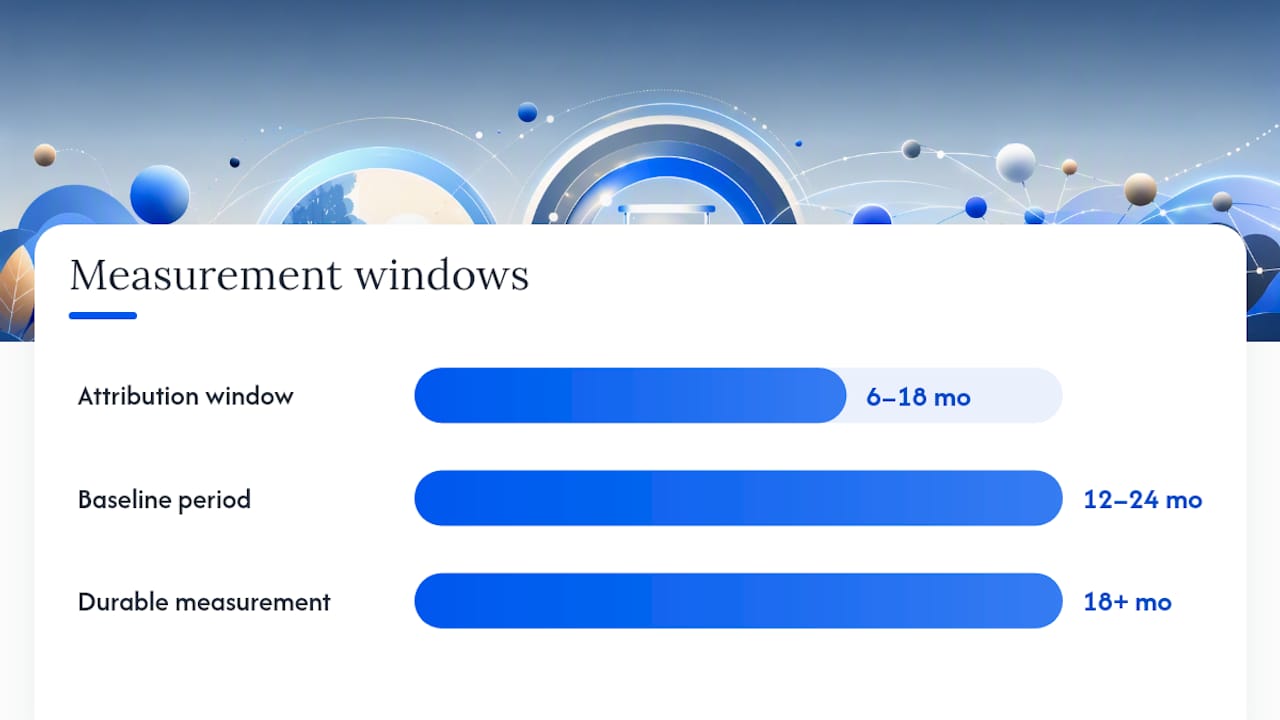
Start with a clean baseline. Pull 12 to 24 months of claims data segmented by condition category, then pick an attribution window before the program launches, not after. A 6 to 18 month window is reasonable for early directional signals like medication adherence or screening rates. Durable claims reduction usually needs 18 months or longer to separate program effect from normal year-to-year noise.
Set realistic expectations using benchmarked outcomes rather than best-case marketing numbers.
- Employers working with Hadaco have seen an average savings of several hundred dollars per employee in the first year, alongside frequent notable reductions in specific claim categories.
- Require quarterly reporting tied to a transparent savings estimator so finance can track projected versus realized savings in real time
- Set KPIs before launch: medication adherence, screening completion, ER utilization for targeted conditions, and total claims trend by cohort
Pilot sizing matters more than most teams realize. A pilot under 200 to 300 covered employees often lacks the statistical power to detect a meaningful claims shift, especially for lower-prevalence conditions like diabetes. Larger pilots, or longer measurement windows, produce more reliable signals.
What's a Realistic Rollout Timeline?
Most employers can move from vendor selection to first-quarter results within six months, with durable savings signals emerging over 18 months.
- Months 1 to 2: Vendor selection, data-sharing agreements, and BAA execution for claims and clinical data access.
- Months 2 to 3: Employee communications, enrollment logistics, and clinician staffing confirmation.
- Months 3 to 6: Pilot launch with baseline claims capture and initial engagement tracking.
- Months 6 to 12: First quarterly measurement checkpoints; expect early signals in adherence and utilization, not yet in total claims.
- Months 12 to 18: Scale decision based on trend data, with claims impact becoming statistically visible for high-prevalence conditions.
Legal and IT teams should treat data-sharing agreements as a critical path item. Delays here are the single most common reason pilots slip their launch date.
Why Measurement Discipline Beats Engagement Metrics
Most employers overweight engagement and underweight clinical targeting. A wellness app with 80% adoption and no impact on your top three cost drivers is a worse investment than a pharmacist-led diabetes program with 30% enrollment among your highest-risk employees. Tie every program dollar to your actual claims data, not to industry averages, and insist on quarterly numbers before you renew anything.
— Gene
Hadaco: Evidence-Based Population Health Without the Upfront Risk
If you're ready to move past pilots that generate engagement scores instead of claims reduction, Hadaco runs evidence-based population-health programs that plug into your existing benefit plan rather than replacing it. There's no upfront fee structure to approve before you see results.
Hadaco's programs target the same conditions that the research highlights: cardiovascular disease, diabetes, and behavioral health, using clinical staff and care navigation instead of generic wellness content. Employers typically see an average of $451 per employee in first-year savings, with a transparent savings estimator and quarterly reporting so your finance team can track realized results against projections instead of taking a vendor's word for it. Double-digit reductions in specific claim categories are common within the first year. If your organization is ready to model what this could mean for your own claims data, request a pilot walkthrough with Hadaco and run the numbers before committing to anything.
Sources
The clinical and cost claims in this article draw on peer-reviewed research and employer trend data rather than vendor marketing copy.
- Long-Term Outcomes of a Cardiovascular and Diabetes Risk-Reduction Program Initiated by a Self-Insured Employer - PMC
- Workplace wellness programs study (JAMA, 2019)
FAQ
What Is Self-Funded Employer Wellness?
In this context, it refers to employer-funded population-health programs that address chronic disease, prevention, and engagement, working alongside an employer's existing benefit plan rather than replacing it.
Do Wellness Programs Actually Reduce Healthcare Claims?
Broad lifestyle-only programs usually don't produce statistically significant spending reductions within 18 to 36 months, but targeted disease-management programs with clinical integration have shown durable cost and clinical improvements over multi-year periods.
How Long Before a Wellness Program Shows Measurable Savings?
Expect early behavioral signals like adherence and screening rates within 6 to 12 months, with durable claims reduction typically visible after 18 months or longer.
What Should Employers Look for in a Wellness Vendor?
Prioritize clinical staffing, claims-data integration, transparent attribution methods, and performance-based fee structures. Look for wellness vendors who offer quarterly reporting and a savings estimator with no upfront fees.
How Much Can Employers Expect to Save in the First Year?
Results vary by program design and population risk, but some employers have averaged hundreds of dollars per employee in first-year savings alongside double-digit reductions in specific claim categories.