
The fastest way to sell wellness benefits is to stop selling wellness and start selling numbers: healthcare cost trends, productivity, and retention, backed by a low-risk pilot with a clear measurement plan and quarterly accountability. Vendors like Hadaco close deals faster because they remove the two biggest objections up front, cost risk and unproven results, with no upfront fees, a transparent savings estimator, and evidence-based programs.
TL;DR:
- Focusing on measurable business outcomes like healthcare costs, productivity, and retention is key to selling wellness programs effectively, especially with a low-risk pilot.
- Tailor outreach and pilot strategies based on company size, decision-making timeline, and stakeholder involvement, with shorter cycles for small employers and longer, formal processes for enterprises.
- Present a clear, data-driven CFO business case using existing metrics and conservative savings estimates to demonstrate return on investment and build credibility.
- Use genuine discovery questions, relatable language, and credible evidence to diagnose organizational needs and foster trust before proposing specific health outcomes or solutions.
- Emphasize proven proof points, transparent cost structures, and quarterly reporting to build vendor accountability and address common objections around privacy, cost, and program effectiveness.
Table of Contents
- Top 7 Practical Sales Strategies to Prospect and Close Wellness Deals
- Segmenting Prospects and Tailoring Your Approach by Company Size
- How Do You Build a CFO-Ready Business Case for Wellness Benefits?
- What Consultative Selling Skills Actually Win Wellness Deals?
- How to Structure a Wellness Benefits Pilot and Price It
- What Makes Employees Actually Participate in Wellness Programs?
- How Do You Measure and Report Wellness Program Results?
- How Do You Handle Objections About Cost, Privacy, and Proof?
- Why Evidence and Vendor Accountability Matter in a Wellness Pitch
- Author Perspective: Three Practical Rules From the Field
- Hadaco: A Wellness Solution You Can Recommend With Confidence
- Sources
Top 7 Practical Sales Strategies to Prospect and Close Wellness Deals
Employers don't buy wellness. They buy relief from a cost problem or a retention problem, and your outreach should say so in the first line.
Start by qualifying hard. An employer with flat claims costs and low turnover isn't a priority account this quarter. One with rising claims trends, a benefits renewal in the next 90 days, and a CFO asking HR uncomfortable questions is exactly who you call first.
- Rank accounts by pain, not size. Renewal timing, claims trend direction, and turnover rate matter more than headcount.
- Work broker and referral channels first. Brokers already have the trust relationship; a warm introduction skips three months of cold outreach.
- Pair digital prospecting with evidence-led content. Share a short case example or benchmark stat instead of a generic pitch deck.
- Lead with a pilot, not a contract. A shared-savings or no-upfront-fee pilot removes the biggest reason CFOs stall.
- Bring a calculator to the first call. A rough savings estimate based on headcount and current claims trend gets a CFO leaning forward.
- Sequence your stakeholders differently. HR wants program design; the CFO wants the number.
- Follow up with data, not reminders. A one-page benchmark update beats "just checking in."
For outreach sequences, keep it short. A first email to a benefits leader might read: "Companies your size typically see double-digit reductions in claims costs within 12 to 18 months of launching a structured program. Worth 15 minutes to see what that could look like for you?" A follow-up to the CFO drops the program talk entirely and opens with the estimated dollar figure.
Pro Tip: Send the savings estimate before the first meeting, not during it. A number in someone's inbox before they've talked to you creates curiosity that a slide deck never will.
Segmenting Prospects and Tailoring Your Approach by Company Size
Small and large employers buy wellness benefits on completely different timelines, with different people signing off, and you'll waste months if you pitch them the same way.
Small and mid-sized employers (roughly 50 to 500 employees) usually have one decision-maker wearing the HR and finance hat simultaneously. Sales cycles here can move in weeks. Pilots should be small, three to six months, with two or three KPIs: participation rate and one hard cost metric.
Mid-market employers (500 to 5,000) add a benefits committee and often a broker into the mix. Expect a 60 to 90 day evaluation, a slightly longer pilot (six to nine months), and a request for benchmark data against similar-sized peers.
Enterprise accounts bring procurement, legal, and sometimes a wellness committee that's been burned by a vendor before. Budget cycles are annual, and pilots often run a full plan year before rollout. Your collateral needs a compliance appendix and a data-security summary before HR will even forward it internally.
- SMB: Fast close, informal pilot, one owner-operator decision-maker.
- Mid-market: Committee buy-in, broker involvement, benchmark-driven pitch.
- Enterprise: Long cycle, formal RFP, legal and security review baked in.
Pro Tip: Ask "who else needs to see this before you decide?" on the first call. The answer tells you the real sales cycle length before you waste a quarter chasing a phantom close date.
How Do You Build a CFO-Ready Business Case for Wellness Benefits?
CFOs care about three things: medical spend trend, absenteeism, and turnover cost, and your ROI narrative needs to speak in those terms or it won't survive the first budget meeting.
Start with the metrics finance already tracks. Medical claims trend (year over year percentage change), short-term disability days, absenteeism rate, and voluntary turnover cost per replaced employee. You don't need proprietary data to build a first pass. A conservative estimate using current headcount, average claims cost per employee, and a modest reduction assumption gets you in the room.
Here's a simple template:
- Current annual healthcare spend per employee × headcount = baseline cost
- Conservative reduction assumption (use a modest, defensible percentage, not the best-case number from a case study)
- Projected first-year savings = baseline cost × reduction assumption
- Compare against program cost to show net return
Among employers who actually measure wellness program ROI, the large majority report positive returns, which is the single most useful sentence you can put in front of a skeptical CFO. It reframes the conversation from "does this work" to "how do we measure it here."
Benchmark to cite: Programs that combine biometric screenings, health risk assessments, and targeted interventions are the structural core of effective employer wellness programs, and citing that structure signals you're proposing something evidence-based, not a wellness fad.
Pair the ROI template with a corporate wellness ROI breakdown that walks through absenteeism and productivity metrics in more depth. Always show your assumptions. A CFO who sees your math trusts the number; a CFO who sees a bottom-line figure with no path to it will push back every time.
What Consultative Selling Skills Actually Win Wellness Deals?
The best wellness sellers act less like salespeople and more like translators, moving fluently between clinical language and business language without losing either audience.
That means genuine curiosity about how a specific organization's health costs are actually structured, not a scripted pitch. It means enough literacy in HRAs and biometric screening to answer a benefits director's technical question without stalling. And it means resisting the urge to persuade before you've actually diagnosed the problem.
Good discovery questions do the diagnosing for you:
- "What's driven your claims trend up or down over the last two renewal cycles?"
- "Where does leadership feel the most pressure, cost, turnover, or both?"
- "What's already been tried, and why didn't it stick?"
- "Who internally owns the success or failure of a new program?"
That last question matters more than it seems. Sellers who translate clinical measures into business language, turning an HRA finding into a cost-per-employee figure or a biometric trend into projected days lost, close faster than sellers who stay in clinical vocabulary the whole meeting.
Pro Tip: Never promise a specific health outcome. Promise a measurement process. "We'll track this quarterly and show you the trend" builds more trust than any specific percentage you could guess at in a first meeting.
The line between education and persuasion is thin, and buyers can feel when you cross it. Trust builds when you seem more interested in getting the diagnosis right than in getting the signature.
How to Structure a Wellness Benefits Pilot and Price It
A pilot exists to answer one question: does this work for this employer, without asking them to bet a full annual budget on a guess.
- Define scope narrowly. Pick one or two locations, or one employee segment, rather than a company-wide rollout.
- Set the duration. Three to six months for SMB, six to nine for mid-market, a full plan year for enterprise.
- Lock in measurement upfront. Baseline metrics before launch, defined KPIs, and a reporting schedule, ideally quarterly.
- Choose a pricing structure. Options include a flat pilot fee, a shared-savings clause tied to measured cost reduction, or a no-upfront-fee model where payment is contingent on results.
- Set the decision checkpoint. Name the exact date and the metrics that trigger a rollout conversation, before the pilot even starts.
A shared-savings clause might read: fees apply only against verified reductions in medical claims trend, measured quarterly against the pre-pilot baseline. That single sentence often does more to close a hesitant CFO than an entire ROI deck.
What Makes Employees Actually Participate in Wellness Programs?
A pilot with a brilliant ROI model still fails if nobody signs up, and participation is where most wellness programs quietly die.
Friction kills participation faster than disinterest does. Programs that succeed integrate into channels employees already use, a text nudge, an existing benefits app, an EAP touchpoint, rather than asking for a new login and a new habit. High-performing interventions embed wellness into how work actually gets done instead of treating it as an extra task layered on top of the workday.
Incentive design needs a light touch and a fairness check. Cash incentives work, but structure them so employees with pre-existing conditions or disabilities aren't effectively penalized for lower participation, and keep any biometric data handling need-to-know and clearly disclosed.
- Use existing platforms (EAP, benefits portal, payroll app) instead of a standalone tool.
- Launch with a visible kickoff and a manager who participates publicly.
- Send short, spaced nudges rather than one large communication.
- Re-engage lapsed participants at 90 days with a simplified entry point.
A workplace wellness challenge built around short, low-effort activities tends to outperform elaborate programs that ask for a big upfront time commitment. Corporate cooking classes and similar hands-on programming, the kind Bite Unite runs for teams, work well as engagement anchors precisely because they're social and low-pressure rather than another solitary app to open.
Pro Tip: Ask the employer who their most respected, not most senior, informal team leader is. Get that person to try the program publicly in week one. Peer visibility drives sign-ups more reliably than any incentive dollar amount.
How Do You Measure and Report Wellness Program Results?
If you can't show the trend line by quarter three, you'll lose the renewal, no matter how good the program actually is.
The minimal metric set is short: participation rate, medical claims trend, absenteeism, a productivity proxy like short-term disability days, and voluntary turnover. Anything beyond that starts diluting the story you're trying to tell.
Baselines matter more than most sellers admit. Measure the 12 months before launch, not the quarter right before, since a single bad quarter skews the comparison. Where possible, use a phased rollout across locations instead of launching everywhere at once. That gives you an informal control group and a more defensible pilot evaluation than a simple before-and-after comparison.
- Report participation and engagement monthly internally, but summarize quarterly for leadership.
- Frame results in trend language ("claims growth slowed from 8% to 3%") rather than static snapshots.
- Separate health metrics from business metrics in the report, then connect them in one summary paragraph.
- Flag confounding factors honestly (layoffs, plan design changes) rather than letting a skeptical CFO find them first.
A ROI-beyond-healthcare-costs framework that includes absenteeism and productivity indicators alongside claims data gives finance leaders more than one lever to credit the program for, which matters when a single metric has a rough quarter.
Quarterly reporting isn't just good practice, it's the mechanism that turns a one-time pilot into a renewed, expanded contract.
How Do You Handle Objections About Cost, Privacy, and Proof?
Every wellness sale runs into the same three objections, and the sellers who close consistently have short, honest answers ready rather than defensive ones.
- "We're worried about employee data privacy." Ask for the minimum data set needed, aggregate reporting only, and no individual-level sharing with the employer. That single commitment defuses most of the concern.
- "We've tried wellness programs before and they didn't work." Point to pilot design. Selection effects and weak measurement, not the concept itself, explain a lot of underwhelming past results.
- "This is too expensive for uncertain results." Offer a no-upfront-fee or shared-savings structure so cost is tied to verified outcomes.
- "Will employees actually participate?" Show the incentive and low-friction delivery plan before they ask, not after.
Why Evidence and Vendor Accountability Matter in a Wellness Pitch
Employers have heard vague wellness promises before, so proof points beat adjectives every time. Hadaco backs its pitch with no upfront fees, a transparent savings estimator, and quarterly reporting, plus a client benchmark of $451 average savings per employee in the first year.
Cite the estimator as a planning tool, not a guarantee, when you build proposals. It's useful precisely because it makes assumptions visible instead of hiding them behind a polished slide.
- No upfront fees: removes the biggest budget objection.
- Savings estimator: gives prospects a personalized, defensible starting number.
- Quarterly reporting: turns a one-time sale into an ongoing, renewable relationship.
Author Perspective: Three Practical Rules From the Field
Three rules cut through most of the noise in this business. Lead with finance, since HR opens the door but the CFO signs the check. Pilot obsessively, because a small measured win beats a big unproven promise every time. Embed, don't bolt on, since programs layered on top of existing work die quietly within two quarters.
One pattern shows up repeatedly: a mid-market employer stalls for months on a full proposal, then signs a three-month pilot within a week once the risk drops to near zero. Measure everything in the CFO's language, not HR's, and the renewal conversation writes itself.
— Gene
Hadaco: A Wellness Solution You Can Recommend With Confidence
Hadaco gives you something most competitors can't: a pitch with the financial risk already removed. There's no upfront fee, so the employer's only real commitment is a pilot and a willingness to measure it. Programs address chronic disease, preventive care, and engagement without disrupting the benefit plans already in place, and the savings estimator lets you hand a prospect a personalized number before the first real meeting.
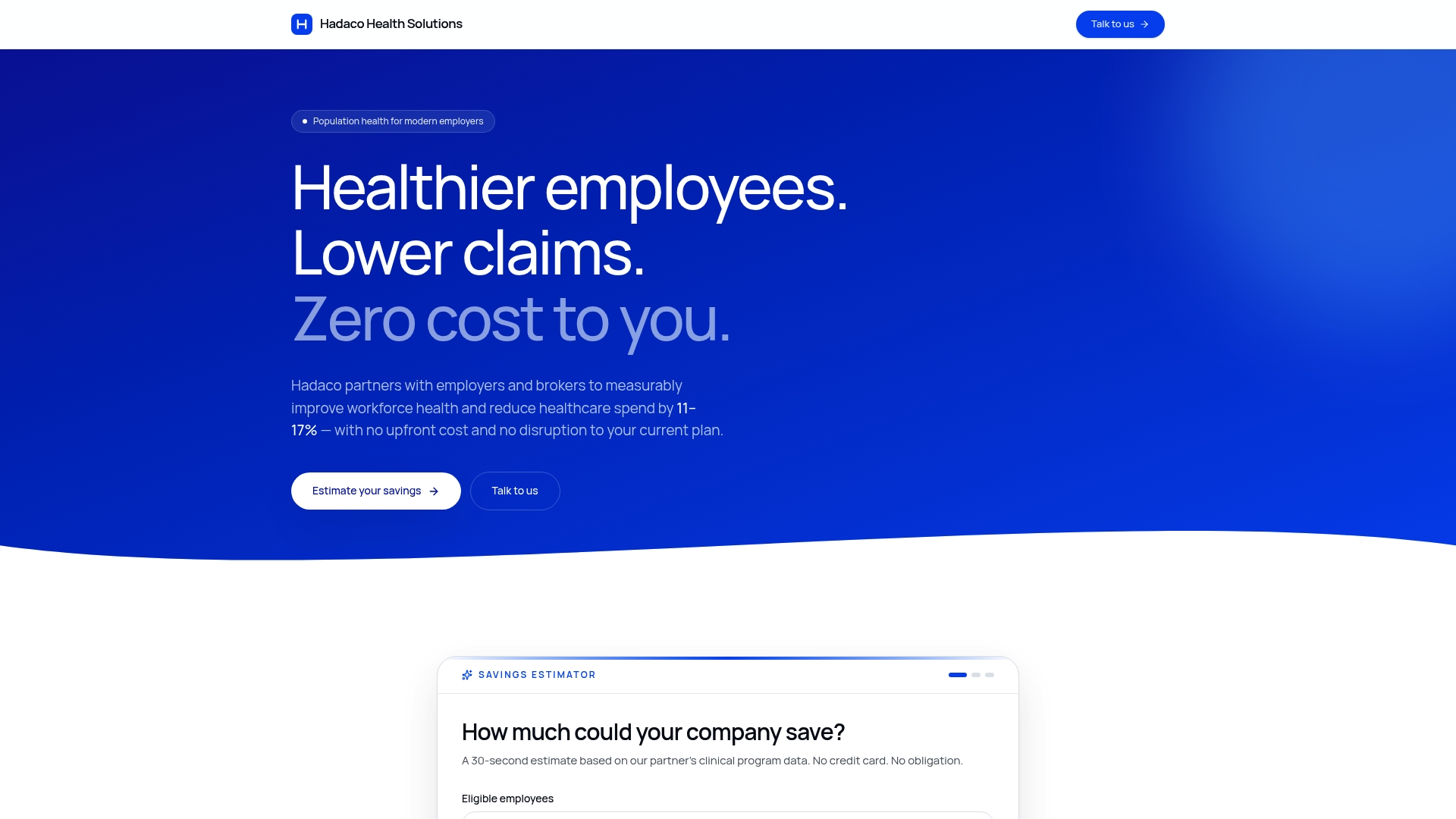
When you position Hadaco to an employer, keep it simple: "This program integrates with what you already have, costs nothing upfront, and reports results every quarter so you're never guessing whether it's working." That's the whole pitch. Run the savings estimator with a prospect's numbers today, and bring the result into your next conversation instead of a generic deck.
Sources
For evidence on program structure and outcomes, see the Illinois Workplace Wellness Study, McKinsey's health intervention research, and Wellhub's ROI benchmarks. For seller-ready frameworks, review Hadaco's guides on financial wellness ROI and integrating wellness benefits.
- What do Workplace Wellness Programs do? Evidence from the Illinois Workplace Wellness Study
- From potential to practical: Fueling performance with proven workplace health interventions