
The clearest lesson across employer wellness case studies is this: programs that combine chronic-condition management with sustained, high-touch communication produce the most measurable health and cost improvements, while broad, one-size-fits-all challenges rarely move the needle. That finding shows up again and again in the Workplace Wellness Programs Study, a systematic review that remains the most-cited academic source on this topic, and it echoes across practitioner collections from SHRM and the International Foundation of Employee Benefit Plans (IFEBP).
If you're an HR leader trying to build a case for your next pilot, start with three sources: the PMC systematic review for rigor, the CDC's employer resources for chronic disease cost data, and curated collections like IFEBP's case study library for real-world program design. Chronic disease alone drives most U.S. health spending, which is exactly why programs targeting diabetes, hypertension, and musculoskeletal conditions tend to outperform generic wellness challenges.
You can move fast without waiting for a perfect study to appear:
- Pick a pilot cohort. Choose one location or department with a clean baseline (claims history, screening data, or both).
- Define your metrics before launch. Decide now whether you're tracking A1c, blood pressure, absenteeism, or claims trends, not after results come in.
- Secure leadership sponsorship and a communications plan. Case studies consistently show this is the difference between 20% and 60% engagement.
A partner like Hadaco can shortcut the data-linkage and reporting work these steps require, but the sequence above works regardless of who runs your program.
Key Takeaways
Employer wellness programs that combine targeted chronic-condition management with sustained, multi-channel engagement produce the clearest measurable improvements in behavior and clinical metrics.
| Point | Details |
|---|---|
| Chronic-condition focus wins | Programs targeting specific conditions like diabetes or hypertension consistently outperform general wellness messaging. |
| Baseline before launch | Define your metrics and collect baseline data before the pilot starts, not after results come in. |
| Communication beats incentives alone | Sustained, multi-channel outreach drives higher engagement than one-time incentive payments. |
| Evaluation needs six to twelve months | Credible clinical or cost signals typically require at least six months of follow-up data. |
| Hadaco fits the case-study pattern | Hadaco links claims data, targets chronic conditions, and reports quarterly, mirroring the structure behind the strongest employer case studies, with no upfront fees. |
Table of Contents
- What Employer Wellness Case Studies Show Overall
- What the Workplace Wellness Programs Study Tells HR Leaders
- Five Employer Wellness Case Studies Worth Studying
- Which Program Components Actually Move Outcomes
- How Should HR Measure Wellness Program Success?
- Turning Case Studies Into a Pilot: An Implementation Checklist
- Designing a Case-Study-Ready Pilot
- What I Learned Piloting a Chronic-Care Cohort
- How Hadaco Helps Employers Build Their Own Success Story
- Where to Read More on Employer Wellness Case Studies
- Frequently Asked Questions
- Sources
What Employer Wellness Case Studies Show Overall
Read enough employer wellness case studies and a pattern emerges fast: programs built around targeted chronic-condition management and multi-channel engagement report the strongest behavior change, while generic, incentive-only programs tend to produce weaker or short-lived results. The PMC systematic review found modest short-term behavior changes across many employer programs, but mixed evidence on whether those changes translated into sustained clinical improvement or clear cost savings.
That gap between behavior change and hard outcomes is the single biggest thing HR teams misjudge when building a business case.
Across academic reviews and curated case collections, a few outcomes show up repeatedly:
- Programs combining screenings, coaching, and digital tools show faster early clinical signal than single-modality efforts, according to practitioner collections cited by SHRM.
- Tailored interventions for specific subgroups, enabled by better demographic data, consistently outperform blanket programs in reducing disparities, per Cambridge Public Health's data linkage case study.
- Common null results include one-off biometric screenings with no follow-up coaching and incentive structures that pay for participation rather than progress.
The recurring caveat in nearly every rigorous evaluation is the same: short follow-up windows, self-selected participants, and inconsistent ROI methodology make it hard to separate a program's real effect from who chose to join it in the first place.
Chronic disease accounts for the majority of U.S. health spending, which is why the strongest case studies almost always center on chronic-condition management rather than general wellness activities. Keep that distinction in mind before you copy a program design that never mentions a specific health condition.
What the Workplace Wellness Programs Study Tells HR Leaders
The Workplace Wellness Programs Study, led by Soeren Mattke and colleagues, remains the most rigorous systematic review of employer wellness evidence available. It synthesized findings across a wide range of employer program evaluations, examining study designs that spanned randomized pilots, pre/post comparisons, and larger observational analyses of claims data.
The methodology matters because it exposes a problem most vendor pitch decks skip past: study quality varies enormously, and many program evaluations lack a true comparison group.
Here's what the review actually found:
- Behavior change was real but modest. Participants in many programs showed measurable improvement in activities like exercise frequency and smoking cessation attempts, though effect sizes were often small.
- Clinical outcomes were inconsistent. Evidence for sustained improvement in biometric markers (weight, blood pressure, cholesterol) was mixed across studies, with stronger signal in programs targeting specific chronic conditions.
- Cost savings evidence was the weakest link. Claims of clear healthcare cost reduction were not consistently supported once researchers accounted for selection bias and short observation windows.
For HR, the implication is direct: don't design a pilot around cost-savings promises alone. Design it around measurable behavior and clinical markers first, and treat cost savings as a downstream outcome you track over multiple years, not a guarantee you make to your CFO in year one.
Five Employer Wellness Case Studies Worth Studying
Here are five case profiles that span company size, sector, and program design, chosen because each is well documented and offers a distinct lesson.
Google. Google's workplace wellness efforts are widely cited in HR literature for embedding health resources directly into the employee environment rather than bolting on a separate program. The company's approach combines on-site fitness and nutrition resources with mental health support integrated into daily workflows. Participation is high largely because access barriers are removed. HR lesson: reducing friction to access matters as much as the intervention itself.

Zappos. Zappos built its wellness reputation on culture-first design, tying health initiatives to its broader employee engagement philosophy rather than treating wellness as an isolated HR function. Its programs emphasize peer support and voluntary participation over mandates. HR lesson: wellness sticks better when it's woven into company culture, not layered on top of it.
Houston Methodist. As a health system employing its own clinical staff, Houston Methodist has documented internal wellness programs that combine biometric screening with direct access to in-house clinical resources for chronic condition management. Its position gives it an evaluation advantage most employers lack: direct access to clinical data for its own workforce. HR lesson: the tighter the link between screening data and follow-up care, the more measurable the outcome.

Motley Fool. The financial media company has been cited in HR case collections for integrating mental health and flexible scheduling into its core benefits rather than treating them as add-ons, with leadership visibly modeling participation. HR lesson: visible leadership endorsement drives engagement more reliably than any single incentive.
Draper, Inc. Draper, a mid-sized manufacturer, appears in SHRM's case study collection as an example of a smaller employer building sustained engagement through tailored, ongoing communication rather than a one-time launch campaign. HR lesson: smaller employers can compete with large-company wellness outcomes when communication is consistent rather than sporadic.
| Company | Primary Interventions | Engagement Approach | Reported Lesson |
|---|---|---|---|
| On-site fitness, nutrition, integrated mental health | Removed access friction | Convenience drives participation | |
| Zappos | Culture-based voluntary programs | Peer support model | Culture fit beats mandates |
| Houston Methodist | Biometric screening + clinical follow-up | Internal clinical access | Data linkage strengthens outcomes |
| Motley Fool | Mental health + flexible scheduling | Leadership modeling | Visible sponsorship raises uptake |
| Draper, Inc. | Tailored ongoing communication | Sustained messaging cadence | Consistency beats one-time launches |
The common denominator isn't budget size. It's the tightness of the link between the intervention, the communication strategy, and some form of follow-up measurement.
Which Program Components Actually Move Outcomes
Not every wellness component earns its budget line. Case studies consistently point to a few high-value elements and a few that underdeliver.
What tends to work:
- Targeted chronic-condition management (diabetes, hypertension, musculoskeletal) rather than general wellness messaging.
- Integrated mental health support, not a standalone EAP number nobody remembers.
- Multi-channel communication, including in-person and mailed materials, not just email or app notifications.
- Quarterly measurement and reporting that lets HR and finance see trends early.
What tends to disappoint:
- Broad incentives paid for participation alone, with no tailoring to individual risk.
- One-off biometric screenings or step challenges with no coaching follow-up.
- Digital-only outreach in workforces with low app adoption or trust barriers.
Pro Tip: SHRM's practitioner research on communication and wellness success found that sustained, high-touch outreach, think on-site roadshows and mailed materials alongside digital tools, consistently outperforms single-channel digital campaigns, especially in workforces with lower initial trust in employer health programs.
If you're mapping intervention to expected outcome for a budget conversation: chronic-condition coaching maps to clinical metric improvement over 6 to 12 months; incentive design maps to short-term participation lift; and mental health integration maps to absenteeism and retention effects that show up more slowly.
How Should HR Measure Wellness Program Success?
Every credible case study answers the same question the same way: define your metrics before launch, not after. Here's the checklist that separates evaluable programs from ones that produce anecdotes.
- Participation rate — who enrolled, out of the eligible population.
- Engagement frequency — how often participants actually used the program, not just signed up.
- Behavior change — self-reported or tracked shifts in activity, nutrition, or smoking status.
- Clinical metrics — A1c, blood pressure, BMI, tracked at baseline and follow-up.
- Utilization and claims trends — emergency room visits, specialist referrals, pharmacy costs.
- Absence and productivity proxies — sick days, short-term disability claims, presenteeism surveys.
Your data sources each come with trade-offs. HRIS data is easy to access but limited to demographics and enrollment. Claims data shows cost trends but usually lags by several months. Health screenings give a real clinical snapshot but only capture a moment in time. Employee surveys are cheap to run but vulnerable to self-report bias.
Common evaluation red flags to watch for: no true baseline measurement, follow-up windows shorter than six months, self-selected participant groups compared against non-participants, and cost-savings estimates that don't account for regression to the mean. If a vendor's ROI methodology skips any of these, ask harder questions before you sign.
Turning Case Studies Into a Pilot: An Implementation Checklist
Translating a case study into your own pilot means answering a short list of practical questions before you launch, not after.
- Select a pilot site or cohort with a clean, accessible baseline.
- Secure visible leadership sponsorship, not just a memo announcement.
- Build a multi-channel communications plan that includes non-digital touchpoints.
- Confirm your data access (claims, screenings, HRIS) supports before/after comparison.
- Set incentive structures tied to progress markers, not just sign-up.
Before you sign a vendor contract, ask about their engagement strategy for low-trust or hard-to-reach segments, their minimum sample size for a credible evaluation, and their reporting cadence. Watch for red flags like vague ROI promises with no methodology attached, or vendor proposals that skip baseline measurement altogether. Any program that can't tell you how it will measure itself isn't ready to launch.
Designing a Case-Study-Ready Pilot
A credible pilot needs a defined cohort, a real or historical baseline, and a minimum follow-up window of six to twelve months before you can call any result a finding rather than a coincidence.
- Define your cohort by location, department, or risk profile, not company-wide from day one.
- Establish a baseline using claims history or screening data collected before launch.
- Set your minimum timeline at six months for behavior metrics and twelve months for clinical or cost trends.
- Link data sources where possible. Cambridge Public Health's data linkage case study shows how connecting demographic and clinical records lets teams target subgroups with worse outcomes.
- Report quarterly so finance and clinical stakeholders see trends before the annual renewal conversation.
Pro Tip: Build your reporting template before your pilot launches, not after. Finance stakeholders trust a before/after narrative far more when the metrics were declared in advance rather than selected retroactively to fit the results.
What I Learned Piloting a Chronic-Care Cohort
When I helped shape a small pilot targeting employees with early-stage hypertension, the hardest decision wasn't picking an intervention. It was resisting pressure to launch company-wide before we had a clean baseline. We chose one distribution center, tracked blood pressure and engagement monthly, and paired coaching with a single in-person kickoff instead of an email blast. The one habit worth repeating: declare your metrics in writing before day one, so nobody can quietly move the goalposts later.
How Hadaco Helps Employers Build Their Own Success Story
Every case study in this article shares the same three ingredients: clean baseline data, sustained engagement, and honest quarterly reporting. That's exactly the structure Hadaco builds into every employer engagement, without requiring you to overhaul your existing benefits plan or pay anything upfront.
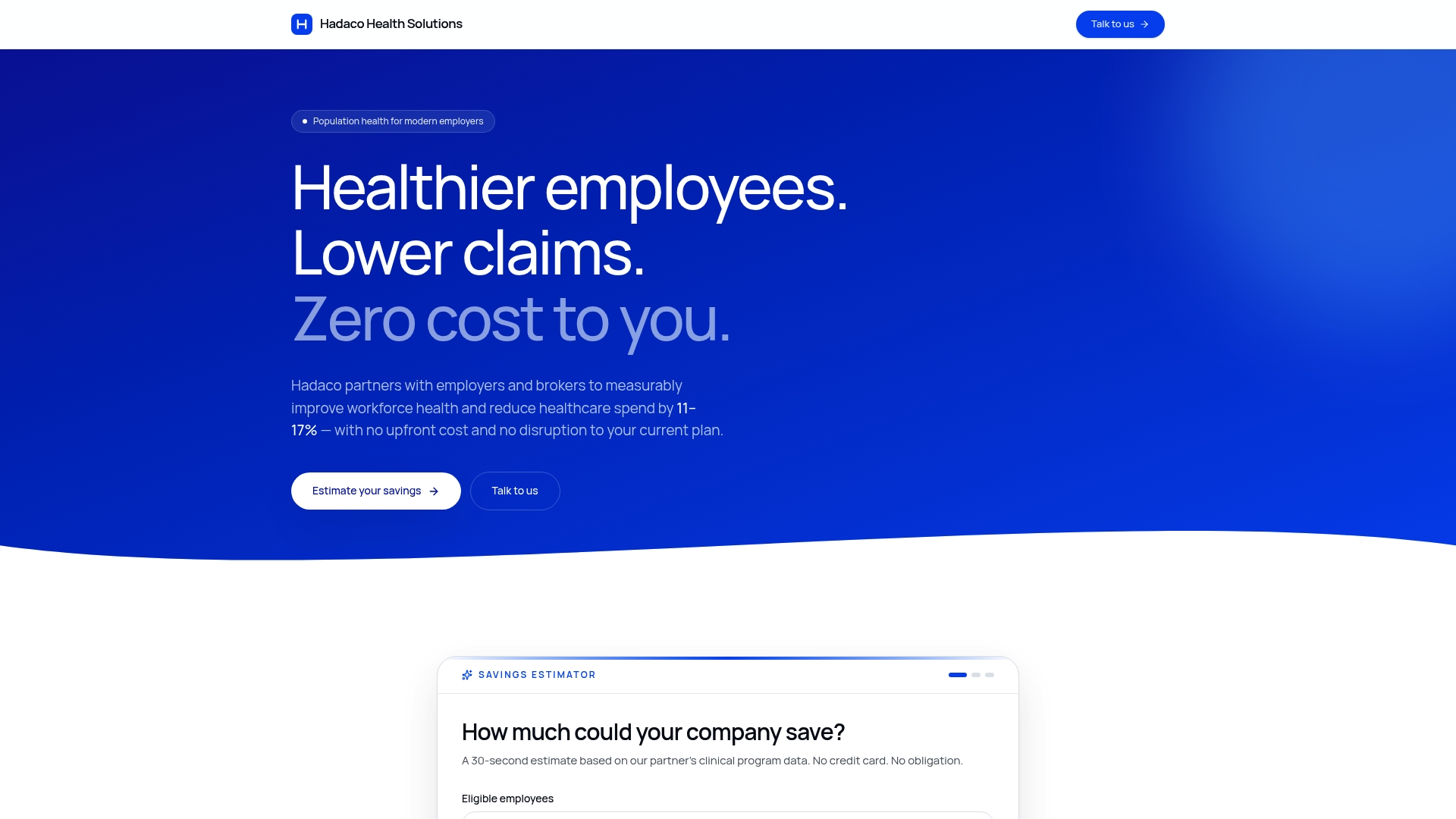
Hadaco maps its approach directly onto what worked across the case profiles above. It links claims and screening data the way Cambridge Public Health's population health work demonstrates. It layers chronic-condition management with mental health and engagement support, following the same combination that drove results at Houston Methodist and Google. And it reports outcomes quarterly instead of leaving you guessing until renewal season. Employers working with Hadaco see average first-year savings of $451 per employee, with a transparent savings estimator showing the math behind that number before you commit to anything.
If you want to see how a program like this would perform against your own claims data, request a savings estimate and a set of comparable case studies through Hadaco's population health platform. It takes one conversation to find out whether your workforce fits the pattern.
Where to Read More on Employer Wellness Case Studies
- Workplace Wellness Programs Study (PMC) — the definitive systematic review of employer wellness evidence.
- IFEBP Case Studies — a curated library of employer program examples across industries.
- SHRM Wellness Case Studies — practitioner-focused examples emphasizing communication and engagement.
- CDC Employers in Action — government-backed tools and implementation case studies.
- Hadaco's ROI resource — for employers who want vendor-provided savings estimates and case examples.
Frequently Asked Questions
Where can HR professionals find reliable wellness case studies employers can actually replicate? Start with the PMC systematic review for academic rigor, then move to SHRM and IFEBP's curated collections, which document practical implementation details that academic reviews often skip.
How long does it take before a wellness program shows measurable results? Most credible case studies show behavior change signals within three to six months, while clinical and cost outcomes typically need six to twelve months of follow-up to become reliable.
What's the biggest mistake employers make when starting a wellness pilot? Skipping baseline measurement. Without a clean before-picture, you can't credibly claim any after-picture improvement, regardless of how good the program feels.
Do smaller employers see the same results as large companies like Google? Case studies like Draper, Inc. show that smaller employers can match large-company engagement levels when communication is consistent and leadership visibly participates.
What role does data linkage play in employer wellness case studies? Linking claims, screening, and demographic data lets programs target subgroups with the worst outcomes, an approach demonstrated in population health work at Cambridge Public Health.
Sources
- Workplace Wellness Programs Study: Final Report - PMC
- Case study: How population health management can help to combat health inequalities through data linkage | Cambridge Public Health
- Wellness: Case Studies - SHRM