
TL;DR:
- Flexible cash stipends, wellness days, peer recognition, and reward marketplaces effectively boost employee participation. Implementing simple programs like wellness stipends and biometric improvement rebates can motivate diverse workforces at lower costs. Ensuring legal compliance, measuring long-term claims outcomes, and pairing incentives with substantive support are key to sustained health improvements.
The incentives that consistently raise employee participation are flexible cash stipends, paid wellness days, choice-based reward marketplaces, and recurring peer recognition. If you want three things to deploy soon, start here:
- Launch a flexible wellness stipend employees can spend on gym memberships, therapy, fitness apps, or ergonomic gear. No receipts, no justification required.
- Run a 6-week team step challenge with digital reward points redeemable through a marketplace. Small prizes (yoga mats, insulated bottles, resistance bands) drive surprising engagement.
- Add two paid wellness days to your calendar year. They cost less than a sick day and signal that recovery is a company value, not a personal indulgence.
A few entities every HR team should know before designing any program: the ACA/DOL/HHS reasonable-alternative requirement governs health-contingent incentives; EEOC and ADA rules require accommodations for employees who cannot meet a health standard; and Hadaco Health Solutions is a population-health partner that integrates with existing benefit plans to deliver measurable outcomes with no upfront fees.
Table of Contents
- 15 Wellness incentives ideas HR teams can use right now
- Why incentives actually change health behavior
- How to design programs that are fair, accessible, and legally sound
- What to measure and when to expect results
- How to launch and sustain a wellness program employees actually use
- What real programs actually produce: examples from the evidence
- When you should bring in a population-health partner
- Key Takeaways
- The incentive is not the program
- Hadaco can help you build a program that pays for itself
- Useful sources for HR teams
15 Wellness incentives ideas HR teams can use right now
The ideas below are grouped by type, with implementation notes, cost cues, and fairness flags. Not every idea fits every workforce. Use the group labels to find your starting point.

Financial and flexible stipends
1. Lifestyle spending accounts (LSAs)
An LSA is an employer-funded account employees spend on any wellness category the plan defines: fitness, mental health, nutrition, ergonomics, or childcare. Unlike an FSA or HSA, it is not tax-advantaged, but it is administratively simple and wildly popular. Budget a moderate amount per employee annually. Frontline workers and desk workers both use them, though the categories they choose differ sharply. Fairness note: make the eligible category list broad enough that a warehouse worker and a remote software engineer both find something useful.
2. Premium discount tied to participation (not outcomes)
Employees who complete a health risk assessment or a set number of wellness activities earn a discount on their health insurance premium. This is a participatory program under ACA rules, which means it carries fewer compliance hurdles than outcome-based designs. A moderate monthly discount can boost registration rates without triggering the full ACA health-contingent framework.
3. HSA or FSA employer contribution as a wellness reward
Deposit a modest amount into an employee's Health Savings Account when they complete a biometric screening or preventive visit. The contribution is tax-advantaged for both parties, and it lands in an account employees already use. Works best for benefits-eligible, full-time staff.
Participation cash and rebates
4. Per-module cash incentives
A randomized clinical trial found that modest per-module incentives totaling moderate potential earnings produced a measurable increase in exercise and self-reported health behaviors. Structure it as moderate cash incentives per completed module across nutrition, stress, activity, and sleep topics. The modular format works especially well for large, distributed employers because employees can complete modules asynchronously.
5. Biometric improvement rebates
Rather than rewarding employees who already meet a health threshold, reward year-over-year improvement. An employee who lowers their blood pressure meaningfully earns the same rebate as one who hits the target outright. Research from Stanford found that greater weekly financial incentives were associated with higher pass rates on biometric measures. Rewarding improvement rather than status is both fairer and more motivating for the employees who need the program most.
Pro Tip: Front-load the reward in a virtual account and deduct for non-completion rather than paying at the end. Loss-aversion designs often produce stronger short-term behavior change than earn-as-you-go models. Just communicate the mechanics clearly upfront or employees will perceive it as a penalty program.
Time-based and schedule rewards
6. Paid wellness days
A few dedicated paid days per year for any health-related purpose: a therapy appointment, a rest day, a preventive screening. No documentation required. The cost is generally less than an unplanned sick day when accounting for productivity loss. Works for desk, hybrid, and frontline workers with appropriate scheduling coordination.
7. Flexible start/end times for health appointments
Allow employees to shift their schedule by 60–90 minutes to attend a medical appointment without using PTO. Zero direct cost. Removes one of the most common barriers to preventive care, particularly for hourly workers who cannot easily leave mid-shift.
8. "Recharge" half-days tied to team challenges
When a team completes a group wellness challenge (step count, hydration, sleep logging), reward the whole team with a shared half-day off. Group rewards build social accountability and make the incentive visible across the organization.

Recognition and social rewards
9. Peer-nominated wellness recognition
A monthly program where employees nominate colleagues who modeled a healthy habit, supported a teammate's mental health, or completed a personal wellness goal. Winners receive a small digital gift card ($25–$50) and a public shout-out in a team channel. Cost is low; the social signal is high. Flexible, personalized recognition consistently outperforms one-size-fits-all discounts in participation surveys.
10. Leaderboards and digital badges for step challenges
For workplace wellness challenges, a visible leaderboard with team rankings and digital badges drives engagement without requiring a large prize budget. The key is making progress visible at a team level, not just individual, so that employees who are not at the top still feel connected to the outcome. Physical prizes like yoga mats, resistance bands, and insulated bottles work well for challenge-based campaigns.
Programmatic supports
11. Subsidized mental health sessions or EAP upgrades
Cover 6–12 therapy sessions per year beyond what the EAP already provides, or increase the EAP session limit and actively promote it. Mental health programs are among the highest-demand benefits in post-pandemic workforces. Pair the benefit with a small participation incentive ($50 gift card for completing an initial intake) to move employees from awareness to use.
12. Preventive care completion incentives
Reward employees with a $75–$100 gift card or HSA contribution for completing an annual physical, a flu vaccination, or a recommended cancer screening. Flu vaccination programs are a low-cost entry point: they are clinically validated, easy to track, and produce measurable claims reductions. Pair with on-site or near-site clinic access to remove the scheduling barrier.
In-kind and experience rewards
13. Ergonomic gear stipends for desk workers
A $100–$200 annual stipend for ergonomic equipment: a standing desk mat, a lumbar support cushion, a monitor riser. Desk workers with ergonomic posture support report fewer musculoskeletal complaints, which shows up in fewer short-term disability claims over time. Easy to administer through an expense reimbursement or a vendor portal.
14. Healthy food and snack programs
Stock break rooms with fresh fruit, nuts, and low-sugar options, or provide a monthly $30–$50 healthy food delivery credit. Works best for on-site and hybrid workers. Frontline and manufacturing environments often respond better to this than to app-based programs.
15. Wellness experience rewards
For high performers or program completers, offer a wellness experience: a massage, a meditation retreat day, a cooking class. These work well as top-tier prizes in a tiered reward structure. Budget $150–$300 per recipient and limit to a defined pool (top 10% of challenge participants, for example) to keep costs manageable.
Why incentives actually change health behavior
Incentives work when they reduce friction, increase perceived value, and reward progress rather than just outcomes; that is the short answer. The behavioral mechanics underneath it are worth understanding because they determine whether your program produces a one-time registration spike or sustained behavior change.
Goal gradients are the most reliable lever. Employees who see themselves getting closer to a goal accelerate their effort as they approach it. Kevin Volpp and colleagues at UPenn's MEHP program recommend rewarding improvement, providing frequent feedback, and using mental accounting to make rewards feel more concrete and salient. An employee who earns a $10 digital badge every week they hit their step goal is more motivated than one waiting for a $520 annual premium discount.
Present bias is the other major force. Employees discount future health benefits heavily. A reward that arrives this week beats a premium reduction that shows up in January. This is why per-module cash incentives and weekly digital rewards outperform annual rebates for driving initial participation.
Stat worth sharing in your next benefits brief: A large employer program found that each additional dollar of weekly financial incentive was associated with a 1.2 percentage point higher pass rate on biometric measures.
Four design takeaways from the behavioral evidence:
- Reward improvement, not just thresholds. Employees who start farthest from a benchmark are the ones who need the program most. A pass/fail design excludes them.
- Make feedback frequent and visible. Weekly progress updates outperform monthly summaries for sustaining engagement.
- Personalize the reward, not just the goal. A choice-based reward marketplace lets employees pick what actually motivates them.
- Keep the incentive salient. A reward employees can see and touch (a gift card, a badge, a prize) is more motivating than an abstract premium adjustment.
How to design programs that are fair, accessible, and legally sound
Compliance is not optional, and it is not as complicated as it looks once you understand the two-track structure of ACA wellness rules.
The ACA/DOL/HHS framework
Under ACA regulations, wellness programs fall into two categories. Participatory programs require only that employees complete an activity (a health risk assessment, a screening, a step challenge). These carry minimal compliance requirements and are open to all employees equally. Health-contingent programs tie the incentive to meeting or maintaining a health standard (a BMI target, a biometric threshold, a tobacco-free status). These trigger the full ACA framework.
For health-contingent programs, federal rules require that employees receive a reasonable alternative standard if they cannot meet the health target due to a medical condition, and that they have at least one opportunity per year to earn the incentive. Compliance with ACA rules does not guarantee compliance with ADA, GINA, or HIPAA, so each framework needs its own review.
ADA and GINA considerations
The EEOC has issued guidance on when wellness programs are "voluntary" under the ADA. Incentives that are so large they effectively coerce participation may cross the line. As a practical rule, keep outcome-based incentives below 30% of the cost of employee-only coverage (the ACA cap) and document the reasonable-alternative process carefully. GINA prohibits collecting genetic information, including family medical history, as part of a wellness program unless the employee provides voluntary, written authorization.
Pro Tip: Before launch, run a legal checklist with your benefits counsel or TPA. The checklist should confirm: (1) program type (participatory vs. health-contingent), (2) reasonable-alternative language in all communications, (3) GINA-compliant data collection, (4) HIPAA-compliant data handling, and (5) ADA accommodation process documented.
Privacy and data handling
Collect the minimum data necessary. Aggregate biometric data at the group level before sharing with HR. Never share individual health data with managers. Use a third-party vendor to administer screenings so that identifiable health information stays outside the employer's direct control. Include a plain-language privacy notice in every program communication.
Legal checklist before rolling out outcome-based incentives:
- Confirm program type and applicable regulatory framework (ACA, ADA, GINA, HIPAA).
- Draft reasonable-alternative language and test it with a non-HR employee for clarity.
- Document the annual opportunity to earn the incentive in plan documents.
- Verify that incentive value stays within ACA caps (30% of employee-only premium; 50% for tobacco programs).
- Establish a data minimization policy and a vendor data-handling agreement.
- Get sign-off from benefits counsel before the first communication goes out.
This article is general information, not legal or benefits advice. Confirm current rules with your benefits counsel or the relevant regulatory agency for your specific program design.
What to measure and when to expect results
Measurement is where most wellness programs fall apart. HR launches a program, tracks registration, and calls it a success. Six months later, no one can say whether health outcomes moved.
Core metrics
- Participation rate: percentage of eligible employees who register. Target 40–60% in year one for a well-promoted program.
- Completion rate: percentage of registered employees who finish the program or earn the incentive. A 60–70% completion rate is a reasonable benchmark.
- Repeat engagement: employees who participate in a second program cycle. This is the truest signal of culture change.
- Clinical proxies: biometric improvements (blood pressure, BMI, cholesterol, HbA1c) measured at annual screenings.
- EAP and behavioral health utilization: an increase in EAP use is a positive signal, not a problem. It means employees are accessing care they previously avoided.
- Claims trends: the metric that matters most to the CFO. Expect 12–24 months before claims data shows a meaningful signal.
Realistic timelines
| Metric | When to expect movement | Sample target |
|---|---|---|
| Participation rate | Weeks 2–4 after launch | 40% of eligible employees |
| Completion rate | End of program cycle | 60–70% of registered employees |
| Biometric improvements | 6–12 months | 5–10% improvement in screened population |
| EAP utilization | 3–6 months | 10–15% increase over baseline |
| Claims cost trend | 18–36 months | Reduction vs. prior trend line |
| ROI | 24–36 months | Positive return on wellness program investment |
For cleaner measurement, run a pilot with one business unit or location as the treatment group and a comparable unit as a control. Even an informal comparison gives you a baseline story to tell leadership. A health risk assessment at program launch gives you the population baseline you need to measure clinical change over time.
How to launch and sustain a wellness program employees actually use
A program that launches well and fades by month three is the most common failure mode. The fix is a structured launch process and a communications cadence that keeps the program visible.
Launch checklist
- Define program goals and success metrics before designing the incentive structure.
- Get stakeholder sign-off from HR leadership, legal/compliance, and finance.
- Select and integrate a vendor or platform (or confirm in-house administration capacity).
- Complete the legal and privacy review (see Section 4 checklist).
- Segment the employee population: desk workers, frontline, hybrid, part-time, high-risk cohorts.
- Build a communications plan with at least four touchpoints before launch and weekly nudges during the program.
- Set pilot KPIs and a review date (typically 60–90 days post-launch).
Segmentation that actually matters
Frontline and hourly workers often cannot access app-based programs during work hours. Design a parallel track: paper-based or SMS-based check-ins, on-site screenings, and physical prizes rather than digital rewards. Part-time employees who are not benefits-eligible still benefit from participation-based incentives that do not require insurance enrollment.
High-risk populations (employees with chronic conditions, high utilizers) need targeted outreach, not just a general email blast. Use health risk assessment data to identify these employees and offer proactive coaching or case management alongside the incentive.
Communications and gamification
- Week 1: leadership announcement with a personal message from the CEO or CHRO. Employees respond to visible executive support.
- Week 2: manager briefing so team leads can answer questions and model participation.
- Ongoing: weekly progress updates, leaderboard refreshes, and peer recognition moments. Keep the program visible in Slack, Teams, or whatever channel employees actually use.
- Mid-program: a "double points" week or a bonus challenge to re-engage employees who have gone quiet.
- Closing: a celebration moment, even a virtual one, that recognizes completers publicly.
Sample announcement framing: Lead with the reward, not the health goal. "Complete any three wellness activities this month and earn $75 in your wellness account" lands better than "Join our new wellness program to improve your health." Show proof points early: "Last year, 68% of participants said they felt less stressed by the end of the program."
What real programs actually produce: examples from the evidence
These examples draw from published research and aggregated employer data, not invented case studies.
Program examples and reported outcomes
| Program type | Incentive design | Key outcome | Lesson for HR |
|---|---|---|---|
| Modular workplace wellness RCT | ~$25 per module | ~3 percentage point increase in exercise for treatment group | Modest incentives produce real but modest effects; set expectations accordingly |
| Large employer biometric program | — | Biometrics improved; short-run cost savings were mixed | Long measurement windows needed; do not promise CFO-level ROI in year one |
| Participatory step challenge | Digital badges, small physical prizes | High registration; sustained engagement through social accountability | Social and visible rewards drive participation even without large cash values |
| Preventive care incentive | $75–$100 per completed screening | Increased preventive visit rates; downstream claims reduction over 2–3 years | Preventive incentives are the lowest-risk, highest-credibility starting point |
What to copy from each:
- Modular RCT: break your program into short, topic-focused modules with a small reward per module. Completion rates are higher when the finish line is close.
- Large biometric program: if you use outcome-based incentives, build in improvement-based rewards alongside threshold rewards. Employees who improve but do not yet meet the standard still deserve recognition.
- Step challenge: pair digital leaderboards with physical prizes. The combination of social visibility and a tangible reward outperforms either alone.
- Preventive care: start here if your program is new. The compliance burden is low, the evidence is strong, and the CFO can see the logic immediately.
When you should bring in a population-health partner
Running a wellness program in-house is feasible for small employers with simple populations. Once the program needs to produce longitudinal outcomes, integrate with claims data, or serve a complex workforce, the case for a specialist partner gets strong quickly.
Decision signals that point toward partnering:
- Your population includes a significant share of employees with chronic conditions (diabetes, hypertension, obesity) where clinical management matters as much as engagement.
- You need outcomes data that connects wellness participation to claims trends, and you do not have an internal analytics team to build that connection.
- Your benefits team is stretched and cannot manage vendor relationships, communications, and measurement simultaneously.
- You want performance-based pricing where the vendor's fee is contingent on demonstrated savings, not a flat retainer.
- You need compliance support across ACA, ADA, GINA, and HIPAA without hiring a dedicated benefits attorney.
What to require from any population-health vendor:
- Outcome measurement tied to claims data, not just participation counts.
- Integration with your existing health plan and benefits administration platform.
- Compliance support documentation for ACA reasonable-alternative requirements.
- Personalization capability: the ability to segment communications and incentives by population cohort.
- Quarterly reporting with named metrics and trend lines, not just annual summaries.
- A clear explanation of how fees are structured and what triggers them.
For corporate wellness program agencies, the difference between a vendor that tracks participation and one that tracks health outcomes is significant. Ask for the specific metrics they report and the methodology they use to attribute claims savings to the program.
Key Takeaways
The most reliable wellness incentives combine flexible financial rewards with visible recognition, clear compliance guardrails, and measurement tied to claims outcomes rather than participation counts alone.
| Point | Details |
|---|---|
| Start with flexible stipends | A $150–$300 LSA or wellness stipend drives participation across diverse workforces faster than any single program. |
| Reward improvement, not just thresholds | Biometric improvement rebates and per-module cash incentives reach the employees who need the program most. |
| Run the legal checklist first | ACA health-contingent programs require reasonable alternatives, annual opportunity, and ADA/GINA review before launch. |
| Measure claims trends over 18–36 months | Participation moves in weeks; clinical and cost outcomes take 18–36 months to show a meaningful signal. |
| Hadaco as a scaling partner | Hadaco delivers evidence-based population-health programs with no upfront fees, quarterly reporting, and average first-year savings of $451 per employee. |
The incentive is not the program
Most HR teams treat the incentive as the program. It is not. A $150 stipend or a step challenge prize is a door opener. What happens after the employee walks through that door determines whether the program produces anything worth measuring.
The organizations that see sustained health improvement and real claims reduction are the ones that pair the incentive with something substantive: a coaching relationship, a clinical touchpoint, a manager culture that makes it safe to take a wellness day. The incentive gets people to show up. The program design keeps them engaged long enough for behavior change to take root.
There is also a fairness problem that most wellness program designs quietly ignore. Programs built around biometric thresholds reward employees who are already healthy and penalize those with chronic conditions, disabilities, or genetic predispositions they cannot control. The ACA's reasonable-alternative requirement exists precisely because Congress recognized this. But compliance with the letter of the rule is not the same as designing a program that actually serves your whole workforce. The most effective programs I have seen are the ones where the incentive structure was built around what employees can control: showing up, completing a module, attending a screening, trying a new habit. Not where they land on a BMI chart.
The other thing HR consistently underestimates is the timeline. Wellness programs are not a Q3 initiative with Q4 results. Claims data takes 18–36 months to show a meaningful signal. If you are measuring success at 90 days, you are measuring the wrong thing.
Hadaco can help you build a program that pays for itself
Most wellness programs cost money and produce a participation report. Hadaco Health Solutions is built to do something different: deliver measurable reductions in healthcare claim costs, with no upfront fees and quarterly reporting that shows exactly what moved.
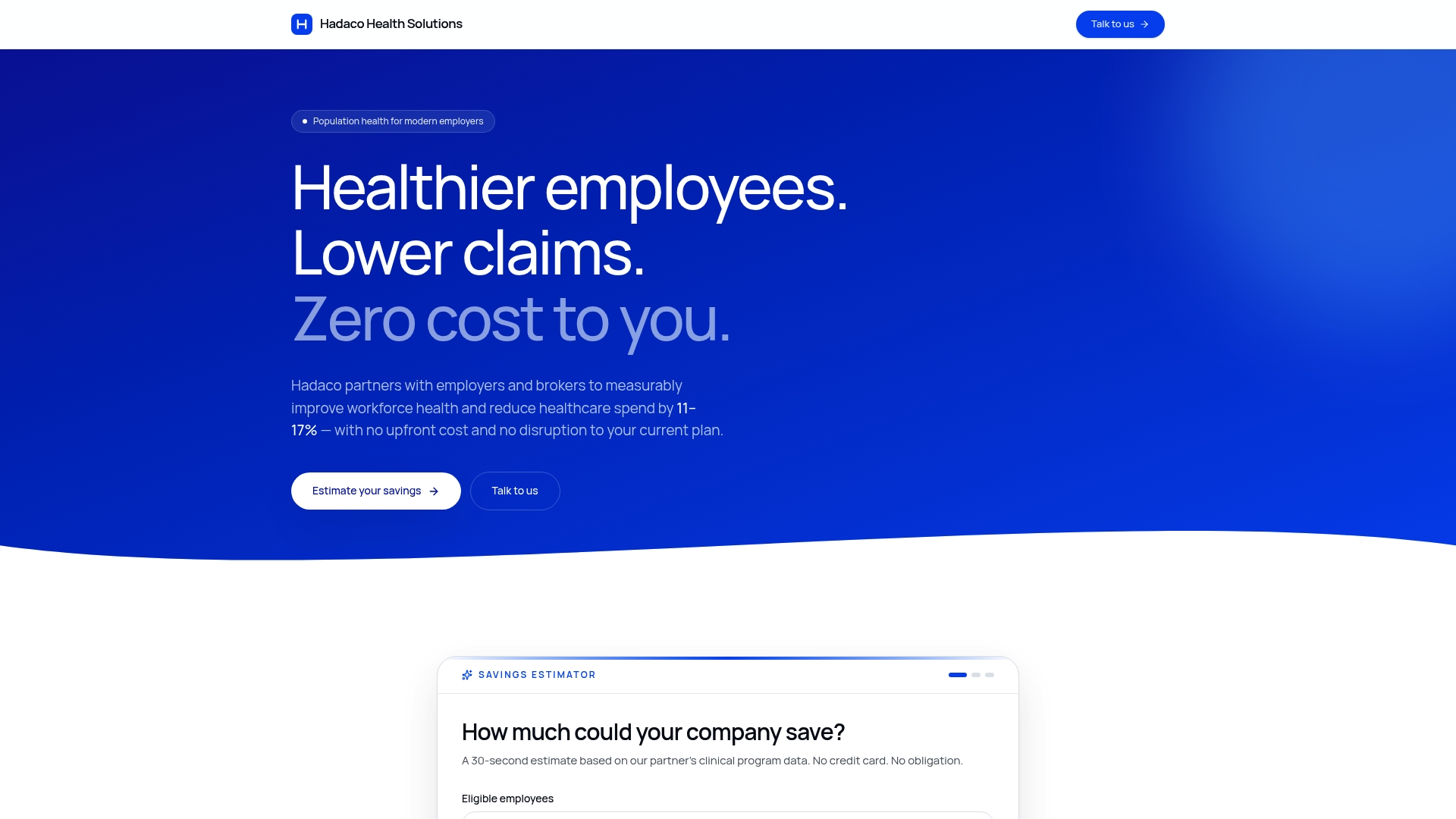
The model is straightforward. Hadaco integrates with your existing health plan without disrupting it, then deploys evidence-based interventions across chronic disease management, preventive care, mental health, and employee engagement. Employers in their first year see an average savings of $451 per employee. The savings estimator on Hadaco's website lets you run your own numbers before committing to anything.
If you are ready to move from a participation-tracking program to one that actually reduces what your company spends on healthcare, book a consultation with Hadaco. Bring your current claims data and your benefits structure. The conversation starts there.
Useful sources for HR teams
- ACA wellness program rules (Healthcare.gov) — the federal framework for employer-sponsored wellness programs and what counts as a qualifying health plan.
- ACA/DOL/HHS reasonable-alternative requirements (Cigna) — plain-language explanation of health-contingent vs. participatory program rules and the annual opportunity requirement.
- Behavioral economics and incentive design (UPenn MEHP) — Kevin Volpp's research on goal gradients, frequent feedback, and mental accounting in health incentive programs.
- Financial incentive effect sizes (Stanford) — large employer analysis quantifying the relationship between incentive magnitude and biometric outcomes.
- Workplace wellness RCT (PMC/JAMA) — randomized clinical trial of a modular workplace wellness program with reported participation and health behavior outcomes.
- CDC workplace health promotion case studies — employer case studies from the CDC on engaging employees in health and wellness programs.
- RAND wellness program analysis (SHRM archive) — RAND Corporation's large-scale analysis of employer wellness program participation and outcomes, archived via SHRM.
- Hadaco Health Solutions — savings estimator, program overview, and consultation booking for employers evaluating a population-health partner.