
Most employers pay between $150 and $1,200 per employee per year for a workplace wellness program, with the bulk of quotes landing between $3 and $12 per employee per month for mid-tier offerings. Pricing splits into three common models: per-employee-per-month (PEPM), flat annual fee, and per-service billing for standalone add-ons like biometric screenings or coaching sessions.
Here's how that breaks down by tier:
- Basic/digital-only: roughly $150 to $300 per employee annually, covering an app, self-guided content, and light tracking.
- Mid-level hybrid: roughly $300 to $600 per employee annually, adding coaching, incentives, and an employee assistance program (EAP) layer.
- Full-service: roughly $600 to $1,200+ per employee annually, with biometric screenings, dedicated account management, and clinical-grade interventions.
One benchmark worth anchoring your budget conversation to: a peer-reviewed review found that well-designed workplace wellness programs can measurably improve health behaviors and clinical markers, which is the evidence base finance teams tend to ask for before approving spend. That's the pivot point for the ROI discussion later in this guide.
Key Takeaways
Wellness program pricing ranges from $150 to $1,200 per employee annually depending on tier, and the strongest budgets pair clear inclusions with a measurable ROI framework.
| Point | Details |
|---|---|
| Three pricing models dominate | PEPM, flat-fee, and per-service billing each fit different program depths and vendor relationships. |
| Add-ons drive real cost | Screenings, incentives, and implementation fees add significant costs beyond the base platform price. |
| Sample budgets scale predictably | A 500-employee full-service program runs roughly $1,040 per employee in year one. |
| ROI needs a range, not a single number | Model low, median, and high savings scenarios using claims, absenteeism, and turnover data. |
| Hadaco ties fees to outcomes | No upfront cost, with fees tied to measured savings and quarterly reporting instead of a flat annual rate. |
Table of Contents
- What Does Wellness Program Pricing Look Like Across Vendors?
- What Add-Ons Push Wellness Program Costs Higher?
- What Do Sample Wellness Budgets Look Like by Company Size?
- How Do You Calculate ROI on a Wellness Program?
- What Questions Should You Ask Vendors About Pricing?
- Can You Lower Wellness Program Costs Without Losing Impact?
- Frequently Asked Questions
- Sources
What Does Wellness Program Pricing Look Like Across Vendors?
Vendors rarely price the same way twice, which is exactly why comparing quotes feels harder than it should. Three models dominate the market. PEPM (per-employee-per-month) charges a set rate multiplied by your enrolled headcount, billed monthly or annually as PEPY. It scales cleanly and is the default for platform-based programs. Flat-fee pricing charges one negotiated price regardless of enrollment, common with smaller employers or bundled broker deals. Per-service pricing charges piece by piece: $40 to $150 per biometric screening, $75 to $200 per coaching session, and so on, which suits companies that want to test specific interventions before committing to a full platform.
Industry benchmarks show a wide spread. Vendor analyses commonly cite a range of roughly $150 to $1,200 per employee per year, and that spread reflects genuinely different products, not just markup.
| Tier | Typical Annual PEPY | What's Usually Included |
|---|---|---|
| Basic/digital | $150–$300 | App access, self-guided content, basic tracking, minimal reporting |
| Mid-level hybrid | $300–$600 | Health assessments, coaching, EAP access, incentive campaigns |
| Full-service | $600–$1,200+ | Biometric screenings, dedicated coaching, chronic disease management, quarterly analytics |
A few factors push these ranges up or down for your specific quote:
- Headcount: vendors typically offer volume discounts once you cross 500 or 1,000 enrolled employees.
- Geography: multi-state or multi-country populations add licensing and localization costs.
- Customization: white-labeled platforms or custom incentive structures run higher than off-the-shelf configurations.
- Cohort targeting: programs built around specific high-risk populations (diabetes, cardiometabolic risk) often price per-cohort rather than per-employee-wide.
Digital-first programs generally carry lower entry costs and deploy faster, while full-service models require more implementation work before you see a return, according to research on workplace wellness program design.
What Add-Ons Push Wellness Program Costs Higher?
The quoted PEPM rate is rarely the whole story. Most proposals separate the platform license from a handful of line items that add up fast once you multiply by headcount.
- Implementation/setup fees: typically $2,000 to $15,000 one-time, scaled to integration complexity.
- Biometric screenings: $40 to $150 per employee, often billed per-service rather than folded into PEPM.
- Coaching or therapy sessions: $75 to $200 per session, especially for licensed clinical staff.
- Incentive/rewards budgets: commonly $100 to $500 per employee annually, separate from the platform fee.
- Translation or multi-site support: flat fees per language or per location, frequently $1,000 to $5,000 each.
- Reporting and analytics upgrades: some vendors charge extra for quarterly or custom dashboards beyond a standard quarterly summary.
An older but still-referenced Goetzel survey of employer wellness programs documents these line items as a standard feature of most vendor budgets, not an exception.
Then there's the cost nobody puts on the invoice: HR administrative time. Someone has to manage enrollment, field employee questions, and coordinate between your benefits broker and the vendor. Budget for that time explicitly, even if it never shows up as a vendor fee.

Here's how small numbers compound: a $75 incentive add-on across a 1,000-employee population is $75,000 a year, easy to overlook when you're staring at a per-employee price tag that looks modest.
Pro Tip: Ask vendors to cap incentive-fund liability during your first year, and negotiate a pilot period covering only your highest-risk cohort before rolling incentives out company-wide. It limits your downside while you validate engagement.
What Do Sample Wellness Budgets Look Like by Company Size?
Numbers mean more when you can see them applied to a real headcount. Here are three worked examples using mid-range benchmark pricing.
Small employer, 80 employees, mid-tier hybrid program:
- Base platform: $450 PEPY × 80 = $36,000
- Incentive budget: $150 per employee × 80 = $12,000
- Screenings: $60 per employee × 80 = $4,800
- Implementation (year one only): $3,500
- HR admin time (estimated): $2,000 Total year one: roughly $58,300, or about $729 per employee.
Mid-size employer, 500 employees, full-service program:
- Base platform: $700 PEPY × 500 = $350,000
- Incentive budget: $200 per employee × 500 = $100,000
- Screenings: $90 per employee × 500 = $45,000
- Implementation: $10,000
- HR admin time (estimated, partial FTE): $15,000 Total year one: roughly $520,000, or about $1,040 per employee.
Large employer, 3,000 employees, mid-level hybrid with volume discount:
- Base platform: $380 PEPY (volume-discounted) × 3,000 = $1,140,000
- Incentive budget: $120 per employee × 3,000 = $360,000
- Screenings: $50 per employee × 3,000 = $150,000
- Implementation: $15,000
- HR admin time (estimated, one FTE equivalent): $80,000 Total year one: roughly $1,745,000, or about $582 per employee.
| Company Size | Program Depth | Total Year-One Cost | Per-Employee Cost |
|---|---|---|---|
| 80 employees | Mid-tier hybrid | ~$58,300 | ~$729 |
| 500 employees | Full-service | ~$520,000 | ~$1,040 |
| 3,000 employees | Mid-tier (volume discount) | roughly $1,745,000 | ~$582 |
Build in a 10 to
contingency line for unplanned add-ons, and if budget is tight, pilot the program with one department or cohort before committing to the full headcount. It's the same logic private equity firms apply to any capital commitment: test the model at small scale, then expand once you have real utilization data.How Do You Calculate ROI on a Wellness Program?
Start with a simple template: (Estimated savings − Total program cost) ÷ Total program cost = ROI. Estimated savings typically combine three buckets: reduced medical claims, reduced absenteeism, and reduced turnover-related hiring costs.
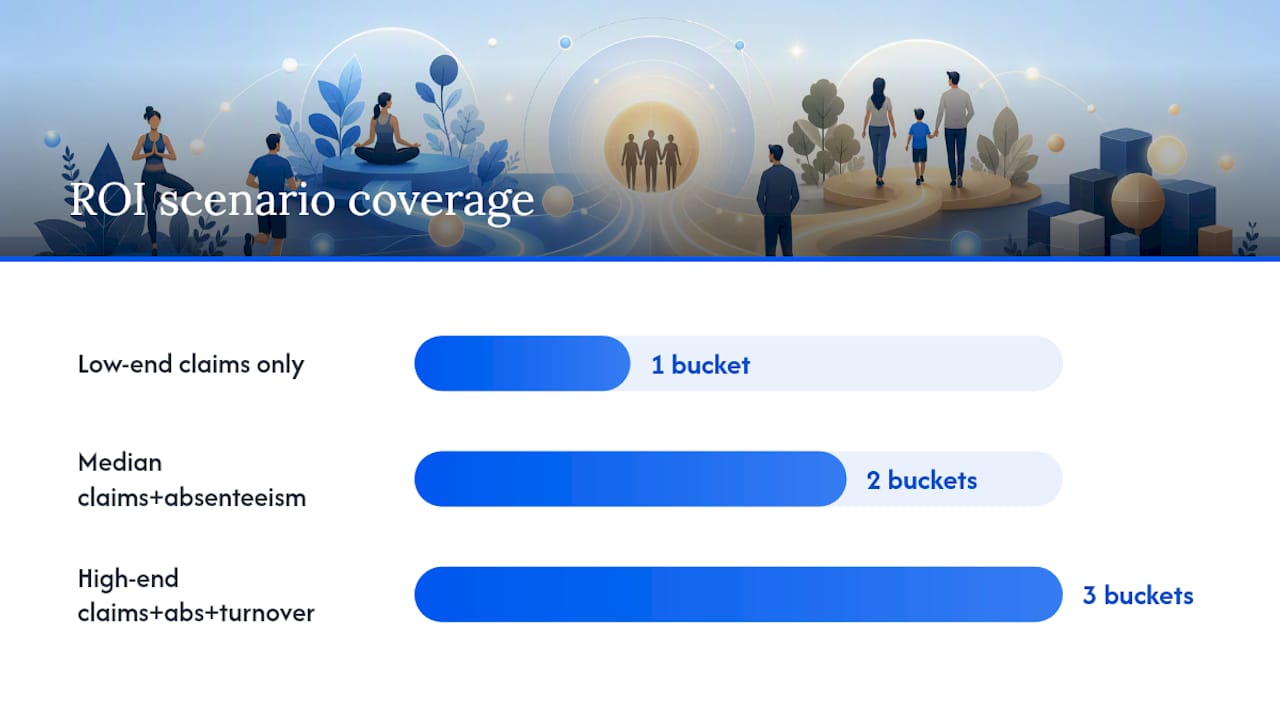
Run three scenarios rather than one number. A low-end scenario might assume savings only cover claims trends among high-risk enrollees. A median scenario adds absenteeism reduction. A high-end scenario includes retention gains, which are real but harder to attribute cleanly to the wellness program alone.
SHRM's research summary on wellness ROI notes that ROI estimates vary significantly depending on program design and how rigorously outcomes get measured; a program with strong biometric screening data will produce more defensible numbers than one relying on self-reported engagement alone. Separately, Health Affairs research on workplace wellness outcomes found that some employer interventions are associated with reductions in medical costs and absenteeism, though results vary by program design and study rigor, so treat any single ROI figure as a range rather than a guarantee.
Some savings are easy to track quarter over quarter:
- Claims trends by cohort (diabetes management, cardiometabolic risk)
- Screening participation and follow-through rates
- Absenteeism days, compared year over year
Others, like presenteeism and long-term retention effects, take 18 to 36 months to show up clearly. Report quarterly on engagement and utilization even before claims data stabilizes. It keeps leadership oriented on leading indicators while the lagging ones catch up. For a deeper walkthrough of the exact metrics to track, see this corporate wellness ROI guide.
What Questions Should You Ask Vendors About Pricing?
Every vendor proposal looks clean until you ask the second question. Build your evaluation around cost drivers, not marketing copy.
Start with a checklist mapped to what actually moves your total spend:
- What's included in the base PEPM rate, and what triggers a per-service charge?
- How does pricing scale as headcount grows or shrinks mid-contract?
- What reporting cadence is standard, and what costs extra?
- Does the platform integrate with your existing benefits administration system, and is that integration billed separately?
- What's the implementation timeline, and who owns delivery of key milestones?
Then get specific in the room:
- What happens to pricing at renewal, and is there a rate lock for year two?
- Are volume discounts automatic at certain headcount thresholds, or negotiated case by case?
- Is the incentive budget capped, or does it scale uncapped with participation?
- What's included in "implementation," and what counts as a change order?
- Can we start with a pilot cohort before committing to full enrollment?
Watch for red flags: uncapped per-service fees with no ceiling, vague reporting language ("regular updates" instead of a defined quarterly cadence), and implementation timelines with no service-level agreement attached. If a vendor won't commit to specific deliverables and dates in writing, that's worth noting before you sign.
Your negotiation playbook should center on three levers: a pilot period with reduced commitment, incentive-budget caps for year one, and where possible, a performance-based fee structure tied to measured savings rather than flat licensing. For context on how full-service agencies typically structure these terms, this comparison of corporate wellness agencies is worth a read before your first vendor call.
Can You Lower Wellness Program Costs Without Losing Impact?
Yes, but the cuts that work are targeted, not across-the-board. Starting with a digital-only platform or layering wellness into an existing EAP contract keeps entry costs near the low end of the $150 to $1,200 benchmark range. Piloting with your highest-risk cohort, rather than your full headcount, concentrates spend where it's most likely to produce measurable savings.
On staffing, outsourcing program delivery or using a reseller model often lowers fixed costs compared to hiring a dedicated in-house coordinator, since you avoid a full salary and benefits load for a role that may not need full-time attention at smaller headcounts.
One trade-off to flag honestly: cutting incentive budgets to save money tends to depress participation, and participation is what drives the engagement outcomes that make the ROI math work in the first place.
A pricing philosophy built on outcomes, not upfront risk
Most vendor pricing models ask employers to pay before proving anything works. After years watching employers weigh PEPM quotes against uncertain ROI, the model that actually holds up ties fees to measured savings, not projected ones.
Get a Savings Estimate Before You Commit to a Budget Line
Every model in this guide assumes you're paying upfront and hoping the ROI math works out later. Hadaco flips that structure: programs launch with no upfront fees, and fees are tied to demonstrated healthcare savings and engagement outcomes, not a flat PEPM rate you're locked into regardless of results.
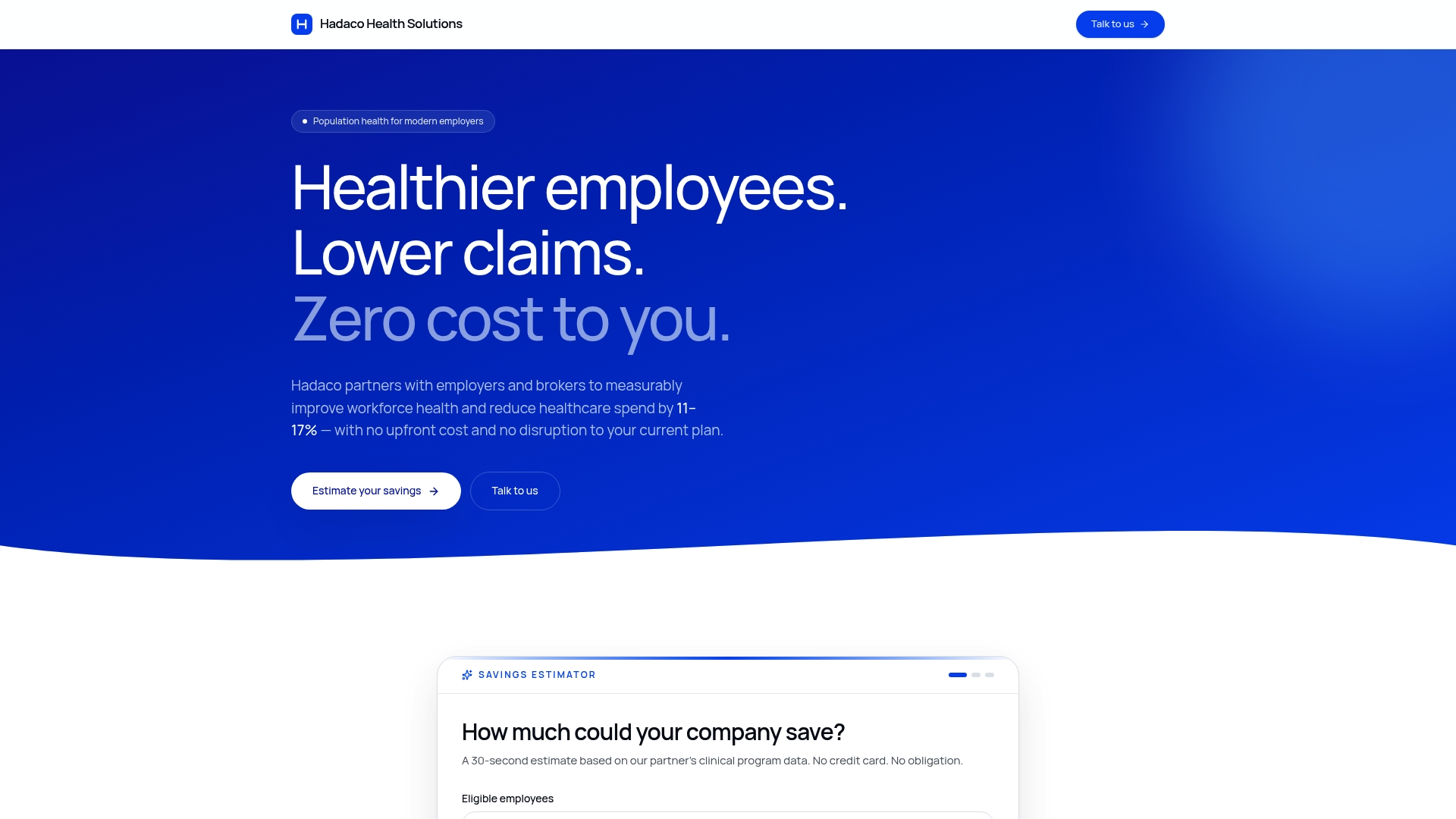
Hadaco's pricing typically includes:
- Evidence-based interventions for chronic disease, preventive care, and mental health, integrated with your existing benefit plans without disruption
- Quarterly reporting and a transparent savings estimator, so you can track outcomes the same way finance tracks any other line item
Employers working with Hadaco have seen an average of $451 saved per employee in their first year. If you're building a budget request and want real numbers instead of benchmark ranges, request a savings estimate from Hadaco before you finalize next year's proposal.
Frequently Asked Questions
How much does a wellness program cost per employee per month? Most mid-tier programs run $3 to $12 per employee per month depending on scope. Basic digital platforms fall below that range, while full-service programs with screenings and dedicated coaching can exceed $15 to $20 monthly.
What's the average cost of a coaching session in a wellness program? Individual coaching sessions typically cost $75 to $200 each when billed per-service, though many mid-level and full-service packages bundle a set number of sessions into the annual PEPM rate.
What are the biggest budgeting pitfalls with wellness program pricing?
Are there drawbacks to cheaper, digital-only wellness programs? Digital-only platforms lower entry costs and deploy quickly, but they generally lack the clinical screenings, coaching, and cohort-specific interventions that drive the strongest documented health outcomes, which can limit measurable ROI over time.
How do I justify wellness program spend to a CFO? Build a range, not a single figure: model conservative, median, and optimistic savings scenarios tied to claims trends and absenteeism data, and report quarterly so leadership sees trend lines rather than a single annual claim.
Sources
Peer-reviewed evidence on outcomes (PMC), ROI methodology (SHRM), cost impact (Health Affairs), and firm-size cost data (Statista).
- PMCID article (workplace wellness evidence)
- SHRM — Real ROI of employee wellness programs
- Health Affairs — workplace wellness outcomes research