
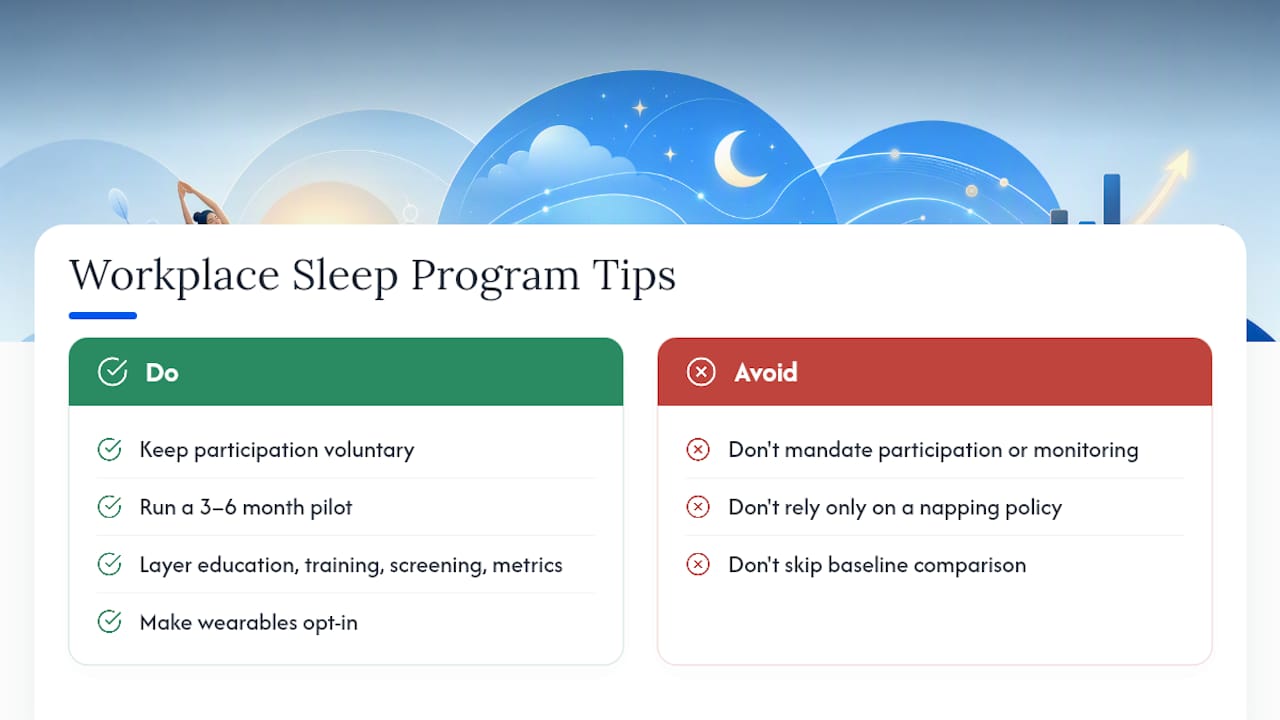
A voluntary, multi-component workplace sleep program, one that combines employee education, supervisor training, screening and referral for sleep disorders, and optional objective monitoring, delivers the best balance of measurable impact and employee buy-in. Fatigued employees cost employers between $1,200 and $3,100 per person per year in lost productivity, and that number alone justifies a serious look at program design. NIOSH and CDC guidance both point toward the same conclusion: single-tactic efforts, like a lunch-and-learn on sleep hygiene, rarely move the needle on their own. Employers that want durable results typically pair internal design work with a partner like Hadaco to handle measurement and reporting without adding headcount.
Start with these four pillars before you build anything else:
- Education built around behavior change, not just slides about caffeine cutoffs
- Supervisor training so managers know how to support rest without policing it
- Screening and referral pathways for undiagnosed sleep apnea or insomnia
- A measurement plan in place before day one, so you can prove what worked
Key Takeaways
A voluntary, multi-component workplace sleep program that pairs education, supervisor training, screening, and measurement produces stronger, more defensible results than any single-tactic effort.
| Point | Details |
|---|---|
| Multi-component beats single-tactic | Combine education, supervisor training, screening/referral, and optional monitoring rather than relying on one workshop. |
| Productivity stakes are real | Fatigued employees cost employers $1,200 to $3,100 per person annually in lost output, per NIH-linked research. |
| Voluntary participation drives engagement | Mandatory monitoring triggers resistance; opt-in models with modest incentives sustain higher participation. |
| Measure before and after | Use validated tools like the PSQI or ISI alongside presenteeism and safety metrics, starting with a baseline. |
| Hadaco offers a turnkey path | Employers lacking internal evaluation capacity can pair sleep programming with Hadaco's no-upfront-fee, outcome-based population health model. |
Primary Sources and Further Reading
- Employee Sleep and Workplace Health Promotion (NIH/PMC): systematic review covering productivity loss estimates and program effectiveness.
- Workplace interventions to promote sleep health (CDC/NIOSH): guidance on multi-component design and follow-up timing.
- Workplace interventions to promote sleep health, narrative review (PMC): review of 47 studies on education, health promotion, and environmental interventions.
- Mobile app and sensor RCT in manufacturing (PLOS One): randomized trial measuring sleep and presenteeism outcomes.
- Evaluation of The REST of Your Life program (PMC): quasi-experimental hospital program evaluation with 12-month follow-up.
- Privacy concerns in workplace sleep tracking (PMC): ethical considerations for consent and data handling in monitoring programs.
Table of Contents
- What Does the Research Say About Workplace Sleep Programs?
- What Core Components Belong in a Corporate Sleep Program?
- How Do You Implement a Workplace Sleep Program Step by Step?
- What Should You Measure to Prove the Program Works?
- What Do Real Workplace Sleep Programs Show?
- What Mistakes Undermine Workplace Sleep Initiatives?
- How Does Hadaco Approach Workplace Sleep and Population Health?
- Get Measurable Sleep Program Results Without the Guesswork
- Frequently Asked Questions
- Sources
What Does the Research Say About Workplace Sleep Programs?
Peer-reviewed evidence on workplace sleep interventions is mostly encouraging, but it's not uniform, and pretending otherwise does employers a disservice. A narrative review covering 47 articles on workplace sleep interventions found that education, health-promotion activities, and environmental changes produced self-reported improvements in sleep duration and quality across most studies. The catch: most of those studies relied on self-report measures, varied wildly in design, and covered different industries and shift patterns, which makes it hard to say any single approach will transfer cleanly to your workforce.
The stronger evidence comes from studies that combined intervention types and measured outcomes objectively. A randomized controlled trial conducted in a manufacturing setting enrolled 215 employees who used a noncontact sleep sensor paired with an app that delivered weekly coaching advice. Over three months, participants who engaged consistently with the program showed measurable sleep improvements and statistically significant gains in presenteeism, the productivity lost while physically present but under-functioning. That distinction matters for how you frame ROI to finance leadership: this wasn't just "people felt better." Productivity gains showed up in validated measures, and they were concentrated among people who actually used the tool.
Fatigued workers cost employers an estimated $1,200 to $3,100 per person annually in lost output. Sleep interventions that keep employees engaged can recover a meaningful share of that loss, but only among the people who stick with the program.
Here's what separates programs that work from programs that fizzle after the launch email:
- Follow-up window matters. Most effective interventions track outcomes over 3 to 6 months, long enough to see whether behavior change survives past the novelty phase.
- Multi-component beats single-tactic. Programs pairing education with screening, supervisor support, and environmental changes consistently outperform standalone workshops.
- Objective measurement changes the story. Studies using actigraphy or validated instruments alongside self-report data produce more credible, board-ready results.
- Engagement is uneven. Nearly every study shows benefits concentrated among people who actually participate consistently, not the full eligible population.
Limitations are worth naming plainly. Shift workers respond differently than standard daytime staff, and a program designed around a 9-to-5 office culture can fall flat on a rotating manufacturing line. Sample sizes in many trials are modest, and few studies run controlled comparisons past 12 months. None of that undermines the case for action. It does mean employers should expect variable results by department and build evaluation into the plan from the start rather than bolting it on afterward.
What Core Components Belong in a Corporate Sleep Program?
An effective program has layers. Strip any one of them out and you're left with a wellness webinar, not a program with a business case behind it.
Education and workshops. Content should go beyond "avoid screens before bed." The strongest programs borrow structure from cognitive behavioral therapy for insomnia (CBT-I), including sleep restriction techniques, stimulus control, and goal setting with follow-up coaching. A single 45-minute session on sleep hygiene rarely produces lasting change; a short series with homework and check-ins does.
Supervisor-level training and support. Managers who understand how to support rest, without turning it into a compliance exercise, amplify everything else in the program. Training that teaches supervisors to recognize fatigue signs and adjust workloads accordingly has been linked to improved perceptions of support and, in combination with employee-level interventions, reduced workplace accidents.
Screening and referral. Undiagnosed sleep apnea and chronic insomnia are common and expensive; a short validated screener (paired with a clear referral pathway to a physician or sleep specialist) catches cases that no amount of sleep-hygiene education will fix.
Optional objective monitoring. Wearables and actigraphy can validate self-reported improvements, but participation has to be opt-in. Employees who feel tracked without consent disengage fast, and that dynamic shows up repeatedly in research on privacy and workplace sleep tracking.
Environmental and scheduling changes. Lighting adjustments, nap policies for shift workers, and flexible scheduling or telecommuting options are recommended by the Harvard Medical School Division of Sleep Medicine as employer-level levers that support circadian health without requiring individual behavior change.
Integration with existing health promotion. Sleep, physical activity, and weight management influence each other. Programs that connect sleep initiatives to existing fitness or nutrition efforts tend to see better cross-participation than sleep programs launched in isolation.
On delivery format: blended designs, a mix of live sessions and self-paced digital content, tend to outperform pure self-paced online courses for sustained behavior change, largely because they include a human touchpoint for accountability. In-person instructor-led training works well for supervisor cohorts but doesn't scale efficiently across a large distributed workforce. Live virtual sessions split the difference reasonably well for most mid-sized employers.
Pro Tip: Skip standalone sleep-hygiene slide decks. Build workshops around one goal-setting exercise per session, something as simple as a personal "sleep recipe" employees commit to in writing, and follow up on it two weeks later. That single follow-up touch is often the difference between a workshop people forget and one that changes behavior.
A sample workshop sequence for a pilot cohort:
- Session one (45 minutes): Baseline assessment using a validated scale, introduction to sleep architecture, and one personal goal-setting exercise per participant.
- Session two (30 minutes, two weeks later): Group check-in on goals, troubleshooting barriers (shift schedules, caregiving, screen habits), and stimulus-control techniques.
- Session three (30 minutes, one month later): Review of self-reported progress, referral pathway reminder for anyone flagging chronic symptoms, and reinforcement of supervisor support resources.
How Do You Implement a Workplace Sleep Program Step by Step?
Moving from "we should do this" to a running pilot takes a sequence, not a single kickoff meeting. Here's a workable path:
- Align leadership and legal early. Confirm data-handling policies, especially if any monitoring component is involved, before you announce anything to employees.
- Define the pilot's scope and audience. Decide whether you're starting with one department, one shift type, or a voluntary company-wide cohort. Smaller, well-measured pilots beat sprawling ones you can't evaluate cleanly.
- Design the intervention mix. Combine at minimum education, supervisor training, and a screening/referral pathway; add monitoring only as an opt-in layer.
- Set enrollment strategy. Voluntary enrollment with modest incentives (a wellness credit, a raffle entry, points toward an existing rewards program) consistently outperforms mandatory participation.
- Build the consent and privacy framework. Spell out what data gets collected, who sees it, whether it's aggregated or individual, and how long it's retained.
- Train supervisors before employee rollout. Managers need the vocabulary and boundaries before their teams start asking questions.
- Launch with a clear communications plan. Different departments need different messaging; a warehouse shift crew and a corporate office team won't respond to the same pitch.
- Run the pilot for 3 to 6 months. This window is long enough to see behavior change stabilize (or fade) without stalling the broader rollout decision.
- Collect baseline and follow-up data on a fixed schedule. Don't wait until the pilot ends to start measuring.
- Debrief and decide on scale. Use pilot data to adjust before expanding company-wide.
That's usually enough volume to generate meaningful data without overextending program staff.
Pro Tip: Structure any monitoring component so raw data belongs to the employee, not the employer. Report only aggregated, de-identified trends to leadership. Programs that follow this pattern see measurably better sustained engagement than programs where employees suspect individual data is being reviewed by managers, a concern documented in research on workplace sleep tracking ethics.
Communication matters more than most HR teams budget for. Shift workers need messaging framed around fatigue and safety, not "wellness" in the abstract. Salaried office staff often respond better to productivity and focus framing. And any sleep initiative should be positioned as an extension of existing benefits, tied explicitly to your EAP, your existing wellness challenges, or a broader mental health program, rather than launched as a standalone initiative competing for attention.
What Should You Measure to Prove the Program Works?
You need a baseline before you can claim anything changed. That means collecting sleep, productivity, and safety data before the pilot launches, then repeating measurement at fixed intervals, typically 1, 3, 6, and 12 months out.
| Outcome category | Recommended instrument | Frequency | Who collects it |
|---|---|---|---|
| Sleep quality | Pittsburgh Sleep Quality Index (PSQI) | Baseline, 3-month, 6-month | HR or occupational health staff |
| Insomnia severity | Insomnia Severity Index (ISI) | Baseline, 6-month | Occupational health or vendor |
| Objective sleep data | Actigraphy or wearable device (opt-in) | Continuous, aggregated monthly | Vendor or program administrator |
| Presenteeism | Work Limitations Questionnaire (WLQ) or WHO-HPQ | Baseline, 3-month, 6-month, 12-month | HR |
| Absenteeism | Payroll/HRIS records | Monthly | HR |
| Safety incidents | OSHA recordable incident logs | Ongoing | Occupational safety team |
A basic ROI calculation looks like this: (productivity gain per employee × number of engaged participants × average labor cost) minus total program cost. If your pilot shows a 10% improvement in presenteeism scores among 100 engaged employees earning an average $60,000 salary, that translates into meaningful recovered output, but only if you can attribute the change to the program rather than seasonal variation or unrelated policy shifts. Run the same measurement in a comparison group or department where possible, and control for obvious confounders like schedule changes or layoffs during the pilot window.
Sample survey questions worth including in your baseline and follow-up instruments:
- "On average, how many hours of sleep do you get on a typical work night?"
- "How often does fatigue interfere with your ability to concentrate at work?"
- "Have you felt supported by your manager in managing your workload and rest?"
- "Would you recommend this program to a colleague?"
What Do Real Workplace Sleep Programs Show?
The REST of Your Life program, delivered in a hospital setting, used four one-hour classroom sessions built around personalized goal-setting tools called "Rest Recipes." A quasi-experimental evaluation found statistically significant improvements in sleep and mental health measures, with outcomes tracked up to 12 months after broader dissemination. Participant feedback stayed favorable even after the program moved beyond its original pilot unit, a sign that the goal-setting format traveled well across departments.
The manufacturing sensor-and-app RCT enrolled 215 applicants and ran for three months, pairing a noncontact sleep sensor with weekly coaching delivered through an app. Sleep improvements translated into statistically significant presenteeism gains, but the effect was concentrated among employees who engaged consistently with the coaching feedback, not the full enrolled group.
Supervisor-focused total worker health interventions combined manager training with employee-level tracking and reported improved perceptions of supervisor support and reduced sleep-related impairment. In occupational samples, this combination has been linked to indirect reductions in workplace accidents and injuries, suggesting the safety case for sleep programs may be as strong as the productivity case in physically demanding industries.
Across these programs, the common thread isn't the specific curriculum. It's the pairing of a personal goal-setting mechanism with some form of ongoing feedback, whether that's a coach, a supervisor, or a follow-up session two weeks later.
What HR teams should take from these three examples: goal setting drives behavior change more reliably than information alone, supervisor involvement extends the reach of any employee-level intervention, and objective feedback loops (sensors, coaching, follow-up sessions) consistently correlate with the strongest results.
What Mistakes Undermine Workplace Sleep Initiatives?
Most failed sleep programs share the same handful of mistakes, and nearly all of them are avoidable with better planning up front.
- Mandatory monitoring. Requiring wearables or tracking without an opt-in choice triggers resistance and tanks honest reporting.
- Education without follow-up. A single seminar with no goal-setting or check-in rarely changes behavior past the first week.
- Skipping supervisor training. Employee-level interventions underperform when managers don't understand or reinforce the program's goals.
- Ignoring shift realities. A program designed around daytime office schedules will flop with rotating-shift or overnight staff unless you adapt timing and content.
- No baseline data. Without a "before" measurement, you can't credibly claim the program caused any change you observe later.
During evaluation, watch for these red flags: participation that drops sharply after month one, no objective measurement layered on top of self-report surveys, and no attempt to connect program data to business metrics like absenteeism or safety incidents. If leadership never models the behavior, staying off email after hours, taking real breaks, that gap between policy and practice will undercut even a well-designed program.
How Does Hadaco Approach Workplace Sleep and Population Health?
Hadaco builds sleep programming into a broader population health strategy rather than treating it as a standalone perk. That means an employer running a sleep initiative through Hadaco gets it integrated with existing chronic disease management, preventive care outreach, and engagement tracking, without disrupting current benefit plans or requiring a rip-and-replace of existing vendors.
The core pitch for employers weighing an internal build versus a vendor partnership comes down to resourcing and measurement capacity:
- No upfront fees, with fees tied to demonstrated outcomes rather than a flat retainer
- A savings estimator that models expected impact before you commit resources
- Quarterly reporting so HR and finance see measurable progress rather than waiting for an annual review
- Integration with existing chronic disease and preventive care programs, avoiding a fragmented benefits landscape
Companies working with Hadaco have reported average first-year savings of $451 per employee, alongside improved engagement and retention, though results vary by workforce composition and existing benefit design. If your organization has fewer than 500 employees or lacks a dedicated occupational health team, running a fully internal pilot with proper measurement infrastructure gets expensive fast. That's typically the threshold where a performance-based partner model starts to make more financial sense than building evaluation capacity from scratch.
Quick Pilot Timeline and Budget Considerations
A 12-week pilot structure works for most first attempts:
- Weeks 1 to 2: Leadership alignment, legal review, and baseline data collection
- Weeks 3 to 4: Supervisor training and program launch communications
- Weeks 5 to 10: Active intervention period (education sessions, screening referrals, optional monitoring)
- Weeks 11 to 12: Follow-up data collection and debrief
Budget line items to plan for:
- Internal staff time for HR and occupational health coordination
- Vendor fees if partnering with an external program provider
- Device costs, if objective monitoring is included and not already vendor-supplied
- Participation incentives (credits, raffle entries, points toward existing rewards)
- Evaluation costs, including survey licensing for validated instruments like the PSQI
Scaling from pilot to company-wide rollout usually means budget shifts from flat per-participant costs toward negotiated vendor rates, and timelines stretch from a single 12-week cycle to rolling cohorts launched quarterly.
How to Judge Whether a Sleep Study Applies to Your Workforce
Before adopting any program model wholesale, run it through a quick quality check:
- Design type. Randomized controlled trials carry more weight than pre/post comparisons with no control group.
- Sample size and duration. A three-month study with 200 participants tells you more than a two-week pilot with 20.
- Measurement type. Objective data (actigraphy, wearables) or validated instruments (PSQI, ISI) beat pure self-report.
- Population match. A program validated on office workers may not transfer cleanly to a rotating-shift manufacturing floor.
Watch for studies that report only self-reported productivity gains with no objective backup, that's the most common overstatement in this space. Prioritize programs and vendors that publish external evaluation results rather than internal marketing claims alone.
What I'd Tell Any Employer Starting This Process
If you're deciding where to start, start small and voluntary. Run a pilot with education, supervisor training, and a screening pathway, add optional monitoring only if your workforce is comfortable with it, and measure sleep quality, presenteeism, and safety incidents from day one. Track engagement as closely as outcomes. The evidence is consistent on one point: benefits concentrate among people who actually participate, so your enrollment and communication strategy matters as much as the curriculum itself.
Get Measurable Sleep Program Results Without the Guesswork
Building an internal pilot from scratch means assembling survey tools, training supervisors, negotiating device costs, and building an evaluation framework, all before you know whether it will move the needle for your workforce. Hadaco gives employers a faster path: sleep programming integrated into a broader population health strategy, with no upfront fees and cost tied directly to outcomes you can see in quarterly reporting.
Employers working with Hadaco get a transparent savings estimator upfront, so finance leadership sees projected impact before committing budget, rather than waiting a full fiscal year to find out if the investment paid off. That same infrastructure extends beyond sleep into chronic disease management and preventive care, meaning a sleep initiative doesn't sit in isolation from the rest of your benefits strategy. If your team lacks the internal bandwidth to run validated instruments, coordinate supervisor training, and track ROI quarter over quarter, that's exactly the gap Hadaco fills. Visit Hadaco to run your savings estimate and book a consultation to scope a pilot for your workforce.
Frequently Asked Questions
Should workplace sleep programs be mandatory or voluntary? Voluntary, incentive-based programs consistently achieve higher sustained participation than mandatory ones. Requiring participation, especially with any monitoring component, tends to generate resistance and unreliable self-report data.
How long should a workplace sleep program pilot run? Most evidence-based pilots run 3 to 6 months, long enough to see whether behavior changes hold up past the initial novelty period while still allowing HR to report results within a single fiscal cycle.
What's the difference between an office napping policy and a full sleep program? A napping policy is one environmental component among several. A complete corporate sleep program layers education, supervisor training, screening and referral, and measurement on top of any scheduling or environmental changes like nap spaces.
Do employees need to use wearables for a sleep program to work? No. Objective monitoring through actigraphy or wearables improves measurement precision but should remain opt-in. Programs built entirely on education, supervisor support, and screening can still produce measurable gains.
How do you calculate ROI for a workplace sleep program? A basic formula multiplies the productivity gain per engaged employee by labor cost and participant count, then subtracts total program cost. Attribution improves when you compare results against a baseline or a non-participating group.
Can a workplace sleep program work for shift workers? Yes, but content and scheduling need to adapt. Shift workers benefit from messaging framed around fatigue and safety, along with environmental adjustments like lighting and flexible scheduling, rather than standard daytime-office program templates.
This article is general information, not a substitute for advice from a qualified doctor. Consult a qualified healthcare professional about your own circumstances before acting on anything here.
Sources
- Employee Sleep and Workplace Health Promotion - PMC - NIH
- Workplace interventions to promote sleep health and an alert, healthy workforce (CDC/ NIOSH-related content)
- Workplace interventions to promote sleep health and an alert, healthy workforce - PMC
- The impact of a mobile app-based corporate sleep health improvement program on productivity: Validation through a randomized controlled trial (PLOS ONE)
- Evaluation of The REST of Your Life workplace program - PMC