
The strongest absenteeism reduction programs combine individualized coaching, care navigation, and short, low-friction sessions targeted at specific chronic conditions rather than generic wellness campaigns. A meta-analysis of workplace interventions found counseling-style programs with fewer than 10 sessions produced the most reliable reductions in sick days, while education-only or exercise-only programs often showed little to no effect. In one employer-verified example, a digital digestive-care program cut sick days by 17% among employees over 50, translating to roughly $672 in annual salary savings per participant.
Expect meaningful results within 6 to 12 months, with larger gains compounding over multiple years. Three things worth knowing before you build a business case:
- No upfront fees means the financial risk sits with the vendor, not your budget.
- Employers using Hadaco see average first-year savings of $451 per employee.
- A transparent savings estimator and quarterly reporting replace guesswork with numbers your CFO can actually audit.
Key Takeaways
Individualized, condition-specific programs with short sessions and care navigation reduce absenteeism more reliably than generic wellness campaigns, and payroll-verified data should anchor every ROI claim.
| Point | Details |
|---|---|
| Individualized beats generic | Counseling programs under 10 sessions outperform education-only or exercise-only campaigns in controlled trials. |
| Target high-cost conditions | Focus first on the chronic conditions driving the most claims and absence, such as GI issues or musculoskeletal pain. |
| Measure with payroll data | Use payroll-verified sick days and claim trends over 6 to 12 months, not self-reported surveys. |
| Expect multiyear payoff | Short-term savings may not cover program costs; larger reductions compound over several years. |
| Hadaco fits the model | No upfront fees, a transparent savings estimator, and quarterly reporting align with the evidence-based program design described above. |
Table of Contents
- What Does the Research Say About Reducing Absenteeism?
- What Should an Effective Program Actually Include?
- How Do You Pilot and Scale an Absenteeism Program?
- How Do You Build a CFO-Ready ROI Model?
- Why Hadaco Fits the Evidence-Based Program Model
- A Practical Take on Long-Term Absenteeism Reduction
- Sources
What Does the Research Say About Reducing Absenteeism?
The evidence on absenteeism is more specific than most HR teams expect. It doesn't say "wellness works." It says a particular kind of program works, and the rest mostly don't move the needle.
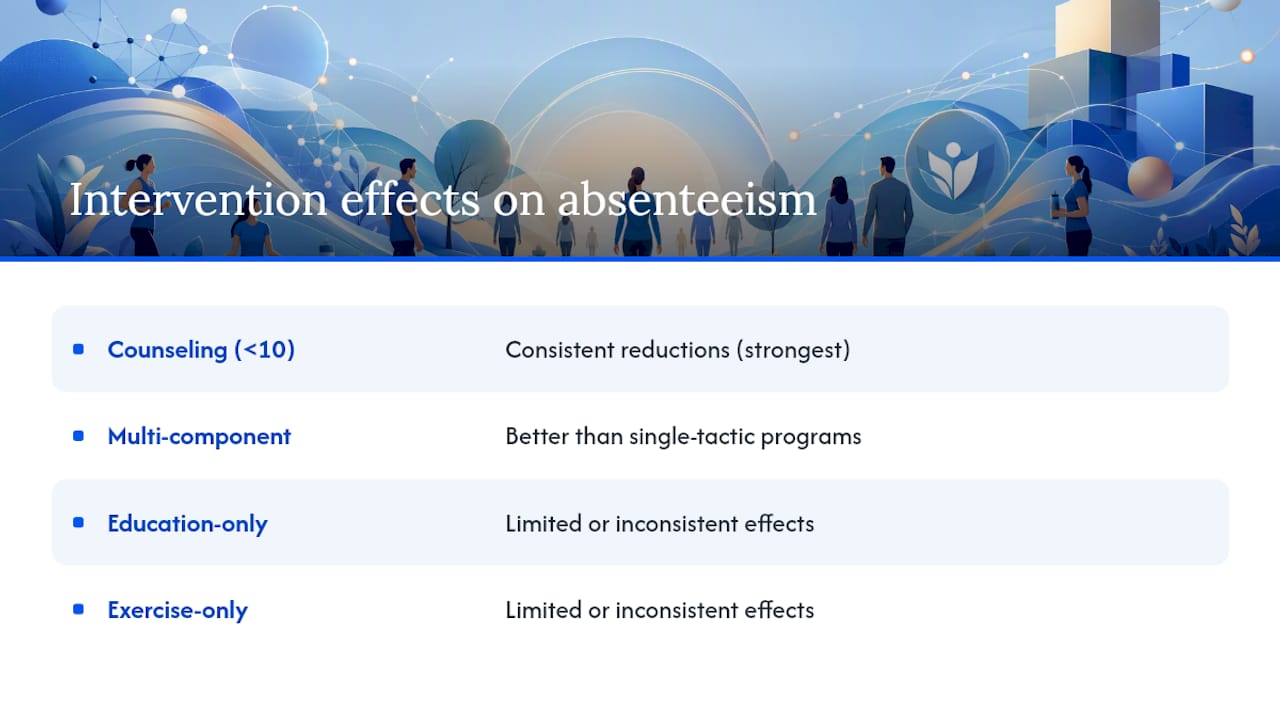
The 2019 systematic review and meta-analysis covering workplace interventions found that individualized counseling programs, especially those capped under 10 sessions, delivered the most consistent absenteeism reductions across moderate-quality randomized controlled trials. Multi-component designs, ones that stack coaching with condition-specific tracks rather than a single generic intervention, performed better than any single-tactic program. Programs built around education alone or exercise alone showed limited or inconsistent effects, which matters because those are exactly the programs many employers already run.
Employer-verified data tells a sharper story than self-reported surveys. The digestive-care program mentioned above didn't rely on employees reporting "I feel healthier." It used payroll records and found a 17% drop in sick days among older workers, with a documented $672 per-employee salary saving. That's the kind of number a finance team can put in a spreadsheet without an asterisk.
Longer time horizons tell a different, and honestly more useful, story for planning purposes. One nine-year workplace health promotion program produced a 38% reduction in sickness absence, but the same analysis cautions that short-term absenteeism savings alone may not cover program costs. That's not a knock against the model. It's a reason to measure retention, engagement, and claims trend alongside sick days, not sick days in isolation.
A separate randomized trial of a 5-session psychoeducational program for employees with chronic conditions improved work engagement and retention at six months, though its effect on absenteeism specifically was mixed. Retention and engagement gains still show up on the P&L, just through a different line item.
What Should an Effective Program Actually Include?
Vendors love the word "comprehensive." Ignore it. The research points to a much narrower set of design choices that separate programs that move the numbers from programs that just look good in a brochure.
- Individualized outreach and brief coaching. Programs built around one-on-one or small-group counseling, capped at fewer than 10 sessions, consistently outperform generalized campaigns in the meta-analysis findings on multi-component design.
- Condition-specific tracks. Target the conditions actually driving your claims and absence data. The CDC estimates that hypertension, diabetes, smoking, physical inactivity, and obesity each cost employers more than $2 billion annually in the U.S. workforce, with employers covering about 58% of the associated medical costs. Musculoskeletal pain and mental health conditions belong on that list too.
- Care navigation or a concierge layer. Employees drop out of programs that require them to figure out next steps alone. A proactive mental-health engagement model built around screening and navigation, rather than waiting for a crisis, shows better utilization than reactive EAP structures.
- Low-friction delivery. Short, frequent, digital-first sessions beat long infrequent workshops for working adults who can't easily leave a shift. Feasibility research on worksite-tailored self-management programs backs this up directly.
- Integration, not disruption. The program needs claims and payroll data access, manager training on referral pathways, and privacy safeguards that satisfy your legal team, all layered onto your existing benefits rather than replacing them.
Pro Tip: Before you sign anything, ask a vendor to show you which specific conditions their program targets in year one. "All of them" usually means none of them get the attention they need.
Medication adherence support deserves a specific mention here too. Employees managing chronic conditions who fall behind on prescriptions tend to generate more absence and higher claims, and structured adherence programs close that gap more reliably than generic reminders.

How Do You Pilot and Scale an Absenteeism Program?
Rolling out a population-health program without a pilot is how good ideas turn into abandoned line items. Here's the sequence that actually works.
- Map the stakeholders first. HR owns day-to-day operations, finance signs off on cost models and ROI thresholds, and legal reviews any data-sharing agreement before a single employee enrolls.
- Choose your pilot cohort deliberately. Target the condition group driving the most claims and absence, whether that's musculoskeletal pain, diabetes, or GI issues, and keep the group large enough to produce a readable signal, typically several hundred employees at minimum.
- Build in a comparison. A matched group of non-participating employees, even an informal one, makes your results defensible when the CFO asks whether the improvement was really the program or just seasonal variation.
- Set a realistic duration. Run the pilot for at least two full quarters before drawing conclusions; shorter windows get swamped by noise.
- Define success thresholds up front. Decide what "working" means in numbers, not vibes, before the pilot starts.
Participation is where most pilots quietly fail. A handful of tactics move enrollment meaningfully:
- Default enrollment with an easy opt-out beats pure opt-in every time.
- Manager-led nudges outperform email blasts because employees trust a direct supervisor's endorsement in the role of peer support programs in the workplace.
- Scheduling flexibility, including sessions during work hours, removes the biggest barrier for shift and hourly workers.
- Tactics that raise wellness program participation generally translate directly to absenteeism programs.
On the contract side, lock down data-sharing terms, PHI handling, claims and payroll integration specifics, and a fixed reporting cadence before you sign. Vague language here becomes a dispute later.
How Do You Build a CFO-Ready ROI Model?
CFOs don't want a wellness story. They want a number they can defend in a board meeting, built from data that's already sitting in payroll and claims systems.
Track five metrics: payroll-verified sick days, short-term disability days, medical claim trend, retention rate, and program engagement. Payroll data beats survey data every time because it's already audited.
A simple ROI model looks like this: multiply your per-employee savings estimate, whether that's the $672 documented in the digestive-care study or a broader $451 average, by your enrolled headcount, then subtract program cost.
| Accounting Approach | What It Includes |
|---|---|
| Conservative | Payroll-verified sick days and short-term disability only |
| Full ROI | Adds claims trend, retention savings, and engagement gains |
Use matched comparison groups, control for seasonality, and measure over 6 to 12 months minimum before reporting results. Quarterly reporting catches problems early instead of surprising anyone at renewal. For a deeper look at how these savings compound, wellness program cost data breaks down the math further.
Why Hadaco Fits the Evidence-Based Program Model
Hadaco was built around the exact design choices the research points to: individualized, condition-focused interventions rather than one-size-fits-all wellness content, delivered without disrupting whatever benefits plan you already run.
There's no upfront fee, so the financial risk sits with Hadaco, not your budget, and the transparent savings estimator gives finance a number before you commit to anything. Companies working with Hadaco see average first-year savings of $451 per employee, with quarterly reporting that tracks payroll-verified absenteeism and claim-cost trends the same way this article recommends measuring them. Onboarding typically starts with a claims and absence review, moves into cohort targeting for your highest-cost conditions, and settles into a quarterly cadence of reported outcomes.
Before you sign with any vendor, including Hadaco, ask these six questions: How does your program integrate with our existing claims and payroll data? How do you select and prioritize condition cohorts? What measurement methodology do you use to isolate program impact from seasonal variation? What savings guarantees, if any, do you offer? How do you handle PHI and data privacy? What's the realistic timeline to first measurable results?
Run your own numbers through Hadaco's savings estimator or book a consultation to see what a pilot targeting your highest-cost condition cohort could look like.
A Practical Take on Long-Term Absenteeism Reduction
Treat absenteeism programs as a multi-year population-health investment, not a one-quarter fix. The nine-year workplace health promotion data makes that case plainly: big absence reductions took years to compound, and short-term savings alone rarely cover the investment.
Start narrow. Pick the condition cohort driving the most claims and absence, pilot it properly, and let the payroll data speak before you scale anything. Programs that try to fix everything at once usually end up measuring nothing well.
— Gene
Sources
- Effectiveness of workplace interventions for absenteeism — systematic review & meta-analysis (2019)
- Digital digestive-care program reduces sick days (Journal of Occupational & Environmental Medicine)
- CDC — chronic disease and workplace costs (2016)
- Sickness absence trend analysis and financial outcomes of a nine-year WHP (2026)