
The five highest-impact wellness engagement strategies employers should act on now are: embed well-being into daily work routines, use targeted segmentation to match offers to readiness, pair modest participation-based incentives with easy first wins, activate managers and peer champions as social proof, and deploy low-friction digital nudges that reduce steps to participate. Programs that combine all five consistently outperform single-lever approaches.
Start this week:
- Send one targeted email to a single business unit this week using a benefit-led subject line ("Earn $50 this month — 10 minutes to enroll") and a single enrollment link.
- Launch a 30-day micro-pilot with one team: a step challenge or a weekly five-minute mindfulness prompt delivered via your existing messaging platform.
- Brief your managers in one sentence: "Your team's participation in the wellness program is a retention signal — here's a two-minute talking point for your next team meeting."
Programs that apply even three of these levers typically see noticeable participation lift within 90 days. Brief your CHRO and CFO first; they control the budget and the manager accountability structure that makes everything else work.
Key Takeaways
The single most important principle in wellness engagement: program quality, accessibility, and consistent communications produce more durable participation gains than any incentive dollar amount alone.
| Point | Details |
|---|---|
| Start with a 90-day pilot | Test one activity, one incentive, and one channel in a single business unit before scaling. |
| Comprehensive programs outperform limited ones | RAND data shows 59% median participation for comprehensive programs versus 20% for limited designs. |
| Incentive type matters less than design | Participation-based and outcome-based incentives perform comparably; prioritize accessibility and fairness. |
| ROI requires a 3–5 year window | Measure participation and behavior in year one; expect claims-level ROI in years two through five. |
| Hadaco delivers measurable outcomes | Evidence-based population health programs with no upfront fees and an average first-year savings of $451 per employee. |
Table of Contents
- What are the best wellness engagement strategies for employers?
- What drives employees to participate — and what stops them?
- An overview of strategy categories that reliably lift participation
- How can technology reduce friction and scale wellness participation?
- What incentive designs actually increase wellness program participation?
- How should HR design communications that drive sustained participation?
- How do leadership visibility and peer champions increase participation?
- How should HR segment employees to maximize engagement lift?
- What metrics should HR track, and when will results show up?
- What are the legal guardrails for wellness incentives and health data?
- A 90-day pilot and 12-month scale roadmap
- Common mistakes that kill wellness program engagement
- What does the research actually say about wellness engagement?
- A practitioner's perspective on running wellness programs that actually work
- How Hadaco supports wellness engagement and measurable savings
- Sources
What are the best wellness engagement strategies for employers?
Higher engagement multiplies program impact and stabilizes ROI in ways that a well-designed benefits package alone cannot. Gallup research shows that employee wellbeing and engagement reinforce one another in a self-sustaining cycle: wellbeing stabilizes engagement, and engagement protects against burnout risk. When that cycle breaks, you pay for it in turnover, absenteeism, and rising claims.
Participation benchmark: RAND's analysis found that comprehensive wellness programs achieved median participation of 59%, compared to 20% for limited programs. Incentives raised participation by roughly 20 percentage points in some samples.
The business case is direct. Higher participation means more employees completing preventive screenings, managing chronic conditions earlier, and using mental health resources before a crisis. Each of those behaviors reduces downstream claims. SHRM's program design toolkit notes that employers should allow three to five years to fully realize ROI, but participation and behavioral change are measurable within 90 days.
Three outcomes HR leaders should connect to engagement when briefing leadership:
- Retention: Employees who feel their employer invests in their health tend to stay longer. Wellness programs can effectively signal that investment beyond traditional benefits materials.
- Productivity: Reduced absenteeism and presenteeism follow from better chronic disease management and mental health support.
- Burnout risk: Gallup's data is clear that engagement without wellbeing is fragile. Programs that push participation without addressing actual well-being can increase short-term effort while accelerating burnout.
What drives employees to participate — and what stops them?

The main participation drivers are relevance, low friction, social proof, leadership endorsement, and perceived employer intent. When employees believe the program exists to help them rather than to manage costs, participation climbs. An MDPI study in hospitality workplaces found that when employees perceive wellness programs as genuine corporate social responsibility, engagement increases significantly.
Common barriers HR teams underestimate:
- Time and scheduling conflicts: Employees on shift work or with caregiving responsibilities can't attend lunch-hour sessions.
- Privacy and trust concerns: Employees worry that health data will affect their employment or insurance.
- Misaligned incentives: A $25 gift card doesn't move someone who works a 10-hour shift and has no time to participate.
- Program complexity: Too many portals, logins, and steps kill enrollment before it starts.
- Poor communications: A single all-staff email announcing the program is not a communications strategy.
| Barrier | Practical lever to test in a pilot |
|---|---|
| Time constraints | Micro-activities under 10 minutes; mobile-first access |
| Privacy concerns | Aggregate-only reporting; third-party data handling; clear opt-in language |
| Misaligned incentives | Survey employees on preferred reward types before designing |
| Program complexity | Single sign-on; one enrollment link; two-step onboarding |
| Poor communications | Manager-delivered talking points; repeated touchpoints over 8 weeks |
| Low perceived relevance | Segment by life stage or health interest; offer multiple program tracks |
An overview of strategy categories that reliably lift participation
Six categories of wellness engagement strategies account for most of the measurable participation gains in the literature. Understanding which category fits your situation saves time and budget.
- Technology and digital nudges: Best for employers with distributed or remote workforces. Delivers the fastest friction reduction. Most useful at pilot stage when you need quick enrollment data.
- Incentives and rewards: Works across employer sizes but requires careful design. Fastest participation lift when paired with easy first actions. Avoid complex outcome-based structures in pilots.
- Communications and campaigns: Foundational for every employer. Without consistent, targeted messaging, every other strategy underperforms. Highest ROI per dollar spent when done well.
- Leadership and peer activation: Delivers the strongest trust signal, especially in organizations with skeptical cultures. Takes 4–8 weeks to set up but pays off in sustained participation.
- Personalization and segmentation: Most powerful for mid-to-large employers with diverse workforces. Requires some data infrastructure but produces the highest per-segment conversion rates.
- Measurement and governance: Structural, longer-term impact. Without it, you can't defend budget or iterate intelligently. Set this up in week one of any pilot, even if reporting is simple.
The fastest wins come from communications, digital nudges, and a simple incentive. Leadership activation and segmentation produce more durable results but take longer to build.
How can technology reduce friction and scale wellness participation?
The answer is simple: use tech that embeds into the flow of work and removes steps between an employee and their first wellness action. McKinsey's analysis confirms that low-friction delivery and embedding interventions into daily routines increase adoption and produce lasting results. A wellness app that requires a separate login, a separate download, and a five-minute onboarding survey will lose most employees before they complete enrollment.
Platform selection checklist:
- Single sign-on integrated with your existing HR or benefits platform
- Mobile-first UX with offline capability for field or shift workers
- Data minimalism: collect only what you need, store it separately from HR records
- Measurement APIs that push participation data to your dashboard automatically
- Admin dashboard with real-time enrollment and activity completion rates
- Accessibility compliance (WCAG 2.1 AA) for employees with disabilities, consistent with CDC disability inclusion guidance
Low-friction tactics that work:
- Micro-challenges: Five-minute daily actions (a breathing exercise, a hydration check-in) delivered via Slack, Teams, or SMS. No app download required.
- Inline enrollment: Embed the enrollment link directly in the benefits confirmation email employees already receive.
- Calendar integrations: Let employees block a 15-minute "well-being break" directly from a wellness platform prompt.
- Manager prompts: Automated weekly nudge to managers with one talking point and a team participation rate.
- Hourly break nudges: For desk workers, a configurable desktop reminder to stand or stretch. Opt-in only.
Pro Tip: Start with the smallest possible feature set. A step challenge delivered via your existing messaging tool will tell you more about your workforce's participation appetite than a six-month platform RFP. Add features only after you have enrollment data.
What incentive designs actually increase wellness program participation?
Incentives can raise uptake, but design matters more than dollar amount. The RAND brief found that comprehensive programs often achieve participation rates close to those driven by large incentives, suggesting that program quality and accessibility are at least as powerful as the reward itself. A multi-employer PMC study found no significant differences in participation or health improvement between participation-based, hybrid, and outcome-based incentive structures after controlling for confounders.
Participation note: RAND data shows comprehensive programs reached median participation of 59% versus 20% for limited programs — a gap that incentives alone rarely close without program quality improvements underneath.
That finding has a practical implication: before increasing your incentive budget, improve program accessibility and communications. A $200 incentive attached to a hard-to-use program will underperform a $50 incentive attached to a well-designed one.
Incentive design rules:
- Keep rewards meaningful but not coercive. EEOC guidance recommends limits on wellness incentives tied to health-contingent activities relative to employee-only coverage costs.
- Offer multiple ways to earn. Not every employee can complete a biometric screening; offer equivalent alternatives (a health coaching call, a financial wellness module).
- Build in reasonable alternative standards (RAS) for employees who cannot meet a health outcome due to a medical condition.
- Test incentive size in a pilot before committing budget. A $25 reward in one business unit versus $75 in another gives you real data.
- Prefer participation-based structures in pilots. They're easier to administer, legally simpler, and the evidence suggests they perform comparably to outcome-based designs.
Sample structures by employer size:
| Employer size | Incentive structure | Example |
|---|---|---|
| Small (under 100) | Participation-based gift cards | $25 per completed activity, up to $150/year |
| Mid-size (100–999) | Points-based rewards tied to a catalog | Points redeemable for PTO, gift cards, or HSA contributions |
| Large (1,000+) | Premium reduction + participation rewards | $300–$600 annual premium discount for completing a health assessment and three activities |
For practical wellness incentive ideas that fit different budgets and workforce types, Hadaco's resource library covers structures HR teams can adapt without starting from scratch.
How should HR design communications that drive sustained participation?
Consistent, targeted, and repeated communications tied to a specific action outperform one-off announcements by a wide margin. SHRM's toolkit names smart communications as a foundational best practice, alongside leadership endorsement and multi-year commitment.
Channel best practices:
- Email: Best for enrollment triggers and milestone reminders. Keep subject lines under 50 characters. Use benefit-led framing ("Earn $50 this month") over feature-led ("Introducing our new wellness portal").
- Manager talking points: A one-page brief per quarter is more effective than a company-wide all-hands mention. Managers deliver the message at the moment of highest relevance.
- Intranet / digital signage: Good for ambient awareness and social proof ("127 colleagues completed a health assessment this month").
- SMS / push notifications: Highest open rates for time-sensitive nudges. Use sparingly — two to three per month maximum.
- Posters and physical signage: Still effective for manufacturing, retail, and healthcare worksites where employees aren't at a desk.
Message frameworks that convert:
- Benefit-led: "Complete your health assessment in 10 minutes. Earn $50 toward your HSA."
- Social proof: "Your team has completed 43% of this month's challenge. Here's how to catch up."
- Micro-commitment: "One small step this week: log your water intake for three days."
Sample 8-week launch campaign:
- Week 1: CEO or senior leader email announcing the program. One enrollment link. No attachments.
- Week 2: Manager talking-point brief distributed. Managers mention the program in team meetings.
- Week 3: Benefit-led email to all employees. Subject line: "10 minutes, $50 — here's how."
- Week 4: Social proof update via intranet: enrollment numbers, early participant highlights (anonymous).
- Week 5: Segment-specific email to non-enrollees. Shorter, simpler message with a single CTA.
- Week 6: Mid-campaign check-in. Manager prompt with team participation rate.
- Week 7: Incentive reminder. "Two weeks left to earn your reward this quarter."
- Week 8: Closing push. Final enrollment deadline. Celebrate early completers publicly (with consent).
Measure open rates, click-through rates, and enrollment conversions at weeks 3, 5, and 8. Adjust subject lines and channels based on what the data shows, not assumptions.
How do leadership visibility and peer champions increase participation?

Visible leadership and team-level champions create social proof and reduce skepticism faster than any communication campaign. When employees see their manager complete a health assessment or join a step challenge, the implicit message is that participation is safe, valued, and normal. That signal matters more than the incentive dollar amount in many cultures.
Practical steps to activate leaders and peers:
- Leader launch participation: Ask the CEO or a senior leader to complete the first wellness activity publicly and share a brief, authentic note about it in the company newsletter or intranet.
- Manager toolkits: Provide a one-page quarterly brief with the program's current participation rate, one talking point, and a suggested team activity. Keep it under five minutes to use.
- Peer ambassador program: Identify two to three volunteers per department who agree to share their participation experience informally. No formal title needed; informal peer influence is the point.
- Team challenges: A department-level step challenge or hydration week creates friendly competition and social accountability. Running workplace wellness challenges at the team level consistently outperforms individual-only program designs.
- Recognition: Acknowledge teams that hit participation milestones in all-hands meetings or on the intranet. Public recognition costs nothing and reinforces the norm.
Training managers to support participation without mandating health decisions is a critical distinction. Managers should invite, share, and recognize — never pressure or ask about specific health conditions. A one-hour manager training session covering this boundary, plus the program's talking points, is enough to prevent most missteps.
How should HR segment employees to maximize engagement lift?
Prioritize three segments first: employees who are high-risk but ready to change, managers as participation multipliers, and low-engagers with time constraints. Matching the right intervention to each segment produces a higher return on your communications and incentive budget than a single program-wide push.
Segment templates and recommended interventions:
- Ready-to-change: Employees who completed a health risk assessment or clicked on a wellness email but haven't enrolled. Send a direct, low-barrier enrollment prompt with a single action step. These are your easiest conversions.
- Time-constrained: Shift workers, caregivers, and field employees. Offer mobile-first, asynchronous micro-activities. Avoid live sessions or lunch-hour programming.
- Socially motivated: Employees who respond to team challenges and peer recognition. Activate through department-level competitions and ambassador programs.
- Skeptical or privacy-concerned: Employees who have opted out or never engaged. Don't push. Offer a no-data-required activity (a walking challenge tracked by self-report) and focus on building trust over two to three quarters.
- Managers: Train and equip separately. Their participation rate directly predicts their team's participation rate.
Data sources for segmentation (with ethical constraints):
- Anonymous employee surveys (preferred — no individual-level health data)
- HRIS attributes: department, role type, location, tenure
- Voluntary health risk assessments (aggregate reporting only; never link to individual HR records)
- Enrollment and activity completion data from the wellness platform
Never use individual health data to target employees without explicit, informed consent. Aggregate reporting thresholds (typically groups of five or more) protect privacy and maintain trust. CDC guidance on disability inclusion also applies here: accessible design and reasonable accommodations are not optional for equitable participation.
What metrics should HR track, and when will results show up?
Measure both engagement metrics and business outcomes, and set realistic windows. Participation rates and activity completion are visible within 30–90 days. Claims trends and ROI take one to three years to emerge. SHRM recommends allowing three to five years for full ROI realization; judging a program at six months based on claims data is a common and costly mistake.
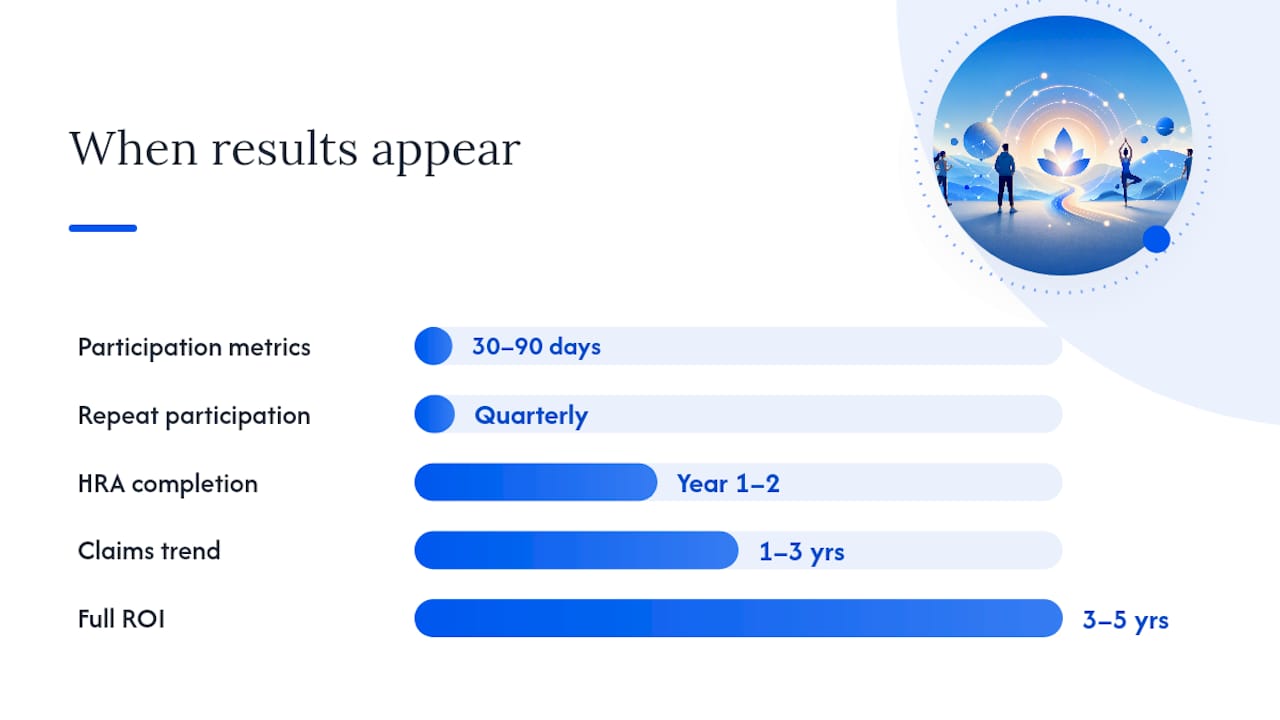
| Metric | Definition | Collection cadence | Pilot threshold | Scale threshold |
|---|---|---|---|---|
| Enrollment rate | % of eligible employees enrolled | Monthly | 30% by day 30 | 50%+ by month 6 |
| Activity completion rate | % of enrolled employees completing at least one activity | Monthly | majority of enrolled | most enrolled |
| Repeat participation | % returning for a second activity or month | Quarterly | 40% of completers | over half of completers |
| Health risk assessment completion | % completing voluntary HRA | Annually | 25% in year 1 | 40%+ by year 2 |
| Absenteeism rate | Unplanned sick days per employee | Quarterly | Baseline only | Measurable reduction by year 2 |
| Claims trend | Year-over-year change in per-employee claims cost | Annually | Baseline only | Reduction by year 3 |
| Employee retention | Annual turnover rate | Annually | Baseline only | Correlation trackable by year 2 |
Privacy-safe reporting: Never report individual-level health data. Set a minimum group size of five for any participation report. Use a third-party vendor or aggregate dashboard to separate health data from HR records. Every leader dashboard should show participation rates, activity trends, and cost trajectory — not individual health status.
What are the legal guardrails for wellness incentives and health data?
Follow nondiscrimination rules, obtain informed consent, and limit data collection. Those three principles cover most of the compliance risk in wellness program design. The key frameworks are ADA, HIPAA, GINA, and EEOC guidance on wellness incentives.
Compliance checklist for incentive and HRA design:
- ADA: Wellness programs must be voluntary. Incentives must not be so large that they are effectively coercive. Provide reasonable accommodations for employees who cannot participate due to a disability.
- HIPAA: Health information collected through wellness programs is subject to HIPAA if the program is part of a group health plan. Use a business associate agreement with any vendor handling health data.
- GINA: Do not request genetic information, including family medical history, as part of a wellness program or incentive. This is a common misstep in health risk assessments.
- EEOC guidance: Incentives tied to health-contingent activities should not exceed 30% of the cost of employee-only coverage. Consult current EEOC guidance, as this threshold has been subject to regulatory revision.
- Reasonable alternative standards (RAS): Any outcome-based incentive must offer a medically appropriate alternative for employees who cannot meet the standard due to a health condition. Document the RAS process and communicate it clearly at enrollment.
- Informed consent: Employees must understand what data is collected, how it is used, who sees it, and that participation is voluntary. Plain-language consent forms outperform legal boilerplate for actual comprehension.
- Aggregate reporting only: Never share individual health data with managers or HR. Report at the group level with a minimum threshold of five participants.
Pro Tip: Involve your legal counsel and benefits broker before finalizing incentive structures or HRA design. A 30-minute review at the design stage costs far less than a compliance correction after launch. Document your RAS process and accommodation decisions from day one.
A 90-day pilot and 12-month scale roadmap
Start with a 90-day pilot in a single business unit or region. Keep it simple: one or two activities, one incentive, one communication channel, and clear success criteria before you begin. The goal is to validate uptake and learn what your workforce responds to, not to run a full program.
90-day pilot timeline:
- Weeks 1–2: Define success criteria (target enrollment rate, activity completion rate). Select pilot group (one department, 50–200 employees). Assign an internal owner. Brief managers with a one-page talking point.
- Weeks 3–4: Launch enrollment. Send benefit-led email. Activate manager talking points. Set up participation tracking in your dashboard.
- Weeks 5–8: Run the first activity (step challenge, mindfulness series, or financial wellness module). Send two to three communications. Track weekly enrollment and completion rates.
- Weeks 9–10: Mid-pilot check-in. Identify non-engagers and send a simplified re-engagement message. Adjust incentive framing if completion is below 40%.
- Weeks 11–12: Close the pilot. Collect participation data, survey participants (5 questions maximum), and calculate cost per enrolled employee. Apply stop/iterate/scale criteria.
Stop/iterate/scale criteria:
- Stop: Enrollment below 15% after 6 weeks with no upward trend. Indicates a structural barrier (trust, access, or relevance) that needs diagnosis before more investment.
- Iterate: Enrollment 15–30%, completion below 40%. Adjust communications, simplify the activity, or test a different incentive structure in the next cohort.
- Scale: Enrollment above 30%, completion above 50%, positive participant survey feedback. Expand to additional business units with the same design.
12-month scale roadmap:
- Months 1–3: Pilot (above).
- Months 4–6: Expand to two additional business units. Add one new activity track based on pilot survey data. Formalize manager training (one hour, quarterly).
- Months 7–9: Company-wide enrollment push. Launch peer ambassador program. Add segmented communications for non-engagers.
- Months 10–12: Annual health risk assessment campaign. Review claims baseline data. Prepare leadership ROI report with participation, behavioral, and early cost trend data.
Rough cost buckets:
- Communications: $2,000–$8,000 for design, copywriting, and distribution tools for a 90-day pilot.
- Incentives: $25–$150 per participating employee, depending on structure and employer size.
- Vendor or platform fees: Varies widely; evaluate on a per-employee-per-month basis and negotiate pilot pricing.
- Evaluation: Budget for a brief employee survey and dashboard setup. Internal time is the primary cost.
For a deeper look at corporate wellness ROI frameworks and how to present them to CFOs, Hadaco's resource library covers the measurement and leadership-briefing angles in detail.
Common mistakes that kill wellness program engagement
The top six program-killers share one trait: they are all preventable at the design stage.
- Lack of leadership support: If senior leaders don't visibly participate, employees read the program as optional noise. Fix: Secure one named leader to complete the first activity publicly before launch.
- Privacy missteps: Employees who suspect their health data will reach their manager or affect their employment will not participate. Fix: Use aggregate-only reporting, third-party data handling, and plain-language consent forms.
- Overcomplicated incentives: A points system with 12 earning categories and a redemption portal that requires a separate login loses employees at step two. Fix: One incentive, one action, one enrollment link for the first 90 days.
- One-size-fits-all design: A lunch-hour yoga class serves one segment of your workforce. Shift workers, remote employees, and caregivers need different formats. Fix: Offer at least two activity formats (synchronous and asynchronous) from day one.
- Poor communications: A single all-staff email is not a campaign. Fix: Eight-week cadence with manager-delivered talking points, two to three emails, and one social proof update.
- Ignoring manager training: Managers who don't understand the program can't promote it, and some will inadvertently pressure employees. Fix: One-hour manager briefing before launch, quarterly one-page update thereafter.
Red-flag metrics that should trigger a program review:
- Enrollment drops by more than 10 percentage points in the week after launch.
- Repeat participation (employees returning for a second activity) falls below 25%.
- Survey feedback includes privacy or fairness concerns from more than 15% of respondents.
Any of these signals warrants a pause to diagnose before adding budget or expanding the program.
What does the research actually say about wellness engagement?
The evidence base is more nuanced than most vendor materials suggest. Here are the practical implications for employers:
What the research consistently shows:
- Comprehensive programs outperform limited ones. RAND's data shows median participation of 59% for comprehensive programs versus 20% for limited ones. Program quality and accessibility matter more than incentive size alone.
- Incentive type matters less than design quality. The PMC multi-employer study found no significant participation differences between participation-based and outcome-based incentive structures after controlling for confounders. Design for fairness and accessibility first.
- ROI takes time. SHRM and the broader literature consistently recommend a three-to-five-year window for full claims-level ROI. Short-term pilots measure participation and behavioral change, not financial return.
- Wellbeing and engagement are a cycle, not a sequence. Gallup's research shows that programs boosting engagement without addressing wellbeing risk accelerating burnout. Both dimensions need attention.
- Framing shapes participation. The MDPI hospitality study found that employees who perceive wellness programs as genuine corporate social responsibility show higher engagement. Authentic framing outperforms cost-control messaging.
- Structural supports amplify program effects. Boston University research links job flexibility and security to better mental health outcomes, which in turn supports wellness program uptake. Programs embedded in a supportive work environment outperform those bolted onto a stressful one.
Where evidence is mixed or limited: Most wellness ROI studies have methodological limitations, including self-selection bias (healthier employees participate more) and short follow-up windows. Treat ROI projections as directional, not guaranteed, and build your measurement plan to account for selection effects.
A practitioner's perspective on running wellness programs that actually work
The programs that consistently outperform are not the ones with the biggest budgets or the most features. They are the ones that started small, measured honestly, and iterated fast.
The most common mistake experienced HR teams make early in their careers is treating a wellness program launch like a benefits rollout: announce it, set it up, and wait for participation. That model doesn't work. Participation is a behavior, and behaviors require repeated prompts, social reinforcement, and a clear, low-barrier first step.
Three things experienced teams prioritize that most guides underemphasize:
-
Establish a data baseline before anything else. You cannot demonstrate ROI or justify budget without knowing your starting point: current participation rates, absenteeism, claims trends, and employee sentiment. A five-question anonymous survey and a claims data pull from your carrier take two weeks and cost almost nothing.
-
Train managers before you launch. Not after. Not during. Before. A manager who doesn't understand the program will answer employee questions incorrectly, and that misinformation spreads faster than your enrollment email.
-
Celebrate the first 10 participants publicly. Not the first 100. The first 10. Early social proof is disproportionately powerful. When employees see peers participating and being recognized, the program shifts from "something HR is doing" to "something people here actually do."
The challenge itself wasn't sophisticated. The data it generated was.
How Hadaco supports wellness engagement and measurable savings
Most wellness programs fail not because the strategy is wrong but because execution is fragmented: incentives designed without compliance review, communications that stop after week two, and no reporting structure to show leadership what's working.
Hadaco delivers evidence-based population health programs that integrate directly with your existing benefit plan, no disruption to current coverage, no upfront fees. The model covers chronic disease management, preventive care, mental health, and employee engagement, with quarterly reporting that gives HR and CFO-level stakeholders the participation and cost trend data they need to defend the investment.
- Pilot support: Hadaco helps design and launch a 90-day pilot with clear success criteria and measurement from day one.
- Incentive design: Evidence-based incentive structures built for compliance and participation, not just dollar amounts.
- Quarterly reporting: Transparent outcome data, including a savings estimator, so you can brief leadership with real numbers.
- No upfront fees: Performance-based model means Hadaco's success is tied to yours. Companies in their first year see an average savings of $451 per employee.
If you're ready to move from strategy to a measurable program, request a consultation with Hadaco to see what a population health program looks like for your workforce size and benefit structure.
Sources
- Employee Wellbeing Strategy: A Practical Guide – Gallup
- Incentives for Workplace Wellness Programs: They Increase Employee Participation, but Building a Better Program Is Just as Effective | RAND
- PMC article comparing incentive types (study summary)
- Designing and Managing Effective Wellness Programs — SHRM
- Boosting Engagement: Effects of Wellness Programs in Hospitality Workplaces — MDPI
This article provides general informational guidance on wellness program design and is not a substitute for legal, benefits, or medical advice. Consult qualified legal counsel and your benefits advisor to confirm that your program design complies with current ADA, HIPAA, GINA, and EEOC requirements.