
The single priority for any benefit consultant wellness strategy is measurement, not menu design: pick evidence-based interventions, demand vendor reporting tied to claims data, and treat every program feature as a hypothesis to be tested. Consultants who lead with vendor fit and quarterly outcome tracking, using a partner like Hadaco to model savings before signing, outperform those who lead with plan perks. Start with a data audit, not a benefits fair.
TL;DR:
- Wellness programs should start with a comprehensive data audit, including claims, HRAs, and workforce demographics, before vendor selection.
- Interventions must be directly tied to identification of specific workforce health gaps, such as chronic conditions or mental health needs, rather than generic offerings.
- Quarterly tracking of claims trends, participation, and risk shifts is essential to prove program ROI and avoid overstating short-term savings.
- Vendors should be evaluated based on evidence-based outcomes, reporting frequency, system integration, and compliance with privacy regulations, not just price.
- Cost management requires phased funding, performance-based vendor arrangements, and targeting high-cost conditions with tailored interventions.
Table of Contents
- What Does a Benefit Consultant Wellness Strategy Actually Require?
- How Do You Conduct a Wellness Needs Assessment?
- Choosing Program Components and the Right Wellness Program Consultant Approach
- Rolling Out a Wellness Program Without Losing Momentum
- What KPIs Prove Wellness Program ROI?
- What Compliance Risks Do Wellness Benefits Carry?
- Designing Wellness Benefits That Reach Every Employee
- How Hadaco Fits Into a Consultant's Vendor Evaluation
- What Standards Should a Wellness Program Consultant Follow?
- How Consultants Should Work With Internal HR and Leadership
- Cost Management Strategies for Wellness Programs
- What Do Successful Wellness Interventions Actually Look Like?
- How Are Wellness Trends Reshaping Benefit Consulting?
- What Consultants Should Do Next
- Get a Wellness Savings Estimate Before You Recommend a Vendor
- Sources
- FAQ
What Does a Benefit Consultant Wellness Strategy Actually Require?
A benefits consultant's real job isn't picking a wellness app. It's translating workforce health data into a plan design that a CFO will actually fund. That means four ongoing responsibilities, not a one-time project.
- Conduct needs assessments using claims data, Health Risk Assessments (HRAs), and demographic patterns.
- Design plan components that map directly to what the data shows, not what's trending.
- Manage vendor relationships and hold them to reporting standards.
- Track outcomes against baseline and report them in language leadership understands: retention, absenteeism, claims trend.
This is a year-round advisory relationship, not a seasonal broker task bolted onto open enrollment. The consultants who earn renewal business are the ones who show up in March with a claims trend update, not just in October with a rate sheet.
How Do You Conduct a Wellness Needs Assessment?
You can't design a program you haven't diagnosed. A needs assessment pulls from three sources: aggregated claims data (chronic condition prevalence, high-cost claimants, utilization patterns), HRA responses (self-reported risk factors, readiness to change), and workforce demographics (age distribution, job type, shift patterns, location spread for hybrid teams).
The practical sequence looks like this:
- Pull two to three years of de-identified claims data from the carrier or third-party administrator to spot cost drivers.
- Deploy an HRA with a completion incentive, since response rates below 40% make the data unreliable.
- Cross-reference HRA findings against claims patterns to find where self-reported risk and actual cost overlap.
- Segment findings by location, shift, and job function to catch access gaps before they show up in disengagement.
- Set a baseline for every KPI you intend to report on later.
Pro Tip: Never present raw HRA data to leadership without aggregation. Even summary statistics need a minimum group size, usually 5 to 10 respondents per cell, to avoid re-identifying individuals and triggering privacy concerns.
Employees need to trust that HRA data won't affect their standing before they'll answer honestly. That trust is earned through explicit communication about data segregation, not a compliance footnote nobody reads.
Choosing Program Components and the Right Wellness Program Consultant Approach
Once the assessment identifies the gaps, whether it's a chronic disease burden, unaddressed mental health need, or a preventive care gap, the design phase maps interventions to those specific findings. A workforce with high diabetes prevalence needs condition management, not a step-count challenge. A workforce reporting stress and burnout needs Employee Assistance Program (EAP) integration and mental health access, an area Mental Health America's workplace wellness research treats as a core design requirement, not an add-on.
Core components worth evaluating for most workforces:
- Preventive care incentives (biometric screenings, annual physicals, vaccination drives).
- Chronic condition management (diabetes, hypertension, musculoskeletal programs).
- Mental health support integrated with EAP, not running parallel to it.
- Engagement incentives tied to participation milestones, not just enrollment.
When comparing vendors, judge them on evidence base first: does the vendor cite peer-reviewed outcomes or just testimonials? Second, judge their reporting cadence and whether the analytics tie back to claims impact or just engagement clicks. Third, check integration: does the platform talk to your benefits administration system, or does it create a parallel data silo? Enterprise platforms tend to offer deeper integration; entry-level field apps often win on price but fall short on reporting depth. Match the category to what your needs assessment actually calls for, not to what's easiest to sell internally.
Rolling Out a Wellness Program Without Losing Momentum
A rushed launch kills more programs than bad design does. The order matters:
- Pilot with one department or location for 60 to 90 days to catch friction points before company-wide rollout.
- Build manager enablement materials before employee communications go out. Managers who can't answer basic questions become a participation drag.
- Time enrollment communications to align with open enrollment, but start awareness campaigns weeks earlier so wellness doesn't get lost in benefits paperwork fatigue.
- Scale in phases by location or business unit, adjusting based on pilot feedback.
- Layer incentive structures (point systems, premium reductions, gift cards) in after initial adoption, once you know what's actually driving engagement.
Communication tactics that consistently raise participation include peer champions within departments, manager-led kickoff meetings rather than email blasts, and incentive structures announced at launch rather than added later. Hadaco's own engagement strategy research points to the same pattern: participation climbs when communication feels like a benefit being explained, not a mandate being announced.
What KPIs Prove Wellness Program ROI?
Leadership doesn't care about step counts. They care about claims trend, absenteeism, and retention. Report against a core KPI set:
- Participation rate, segmented by department and demographic, not just a company-wide average.
- Risk shift, meaning movement of high-risk HRA respondents into lower-risk categories over 12 to 24 months.
- Claim-cost trend relative to your industry benchmark, since KFF's 2024 Employer Health Benefits Survey gives you a national baseline to measure against.
- Absenteeism and presenteeism, ideally tracked before and after program launch.
- Retention and turnover among program participants versus non-participants.
Quarterly reporting cadence matters more than annual reviews because it lets you catch a stalling program before the renewal conversation. A transparent savings estimator, the kind Hadaco builds into its model, gives you a projected number early so quarterly actuals can be measured against expectation rather than guesswork.
The most common attribution mistake: crediting a full-year claims drop to the wellness program alone when plan design changes, network shifts, or a single high-cost claimant leaving the company likely did most of the work. Isolate variables before you report a number to the C-suite, and always caveat short-term savings claims until you have at least two renewal cycles of data.
What Compliance Risks Do Wellness Benefits Carry?
Wellness programs sit at the intersection of several regulatory frameworks, and the overlap catches consultants off guard. HIPAA's nondiscrimination rules apply when a program is part of a group health plan and ties rewards to health outcomes. The Americans with Disabilities Act (ADA) governs how HRA participation and biometric screenings can be structured, particularly around voluntariness and reasonable alternatives.
Contract language to require from any vendor before signing:
- Explicit data segregation between wellness program data and employment decisions.
- Limits on identifiable data access, restricted to those administering the program.
- A documented breach response protocol with notification timelines.
- Clear incentive caps that don't cross into "involuntary" territory under ADA guidance.
Red flags include vendors who want raw, identifiable HRA data pushed to HR systems, or incentive structures large enough that non-participation starts to feel like a financial penalty rather than a choice. Hadaco's own compliance primer walks through where HIPAA actually applies versus where it doesn't, which is worth reviewing before any vendor contract gets signed.
Designing Wellness Benefits That Reach Every Employee
A program built for one shift, one office, or one language excludes the workforce segments that often need it most. Multichannel access, mobile-first tools, printed materials in break rooms, and translated HRA forms close gaps that a single email campaign misses entirely.

Hybrid and distributed teams need this even more. Gallup's hybrid work research shows work arrangements have settled into a durable mix of remote, hybrid, and onsite patterns, meaning a program designed only for people at a desk on Tuesday will structurally under-serve a meaningful share of the workforce. Culturally relevant programming, flexible scheduling for screenings, and accessible formats aren't nice extras. They're what determines whether participation numbers reflect your whole workforce or just the easiest-to-reach third of it.
How Hadaco Fits Into a Consultant's Vendor Evaluation
Consultants evaluating vendors need a partner that adds evidence-based intervention without disrupting the benefits plan already in place. That's the specific gap Hadaco is built to fill: population health programs that layer chronic disease management, preventive care, mental health support, and engagement tactics onto an existing plan rather than replacing it.
Hadaco reports that companies using its program see an average savings of $451 per employee in the first year, alongside double-digit reductions in healthcare claim costs, figures the company presents through its own transparent savings estimator and quarterly outcome reporting.
For a consultant building a vendor shortlist, Hadaco's model offers concrete points to test against other options:
- Fees often structured around demonstrated savings performance.
- A savings estimator consultants can run before recommending the program to a client.
- Quarterly reporting that gives HR leadership the same cadence recommended above for claims and participation tracking.
- Integration designed to complement current plans rather than requiring a plan rebuild.
Consultants can use these figures as a benchmark when scoring other vendors on evidence base and reporting rigor, the same criteria that should drive any vendor comparison in this category.
What Standards Should a Wellness Program Consultant Follow?
The field doesn't have a single certifying body the way actuarial work does, but a few best practices function as an informal standard. First, every recommended intervention should trace back to a documented needs assessment, not a vendor's marketing deck. Second, reporting should follow a consistent cadence, quarterly at minimum, with the same KPI set measured the same way each period so trend lines actually mean something.
Third, vendor evaluation should separate engagement metrics (logins, app downloads, challenge completions) from outcome metrics (risk shift, claims impact, absenteeism change). Too many program reviews conflate the two, reporting high engagement as if it proves cost impact when it only proves people opened an app.
Fourth, credentialed consultants increasingly draw on health-economics literature and payer-side cost trend data, SHRM's cost projection tools among them, to stress-test whether a program's projected savings are plausible given broader market trends. A program claiming to beat national trend by a wide margin in its first year deserves scrutiny, not applause.
Fifth, transparency with the client about attribution limits builds more long-term trust than an inflated first-year number. A consultant who says "here's what we can attribute confidently, and here's what needs another cycle to confirm" keeps the account. One who overclaims loses credibility the moment the second-year numbers regress toward the mean.
These practices aren't formalized into a single accreditation, but they separate consultants clients keep renewing from those they don't.
How Consultants Should Work With Internal HR and Leadership
The best wellness outcomes come from a three-way partnership: the consultant brings the data and vendor expertise, HR brings organizational knowledge of what will and won't land with the workforce, and leadership sets the budget tolerance and the metrics that actually matter to them.
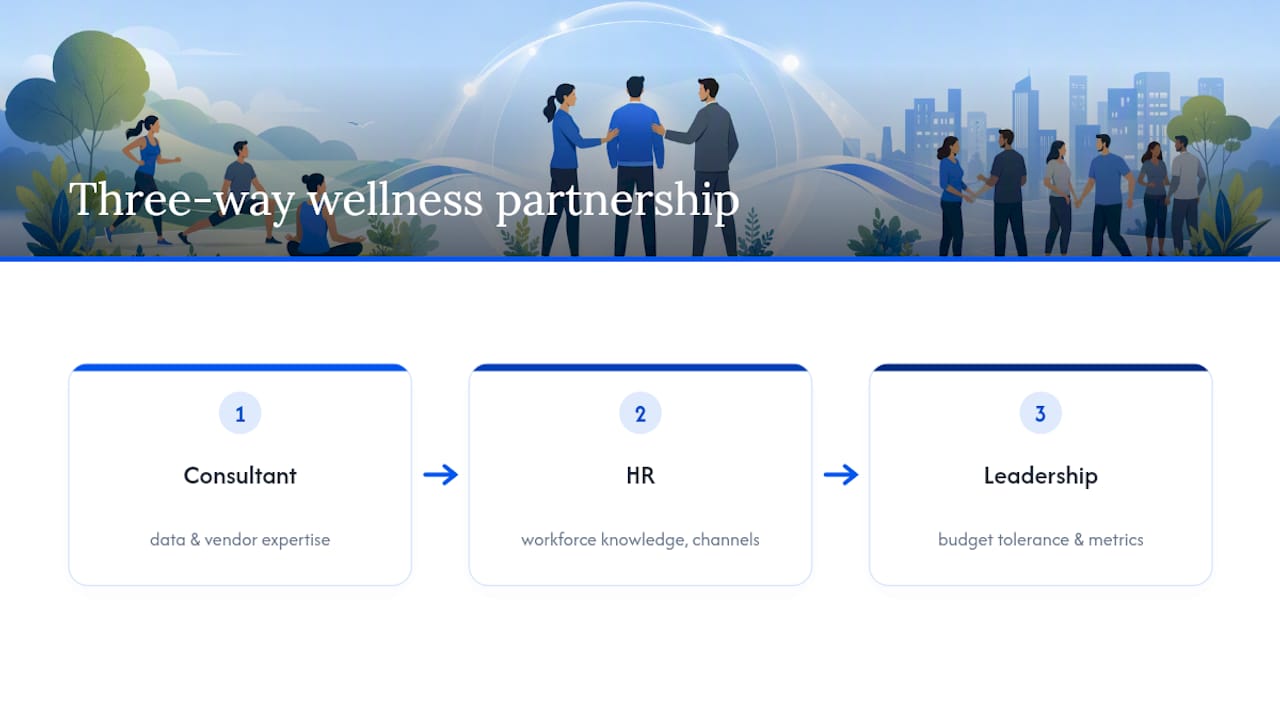
That partnership breaks down when consultants treat HR as an implementation afterthought. HR teams know which departments have historically resisted wellness initiatives, which managers will champion a program versus quietly ignore it, and which communication channels employees actually read. Skipping that input produces a technically sound program that nobody uses.
Leadership alignment works differently. Executives generally don't want a wellness curriculum; they want a claims trend number and a retention story. The consultant's job is translating HRA results and participation data into that language before the leadership meeting, not during it. A useful practice: bring one slide, not ten, to any leadership check-in, showing the KPI trend against baseline and against the original savings estimate.
Regular touchpoints matter more than perfect ones. A 30-minute monthly sync between the consultant and HR, with a quarterly leadership readout, catches problems while they're still small. Waiting for the annual renewal meeting to surface a stalled program means a full year of underperformance goes unaddressed. Consultants who build this rhythm into the relationship from day one, rather than treating it as optional, are the ones HR calls first when it's time to expand the program to a new location or business unit.
Cost Management Strategies for Wellness Programs
Cost control in wellness benefits isn't about cutting the program budget. It's about sequencing spend so money goes toward interventions the needs assessment actually justifies.
Start with a phased-funding approach: pilot smaller, prove the ROI model with real data, then scale funding to match. Committing full-year budget to a company-wide rollout before pilot data exists is the single biggest cost-management mistake consultants see repeated year after year.
Second, negotiate performance-based vendor arrangements where possible. A structure with no upfront fees and fees tied to demonstrated savings shifts risk away from the employer and forces the vendor to prove impact before getting paid at scale.
Third, use claims data to prioritize spend toward the highest-cost condition categories first. A workforce with a small number of very high-cost chronic condition claimants often sees more cost impact from targeted case management than from broad-based wellness perks spread thin across everyone.
Fourth, avoid vendor stacking. Consultants sometimes layer three or four point solutions, a fitness app, a separate mental health app, a separate diabetes platform, each with its own subscription cost and no integration between them. Consolidating into fewer, better-integrated programs usually cuts administrative overhead and improves the data picture at the same time.
Fifth, benchmark renewal costs against KFF's national employer benefits data every year, not just at signing. A vendor whose costs creep above trend without matching outcome improvement is a renegotiation conversation waiting to happen. Hadaco's guide on wellness program ROI breaks down how to model these cost tradeoffs before a renewal deadline forces a rushed decision.
What Do Successful Wellness Interventions Actually Look Like?
The pattern in successful interventions is consistent: they target a specific, data-identified problem rather than offering a generic wellness menu. A workforce needs assessment that surfaces high rates of untreated hypertension leads to a targeted screening and management program, not a wellness fair with a blood pressure cuff at one booth among many.

Mental health interventions succeed when they're integrated rather than parallel. A program that connects EAP counseling directly to ongoing care pathways, rather than offering a hotline number that dead-ends after one call, produces measurably better engagement. That integration point is exactly what Mental Health America's workplace research flags as the difference between programs that move outcomes and programs that just look good in a benefits brochure.
Engagement-driven interventions work best when incentives are tied to meaningful milestones rather than simple enrollment. A program rewarding sustained participation over several months, rather than a one-time signup bonus, tends to sustain the behavior change that actually shows up in claims data a year later.
The common thread across effective interventions: they start with the needs assessment, get implemented in a pilot before scaling, and get measured against a pre-set baseline rather than judged by anecdote. Programs that skip any of those three steps tend to produce a lot of activity and very little claims impact, which is the exact gap a rigorous benefit consultant wellness process is designed to close.
How Are Wellness Trends Reshaping Benefit Consulting?
A few shifts are changing what consultants need to evaluate in a vendor. Personalized, data-driven interventions are replacing one-size-fits-all wellness portals, meaning vendor evaluation increasingly requires checking whether a platform can segment interventions by individual risk profile rather than pushing the same content to everyone.
Hybrid work has permanently changed access requirements. With Gallup's data confirming that hybrid and remote arrangements are now a settled fixture rather than a pandemic-era anomaly, any program designed around onsite biometric screenings or in-person events alone will systematically under-serve a meaningful share of most workforces.
Mental health integration is moving from a stand-alone benefit to a required design element woven through the entire program, not bolted onto the side as a hotline number. Consultants who still treat EAP and general wellness as separate line items are behind where the workplace mental health research already points.
Performance-based vendor pricing is also gaining traction, shifting financial risk toward vendors who can actually demonstrate outcomes rather than employers paying flat subscription fees regardless of results. That shift changes how consultants should structure RFPs: ask every vendor what happens to their fee if the promised savings don't materialize, and treat a vague answer as a warning sign.
None of these trends replace the fundamentals. They raise the bar on what "evidence-based" and "measurable" actually mean in a vendor contract.
What Consultants Should Do Next
The consultants who get renewed year after year aren't the ones with the flashiest wellness portal. They're the ones who can walk into a leadership meeting with a claims trend number they can defend. That means treating measurement as the deliverable, not an afterthought bolted onto a program summary.
If you're advising a client right now, here's the 30 to 90 day version:
- Run a claims and HRA data pull before recommending any vendor.
- Score two or three vendor categories against evidence base and reporting cadence, not price alone.
- Pilot before scaling, and set your KPI baseline before launch, not after.
- Book a data audit or discovery call with a potential partner before committing budget.
The gap between programs that work and programs that just look good in a proposal comes down to whether anyone measured the baseline before spending the money.
— Gene
Get a Wellness Savings Estimate Before You Recommend a Vendor
Some wellness vendors offer a savings figure you can check before you commit, programs that integrate with existing benefit plans instead of replacing them, and quarterly reporting so you don't have to wait a full year to find out if they're working.
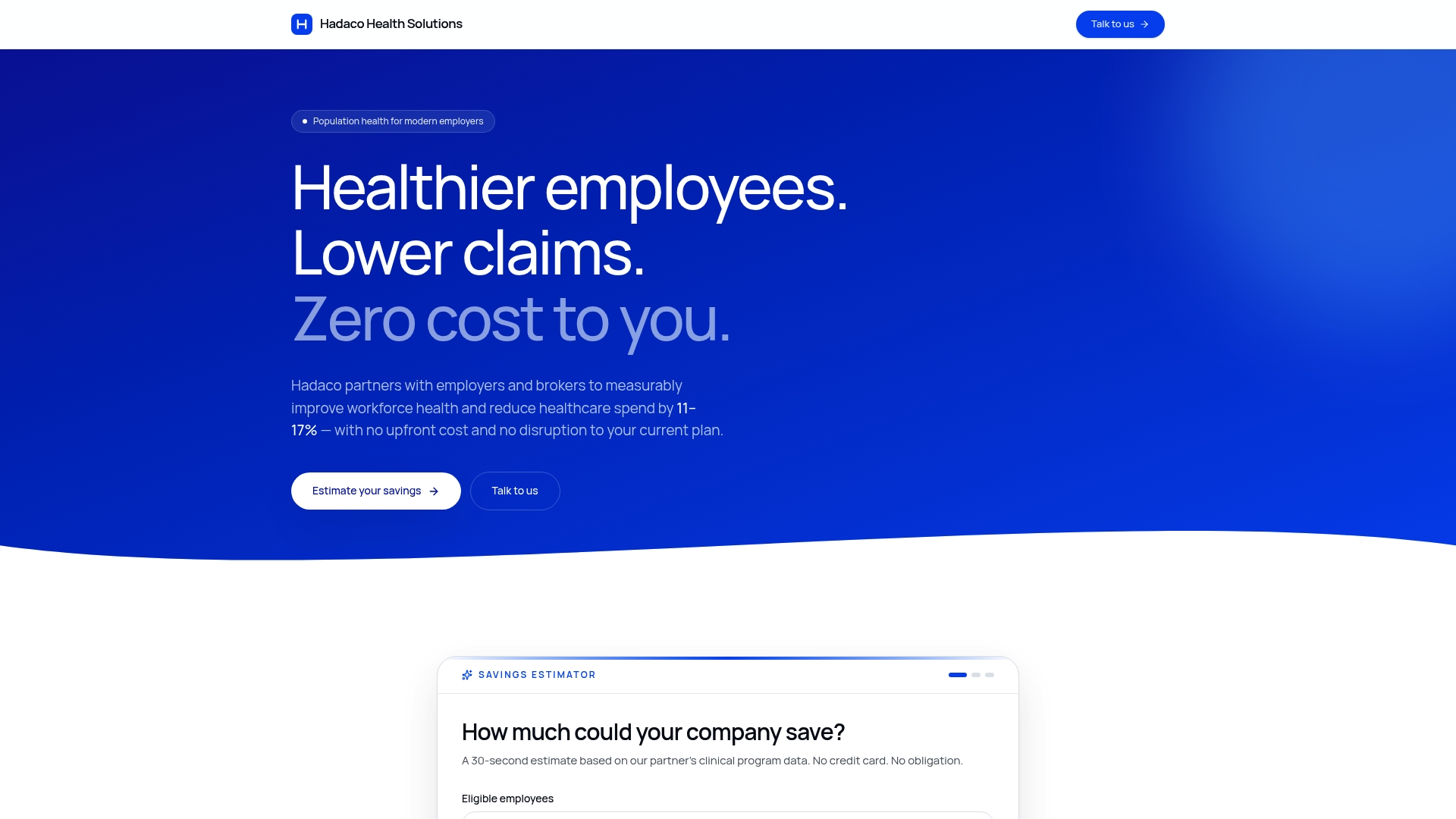
If you're building a vendor shortlist for a client, or you're an HR leader evaluating options directly, run the numbers through Hadaco's savings estimator before you sign anything. It's built for exactly the evaluation criteria covered above: evidence-based interventions, transparent reporting, and a model that shows its work instead of asking you to take it on faith. Book a demo, get a projected estimate for your workforce, and bring real numbers into your next renewal conversation instead of a vendor's marketing deck.
Sources
- 2024 Employer Health Benefits Survey | KFF
- Health-care cost projections 2025 | SHRM
- 2024 workplace wellness research | Mental Health America
Consult primary sources directly for legal or compliance questions specific to your organization.
FAQ
What Does a Benefits Consultant Do?
A benefits consultant assesses workforce health data, designs plan components that address the findings, manages vendor relationships, and reports outcomes back to leadership in business terms like claims trend and retention. It's a year-round advisory role, not a once-a-year enrollment task.
What Does a Wellness Consultant Do?
A wellness consultant focuses specifically on the health and engagement side of benefits, running needs assessments, selecting evidence-based interventions, and tracking participation and outcome metrics against a set baseline. Many consultants handle both wellness and broader benefits strategy under one engagement.
Do You Need a Degree to Be a Benefit Specialist?
Most employers prefer a bachelor's degree in human resources, business, or a related field, though it isn't universally required. Professional certifications and hands-on experience with benefits administration and compliance often matter as much as the degree itself.
How Much Does an Insurance Consultant Charge?
Fees vary widely by scope, structure, and whether the consultant works on commission, flat fee, or a performance basis tied to outcomes. Some population-health partners, including Hadaco, structure fees around demonstrated savings with no upfront cost, which shifts the pricing model away from a flat retainer entirely.