
Targeted population-health and disease-management programs reduce employer healthcare claims more reliably than broad, engagement-only wellness perks. Chronic-condition management, care navigation, and mental health support drive most of the measurable savings. One example of a partner offering evidence-based programs with no upfront fee and a transparent savings estimate is available. Employers working with Hadaco often see average first-year savings of $451 per employee, a useful benchmark for setting expectations.
TL;DR:
- Targeted chronic disease management for conditions like diabetes and COPD achieves the highest short-term claims savings, often over a year.
- Using claims data to identify and prioritize the highest-cost, modifiable risk cohorts allows for more effective resource allocation and intervention.
- Incentive structures that lower costs for high-value care and embed automatic enrollment significantly increase employee participation and program impact.
- Implementing a performance-based vendor model with transparent savings estimates and regular reporting enhances accountability and measurable results.
- Addressing behavioral health in conjunction with chronic disease programs reduces overall claims by improving medication adherence and decreasing unnecessary ER visits.
Table of Contents
- Why Population Health Beats Generic Wellness for Claims Reduction
- High-Impact Interventions That Lower Claims
- Use Claims Data to Find and Prioritize High-Cost Cohorts
- Benefit Design and Incentives That Steer Employees to High-Value Care
- Measuring Results: KPIs, Timeline, and Credible Reporting
- How to Select and Implement a Population-Health Partner
- Legal and Compliance Considerations for Healthcare Claims Management
- Impact of Mental Health and Behavioral Health Initiatives on Reducing Claims
- Author Perspective: Why Targeted Population Health Wins
- How Hadaco Helps You Reduce Healthcare Claims
- Sources
Why Population Health Beats Generic Wellness for Claims Reduction
Randomized trials tell an inconvenient story about traditional wellness programs. A widely cited study found that workplace wellness programs improved self-reported health habits but produced no statistically significant reduction in health care spending or clinical markers at 18 months. Employees walked more and ate better on paper. Claims costs barely moved.
The gap comes down to design. Wellness programs typically reward participation, biometric screenings, or step counts across an entire workforce. Population health and disease management target the smaller group of employees whose chronic conditions actually generate claims. RAND's research on employer wellness programs found disease management components accounted for the large majority of measured short-term savings, while lifestyle-only components contributed far less.
Two things follow from this:
- Broad wellness engagement is worth having, but it is not a claims-reduction strategy on its own; consider practical employee wellness day ideas to boost participation complementary to targeted programs.
- Meaningful savings require identifying who is actually driving cost and intervening on their specific condition, not their general habits.
Expect measurable claims impact on a 12 to 36-month horizon, not a single open enrollment cycle. Organizations that treat this as a multi-year commitment, not a one-time vendor purchase, see the better outcomes.
High-Impact Interventions That Lower Claims
Not every program component pulls equal weight. Some interventions move PMPM (per member per month) spend within a year; others take longer or never show up in the claims data at all. Here is where the evidence points first.
- Chronic disease management for diabetes, congestive heart failure, and COPD. These three conditions drive a disproportionate share of hospitalizations and emergency visits. Structured management, including regular monitoring and care team follow-up, reduces avoidable admissions more than any other single lever.
- Care navigation and utilization management. Employees often land in the ER or get referred to high-cost specialists simply because they don't know a better option exists. A navigator who redirects a non-emergency case to urgent care or telehealth prevents a claim before it happens.
- Evidence-based prevention programs, including the National Diabetes Prevention Program, which targets prediabetic employees before they convert to a far more expensive chronic diagnosis.
- Medication adherence support and targeted case management. Missed prescriptions for hypertension or diabetes are a quiet driver of downstream ER visits and hospitalizations, and they're one of the cheapest problems to fix.
- Integration with primary care. Programs that share data with a member's existing physician, rather than operating in isolation, see better follow-through on treatment plans.
A seven-year academic cohort study found participants in a well-designed program had mean monthly health care costs $35 lower than non-participants, with an estimated ROI of $2.53 per dollar spent. That return took years to materialize, and it depended on consistent program design, not a single flashy feature.
Pro Tip: Before adding a new point solution, check whether your existing chronic disease management program already covers the condition. Overlapping vendors targeting the same cohort waste budget and confuse employees about who to call.
Use Claims Data to Find and Prioritize High-Cost Cohorts
You cannot reduce what you haven't measured. The first move is pulling 12 to 24 months of claims history and cleaning it up before drawing any conclusions.
- Extract claims data and de-duplicate records across medical and pharmacy files so the same episode isn't counted twice.
- Set a look-back window, typically 12 to 24 months, long enough to catch chronic patterns without diluting them with old, resolved issues.
- Define a high-cost threshold, commonly the top 1% to 5% of claimants by annual spend, since this group often accounts for a disproportionate share of total plan cost.
- Segment by diagnosis category, utilization pattern (repeat ER visits, multiple hospital admissions), and modifiable risk factors that a program can actually influence.
- Rank cohorts using a simple rubric: cost concentration, modifiability, and time to impact.
A useful reference point: the CDC-backed cohort study on workplace health programs tracked participants over seven years to isolate the effect of the program from natural cost trends, which is the same discipline your internal reporting needs.
Track a small set of KPIs from day one: PMPM medical spend, the count of high-cost claimants, and avoidable ER visits. These three numbers tell you faster than almost anything else whether an intervention is working. For a deeper walk-through of the cohort-identification process, see this HR playbook on managing high-cost claimants.
Benefit Design and Incentives That Steer Employees to High-Value Care
Plan design either helps or fights against your population health strategy. Cost-sharing structures that make chronic-disease programs, virtual care, and high-value providers cheaper than the alternative change behavior at the point of decision, which is exactly when it matters most.
- Lower copays for chronic-disease management visits and virtual primary care compared to ER or urgent care for non-emergency issues.
- Waive or reduce cost-sharing for evidence-based programs like diabetes prevention, since a small copay can be enough to suppress enrollment among the people who need it most.
- Reserve the largest financial incentives for high-risk cohorts identified through claims data, rather than spreading incentive dollars evenly across a healthy majority who were never going to generate a claim anyway.
- Use behavioral design, such as automatic enrollment with an opt-out rather than an opt-in, to raise participation among people who intend to join but never get around to it.
- Coordinate with your carrier, PBM, and any care-navigation partner so referral pathways actually route members to the lower-cost, higher-value setting rather than defaulting to the most convenient one.
None of this requires ripping up your existing plan. A healthcare cost containment playbook built around these incentive adjustments layers on top of what you already offer.
Measuring Results: KPIs, Timeline, and Credible Reporting
Set expectations before the program starts, not after the first disappointing quarter. Behavior change tends to show up in engagement metrics within a few months; measurable claims impact from disease management, particularly fewer hospitalizations, usually takes 12 to 36 months to show clearly in the data.
Track these consistently:
- PMPM medical spend, tracked against a comparison cohort or your own historical trend
- High-cost claimant count, quarter over quarter
- ER visits and inpatient admissions among the targeted cohort
- Engagement and program completion rates
| KPI | What it signals | Typical timeline to move |
|---|---|---|
| Engagement rate | Whether outreach and enrollment are working | 1 to 3 months |
| ER visits (targeted cohort) | Whether navigation is redirecting care | 6 to 12 months |
| High-cost claimant count | Whether disease management is preventing escalation | 12 to 24 months |
| PMPM medical spend | Overall program financial impact | 12 to 36 months |
Attribution is the hard part. Use a comparison cohort where possible, apply modest statistical adjustment for age and risk mix, and report on a quarterly cadence rather than waiting for an annual renewal to find out whether anything worked.
How to Select and Implement a Population-Health Partner
Vendor selection determines whether any of this actually happens. A short evaluation checklist protects you from a costly, multi-year commitment to a program that never produces claims data worth trusting.
- Demand outcomes evidence, not marketing claims. Ask for published trial data or longitudinal results, not just testimonials.
- Confirm claims-data integration. A partner that can't connect to your actual claims feed is working blind, and so are you.
- Look for a transparent savings estimator you can review before signing anything, rather than a vague promise of "significant savings."
- Prefer a no-upfront-fee, performance-based model so the vendor's incentives align with your actual cost reduction.
- Set a quarterly reporting cadence in the contract, not as an informal aside.
- Start with a pilot: select one or two cohorts, establish a baseline, define success metrics up front, and set a governance check-in at 90 days.
Red flags include vendors who promise fast, broad savings without claims-driven evidence, who resist sharing measurement methodology, or who can't explain how their model isolates their program's effect from normal cost trends.
Legal and Compliance Considerations for Healthcare Claims Management
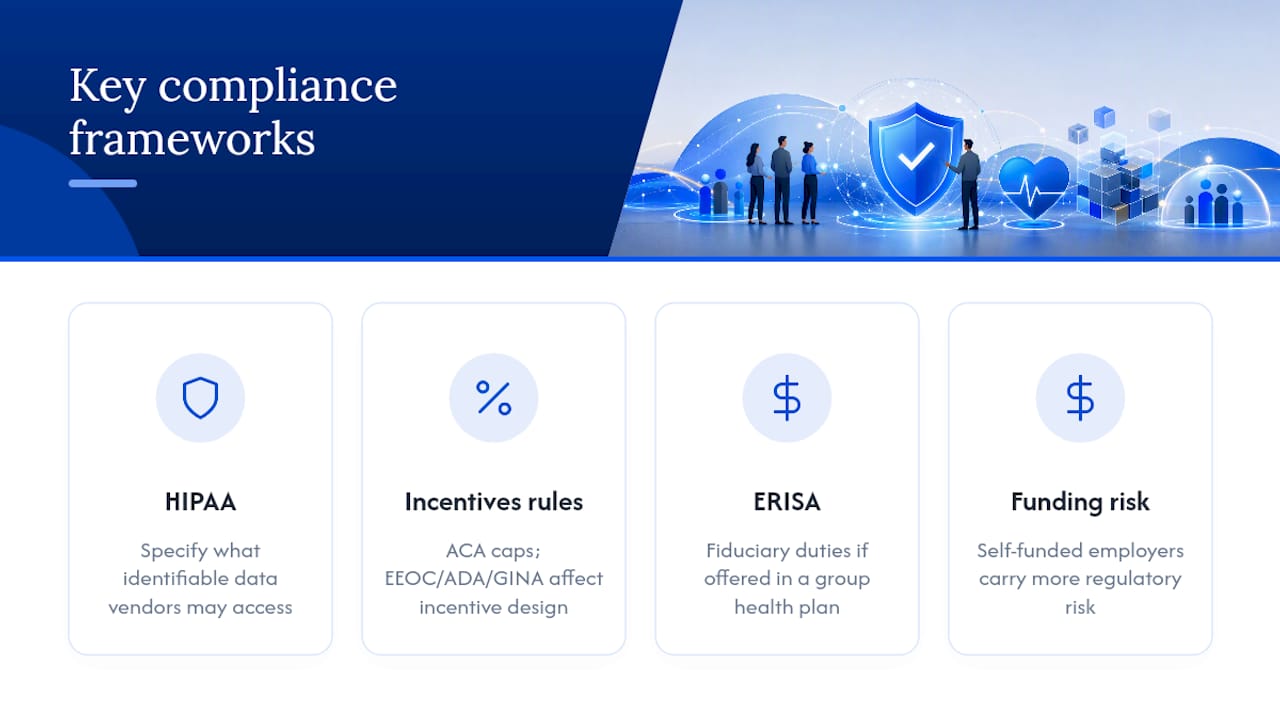
Population health programs sit at the intersection of several federal frameworks, and getting the compliance layer wrong can undo the financial case entirely. HIPAA governs how claims and health data move between the employer, the carrier, and any population health vendor. That means data-sharing agreements need to specify exactly what identifiable information a vendor can access and how it's protected, not just that it "complies with HIPAA."
The Affordable Care Act's wellness program rules cap the value of participatory and health-contingent incentives, and the EEOC has separately weighed in on how incentive structures interact with the Americans with Disabilities Act and GINA (the Genetic Information Nondiscrimination Act). Incentive design has to walk a line: aggressive enough to move participation, structured carefully enough to avoid functioning as a penalty for employees who can't meet a health standard.
ERISA also applies if the population health program is offered as part of an employer-sponsored group health plan, which brings fiduciary duties around plan administration and disclosure. Self-funded employers carry more of this compliance burden directly than fully insured groups, since there's no carrier absorbing the regulatory risk layer.
None of this should discourage you from pursuing claims reduction. It does mean legal review of any vendor contract, incentive structure, and data-sharing agreement belongs in the process before rollout, not after a compliance question surfaces mid-pilot. Most reputable population health vendors have already built their programs around these constraints and can walk your legal team through their approach.
Impact of Mental Health and Behavioral Health Initiatives on Reducing Claims
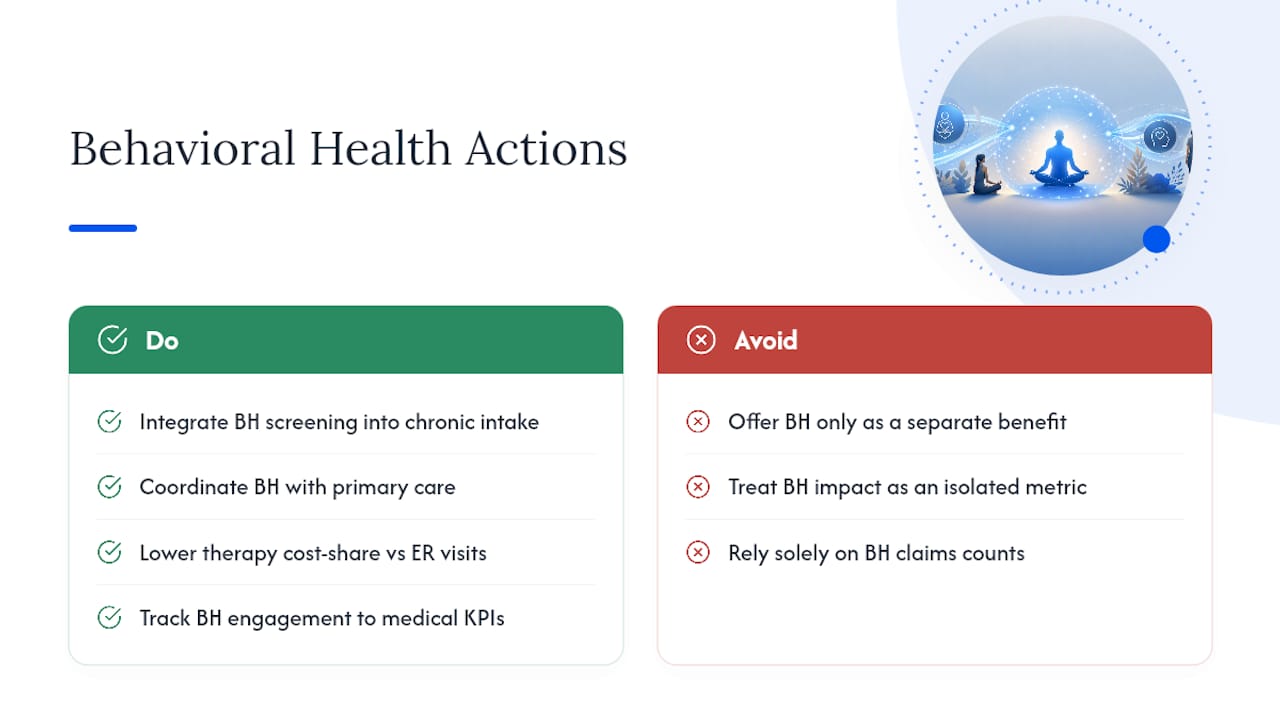
Behavioral health is one of the most underused levers in claims reduction, largely because its cost impact hides inside other categories. Untreated depression and anxiety correlate with higher rates of chronic disease flare-ups, missed medication adherence, and increased ER use, all of which show up as medical claims rather than behavioral health claims.
Employers who add accessible mental health support, whether through an EAP, expanded teletherapy access, or integration with primary care, tend to see improvement in adherence and engagement across their other disease management programs. An employee managing diabetes and untreated depression at the same time is far less likely to stick with a care plan than one whose mental health is also being addressed.
The practical move is coordination, not addition. Behavioral health screening built into chronic disease management intake, rather than offered as a completely separate benefit, catches more people and costs less to administer. Lowering the cost-sharing barrier for a therapy visit compared to an ER visit for a panic attack is a benefit design change with a direct claims impact, not just a wellness perk.
This is also where measurement gets harder. Behavioral health's effect on claims often shows up as a reduction in medical utilization elsewhere, which means your KPI tracking needs to connect behavioral health engagement to the chronic disease and ER metrics discussed earlier, rather than treating it as its own isolated line item.
Author Perspective: Why Targeted Population Health Wins
Employers keep buying broad wellness programs because they're easy to sell to a workforce. But the claims data-driven approach works because it targets the small cohort actually driving cost. Start with your high-cost claimants, measure quarterly, and pick a partner who'll show you the math, not just the marketing.
— Gene
How Hadaco Helps You Reduce Healthcare Claims
This is a direct option for employers who want the evidence-based approach this article describes without disrupting the benefit plan they already have. The program layers chronic disease management, preventive care, and behavioral health support on top of existing plans, backed by a transparent savings estimator and quarterly reporting so finance teams see measurable results.
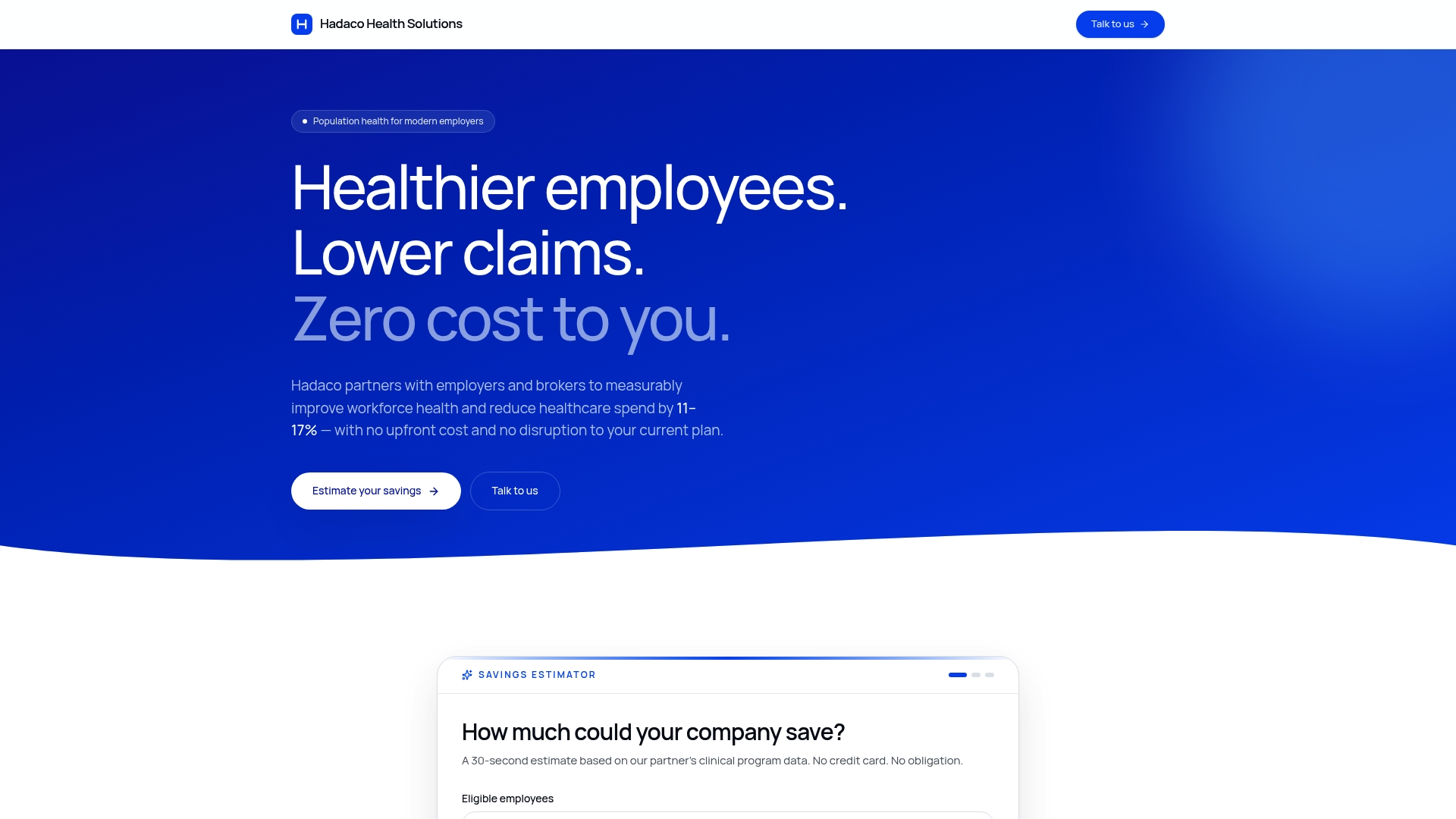
There's no upfront fee to get started, and the model is built around measurable outcomes rather than a flat contract cost. Employers working with Hadaco often see average first-year savings of $451 per employee, a figure worth comparing against your own claims baseline before committing to anything larger. If you're weighing a pilot cohort against a full rollout, that's exactly the kind of conversation worth having early.
Ready to see what a targeted program could save your organization? Request a savings estimate from Hadaco and get a quarterly reporting model built around your own claims data, not an industry average.
Sources
The claims and figures in this article draw on a small set of credible studies worth reading directly. The RAND research brief on workplace wellness savings breaks down where measurable savings actually come from. The randomized trial published on employee health and economic outcomes offers the clearest evidence on wellness-only limitations. The seven-year academic cohort study shows what a well-designed, sustained program can return. The CDC framework on chronic disease prevention program adoption covers implementation strategy for employers.
- Effect of a Workplace Wellness Program on Employee Health and Economic Outcomes
- Do workplace wellness programs save employers money? | RAND
- Hadaco Health Solutions — Healthier employees, lower claims