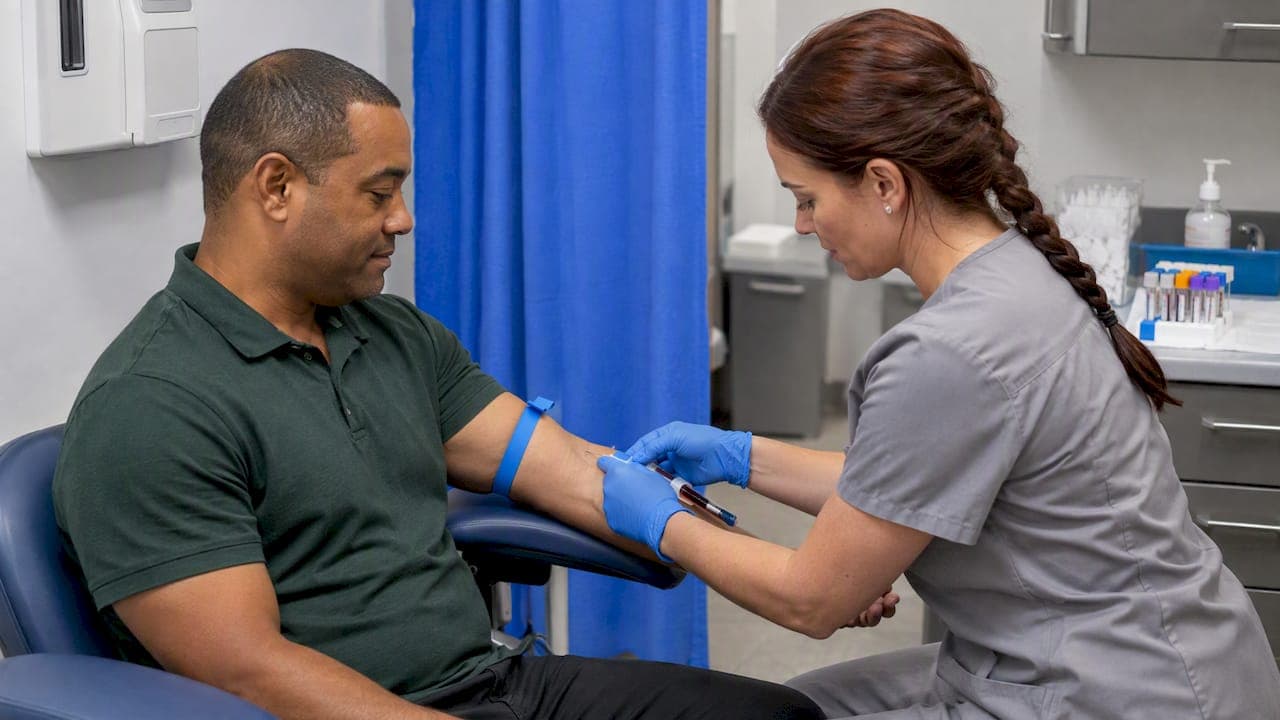
The most effective employer approach to cholesterol combines screening, access to treatment, lifestyle support and a referral path to a clinician, all run as a voluntary and confidential program. Your role is to remove barriers to care, not to replace it. This guide covers what to offer, how to stay within U.S. wellness-program rules, how to get employees to participate, and which numbers to track so a CFO can see whether it works.
TL;DR
- High cholesterol is a modifiable risk, and cardiovascular disease is among the costliest conditions for U.S. employers, so it belongs in your health strategy.
- The core levers are screening, low-cost access to lipid medication, lifestyle counseling, and referral to a health care provider.
- Wellness programs must be voluntary, confidential, and compliant with ADA, GINA and EEOC incentive limits.
- Measure participation, clinical markers in aggregate, medication adherence and claims trends. Set realistic expectations on short-term ROI.
- Programs that sit alongside your current benefits are easier to launch than ones that replace them.
Table of Contents
- Why cholesterol belongs on the employer agenda
- What employers can actually do
- Staying compliant: voluntary, confidential, non-discriminatory
- How to launch and get people to participate
- What to measure, and what to expect
- Common mistakes to avoid
- Our perspective
- How Hadaco can help
- FAQ
- Sources
Why cholesterol belongs on the employer agenda
Heart disease and stroke are leading causes of death and disability, and the CDC describes them as among the most expensive medical conditions for U.S. businesses. High cholesterol and high blood pressure are modifiable risks. Reducing them can lower direct medical costs and indirect costs such as absenteeism and lower productivity.
The scale of the issue is large. CDC data for 2017 to 2020 show about 86 million U.S. adults with total cholesterol above 200 mg/dL, and nearly 25 million above 240 mg/dL. The same page reports that slightly more than half of adults who could benefit from cholesterol medicine are taking it. For an employer, that gap is the opportunity: a share of your workforce likely has elevated lipids that nobody is addressing.
High cholesterol rarely causes symptoms, which is why it tends to surface only after a cardiac event or an expensive hospitalization. Finding it earlier, and keeping people engaged with treatment, is the whole point of a workplace program.
What employers can actually do
You do not need to practice medicine. The CDC's employer guide lists a set of supports that work around a person's own clinician:
- Lifestyle counseling and education.
- Healthier food options or food subsidies at work.
- Fitness benefits.
- Cholesterol screening and coverage for treatment.
- Referral of employees with high cholesterol to a health care provider.
These come from the CDC's guide to heart disease and stroke prevention for employers, which also recommends coordinated programs that combine individual-level support with organizational changes such as supportive policies and healthier workplace environments.
Coverage and access
The Million Hearts employer action guide recommends coverage with no or low out-of-pocket cost for lipid-control medications and home blood pressure monitoring devices, plus lifestyle counseling and follow-up monitoring for employees with high cholesterol. Cost is a common reason people stop taking a prescribed medication, so plan design is often the quietest and most powerful lever you have. Work with your benefits advisor or carrier to review copays and prior-authorization rules for common lipid-lowering drugs.
Screening
Screening is the entry point. A simple lipid panel at an onsite event, through a virtual provider, or via your plan's preventive benefit gives employees a number and a reason to act. Screening on its own does little, though. What matters is what happens next: a clear referral path, follow-up testing, and support between appointments.
Education and lifestyle support
There is academic evidence that the format of education matters. In a randomized study published in the American Journal of Public Health, a behaviorally based two-hour nutrition program after screening cut cholesterol 6.5% at 12 months, compared with a 3% drop after a five-minute counseling session. The study is from 1995, so treat it as a signal about design rather than a benchmark for today's results: structured, behavior-focused support beats a brochure and a quick chat.

Food and environment
Cafeteria choices, vending options, catered meals and break-room defaults shape what people eat on 200-plus workdays a year. Healthier defaults and subsidies are low-cost changes that reinforce whatever individual coaching you offer.

Staying compliant: voluntary, confidential, non-discriminatory
Cholesterol programs usually involve health data, so the legal frame matters before you launch. This is a summary of federal rules, not legal advice. Have employment counsel review your design, especially if you operate in states with their own requirements.
| Rule | What it means for a cholesterol program |
|---|---|
| ADA and GINA | Employers may ask health-related questions or run medical exams as part of a voluntary wellness program. |
| EEOC incentive limit | The 2016 final rules allow incentives of up to 30% of the total cost of self-only coverage, for employees and spouses. |
| Confidentiality | Information may reach the employer only in aggregate, and employees must get notice of what is collected, who sees it and how it is protected. |
| No waivers | Employees cannot be required to waive confidentiality of their health information to take part or earn an incentive. |
| GINA | Employers generally may not request or obtain genetic information, including family medical history, with narrow exceptions including qualifying voluntary wellness programs. |
One practical point on family history: cholesterol risk questionnaires often ask about it. Our deeper walkthrough of GINA and wellness programs covers what you can and cannot ask.
HIPAA is often misunderstood here. The Privacy Rule does not generally apply to employers themselves, but it does bind covered entities such as health care providers and health plans. In practice, that is a reason to use a vendor that keeps individual results away from your HR team and reports only de-identified, aggregate data.
How to launch and get people to participate
The CDC guide outlines a sequence that works for most employers: assess needs, integrate the program into organizational structures, enroll employees flexibly, communicate clearly, and use incentives plus onsite or virtual services. Here is how that looks in practice.
- Start with your claims and demographics. Look at aggregate claims for cardiovascular conditions, lipid medication fills and age mix. This tells you whether to focus on screening, adherence or high-risk follow-up.
- Pick a small set of goals. For example: raise screening participation, improve medication adherence among people already on treatment, and connect high-risk employees to care.
- Fit the program into existing benefits. Employees should not need a new portal, a new card or a new provider network just to take part. Programs that complement your current plan reduce friction and avoid disrupting your carrier relationships.
- Offer more than one way in. Onsite events work for campuses and plants. Virtual options reach remote staff, shift workers and dependents.
- Communicate privacy first. Say plainly that participation is voluntary, that you will only see aggregate results, and that nobody's job or coverage depends on their numbers.
- Use incentives within the limits. Keep any reward within the EEOC thresholds above and do not tie it to a health outcome you cannot make accessible to everyone.
- Follow up. A single event rarely moves a number. Schedule re-checks and coaching touchpoints across the year.
Make it accessible
A program that only suits desk workers who can attend a lunchtime seminar will miss many of the people at highest risk. Offer alternatives for employees who cannot take part in an activity because of a disability, a medical condition, or their shift. Provide materials in the languages your workforce speaks.
What to measure, and what to expect
Boards and CFOs will ask whether a cholesterol program pays off. Answer with a scorecard rather than a single number.
- Participation: the share of eligible employees and dependents who screened, enrolled and completed follow-up.
- Clinical markers, in aggregate: movement in LDL and total cholesterol among participants, and the share moving into a lower-risk category.
- Medication adherence: whether employees prescribed lipid-lowering drugs keep filling them.
- Claims trends: cardiovascular-related medical and pharmacy spending against a reasonable baseline.
- Indirect measures: absenteeism, engagement and retention, tracked with care not to attribute everything to one program.
Published figures give context, with limits. A CDC-published study of a small-workplace lifestyle education program found a cost of $10.17 per percentage-point reduction in LDL cholesterol, which suggests that even small organizations can run cost-effective programs. A one-year ROI model estimated $2.03 in medical and productivity savings for every $1 invested.
At the same time, researchers Zirui Song and Katherine Baicker reported in JAMA that a large randomized trial of a workplace wellness program did not show significant clinical or financial improvement in the short term. Their conclusion is a good reason to set a multi-year horizon, target people with real risk rather than whole populations indiscriminately, and judge the program on a mix of health and cost indicators. For more on building a defensible business case, see our guide to corporate wellness ROI, and for program design principles, our evidence-based wellness programs guide.
Common mistakes to avoid
- Screening without follow-up. A number with no next step produces anxiety, not outcomes.
- Treating cholesterol in isolation. Lipids, blood pressure, blood sugar, weight and mental health interact. A program that addresses them together is easier for employees to follow and easier to evaluate.
- Putting individual results in front of managers. It breaks the confidentiality promise and risks discrimination claims.
- Overly large incentives. Rewards beyond the EEOC limits can make participation look coerced.
- Expecting a first-quarter payback. Behavior change and adherence take time to show in claims.
- Ignoring dependents. Spouses and adult children are often a large share of your claims.
Our perspective
We see cholesterol as a good test of whether an employer's health strategy is working. It is common, it is silent, it is treatable, and the gap between people who could benefit from care and people who get it is large. That is exactly where a well-run program earns its keep.
Our view is that employers should not have to tear up their benefits to address it. We design population health programs to complement the plans you already have, covering chronic disease, preventive care, mental health and engagement together, because employees do not experience their health in separate boxes.
We also think employers deserve transparency. That is why we offer a savings estimator before you commit and quarterly reporting once you do, so HR and finance can see outcomes and hold us accountable. Our programs carry no upfront fees, and our compensation is tied to demonstrated savings and engagement.
In their first year, companies often see an average savings of $451 per employee, along with improved engagement and retention. Results vary by workforce, and we say so up front, but we would rather be measured on outcomes than on promises.
Gene
How Hadaco can help
If you want cholesterol and broader cardiovascular risk handled as part of a single program rather than a string of one-off events, our population health service is built for that. It delivers evidence-based interventions for chronic disease, preventive care, mental health and engagement, integrated with your current benefit plans, with a cost savings estimator and quarterly outcome reporting. There are no upfront fees.
Benefit consultants and brokers can use the same approach with their clients. You can explore our population health program and book a consultation to see what it could look like for your workforce.
FAQ
Can an employer require employees to get a cholesterol screening?
Not as part of a wellness program. Under ADA and GINA rules, health-related questions and medical exams are permitted in wellness programs only when participation is voluntary. Employers also cannot require employees to waive confidentiality of their health information to take part, per the EEOC's 2016 final rules. Ask employment counsel about any exam required for a specific job.
Can we see which employees have high cholesterol?
No. Wellness-program information should reach the employer only in aggregate form, and employees must be told what is collected and how it is kept confidential. Choose a vendor that reports de-identified group data and keeps individual results with the employee and their clinician.
How much can we offer as an incentive?
The EEOC's 2016 final rules allow incentives of up to 30% of the total cost of self-only health coverage for employees and for spouses. Confirm current guidance and any other applicable rules with counsel before you set rewards, because regulations and agency positions can change.
How quickly will a cholesterol program reduce claims costs?
Expect gradual progress. Published research shows mixed results, with some studies reporting positive ROI models and a large randomized trial finding no significant short-term financial change. Track participation, adherence and clinical markers from the start, and review claims over a multi-year window.
Does a program replace our current health plan?
It should not. The strongest designs work alongside your existing benefits, adding screening, coaching, adherence support and referral paths, while employees keep seeing their own doctors. Our own approach is built to complement current plans rather than disrupt them.
Sources
- How to Promote Heart Disease and Stroke Prevention in the Workplace (CDC employer guide)
- High Cholesterol Facts (CDC)
- Cardiovascular Health: Action Steps for Employers (Million Hearts)
- The costs and effects of a nutritional education program following workplace screening (AJPH, 1995)
- Cost-Effectiveness of Health Education Program in a Small Workplace (Preventing Chronic Disease, CDC)
- Estimating the Return on Investment From a Health Risk Management Program (CDC Stacks)
- Effect of a Workplace Wellness Program on Employee Health and Economic Outcomes (JAMA, PubMed)
- EEOC Issues Final Rules on Employer Wellness Programs
- The Genetic Information Nondiscrimination Act of 2008 (U.S. Department of Labor)
- HHS OCR Guidance on HIPAA and workers' compensation (U.S. Department of Labor)