
The most effective employer response to workplace chronic disease combines evidence-based self-management coaching or DSMES and National DPP referrals with low-cost accommodations and work-design changes. Systematic reviews and randomized trials back this approach, and it aligns with ADA and EEOC obligations. Employers that act on it see lower absenteeism, better engagement, and often measurable claims savings within a year.
TL;DR:
- Multidisciplinary programs with cognitive behavioral therapy and group self-management coaching deliver the strongest return-to-work outcomes and cost savings within one year.
- Clinical programs like DSMES and the National DPP, along with low-cost work design changes, are proven to improve health management and reduce long-term healthcare costs.
- Employers must recognize that most accommodations for chronic conditions are inexpensive and that engaging in the interactive process under the ADA is essential for compliance.
- Work environment factors, including supervisor attitudes, task flexibility, and psychosocial safety climate, significantly influence employees' ability to manage chronic illness effectively.
- Effective programs should integrate with existing benefits, be measurable through quarterly reporting, and include a clear evaluation of clinical and productivity impacts to justify ongoing investment.
Table of Contents
- Why Workplace Chronic Disease Matters to Your Bottom Line
- What the Evidence Shows: The Interventions That Actually Work
- Legal Duties and Reasonable Accommodations Under the ADA
- Work Design and Supervisor Support Employees Actually Notice
- Choosing the Right Program Model for Your Workforce
- A Step-by-Step Rollout Checklist for HR Teams
- Measuring Impact and Building the Business Case
- Where Occupational Health Fits Into the Picture
- A Hadaco Perspective on Deploying These Programs Without Disrupting Benefits
- Get a Clear Picture of What Chronic Disease Is Costing You
- Sources
- FAQ
Why Workplace Chronic Disease Matters to Your Bottom Line
Chronic disease in the workforce is not a fringe HR issue. It is the baseline condition of the American workforce, and it is getting more common, not less.
National survey data shows a large share of U.S. employees report living with at least one chronic condition, and a substantial portion of the workforce also carries the informal job of caring for a family member with one, according to a February 2025 employee poll from the Harvard T.H. Chan School of Public Health. That double burden, managing your own condition while coordinating care for a parent or spouse, shows up at work as missed meetings, distracted afternoons, and unplanned time off that never gets logged as "sick leave."
The conditions that show up most often in HR case files are predictable: type 2 diabetes, musculoskeletal pain and arthritis, cardiovascular disease, asthma, and mood disorders like depression and anxiety. Each affects work capacity differently. Diabetes brings fatigue and the need for glucose checks or scheduled meals. Arthritis brings pain flare-ups that make a normal Tuesday unpredictable. Cardiovascular disease often means frequent specialist appointments and activity restrictions. Mood disorders compound almost everything else, since untreated depression or anxiety tends to make physical symptoms feel worse and harder to manage.
The cost shows up in four separate channels, and most employers only track one of them:
- Presenteeism: employees at their desk but operating at reduced capacity, often the largest hidden cost and the hardest to measure.
- Absenteeism: missed days tied directly to symptom flare-ups, treatment, or appointments.
- Claims costs: higher utilization of emergency care, specialist visits, and prescriptions when conditions go unmanaged.
- Turnover: employees who leave because the job doesn't flex around their health needs, taking institutional knowledge and hiring costs with them.
Most benefits teams can pull a claims report. Fewer can quantify presenteeism, which is exactly why it tends to get ignored even though it often costs more than the other three combined. A short, anonymous pulse survey asking employees to rate their own productivity on bad symptom days is a cheap way to put a number on it before you build a business case for leadership.
What the Evidence Shows: The Interventions That Actually Work
Not every wellness initiative earns its budget line. The research on workplace chronic disease has narrowed down to a short list of approaches that reliably move the needle, and it's worth knowing which ones those are before you spend money on the rest.
Multidisciplinary programs combined with cognitive behavioral therapy (CBT) produce the strongest return-to-work results. A systematic review analyzing 15 randomized controlled trials found that programs pairing medical or occupational support with CBT-based coping strategies consistently outperformed single-track interventions for maintaining employment and reducing sickness absence among workers with chronic illness. The CBT component matters because chronic illness carries a psychological load, health anxiety, fear of judgment from coworkers, frustration over reduced capacity, and addressing that load directly is what separates programs that work from programs that just hand out pamphlets.
The evidence in numbers: Across 15 randomized controlled trials reviewed, multidisciplinary programs combining clinical support with CBT-informed self-management consistently showed better return-to-work and absence outcomes than standard care alone.
Group self-management coaching is the second proven layer, and it's cheaper to deploy than most employers assume. The Manage at Work trial, a randomized evaluation of a five-session worksite self-management program, found measurable improvements in work engagement at six months among participants. The program's limited number of sessions is a modest ask. Compare that to a full clinical program, and the return on a short facilitated workshop looks disproportionate to its cost.
For diabetes specifically, the clinical evidence points to two named, federally backed programs employers should know by name rather than treat as generic "wellness":
- Diabetes Self-Management Education and Support (DSMES): structured clinical education that helps employees with diabetes manage medication, diet, and monitoring, with CDC guidance identifying it as a proven lever for lowering A1C and reducing complications when integrated into employer benefits.
- National Diabetes Prevention Program (National DPP): a lifestyle-change cohort model aimed at employees with prediabetes, shown to reduce progression to full type 2 diabetes and cut long-term healthcare spending.
Neither program requires an employer to build clinical infrastructure from scratch. Both are designed to be referred into, through a health plan, a CDC-recognized provider network, or a population-health partner that handles enrollment and reporting.
The broader frame that ties all of this together is Total Worker Health®, a model developed by the National Institute for Occupational Safety and Health (NIOSH). It argues that health protection (safety, ergonomics, hazard reduction) and health promotion (screenings, coaching, prevention programs) work better together than either does alone. NIOSH's own materials on chronic disease at work make the case that isolated wellness perks rarely move outcomes, but a workplace that reduces physical strain and offers real management support sees compounding benefit. An employer running a diabetes prevention cohort while ignoring an ergonomically brutal shift schedule is working against itself.
The takeaway for anyone building a budget request: fund the interventions with trial data behind them first (DSMES referral pathways, National DPP cohorts, short self-management workshops), then layer in the Total Worker Health framing to justify pairing them with work-design fixes rather than treating those as a separate initiative.
Legal Duties and Reasonable Accommodations Under the ADA
Employers are legally required to provide reasonable accommodations for employees with chronic conditions unless doing so would create an undue hardship for the business, under the Americans with Disabilities Act (ADA). The EEOC's enforcement guidance on reasonable accommodation is the primary document HR should keep bookmarked, not a competitor's blog post summarizing it secondhand.
Chronic illness qualifies as a disability under the ADA when it substantially limits a major life activity, and conditions like diabetes, cancer, epilepsy, and major depressive disorder are explicitly recognized. The obligation isn't triggered only by a formal written request citing "the ADA" by name. A vague comment like "I'm having a hard time managing my blood sugar during long shifts" is enough to start what the EEOC calls the interactive process, a back-and-forth conversation between employer and employee to identify workable accommodation.
Here's what that process looks like in practice:
- Recognize the trigger. Train managers to treat any health-related request for a change in duties, schedule, or environment as a potential accommodation request, even if the employee never uses formal language.
- Start the conversation promptly. HR or a trained manager opens a dialogue about what the employee needs and what's functionally possible, without demanding a full diagnosis.
- Request limited documentation only when necessary. Employers can ask for medical documentation confirming the need for accommodation, but cannot demand a complete medical history or ongoing health monitoring.
- Identify and test the accommodation. This might be a modified schedule, a private space for medication or glucose testing, permission to keep snacks at a workstation, or a temporary change in duties.
- Document the process, not the diagnosis. Keep records of what was discussed and agreed to, stored separately from general personnel files and accessible only to those with a legitimate need to know.
- Revisit if circumstances change. Chronic conditions fluctuate; accommodation that worked in January may need adjustment in July.
Most accommodations that come up for chronic disease cost little or nothing: flexible break timing, a quiet space, permission to work from home during a flare, or adjusted start times around treatment appointments. Reassignment to a different role is a legitimate accommodation but should be treated as a later option, not a first offer, since the ADA favors keeping employees in their current position when a reasonable adjustment makes that possible.
"Undue hardship" is a real legal threshold, not just an employer's discomfort with the request. It means significant difficulty or expense relative to the size and resources of the business. A small clinic denying a request that would cost thousands of dollars a month has a stronger case than a large employer denying a $200 ergonomic chair.
Pro Tip: Train frontline managers, not just HR, to recognize accommodation triggers. The EEOC has found that employers frequently confuse accommodation with ongoing health monitoring. Removing a barrier to work is the legal obligation; tracking an employee's blood sugar or symptoms is not, and treating those as the same thing creates both a compliance risk and an invasion-of-privacy problem.
Work Design and Supervisor Support Employees Actually Notice
Clinical programs matter, but the day-to-day experience of managing a chronic condition at work is shaped far more by a direct supervisor's attitude than by any benefit in the employee handbook.
Researchers use the term "leeway" to describe how much autonomy an employee has to self-regulate the pace and sequencing of their own work. A review synthesizing interdisciplinary evidence on chronic conditions in the workplace identifies leeway as one of the strongest organizational predictors of whether an employee with a fluctuating condition, arthritis, fibromyalgia, IBS, migraine, stays productive and stays employed. Autonomy to shift a task to the afternoon when morning symptoms are worse costs the employer nothing and often prevents a full sick day.

Closely related is psychosocial safety climate, the degree to which employees believe management genuinely prioritizes psychological and physical well-being over pure output. A workplace can have generous formal accommodations on paper and still score poorly here if supervisors visibly resent employees who use them.
Practical, low-cost policy moves that build both leeway and safety climate:
- Let employees reorder tasks within a shift rather than following a fixed sequence, where the job allows it.
- Normalize short, unscheduled microbreaks rather than requiring formal break-time requests.
- Set up peer support groups, informal or structured, for employees managing similar conditions.
- Build temporary task reallocation into team workflows so a flare-up doesn't require a crisis conversation every time.
- Train supervisors specifically on stigma reduction, since fear of being seen as "less capable" is what stops employees from asking for help in the first place.
Measurement here doesn't need to be complicated. A short quarterly pulse survey asking employees to rate manager support and workload flexibility, combined with a simple manager checklist for handling accommodation conversations, gives HR an early warning system. Watch turnover specifically among employees who have disclosed a chronic condition or used FMLA leave; a spike there usually means a work-design problem, not a benefits problem.
Choosing the Right Program Model for Your Workforce
Not every chronic disease program fits every employer. Program selection should follow workforce size, budget, and whether the priority is clinical management or prevention.
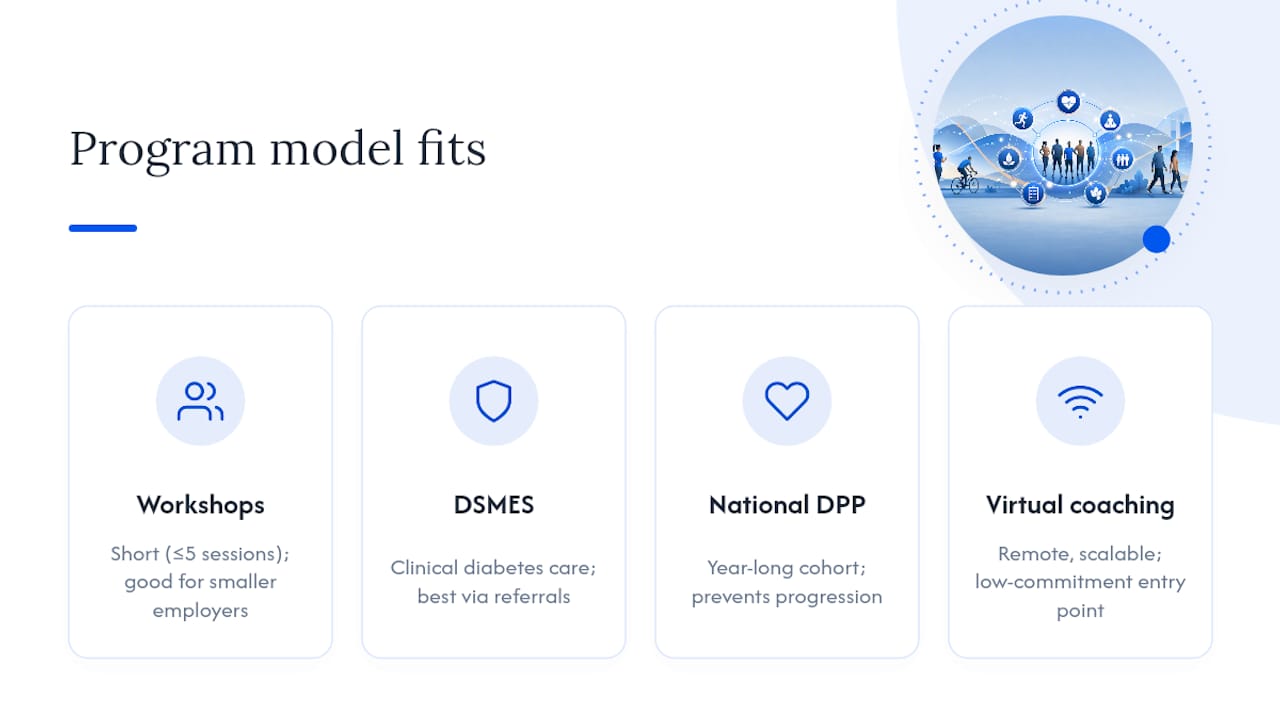
Worksite self-management workshops are brief, facilitated group sessions, typically five sessions or fewer, run by a trained EAP counselor or occupational health staff member. The Manage at Work trial model showed engagement gains at six months and is well suited to smaller employers who can't justify a full clinical vendor contract but want something more structured than a wellness newsletter.
DSMES is the right call when diabetes management is a known issue in your claims data. It's clinical, typically delivered through a certified educator, and works best as a referral pathway integrated with your health plan rather than something HR runs internally. Larger employers with self-funded plans see the clearest cost signal from DSMES referrals.
National DPP targets prediabetes specifically, aiming to prevent progression rather than manage an existing diagnosis. It runs as a cohort, typically a year-long lifestyle-change program, and fits employers willing to commit to a longer engagement window for a bigger prevention payoff.
Virtual coaching and EAP-facilitated programs are the most remote-friendly option and the easiest to scale across a distributed or hybrid workforce. They work well as a lower-commitment entry point, particularly for employers testing appetite before investing in a full DSMES or National DPP pathway.
A few cross-cutting considerations apply regardless of which model you pick. CDC guidance on employer diabetes programs notes that flexible scheduling and a mix of on-site and virtual delivery meaningfully increase participation rates, since employees on rotating shifts or in field roles often can't attend a fixed weekly meeting. Modest participation incentives, gift cards, extra PTO, or premium credits, also lift enrollment without requiring a large budget. And any program should be positioned as a benefit integration, not a bolt-on: employees are far more likely to enroll when a program is introduced through existing benefits communications rather than as a separate, unfamiliar outreach.
Prevention-oriented programming rounds out the model mix. Public health reviews point to workplace screenings, tobacco cessation support, vaccination access, and short movement breaks as practical, low-cost levers that reduce chronic disease incidence over time, according to an Annual Reviews analysis of workplace health promotion. These belong alongside management programs, not instead of them.
A Step-by-Step Rollout Checklist for HR Teams
Building a chronic disease strategy from scratch feels overwhelming until you break it into phases. Here's a realistic sequence that most mid-sized employers can execute inside a single benefits cycle.
- Assess the need before choosing a program. Pull a claims report to identify high-cost conditions, run an anonymous employee survey to gauge interest and self-reported burden, and consider a formal health risk assessment to establish a baseline. Skipping this step is the single most common reason chronic disease programs get low enrollment; employers guess at what workers need instead of asking.
- Ship quick wins within 30 to 60 days. Roll out low-cost accommodations (flexible breaks, private space for medication, adjusted start times) and run a short manager training session on the interactive process and stigma reduction. This buys credibility before the bigger program launches.
- Pick one program model to pilot, not five. Choose based on what your claims data shows. High diabetes prevalence points toward DSMES referrals and a National DPP cohort. High musculoskeletal or stress-related claims point toward a self-management workshop pilot instead.
- Build the operational backbone. Confirm ADA and privacy compliance for any data collected, set vendor selection criteria (evidence base, reporting cadence, integration with your current plan), and set a pilot timeline, typically 6 to 12 months for a fair read on outcomes.
- Communicate through channels employees already trust. Introduce the program through existing benefits enrollment materials and team meetings, not a standalone email that reads like spam. Name a specific point of contact for questions.
- Set a measurement plan before launch, not after. Decide your baseline metrics, absenteeism days, self-reported productivity, participation rate, and assign an owner for each: HR tracks engagement, the benefits team tracks claims impact, and the clinical vendor reports outcome data on a fixed schedule.
Pro Tip: Run your pilot with one clearly defined cohort, one specific condition category or one department, rather than opening it company-wide immediately. A focused pilot gives you a clean before-and-after comparison and a real story to bring to leadership when you ask to scale it.
Employers evaluating outside vendors for any of these program types should compare options against a clear set of chronic disease management program criteria, since evidence base, reporting transparency, and integration with existing benefits vary widely across providers.
Measuring Impact and Building the Business Case
The metrics that matter to a CFO are narrower than the metrics that matter to a program manager, and HR needs to speak both languages.
Track five things consistently: absenteeism days tied to chronic conditions, a presenteeism proxy from a short productivity self-report, program utilization rate, aggregate clinical markers where appropriate (average A1C shift across a DSMES cohort, for instance, reported in aggregate to protect privacy), and retention among employees who've disclosed a condition or used related leave.
Set a realistic baseline before launch and treat year one as a pilot, not a victory lap. Programs like DSMES and National DPP show their clearest clinical and cost signal over 12 to 24 months, not 90 days. The systematic review of 15 randomized controlled trials found multidisciplinary, CBT-informed programs outperformed standard care on return-to-work and absence, but even trial-level effects take real time to translate into a claims report.
What to expect in year one: most employers should frame early results in terms of engagement and utilization, not immediate claims reduction, since clinical improvement from DSMES and National DPP cohorts typically compounds over the following year.
A transparent savings estimator paired with quarterly reporting is what turns this from a hopeful pilot into a defensible line item. When leadership can see engagement numbers and projected savings every quarter instead of once a year, the program stops being a line item nobody can explain and becomes a metric people actually watch.
Where Occupational Health Fits Into the Picture
Occupational health services and chronic disease management often live in separate silos, one focused on injury prevention and workplace safety, the other on benefits and wellness. That separation is a mistake. An employee managing rheumatoid arthritis who also works a physically demanding job needs both an ergonomic assessment from occupational health and a treatment adherence conversation from a DSMES-style program, and those two conversations should be coordinated, not parallel.
Occupational health staff, where an employer has them on-site or contracted, are well positioned to serve as the front door for the interactive process under the ADA, since they already handle confidential health information under existing protocols. They can also flag early warning signs, a worker repeatedly favoring one side of the body, frequent unexplained absences tied to a known condition, that HR alone would never see.
The Total Worker Health® framework from NIOSH explicitly argues for this integration, treating physical hazard reduction and chronic disease support as two halves of the same system rather than competing budget lines. Employers without a dedicated occupational health function can approximate this by giving their benefits vendor and safety or facilities team a shared reporting line, even a simple monthly check-in, so ergonomic and clinical interventions reinforce each other instead of running independently.
A Hadaco Perspective on Deploying These Programs Without Disrupting Benefits
Most employers I've watched approach workplace chronic disease get stuck on the wrong question. They ask "which vendor has the best app?" when the real question is "does this integrate with what we already have, and can I prove it worked?" Population health programs fail more often from poor integration and poor reporting than from weak clinical content.
That's the gap Hadaco is built to close. Rather than asking an employer to replace or restructure existing benefit plans, Hadaco layers population-health programs on top of them, covering chronic disease support, preventive care, and mental health, without requiring the plan disruption that scares off risk-averse HR leaders. There's no upfront fee, which matters for benefits teams that have been burned by wellness vendors charging big setup costs for programs that never got measured properly.
The pieces map directly onto what the evidence supports elsewhere in this article: population screening to identify who needs DSMES or National DPP referral, virtual coaching for employees who can't attend in-person sessions, and structured measurement so a pilot doesn't disappear into an unread annual report. A transparent savings estimator and quarterly outcome reporting give HR and CFOs the same visibility into engagement and projected savings that this article argues employers need to build a real business case, rather than a hopeful one.
— Gene
Get a Clear Picture of What Chronic Disease Is Costing You
Everything in this article points to the same conclusion: employers that treat chronic disease support as an integrated part of existing benefits, not a bolt-on wellness perk, see better engagement and real cost signals. Hadaco is built around that exact idea. It layers population-health programs, chronic disease support, preventive care, mental health, engagement, directly onto your current plan with no upfront fee, so there's no plan rebuild and no disruption to what your employees already know.
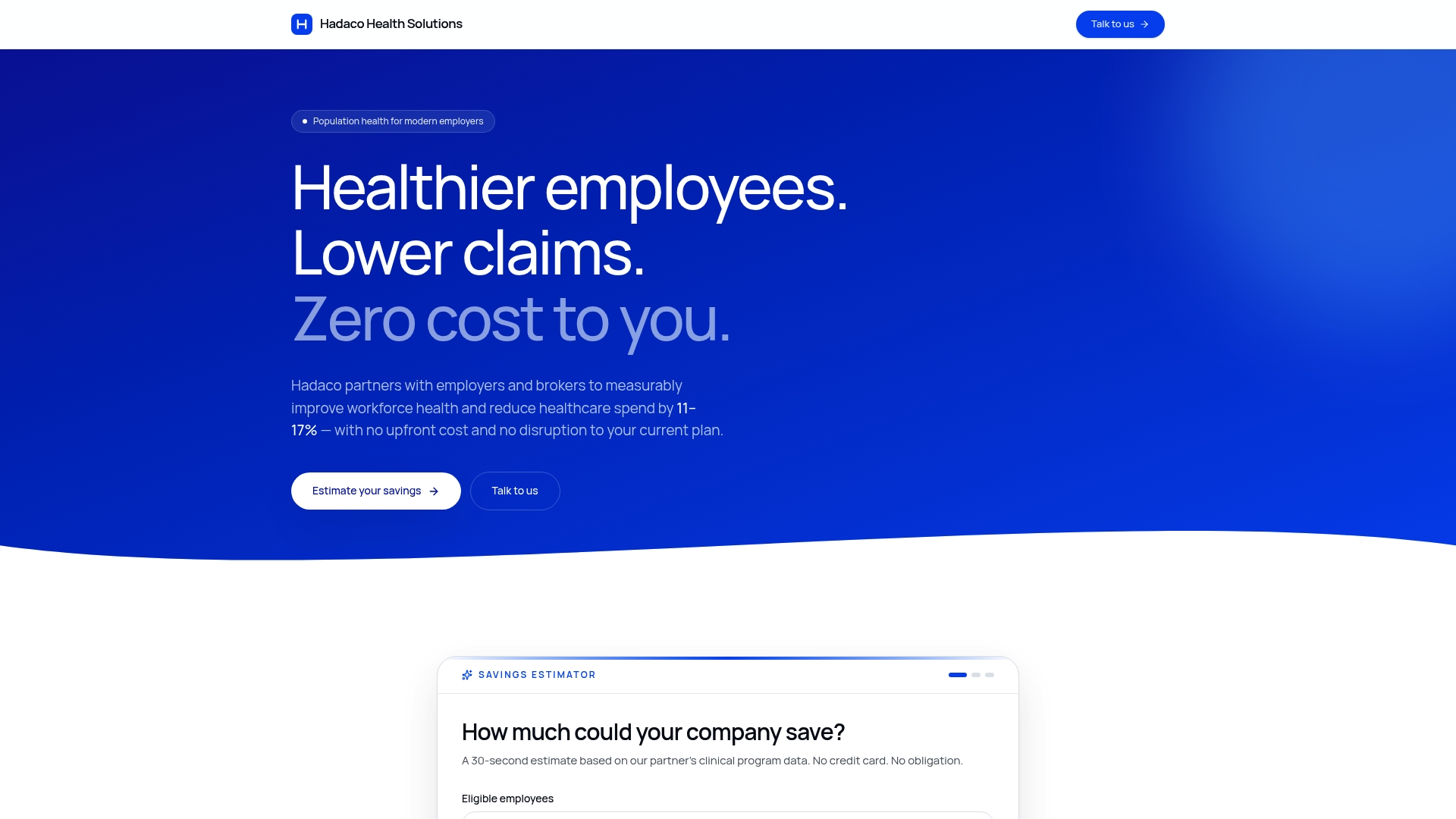
What sets it apart is visibility. A transparent savings estimator shows projected impact before you commit to anything, and quarterly reporting keeps that promise honest instead of leaving you with a single annual summary nobody reads until renewal season. Employers working with population health programs focused on chronic disease support often see measurable savings per employee in their first year, alongside stronger engagement and retention.
If your claims data shows a chronic disease pattern you haven't fully addressed, or you're simply tired of running wellness programs you can't measure, get your savings estimate from Hadaco and see what a quarter of real reporting looks like before you decide on anything bigger.
This article is general information, not a substitute for advice from a qualified doctor. Consult a qualified healthcare professional about your own circumstances before acting on anything here.
Sources
- Chronic Diseases and Employment: Which Interventions Support the Maintenance of Work and Return to Work among Workers with Chronic Illnesses? A Systematic Review
- Enforcement guidance: reasonable accommodation and undue hardship under the ADA
- Employers and Insurers | Diabetes | CDC
- Chronic health conditions in the workplace: work stressors and supportive supervision, work design, and programs (Occupational Health Science special issue)
FAQ
What Are Examples of Debilitating Chronic Conditions That Affect Work?
Diabetes, cardiovascular disease, arthritis and other musculoskeletal disorders, asthma, epilepsy, cancer, and major depressive disorder are among the most common chronic conditions that limit work capacity through fatigue, pain, treatment schedules, or symptom flare-ups.
Can an Employer Fire Someone for Having a Chronic Illness?
No. Firing an employee because of a chronic illness that qualifies as a disability under the ADA is illegal discrimination, and employers are instead required to explore reasonable accommodations through the interactive process before considering any adverse action.
What Should an Employee Do About an Undiagnosed Chronic Illness Affecting Work?
An employee dealing with undiagnosed symptoms should still raise the impact with HR or a supervisor. Under EEOC guidance, even a vague, non-diagnosis-specific request for support can trigger the employer's obligation to start the interactive process and explore temporary accommodations.
What Counts as a Chronic Disease?
A chronic disease is a long-lasting health condition, typically one year or longer, that requires ongoing medical management and can limit daily activities; diabetes, heart disease, arthritis, and chronic depression are common examples that show up in workplace settings.
How Can Employers Measure the ROI of a Chronic Disease Program?
Track absenteeism days, a presenteeism proxy from short productivity surveys, program participation rates, aggregate clinical markers like average A1C shifts, and retention among affected employees. Programs like Hadaco use a transparent savings estimator and quarterly reporting so employers can see these figures on an ongoing basis rather than waiting for an annual renewal review.