
Employers manage chronic kidney disease (CKD) best by acting before dialysis: find at-risk employees through claims data, push prevention for diabetes and high blood pressure, expect targeted outreach from health plans and vendors, and track costs and risk factors every year. Support for employees already in treatment, including flexible schedules and leave, protects both the person and your budget. This guide walks through the cost picture, the steps that work, the legal basics, and the numbers to measure.
TL;DR
- CKD is common in the workforce. The American Kidney Fund and the National Alliance of Healthcare Purchaser Coalitions report it affects over 11 million US workers, 7.4% of the workforce.
- The costliest moment is late detection. Employers may carry dialysis costs for the first 30 months of treatment before Medicare takes over.
- Prevention runs through diabetes, hypertension and obesity programs, plus health plan and vendor outreach to people at risk.
- Employees on dialysis often need flexible schedules. The ADA and FMLA can apply, so train managers before the first request lands.
- Measure risk-factor prevalence, screening rates, adherence and claims cost once a year, and ask vendors for reporting you can audit.
Table of Contents
- Why CKD belongs on the employer's agenda
- Start with your own claims data
- Prevention: where the largest savings sit
- Supporting employees who already have CKD
- What to measure
- How to choose a program partner
- Perspective
- See what a population health program could save you
- FAQ
- Sources
Why CKD belongs on the employer's agenda
Kidney disease rarely shows up on a benefits dashboard until it is expensive. Early CKD has few symptoms, so many employees do not know they have it. The cost arrives later, as hospitalizations, dialysis and lost workdays.

The scale is larger than most HR teams assume. A 2024 report from the American Kidney Fund and the National Alliance of Healthcare Purchaser Coalitions found that CKD affects over 11 million US workers, or 7.4% of the workforce. The same report estimates that stage 3 to 5 CKD and its associated conditions cost employers about $107 billion a year, through absenteeism, reduced performance and employees leaving the labor force.
The pattern inside a company looks like this:
- Reduced capacity at work. The National Kidney Foundation reports that 49% of employed people with CKD describe work-related limitations: 51% work fewer hours, 42% work at a slower pace and 31% adjust their work tasks.
- Medical spend on the plan. The same source estimates that employers can be responsible for dialysis costs during the first 30 months of treatment, about $15,444 a month, or $463,320 over 30 months, before Medicare becomes the primary payer.
- Turnover. Employees who cannot keep up with treatment and a full schedule often reduce hours or leave, taking skills and benefits history with them.
The point for a CFO is simple: a single employee who reaches kidney failure unexpectedly can cost more than a whole year of prevention programming for a large group. The point for a CHRO is just as clear: the employees affected are often mid-career and experienced.
Start with your own claims data
You cannot manage what you cannot see. The National Alliance's March 2025 action brief advises employers to review medical and pharmacy claims every year to identify the prevalence of hypertension, diabetes and CKD, and to look at differences by age, gender, race and ethnicity, and geography.
A useful first pass answers five questions:
- How many members have diabetes or hypertension, the two leading drivers of kidney damage?
- Of those, how many have had a kidney screening in the past year? CKD screening rates are one of the measures the brief recommends collecting.
- How many have a CKD diagnosis, and at what stage?
- Are people with these conditions taking their medications as prescribed, and do they have a primary care relationship?
- Where is the spend concentrated: emergency visits, inpatient stays, specialty drugs, dialysis?
Your broker or health plan can usually pull most of this. If they cannot, that is itself a finding. Ask for the data in a de-identified, population-level format so you stay on the right side of privacy rules.
Prevention: where the largest savings sit
The cheapest case of kidney failure is the one that never happens. Most CKD in working-age adults traces back to diabetes, high blood pressure or both, so prevention for kidney disease is largely prevention for those conditions.
The National Kidney Foundation lists several evidence-based benefits employers can cover, including the Diabetes Prevention Program, self-measured blood pressure programs, and medical nutrition therapy or nutrition counseling for employees with diabetes, hypertension or obesity. Each is a concrete benefit design decision, not a poster campaign.
Make the workplace kidney-friendly
Smaller changes support the bigger ones. The same National Kidney Foundation guidance suggests providing water filling stations and posting nutrition information, including protein, phosphorus and potassium content, for food served at work. Cafeteria and catered-meal contracts are an easy place to start.
Improve health literacy
Many employees with early CKD have never heard the term. The National Alliance brief suggests simple infographics translated into the languages your workforce speaks, and employee resource groups to build understanding of preventive care and treatment. For a distributed or multilingual workforce, this matters more than another portal login.
Hold plans and vendors to outreach standards
The brief also advises employers to set the expectation that health plans and other vendors provide targeted outreach to people at risk for or living with CKD. Put it in the contract language and the renewal scorecard, not just the kickoff call.
The broader framework from the American Kidney Fund and the National Alliance has four parts: track risk-factor prevalence, prioritize early screening and detection, foster timely collaboration and referrals among plans and providers, and provide access to comprehensive treatment. Use it as a checklist when you review your current vendors.

If you want the wider view of how chronic conditions drive cost and what a sound plan looks like, our guide to a workplace chronic disease cost plan covers the same logic across conditions. Our article on a workplace prediabetes prevention plan covers one of the earliest and most actionable points in the path toward kidney disease.
Supporting employees who already have CKD
Some of your employees are already in stages 3 to 5, on dialysis, or recovering from a transplant. Good management here is mostly about predictability: knowing in advance how schedule changes will be handled, so no one has to negotiate from scratch while sick.
What the schedule can look like
Hemodialysis commonly happens several times a week in sessions of a few hours, with fatigue afterward. Home dialysis options change the pattern but not the need for flexibility. The National Kidney Foundation's guidance on workplace rights lists reasonable accommodations such as flexible hours, modified duties, remote work and extra breaks. Many of these cost little or nothing, and they help you keep an experienced employee.
The legal basics: ADA and FMLA
Two federal laws come up most often. This is an overview for planning, and your employment counsel should confirm how they apply to your company and state.
- ADA. The National Kidney Foundation explains that kidney disease and its treatments may qualify as disabilities under the ADA, especially when they limit daily activities. That can trigger a duty to consider reasonable accommodations through an interactive conversation with the employee.
- FMLA. Federal guidance on serious health conditions lists kidney dialysis as an example of a condition that can involve continuing treatment. Where an employee and employer are covered, that can support intermittent leave for treatment. Eligibility depends on employer size, tenure and hours worked, and some states add their own leave laws.
As a practical matter, give managers a short script: who to send the request to, what not to ask, and how fast HR responds. Keep medical details with HR or your leave administrator, not in team chats.
Coordinate with the benefits side
Employees with CKD are best served when the plan, the care team and the employer are not working at cross purposes. That means a clear point of contact for questions about coverage, care navigation to a nephrologist before the late stage, and attention to the transition to Medicare, since the 30-month period noted above shapes who pays.
What to measure
A CKD program without measurement turns into an annual wellness fair. The research suggests tracking the prevalence of CKD risk factors and diagnoses, health care costs, and the potential savings from delaying disease progression. Add the measures from the National Alliance brief: medication and treatment adherence, primary care relationships and screening rates.
A simple annual scorecard:
| Measure | Why it matters | Typical source |
|---|---|---|
| Prevalence of diabetes, hypertension, CKD | Shows the size of the at-risk group | Medical and pharmacy claims |
| CKD screening rate among at-risk members | Early detection is the lever | Claims, vendor reports |
| Medication and treatment adherence | Predicts progression | Pharmacy claims |
| Primary care relationship | Predicts follow-through | Claims, plan data |
| Total cost for members with CKD | Baseline for savings | Claims |
| Absenteeism and work limitations | Captures the non-medical cost | HR and leave records |
On absenteeism, a CDC analysis of diabetes gives a useful sense of scale for a related condition: it estimated annual absenteeism costs of $1,621 for a 100-employee employer and $17,107 for a 1,000-employee employer (published 2016, so costs today are higher). Use it to frame the conversation, then replace it with your own data.
Results take time. Kidney disease progresses slowly, so judge the first year on process measures such as screening and adherence, and the second and third on claims.
How to choose a program partner
Whether you build in-house, work through your plan or hire a population health partner, ask the same questions:
- Does it integrate with the benefits you already have, or does it require replacing them?
- How does it find at-risk members who have never been diagnosed?
- Is the fee tied to results, or paid upfront regardless?
- What will you see each quarter, and can your broker or finance team verify it?
- How does it reach employees in the languages and shifts your workforce actually works?
Avoid programs that only offer a portal or a webinar. CKD management works when someone follows up with people, repeatedly, on the specific gaps in their care.
Perspective
Kidney disease is a good example of why we build population health programs around the full path, not a single condition. The costly event, dialysis, is the end of a long stretch in which hypertension, diabetes or prediabetes went unmanaged. Employers who only look at the end of that stretch are paying for a problem they could have shortened.
Our approach is to complement the benefit plan you already have, not disrupt it, and to be accountable for outcomes. That is why we offer programs with no upfront fees, a transparent savings estimator and quarterly reporting. Employers tell us they want to know what changed, not just that something was offered.
We have seen companies average $451 in savings per employee in the first year of our evidence-based chronic disease programs, alongside better engagement and retention. Your own number depends on your population, and the estimator is built to show you that before you commit.
Gene
See what a population health program could save you
If your claims show a rising share of diabetes, hypertension or kidney-related spending, a structured program can help you act before the expensive events. Hadaco delivers evidence-based population health programs for employers that sit alongside your current benefit plans, with no upfront fees and quarterly reporting on outcomes.
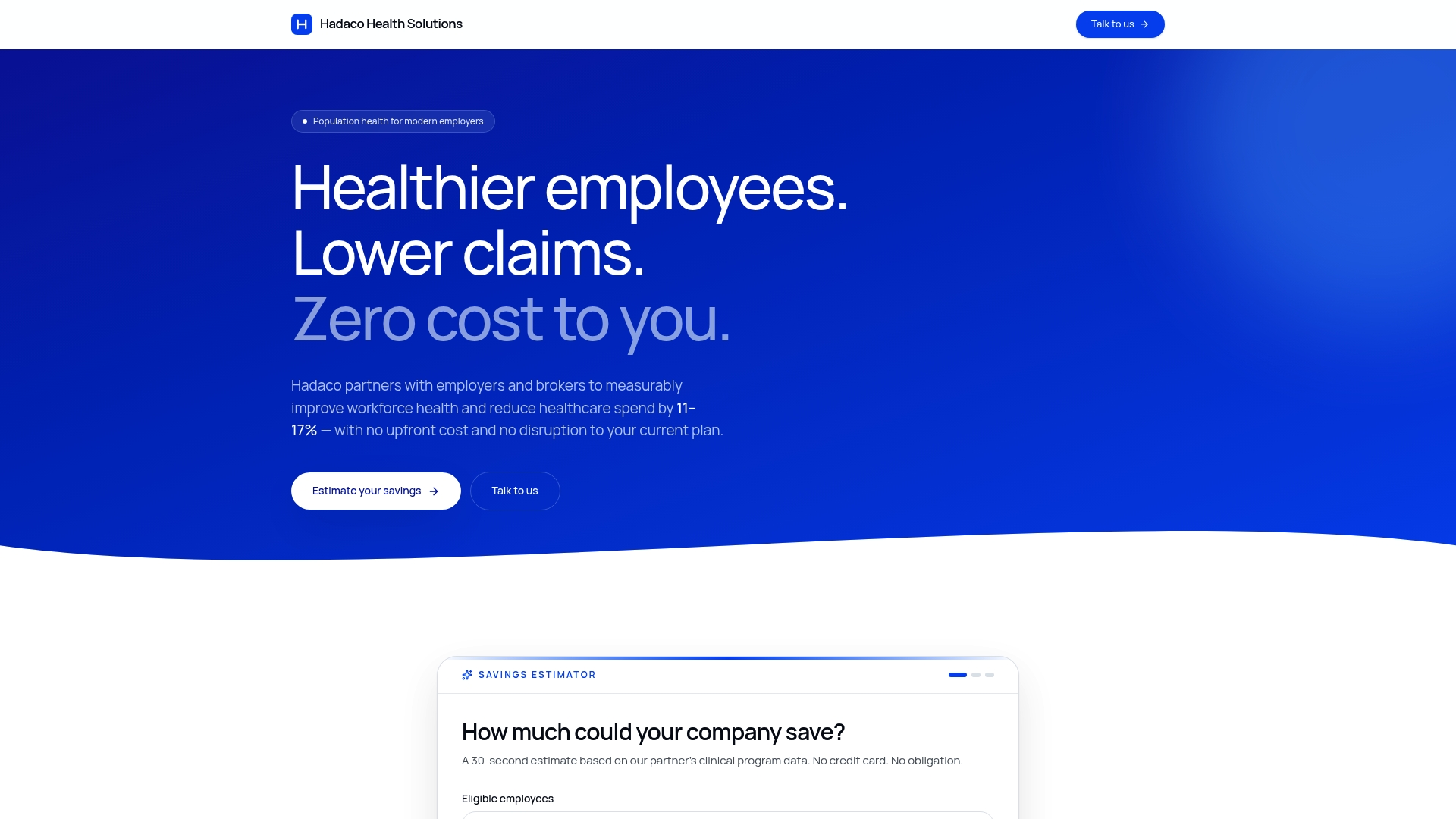
You can explore our population health program and use the savings estimator to see what a first-year result might look like for your headcount. For a finance-side view, read how HR and finance teams reduce healthcare claims.
FAQ
How many employees have chronic kidney disease?
The American Kidney Fund and National Alliance report that over 11 million US workers have CKD, which is 7.4% of the workforce. Many do not know it, because early kidney disease often causes no symptoms. For a company of 1,000, that ratio implies dozens of affected employees and dependents, though your own numbers will differ.
Who pays for dialysis, the employer or Medicare?
Medicare eventually covers dialysis, but the National Kidney Foundation notes that employer plans may be responsible for the first 30 months of treatment. It estimates about $15,444 a month over that period. Your plan documents and your broker can tell you exactly how coordination of benefits works for your group.
Does the ADA cover employees on dialysis?
Kidney disease and its treatment may qualify as a disability under the ADA, particularly when they limit daily activities. If so, you may need to consider reasonable accommodations, such as a flexible schedule or remote work. Coverage depends on the facts, so involve employment counsel for specific cases.
Can an employee take FMLA leave for dialysis?
Federal guidance lists kidney dialysis as an example of a condition involving continuing treatment, which can qualify as a serious health condition. Eligible employees at covered employers may be able to take leave intermittently for treatment. Employer size, tenure and hours worked all affect eligibility, and some states add their own protections.
What should we measure first?
Start with claims: the prevalence of diabetes, hypertension and CKD, plus screening rates and medication adherence among those members. These show whether early detection is working before costs move. Add total cost for members with CKD as your baseline.
Sources
- Healthy Workforces, Sustainable Futures (American Kidney Fund and National Alliance, 2024)
- NKF Corporate Wellness Background for Employers
- Create a Kidney Protective Environment (National Kidney Foundation)
- National Alliance CKD Action Brief, March 2025
- National Alliance CKD Action Brief, health literacy recommendations
- Absenteeism and Employer Costs Associated With Chronic Diseases (CDC, 2016)
- Workplace Accommodations and FMLA for People with Kidney Disease (National Kidney Foundation)
- FMLA Serious Health Condition (U.S. Department of Commerce)