
Claims data gives HR a validated, longitudinal view of utilization and cost, which makes it one of the most reliable tools for finding where wellness efforts can reduce future spending. But claims data is retrospective by nature, so it works best paired with other signals rather than used alone. The first move for most HR teams: request de-identified claims extracts from your carrier or TPA and set up quarterly reporting before you build anything else.
TL;DR:
- Claims data provides reliable long-term insights into healthcare utilization and costs but requires pairing with real-time signals for more accurate wellness evaluation.
- Effective use involves stratifying employees into risk tiers, focusing outreach on high-utilizers and early markers in the middle-risk group for prevention.
- Privacy regulations necessitate de-identification and careful control of individual-level data, with clear communication and compliance measures in place.
- Quarterly reporting of key metrics like emergency visits, hospitalizations, and overall costs allows tracking progress without overpromising short-term results.
- Starting with one cohort, building in a structured cycle, and validating claims flags with clinical review are vital steps to implement a claims-driven wellness program successfully.
Table of Contents
- Strengths and limits of claims data for wellness programs
- How employers use claims data to drive wellness
- Privacy, legal and compliance guardrails for claims-based outreach
- Measuring impact: metrics, cadence, and reporting to finance
- Practical steps to integrate claims into your wellness workflow
- Hadaco evidence and how claims-driven programs deliver measurable results
- Where this guide leaves the hardest decisions
- Getting started with a claims-driven wellness partner
- FAQ
- Sources
Strengths and limits of claims data for wellness programs
Claims data's biggest strength is that it reflects real, reimbursed events rather than self-reported behavior. It lets you attribute cost to specific conditions and track a population over years, which is exactly what's needed to measure whether a wellness program is moving the needle on spend.
The limits matter just as much. Claims typically lag by 30 to 90 days before they're fully adjudicated, so you're always looking slightly into the past. They also contain no vitals, no behavioral indicators, and no real-time signals.
- Strength: ties cost directly to reimbursed medical and pharmacy events
- Strength: supports multi-year trend analysis for the same population
- Limit: lagged reporting delays visibility into current health status
- Limit: coding inconsistency and masking rules can obscure smaller cohorts
Claims data lacks real-time clinical vitals like blood pressure or weight, and peer-reviewed research on employer health data recommends pairing it with biometric screenings or health risk assessments for a complete population view. Set measurement windows that account for the lag, typically a full quarter or more, rather than expecting immediate shifts.
How employers use claims data to drive wellness
Once you have clean claims extracts, the real work is turning them into targeted action instead of a static report. Most employers start by stratifying the population into risk tiers based on utilization and diagnosis patterns, then build outreach around the tiers that offer the most room for improvement.
- Identify high-utilizers. A small share of employees typically drives a disproportionate share of cost, and claims history flags them quickly.
- Target the at-risk middle group. Employees without a chronic diagnosis yet but with early markers (repeated urgent care visits, pre-diabetic lab codes) often respond best to prevention.
- Build condition-focused outreach. Diabetes, musculoskeletal (MSK) issues, and behavioral health consistently show up as high-cost categories worth dedicated programs.
- Optimize pharmacy spend. Claims reveal patterns like brand-name fills where generics are available, or gaps in medication adherence for chronic conditions.
- Route to referral pathways. Claims-flagged cohorts get connected to condition management, coaching, or specialist referral rather than generic wellness messaging.
Expect three to six months before a cohort shows measurable engagement, and plan outreach in waves tied to your reporting cadence rather than one-time pushes.
Pro Tip: Validate claims-based condition flags with a clinical reviewer before outreach, since coding alone can produce false positives.
Privacy, legal and compliance guardrails for claims-based outreach
Using claims data for wellness touches several overlapping regulations, and getting the sequence wrong creates real exposure. The EEOC's final wellness program rules cap participation incentives at 30% of the total cost of self-only coverage and require written notice explaining what health information is collected, how it's used, and how it's protected.
Practical controls to put in place:
- De-identify claims before any internal team sees individual-level data
- Execute a Business Associate Agreement (BAA) with any vendor handling protected health information
- Distribute a written notice template before launching any incentive-linked program
- Offer a reasonable alternative standard for employees who can't meet a health-based goal
- Share only aggregate risk clusters with managers; individual-level outreach should come from a clinical vendor, not HR directly
HIPAA's aggregation rules mean HR typically sees population-level trends, not individual medical histories. That separation protects both the employee and the employer. Hadaco's own GINA and wellness compliance guidance covers sample notice language if you need a starting template.
Measuring impact: metrics, cadence, and reporting to finance
A credible measurement framework needs a short list of metrics tracked consistently over time, not a dashboard with forty data points nobody reviews. Focus on emergency department visits, inpatient admissions, total allowed cost, per-member-per-month (PMPM) trend, condition-specific cost trajectories, and pharmacy spend.
- Report on a quarterly cadence, using the prior plan year as your baseline
- Flag any cohort below a reasonable sample size, since small groups produce unstable percentages
- Present savings as participation-adjusted, not applied to the full population
- Use conservative attribution, crediting the program only for the portion of change it plausibly caused
- Include a confidence range rather than a single precise figure when the sample is limited
The DOL/RAND workplace wellness study found that incentives increase participation, but lifestyle management programs often show limited short-term cost reduction, which is a reason to report gains cautiously rather than promise fast ROI. When presenting to finance, frame results as a trend over several quarters, not a single snapshot.
Practical steps to integrate claims into your wellness workflow
Getting started doesn't require a new platform on day one. It requires a sequence, done in order, so the data you build on is trustworthy.
- Inventory what's available. Ask your TPA or insurer exactly what claims fields they can export and how often.
- Request de-identified extracts. Confirm the format, frequency, and any masking thresholds applied.
- Map fields to condition groups. Translate raw CPT/ICD/NDC codes into categories your team can act on.
- Agree on cadence and masking rules. Set the reporting schedule and the minimum group size for any breakdown.
- Pilot with one cohort. Choose a single high-value group, like employees flagged for MSK or diabetes risk, before expanding.
When linking claims to other sources like HRAs or wearable device data, work at the cohort level rather than trying to match individual records, which avoids re-identification risk. Before signing with any vendor, ask about coverage percentage of your population, how timely their extracts are, their de-identification method, and whether they'll provide a sample report before you commit.
Pro Tip: Ask any claims vendor for a sample quarterly report before signing. If they can't produce one, they likely can't produce it after launch either.
Hadaco evidence and how claims-driven programs deliver measurable results
Hadaco's model runs on the same claims-driven logic this guide describes: no upfront fees, fees tied to demonstrated outcomes, and programs that complement existing benefit plans rather than replace them. Employers working with Hadaco have seen measurable savings per employee in their first year, paired with a transparent savings estimator and quarterly outcome reporting that mirrors the cadence described above. That reporting structure gives HR and finance the same baseline-to-quarter comparison a sound measurement framework requires. Readers building their own claims program can request a sample report to see the format before committing to anything.
Where this guide leaves the hardest decisions
Most employers treat claims data as a reporting exercise instead of what it actually is: a continuous feedback loop. The mistake isn't a lack of data, it's a lack of a repeatable quarterly cycle that connects claims trends back to specific outreach decisions. Start with one cohort and run it for three full quarters before drawing conclusions about ROI, since a single quarter of claims almost never has enough volume to separate real change from noise. Document your attribution assumptions in writing, every quarter, so finance can trust the number instead of just the headline.
— Gene
Getting started with a claims-driven wellness partner
Hadaco's approach fits the model this guide lays out: claims-driven targeting, quarterly reporting, and a structure that complements your current benefit plans instead of disrupting them, with fees tied to the savings actually delivered. If you want to see what this looks like for your own population, ask for a savings estimate, a sample quarterly report, or a walkthrough of how the cohorts are built.
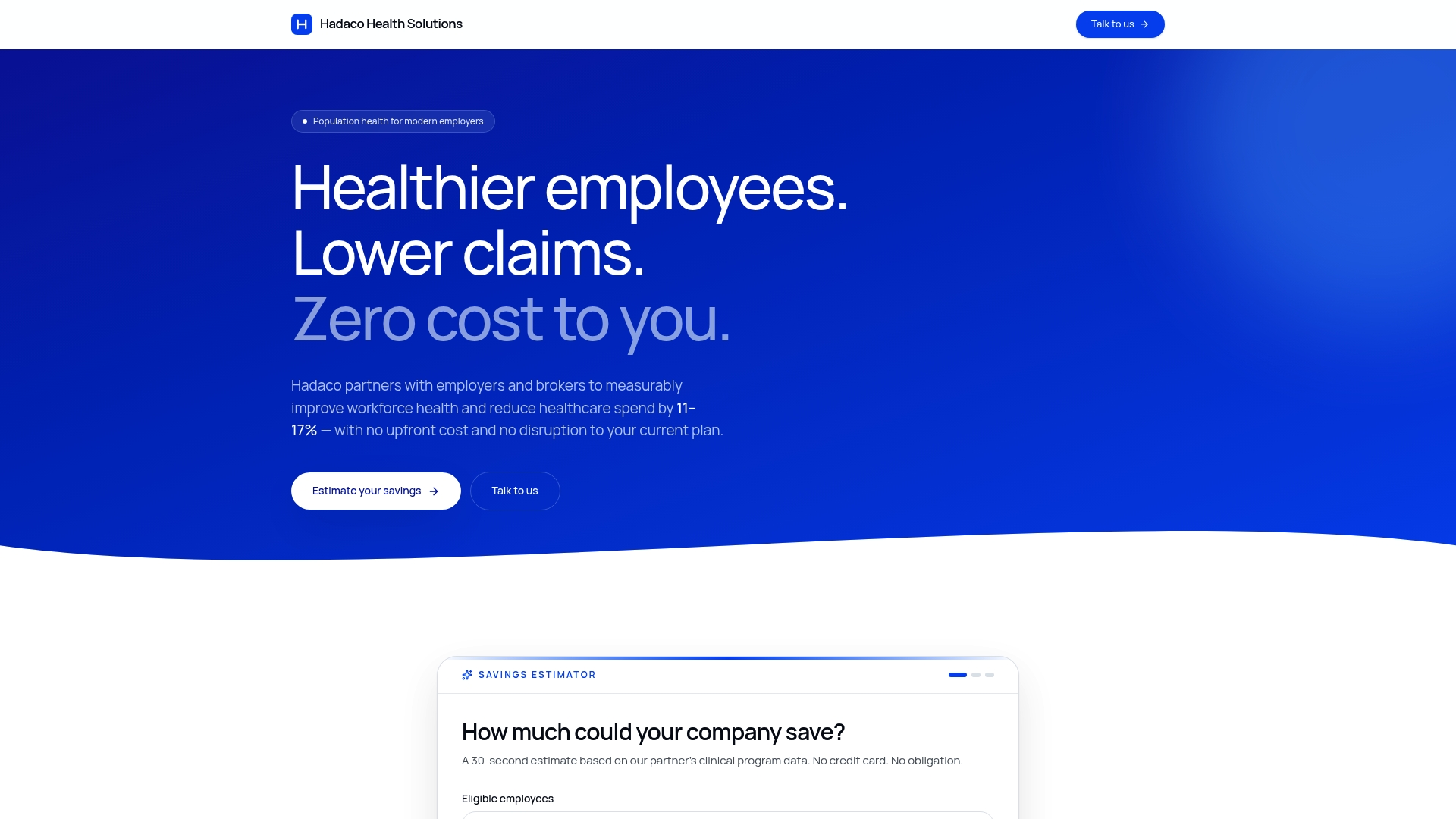
You can start with Hadaco's savings estimator to see a projected first-year number based on your current plan, then book a consultation to review what a pilot cohort would look like for your workforce.
This article is general information, not a substitute for advice from a qualified doctor. Consult a qualified healthcare professional about your own circumstances before acting on anything here.

FAQ
What are some examples of claims data?
Claims data includes medical claims (diagnosis and procedure codes, place of service, billed and paid amounts) and pharmacy claims (medication codes, fill dates, and quantities). Multi-payer sources like HCCI's claims database aggregate these records across insurers for benchmarking purposes.
What are wellness claims?
Wellness claims aren't a distinct data category. They refer to using standard medical and pharmacy claims data to track how a wellness program affects utilization, cost, and health outcomes over time within employer-sponsored plans.
What is included in claims data?
A claims record typically includes diagnosis codes (ICD), procedure codes (CPT), pharmacy codes (NDC), service dates, place of service, and the billed, allowed, and paid amounts. Medical and pharmacy claims are usually stored as separate files that need to be linked for a full view.
How does claims data differ from biometric or wearable data?
Claims data is retrospective, built from reimbursed healthcare events, while biometric screenings and wearable devices capture current vitals and behavior in real time. Research on employer health data recommends combining both for a complete picture, since claims alone miss the day-to-day signals that precede a diagnosis.
How often should employers review claims-based wellness metrics?
Quarterly reporting is the standard cadence recommended across government-sponsored wellness research, since claims take time to fully adjudicate and smaller time windows produce unstable results. A quarterly cycle also matches typical budget and benefits review timelines for most employers.
Sources
Claims data for wellness comes from the records insurers and pharmacy benefit managers generate every time a provider bills for care. Each record typically carries standardized codes and administrative details that let you see what happened, when, and at what cost.
A typical claims extract includes:
- EEOC issues final rules on employer wellness programs
- Scoping Review of Employer-Led Research Using Employee Health Data
- Workplace wellness programs study (DOL/RAND)
Medical and pharmacy claims are usually separate files that need to be joined to see a full picture of a condition. Employers can request data directly from their carrier, through a third-party aggregator, or reference multi-payer sources like HCCI's claims data, which compiles commercial claims from multiple insurers for benchmarking.