
Yes, employers can integrate claims data into wellness programs and get measurable results. The practical path is to analyze, prioritize, intervene, and report: pull claims by condition and cost, target the handful of drivers eating your budget, launch narrow interventions against them, and track savings quarterly. Done this way, most employers see meaningful shifts in per-member costs within 12 months, not vague wellness "engagement."
TL;DR:
- Claims data reveals that a small group of high-cost claimants, often with chronic conditions, drives most of the employer’s healthcare expenses.
- Starting with specific metrics like condition prevalence, per-member costs, and utilization rates over at least 24 months prevents misinterpretation of short-term fluctuations.
- Interventions should directly target data-identified drivers, such as unmanaged diabetes or pharmacy adherence, rather than generic wellness activities.
- Privacy safeguards include data use agreements, tokenized IDs, role-based access, and deidentified data, with IRB approval being common practice.
- A 12-month attribution window and conservative savings estimates are essential for credible, finance-sensible reporting.
Table of Contents
- Why Claims Data Matters for Wellness Program ROI
- What to Measure: Metrics, Fields, and Complementary Data
- How to Move From Claims Analysis to Targeted Interventions
- How Do You Protect Privacy When Analyzing Claims Data?
- What KPIs Should You Report to Finance, and How Often?
- What HR Teams Get Wrong About Claims-Driven Wellness
- How Hadaco Turns Claims Insights Into Measurable Savings
- Sources
- FAQ
Why Claims Data Matters for Wellness Program ROI
Most employer wellness budgets get spent on programs nobody asked for and nobody's cost data supports. Claims data fixes that by showing exactly who is expensive and why, instead of guessing. Industry analysis on wellness ROI has flagged this repeatedly: employers underperform on ROI because they skip claims-driven identification of what's actually driving their spend, then wonder why generic step-challenge programs never move the needle.
A small share of your workforce almost always accounts for most of the cost. Claims records name those members' conditions, treatment patterns, and prescription trends with a precision no employee survey can match.
What claims analysis typically surfaces:
- A concentrated group of high-cost claimants, often clustered around a handful of chronic conditions
- ER utilization spikes tied to specific plan locations, shifts, or age bands
- Specialty pharmacy costs climbing faster than the rest of the pharmacy budget
- Gaps between diagnosis and follow-up care that generic wellness content never touches
- Signals for whether self-funding, level-funding, or plan redesign makes financial sense
Once you see the pattern, the funding and design decisions practically make themselves.
What to Measure: Metrics, Fields, and Complementary Data
Start with metrics that map straight to dollars, not vague "wellness scores." The core set benefits and finance teams should track together:
- Condition prevalence and trend (diabetes, musculoskeletal, behavioral health, cardiometabolic)
- Per-member-per-year (PMPY) cost, broken out by condition
- High-cost claimant count and their share of total plan spend
- ER and inpatient utilization rates
- Pharmacy trend, with specialty drug spend isolated from traditional Rx
Pro Tip: Ask your third-party administrator (TPA) or carrier for trend data going back at least 24 months before you draw conclusions from a single year. Claims are noisy year to year, and a one-off spike can send you chasing the wrong driver.
To run that analysis, request specific claims fields, not a summary PDF: ICD and CPT codes, paid amounts, provider identifiers, Rx NDC or drug class, date of service, and a hashed or tokenized member ID that protects identity while still letting you track patterns over time.
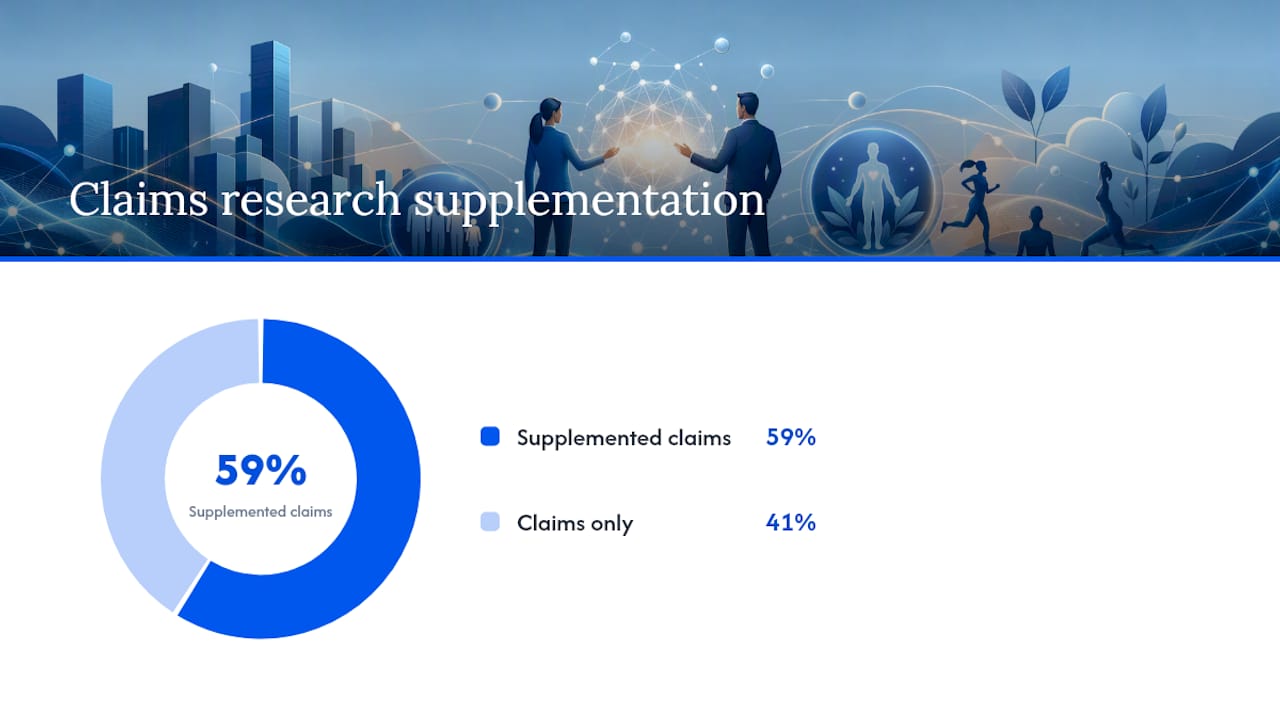
Claims alone won't tell you why someone isn't managing a condition. That's where HR demographics, health risk assessment (HRA) responses, biometric screening results, and on-site clinic visit data earn their place, filling in behavioral and risk context claims can't capture. A scoping review of employer-led claims research found that 59% of the 41 studies reviewed supplemented claims with exactly this kind of data, precisely because claims by themselves miss the "why."
How to Move From Claims Analysis to Targeted Interventions
Turning a spreadsheet of claims into a working program takes a defined sequence, not a one-off analytics project.
- Secure scoped data access. Work with your TPA or carrier to define the timeframe (24 months minimum), the data format, and which fields arrive deidentified versus aggregated.
- Run the cost-driver analysis. Calculate PMPY by condition, chart cost concentration among your highest-cost claimants, and flag specialty pharmacy trendlines separately from the rest.
- Prioritize with a spend times modifiability matrix. Plot each condition or driver by dollar impact against how modifiable it actually is through intervention. Diabetes management and musculoskeletal physical therapy usually score high on both axes. A rare genetic condition scores high on cost, low on modifiability, and belongs in case management, not a wellness campaign.
- Design interventions tied directly to what the data showed. That might mean a condition management program for uncontrolled diabetes, a pharmacy adherence push for members lapsing on maintenance medications, expanded on-site clinic hours, or a plan design tweak like waiving copays for tier-one chronic drugs. TPA claims data is granular enough to show exactly which service categories and provider types are driving cost, so the intervention list should read like a direct response to the data, not a wellness vendor's catalog.
- Pilot before you scale. Set a baseline period, define your KPIs in writing before launch, and commit to a 12-month attribution window. Programs that skip the baseline step are the ones that can't explain their results later.
Predictive analytics paired with a care-delivery partner can push this further, flagging at-risk members before they become high-cost claimants rather than reacting after the fact, an approach Premise Health has documented as a way to close care gaps proactively. For a deeper walkthrough of the analytics side, Hadaco's practical guide to employee wellness analytics covers the technical steps in more depth.
How Do You Protect Privacy When Analyzing Claims Data?
Claims analysis lives or dies on trust. One privacy misstep and employees stop trusting the program, even if the intent was good. Start by determining whether HIPAA applies to your specific data flow. It often does when a health plan or its business associates are involved, which usually means the TPA holds the identified data and shares only aggregated or deidentified results with the employer.
Practical safeguards that should be non-negotiable:
- A data use agreement with your TPA or carrier specifying what's shared, in what form, and for how long
- Tokenized or hashed member IDs instead of names or Social Security numbers
- Role-based access limiting who inside HR or finance can see individual-level data
- Data minimization: request only the fields the analysis actually needs
- Secure storage with encryption at rest and in transit
On the operational side, a privacy or IRB-style review before launch, a plain-language explanation to employees of why the data is being used and how they're protected, and a firm limit on individual-level outreach (aggregate targeting, not "we know you have diabetes" messaging) all matter. Among studies in the employer claims research review that addressed confidentiality, 68% reported IRB approval and 48% used deidentified data, a strong signal that formal review is standard practice, not overkill. For the legal specifics, Hadaco's breakdown of HIPAA and wellness programs is worth a read before you finalize any data use agreement.
What KPIs Should You Report to Finance, and How Often?
Finance teams don't want a wellness newsletter. They want numbers that tie back to the plan's bottom line, on a schedule they can plan around.
Run two cadences in parallel: quarterly operational reporting to track whether interventions are on pace, and a full 12-month window before you claim actual PMPY savings. Claims lag, and a condition management program needs time to show up in cost data.
KPIs worth putting in front of a CFO:
- PMPY cost change by targeted condition, quarter over quarter
- Number of high-cost claimants avoided or moved to a lower-cost care pathway
- Utilization shifts, especially ER visits down and preventive visits up
- Program participation rate and, more importantly, adherence among enrolled members
Attribution is where a lot of wellness reporting falls apart. The fix is conservative math: compare against a pre-intervention baseline, use a control group or staggered rollout where headcount allows, and build a sensitivity range into any savings estimate rather than a single confident number. Industry guidance on wellness ROI backs this approach specifically because it holds up under finance scrutiny, where a single inflated figure usually doesn't.
What HR Teams Get Wrong About Claims-Driven Wellness
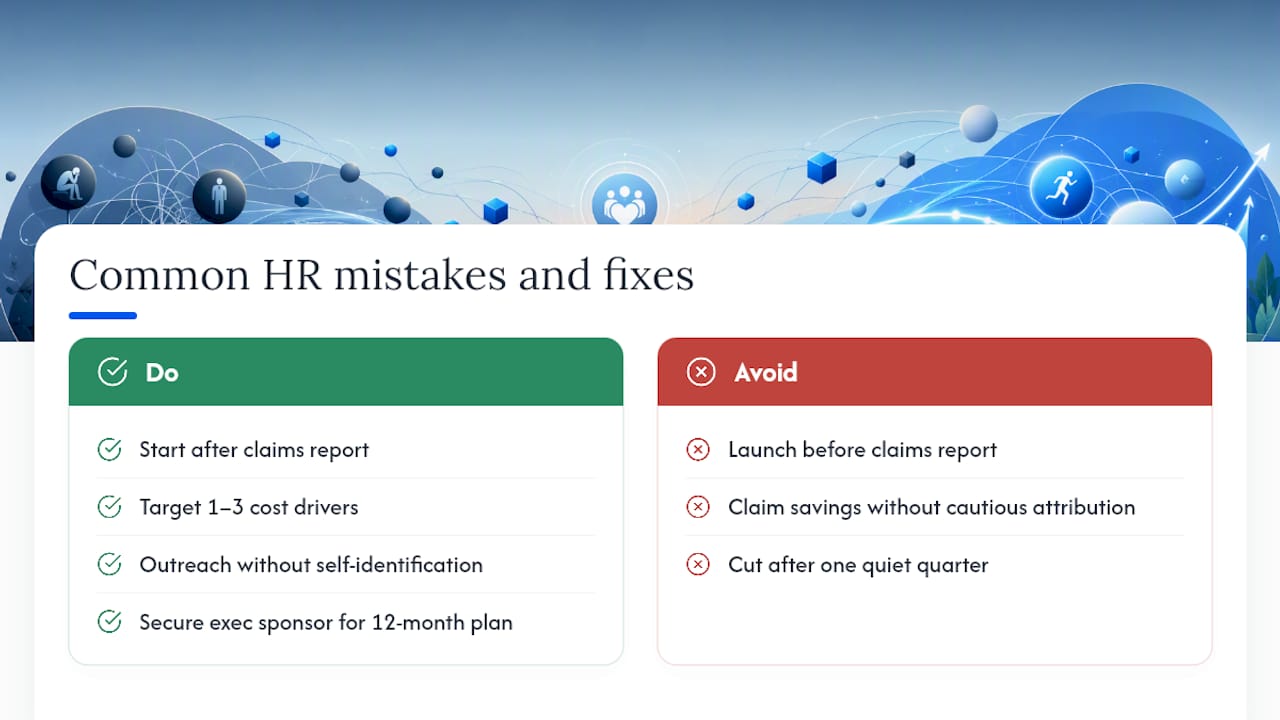
The biggest failure mode isn't bad data. Its programs built on assumptions about what employees need, launched before anyone pulled a claims report. The second most common mistake is weak attribution, claiming credit for savings that were really just a good year for the plan overall.
Skip both by starting narrow. Pick your top one to three cost drivers, build outreach that doesn't require employees to self-identify a condition, and get an executive sponsor who will defend the 12-month timeline when quarter one looks unremarkable. That patience is usually what separates programs that get funded again from programs that get cut. An approach with quarterly reporting paired with a transparent savings estimator exists specifically because employers need to see progress without overselling it before the data is in, focusing on cautious attribution models and realistic timelines.
— Gene
How Hadaco Turns Claims Insights Into Measurable Savings
Evidence-based programs can be built to plug into your existing plan rather than replacing it, so there's no disruption to worry about while you're testing whether claims-driven interventions work for your workforce. There are no upfront fees, and some employers have seen average first-year savings alongside better engagement and retention.
Two moves get you started. Run your numbers through Hadaco's savings estimator to see what a claims-driven program could realistically return for your plan, or book a claims scoping call to figure out exactly which data fields and timeframe you'll need from your TPA. Every quarter after launch, you get a report tying interventions back to actual cost movement, the same finance-ready format covered throughout this guide. If you want the fuller implementation playbook first, Hadaco's guide to evidence-based wellness program design walks through how the interventions get built once your cost drivers are identified.
Sources
For readers who want to verify the evidence base or go deeper: the scoping review of employer-led claims research covers 41 studies spanning nearly four decades. SandStone Insurance Partners and Premise Health both offer practical industry perspective on ROI and predictive analytics. For a plan-design angle, Sobal Health's guide to lowering insurance costs is a useful companion read.
- Scoping review of employer-led research using employee health claims data (PMC)
- A Guide to TPA claims data risk management
FAQ
How Much Claims History Do You Need Before Analyzing?
Most analysts recommend at least 24 months of claims history to separate real cost trends from one-year noise, especially for conditions with irregular treatment patterns like specialty pharmacy use.
Does HIPAA Prevent Employers From Seeing Claims Data?
HIPAA generally requires that identified claims data stay with the health plan or its business associates, but employers can typically receive aggregated or deidentified reports for wellness program design without violating the rule.
How Long Before a Claims-Driven Wellness Program Shows Savings?
Plan on a 12-month attribution window for credible PMPY savings figures, even though operational metrics like participation and utilization shifts can be tracked quarterly.
What's the Fastest Way to Start Without a Full Analytics Team?
Request a scoped claims pull from your TPA covering your top cost categories, then work with a partner like Hadaco that provides a savings estimator and quarterly reporting so you're not building the analysis pipeline from scratch.
Can Small HR Teams Realistically Run This Without a Data Analyst?
Yes, if you lean on your TPA for the raw analysis and use a program partner to translate findings into interventions and reporting, rather than trying to build claims analytics capability in-house.