
Digital musculoskeletal programs are employer-facing, benefits-integrated population-health tools built to cut MSK-related claims, disability days, and lost productivity across a workforce. They combine physician oversight, physical therapy, and coaching with claims analytics so HR and finance leaders can track results. When integrated correctly and measured against baseline claims, the evidence shows real gains in pain scores, function, and coordination, though cost savings vary by program and year.
TL;DR:
- Digital MSK programs can reduce unnecessary surgical escalation and improve pain and function, but cost savings are inconsistent across programs and years.
- Program success depends on thorough claims-based ROI analysis, patient-reported outcome reporting, and proper benefit design to prevent low engagement.
- Pilot programs should last 90 to 180 days with baseline measurements, clear communication, and integration with existing referral pathways to avoid rollout failures.
- Employers should evaluate vendors by requesting detailed ROI methodology, PROMs data, operational fit, and performance-based contracts before scaling.
- Treat MSK programs as infrastructure costs with set metrics and regular reviews, rather than benefits perks, to achieve meaningful long-term savings and outcomes.
Table of Contents
- What Do Employer-Facing Digital MSK Programs Actually Include?
- What Does the Evidence Say About Employer Savings?
- How Should You Evaluate a Digital MSK Vendor?
- How Do You Roll Out a Digital MSK Program Without It Stalling?
- Why MSK Programs Deserve the Same Attention as IT Infrastructure
- Where Hadaco Fits Into Your MSK Strategy
- Sources
- FAQ
What Do Employer-Facing Digital MSK Programs Actually Include?
Most digital musculoskeletal programs employers evaluate today share a similar clinical backbone, even when the delivery model looks different from vendor to vendor. The clinical core usually includes physician oversight for triage, physical therapy delivered by licensed clinicians, health coaching for behavior change, and sometimes behavioral health touchpoints for employees whose pain has a mental health component.
On the operational side, the program needs to connect to something real. That means care navigation into in-network orthopedic and PT providers, referral pathways that avoid unnecessary imaging or surgery, and coordination with workplace ergonomics or design changes. Industry reporting on employer MSK costs points to the workplace itself, not just the individual, as a driver worth fixing.
Delivery models generally fall into three buckets:
- Virtual-first integrated practice units (V-IPUs): multidisciplinary teams coordinating care in one virtual setting.
- Clinician-led hybrid models: virtual coaching and PT paired with in-person visits when needed.
- Asynchronous exercise-based platforms: app-guided exercise plans with lighter clinical oversight.
Engagement features matter as much as the clinical model, including sensor and device-enabled engagement options described in Technology and Tools for Independent Living. Look for symptom tracking, patient-reported outcome measures (PROMs), Net Promoter Score (NPS) tracking, and optional wearable or sensor support, with clear data-privacy boundaries around what gets shared with the employer.
What Does the Evidence Say About Employer Savings?
The clinical evidence for digital MSK programs is more consistent than the cost evidence, and CFOs should know the difference going in.
A prospective study of a virtual musculoskeletal integrated practice unit found clinically meaningful PROMIS improvements in physical function, mental health, and pain interference over a 12-week multidisciplinary program. Engaged participants gave the program an NPS score considered high, a score that rivals the best consumer brands in any category. That kind of coordination, virtual triage feeding directly into the right specialist, also reduced unnecessary escalation to surgery in some employer cohorts.
Statistic to weigh carefully: a systematic review of a number of studies on employer-led benefit changes found lowering cost-sharing for primary care and PT was among the most promising value interventions, but overall spending results across programs were mixed.
That mixed picture shows up again in claims data. A RAND-published observational study of employer health-management programs found some programs reduced admissions for specific conditions, but first-year net cost reductions were not consistent once program fees were factored in. The lesson for finance leaders:
- Ask for savings framed in PMPM or PMPY (per member per month/year) terms, not just gross claims reduction.
- Require that any ROI figure nets out the vendor's own fees.
- Treat year one as a baseline-setting year, not a guaranteed payback period.
How Should You Evaluate a Digital MSK Vendor?
A vendor demo will always look good. The questions below are what separate a program that moves claims data from one that just moves engagement dashboards.
- Request the claims-based ROI methodology, not just the headline number. Ask which claims categories were included, what the comparison population looked like, and whether the vendor's own fees were subtracted before the savings figure was calculated.
- Ask for PROMs and a sample reporting dashboard. A program that cannot show you patient-reported outcome trends, not just enrollment counts, is measuring activity instead of health.
- Confirm the benefit-design fit. Does the program work with first-dollar coverage, or does it tend to reduce point-of-care costs enough on its own to drive utilization? Programs that ignore this tend to enroll well and engage poorly.
- Set the reporting cadence up front. Quarterly reporting on PMPM, PMPY, utilization, PROMs, and NPS should be standard, along with some path to raw data access if your internal analytics team wants to verify it.
- Check operational fit. Ask about onboarding timeline, how referrals are coordinated into in-network care, and how the vendor handles HIPAA compliance and data-sharing boundaries.
- Negotiate the contract around performance. Ask whether fees are contingent on outcomes, what a pilot looks like in duration and cohort size, and whether the vendor can show a savings estimate for an employer of comparable size and industry.
Pro Tip: Ask every finalist vendor to run their savings estimator using your actual employee count and industry mix before you sign anything. A generic case study from a different sector tells you very little about your own claims trajectory.
How Do You Roll Out a Digital MSK Program Without It Stalling?
Most digital MSK program failures are not clinical failures. They are rollout failures, usually traced to weak communication or a benefit design that quietly discourages the exact behavior the program is trying to create.
Start with a pilot, not an enterprise-wide launch. Pick one or two cohorts, ideally departments with known ergonomic strain or a documented pattern of MSK claims, and take a baseline measurement before enrollment opens. A 90 to 180-day pilot with a comparison cohort gives you a real signal instead of a marketing anecdote.
Communication matters more than most HR teams expect. Manager training on how to talk about the program, basic ergonomics education, and workplace policies like micro-breaks all move engagement numbers. Removing cost barriers matters just as much: if employees face a copay every time they use the service, utilization drops regardless of how good the clinical model is.
On the integration side, make sure the program has real hooks into your benefits vendor and referral pathways to local PT and orthopedic providers. For distributed teams, review guidance on remote workforce wellness before finalizing your communications plan.
Common pitfalls to watch for:
- Cost-sharing that contradicts the program's own incentive to use it early.
- Executive sponsorship that exists on paper but never shows up in internal messaging.
- No pre-agreed success gate, so the pilot never actually gets evaluated against anything.
Pro Tip: Set your quarterly review dates before the pilot starts, not after. A program without a scheduled checkpoint tends to drift into "we'll look at it eventually."
Why MSK Programs Deserve the Same Attention as IT Infrastructure
Most benefits leaders still file musculoskeletal programs under "wellness perk," somewhere near the gym stipend and the meditation app. That is the wrong drawer. MSK claims behave more like a recurring infrastructure cost, predictable, tied directly to workplace design, and responsive to intervention in a way that most chronic conditions are not.
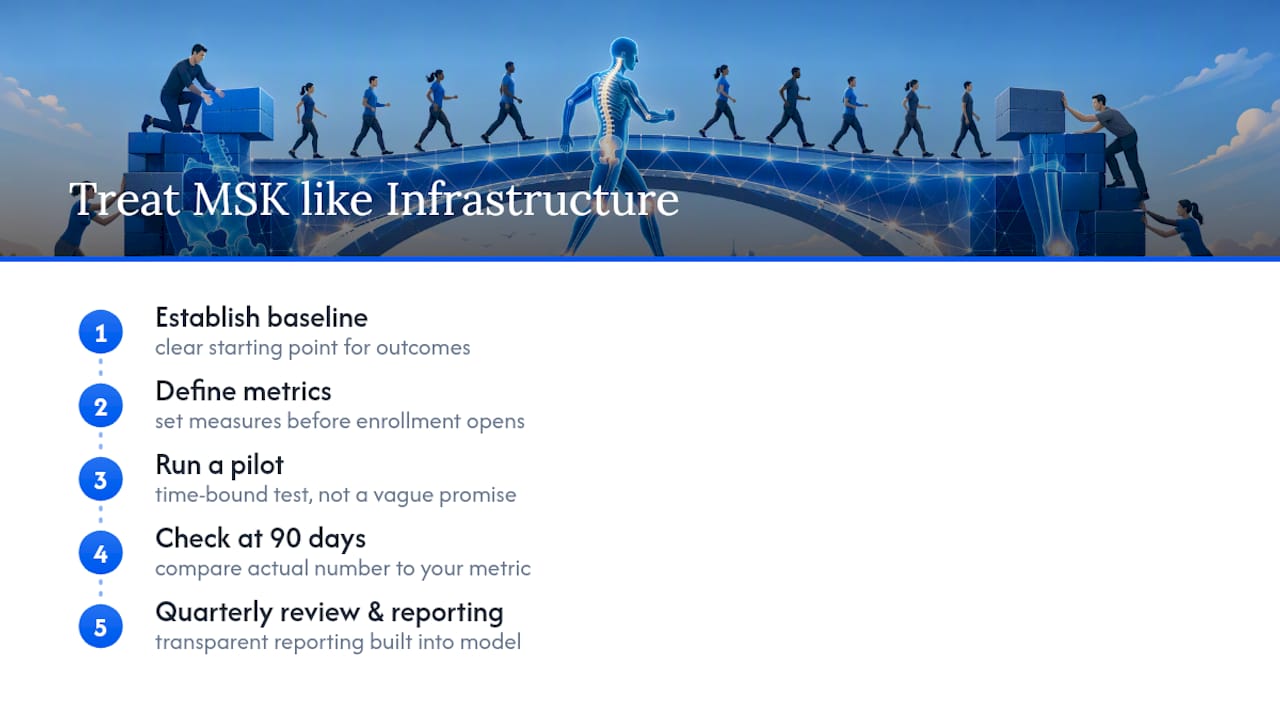
The employers getting real traction treat these programs like they'd treat a network upgrade: clear baseline, defined metrics, a review cadence, and a demand for transparent reporting rather than a year-end summary slide. That is the standard Hadaco holds itself to a standard with a transparent savings estimator and quarterly reporting built into the model rather than bolted on after a client complains.
If you take one thing from this, run a time-bound pilot with metrics you set before enrollment opens. Not a vague promise, an actual number you'll check against in ninety days.
— Gene
Where Hadaco Fits Into Your MSK Strategy
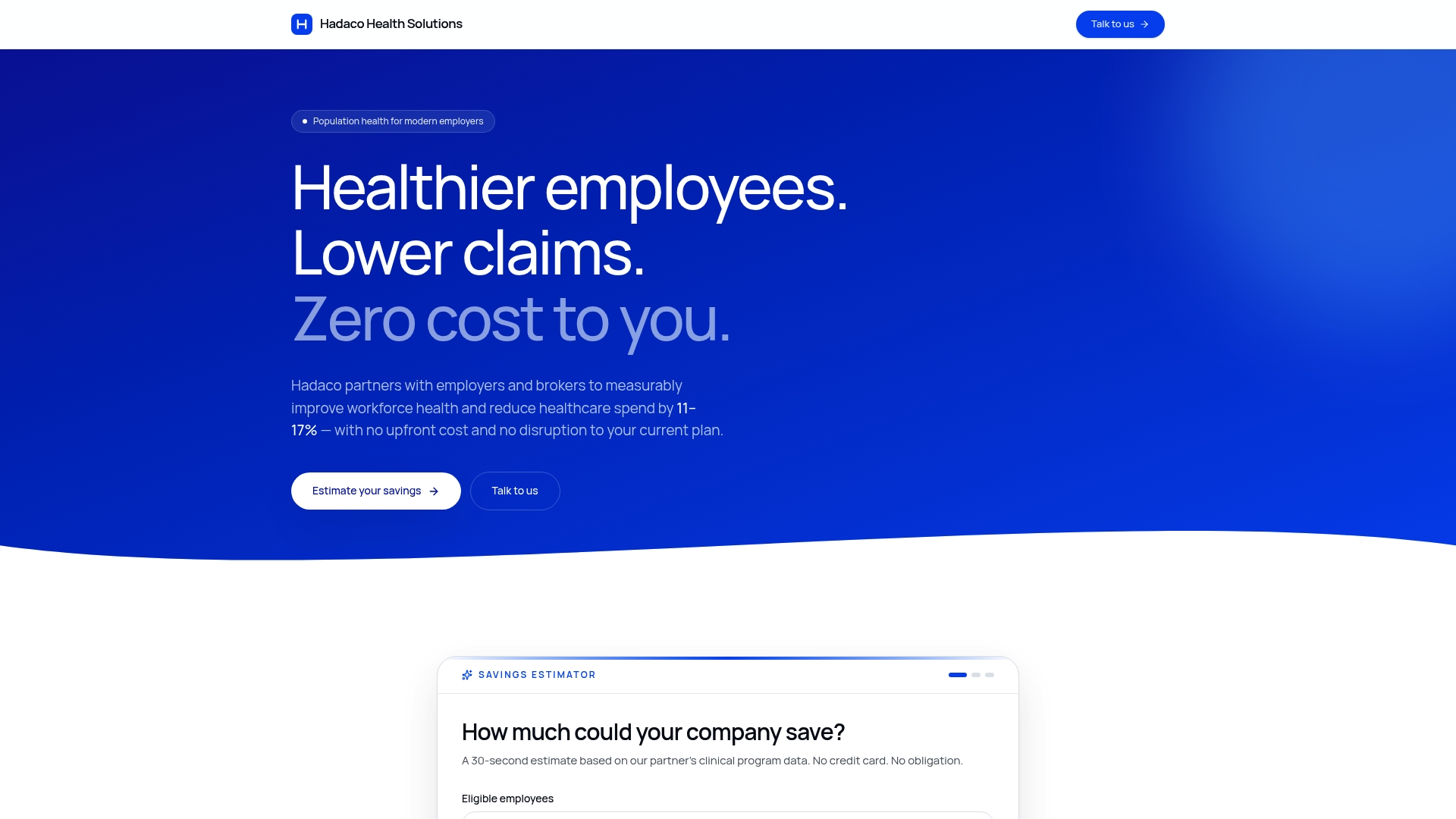
Hadaco builds evidence-based population-health programs that fold into your existing benefit plans instead of replacing them, with no upfront fees and a transparent savings estimator so finance leaders can see the math before committing. Employers running Hadaco's broader programs have seen average first-year savings of $451 per employee in certain program categories, alongside quarterly reporting that tracks engagement and outcomes over time.
Before signing with any vendor, including Hadaco, ask three things on the first call: how often you'll get reporting and in what format, what a savings estimate looks like for an employer your size and industry, and what a pilot costs in time and dollars before you scale it company-wide. Those three answers tell you more than any sales deck.
If you want to see what that estimate looks like for your own workforce, start with Hadaco's savings estimator and bring the numbers to your next benefits review.
Sources
- Musculoskeletal disorders are draining employer health budgets — the workplace itself may be the cause
- Systematic review of employer-led efforts to improve health care value (employer perspective)
- Observational study of employer-sponsored health management programs and cost outcomes (RAND)
FAQ
What Are Digital Musculoskeletal Programs?
They are employer-facing, benefits-integrated population-health programs that combine virtual physician oversight, physical therapy, and coaching to reduce MSK-related claims and improve workforce productivity.
How Much Can Employers Save in the First Year?
Savings vary widely by program and population; Hadaco reports an average of $451 per employee in the first year for certain program categories, while broader industry data shows mixed first-year net cost results once fees are included.
Do These Programs Replace Existing Health Benefits?
No. Well-designed digital MSK programs integrate with your current benefit plan and referral network rather than replacing it, coordinating care into in-network PT and orthopedic providers.
What Engagement Metrics Should We Expect From a Vendor?
Ask for enrollment rates, active usage, PROMs, and NPS; a well-run virtual MSK program has reported an NPS score considered high among engaged participants.
Is Employee Health Data Protected in These Programs?
Reputable vendors maintain HIPAA compliance and limit what employee-level data reaches the employer, typically sharing only aggregated, de-identified reporting.