
Start with a rapid health needs assessment, launch a 90-day pilot built around three high-impact pillars, and partner with a vendor that delivers measurable savings and quarterly reporting. That sequence, done in that order, is what separates programs that move the needle from ones that quietly expire after open enrollment.
The immediate next step is simpler than most HR teams expect: a short Health Risk Assessment (HRA) or baseline survey, combined with an ergonomic self-assessment and a focused manager training session. You do not need a full platform contract to begin. You need data and a 90-day window.
A few things to confirm before you pilot anything:
- HIPAA governs how health data collected through wellness programs must be handled; involve legal before you collect a single HRA response.
- ADA requires that any wellness program participation be voluntary and that accommodations be available.
- Hadaco offers a savings estimator and no-upfront-fee model that fits a pilot-first approach without locking you into a long-term contract before you see results.
Pro Tip: Run your HRA through your existing benefits vendor or EAP if possible. It keeps PHI handling clean and avoids creating a new data silo before you have a BAA in place.
Key Takeaways
A well-designed remote wellness program starts with assessment, not platform selection, and delivers measurable savings within the first year when built on evidence-based interventions and quarterly reporting.
| Point | Details |
|---|---|
| Assess before you buy | Run a short HRA and ergonomic survey in weeks 0–2 before selecting any vendor or platform. |
| Pilot two pillars first | Score pillars by impact and feasibility; run the top two for 90 days with a defined sample group. |
| Train managers first | The Frontiers 2025 review ties five leadership competencies directly to remote employee wellbeing; manager training is the highest-leverage intervention. |
| Separate leading from lagging metrics | Report participation and wellbeing signals quarterly; expect claims-cost trends to take 2–3 years to appear clearly. |
| Hadaco's model fits a pilot-first approach | No upfront fees, integration with existing benefits, and an average first-year savings of $451 per employee with quarterly outcome reporting. |
Table of Contents
- What does a strong remote workforce wellness program actually include?
- How do you build a pilot-to-scale roadmap that actually holds?
- Which engagement tactics reliably move participation for remote teams?
- How should you evaluate wellness platforms and vendors for a remote program?
- What metrics and ROI framework should you bring to leadership?
- What privacy and compliance rules govern U.S. remote wellness programs?
- What does the research say about leadership and employer outcomes?
- What HR leaders consistently get wrong about remote wellness
- How Hadaco supports employers building remote wellness programs
- Sources
What does a strong remote workforce wellness program actually include?
For Prevention makes the case that remote wellness succeeds when it is treated as organizational infrastructure, not a perk. That means written policy, manager modeling, simple benefit access, and measurement baked into operations from day one. The pillars below reflect that logic.
- Mental health. EAP access, manager training on psychological safety, and short digital check-in tools. Success looks like a manager who knows how to respond when a direct report flags burnout, not just a hotline number in the benefits portal.
- Physical health and ergonomics. Aflac reports that remote employees have very high daily screen exposure and a large share reported new vision issues after shifting to remote work. A stipend for a monitor riser and a 20-20-20 rule reminder in Slack costs almost nothing and addresses a documented risk.
- Social connection and belonging. Gallup documents elevated loneliness among employees worldwide, and remote workers are disproportionately affected. Structured virtual rituals, not just optional happy hours, are what close that gap.
- Financial wellness. Debt stress and financial anxiety are among the top drivers of reduced productivity. A financial wellness program does not need to be elaborate; access to a financial coach or a budgeting tool integrated with benefits is a meaningful start.
- Work design and boundaries. Async-first norms, clear off-hours expectations, and calendar hygiene policies reduce boundary collapse. The Remote Wellness Blueprint recommends short daily practices across three pillars: physical health, work-life boundaries, and social connection.
- Inclusion and customization. A single program design rarely fits a workforce that spans time zones, caregiving responsibilities, and health literacy levels. Build opt-in tracks, not mandatory one-size programs.
Pro Tip: For your 90-day pilot, score each pillar on two axes: expected impact on your population's top health risks, and feasibility given your current vendor relationships. Pick the top two. Trying to run all six at once in a pilot is how programs stall.
How do you build a pilot-to-scale roadmap that actually holds?
The three-phase structure below gives HR a sequenced plan with clear owners and realistic budget categories. Timelines are approximate; your population size and existing vendor relationships will shift them.
- Assess (Weeks 0–2). Deploy a short HRA or baseline wellbeing survey. Add an ergonomic self-assessment (a simple five-question form works). Pull existing claims data and engagement metrics if available. Identify your top two or three health risk categories. Assign a program owner and a data steward.
- Pilot (Month 1–3). Select 50–200 employees across two or three teams. Run interventions on your two highest-priority pillars. Budget buckets: platform or vendor fee (often waived or performance-based in the first phase), stipends for ergonomic equipment ($50–$150 per participant is a common range), manager training (one half-day session), and measurement tooling. Track participation weekly; collect a short pulse survey at week six.
- Scale (Month 4 onward). Expand based on three criteria: participation rate above 40%, at least one measurable wellbeing signal moving in the right direction, and manager buy-in confirmed. Establish a quarterly review cadence, a governance owner (usually the benefits lead or CHRO), and a communications calendar. Change management at this stage means updating your manager enablement toolkit and redesigning incentives based on what actually drove pilot participation.
| Phase | Timeline | Key Activities | Budget Category |
|---|---|---|---|
| Assess | Weeks 0–2 | HRA, ergonomic survey, claims review | Staff time, survey tool |
| Pilot | Months 1–3 | Interventions, manager training, pulse surveys | Stipends, vendor fee, training |
| Scale | Month 4+ | Full rollout, governance, quarterly reporting | Platform contract, incentives |
The HRCI program design guidance reinforces separating participation signals (weekly) from lagging health and cost outcomes (quarterly), which keeps leadership expectations calibrated.
Which engagement tactics reliably move participation for remote teams?
Participation is the first metric that dies in a remote wellness program. The tactics below are the ones that hold up across distributed populations.
Async-first tactics:
- Micro-challenges delivered via Slack or Teams (a five-minute stretch challenge, a hydration check-in) get higher completion than scheduled webinars because they meet employees where they already are.
- Short video content (under three minutes) on mental health topics, financial basics, or ergonomic setup outperforms long-form written guides in remote populations.
- Curated async social rituals, like a weekly photo thread or a shared playlist, build belonging without requiring calendar coordination.
Synchronous offerings that work:
- 15-minute "body double" sessions, where employees work silently on camera together, address isolation without demanding social energy.
- Short workshops (20–30 minutes) timed to overlap across time zones perform better than hour-long sessions that exclude one coast.
- Manager-facilitated team rituals, like a Monday intention-setting check-in, signal that wellness is part of the work, not separate from it.
Reducing friction:
- Single sign-on (SSO) integration with your HRIS or benefits portal cuts drop-off at login by a significant margin. Any extra credential step loses participants.
- Simple stipend workflows, like a reimbursement form with fewer than five fields, increase equipment and resource uptake. Complicated approval chains kill participation before it starts.
- Remove pre-authorization steps for EAP access wherever legally and contractually possible.
Pro Tip: The single highest-leverage engagement move for remote teams is manager modeling. When a manager publicly completes a wellness activity, team participation rates climb. Train managers first, before you launch anything to the broader population. See the wellness incentives guide for low-friction incentive structures that reinforce this.
How should you evaluate wellness platforms and vendors for a remote program?
The vendor market for employee wellness is crowded, and most platforms look similar in a demo. The criteria below cut through the noise.
What to require:
- Integration with your existing benefits stack and HRIS (ideally via SSO).
- A defined reporting cadence: weekly participation data, quarterly clinical and cost outcomes.
- Evidence of clinical interventions, not just content libraries. Ask for outcome data from comparable populations.
- Outcome-based or performance-based pricing. A vendor confident in their results will tie fees to demonstrated savings.
- A Business Associate Agreement (BAA) covering any PHI that flows through the platform.
Red flags:
- Opaque data handling with no clear answer on where employee health data is stored or who can access it.
- No SSO or integration pathway, which means a separate login and guaranteed drop-off.
- ROI reporting that relies entirely on self-reported satisfaction scores rather than claims or utilization data.
- Content that is not adapted for remote or distributed workers (office-centric ergonomics guides, in-person fitness challenges).
Security and data protection:
HIPAA applies when your wellness vendor handles Protected Health Information. De-identified aggregate reporting is the standard for employer-facing dashboards; individual-level health data should never flow to HR without explicit consent and a clear legal basis. Minimize PHI collection at every step. The corporate wellness agency landscape varies widely on these standards, so verify rather than assume.
Pro Tip: Ask every vendor: "Show me a sample quarterly report from a comparable client." If they cannot produce one, or if the report contains only engagement metrics with no health or cost outcomes, keep looking.
What metrics and ROI framework should you bring to leadership?
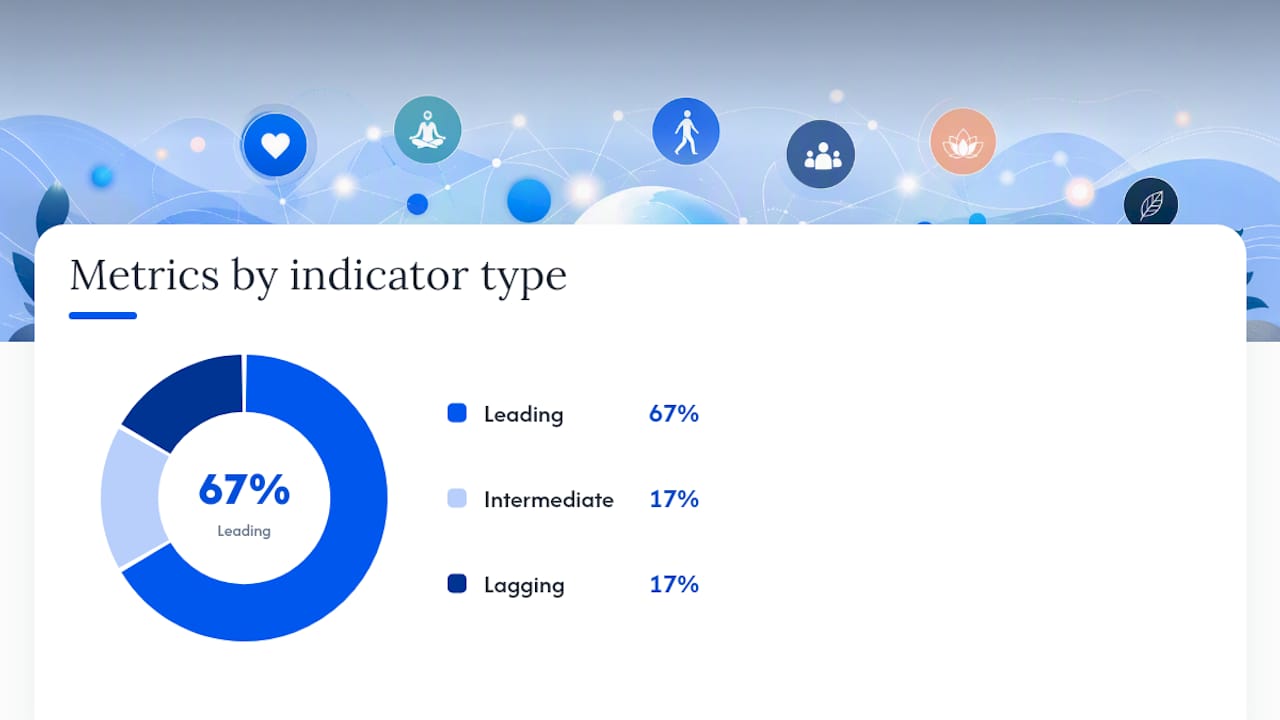
Measurement is where most wellness programs lose credibility with CFOs. The fix is separating leading indicators from lagging ones and being honest about timelines.
Core metrics by cadence:
| Metric | Type | Reporting Cadence |
|---|---|---|
| HRA completion rate | Leading | Monthly during pilot |
| Program participation rate | Leading | Weekly |
| EAP and mental health service utilization | Leading | Monthly |
| Short-term wellbeing pulse scores | Leading | Quarterly |
| Biometric screening completion | Intermediate | Quarterly |
| Healthcare claims trends | Lagging | Annual (2–3 year horizon) |
ROI calculation sketch: If your program costs $200 per employee per year and generates $451 in average first-year savings per employee (Hadaco's reported average), the net return is $251 per employee before accounting for productivity or retention effects. At 500 employees, that is $125,500 in net savings in year one, a figure worth putting in front of a CFO.
The corporate wellness ROI framework from Hadaco's resource library gives a CFO-facing structure for presenting these numbers without overpromising on short-term claims impact.
What privacy and compliance rules govern U.S. remote wellness programs?
Compliance checklist:
- HIPAA: Applies when your vendor handles PHI. Require a BAA. Use de-identified aggregate reporting for employer-facing dashboards. Never route individual health data to HR without consent.
- ADA: Wellness program participation must be voluntary. Reasonable accommodations must be available for employees who cannot participate in standard program activities.
- GINA: Prohibits collecting genetic information as part of a wellness program. If your HRA includes family health history questions, review them with legal before deployment.
- State laws: California (CCPA), Illinois (BIPA), and several other states layer additional privacy requirements on top of federal rules. If your workforce is distributed across states, a one-size compliance approach will miss something.
Practical protections:
- Use opt-in consent for all health data collection, with plain-language employee notices.
- Collect the minimum data needed to run the program. More data is not better data.
- Route clinical workflows through your benefits vendors (EAP, health plan) rather than through HR directly.
- Involve legal before you finalize your HRA questions and before you sign any vendor contract that involves health data.
Pro Tip: Treat wellness data with the same sensitivity as payroll data. The moment employees believe their health information could affect their employment, participation collapses and trust does not recover quickly.
What does the research say about leadership and employer outcomes?
A 2025 systematic review published in Frontiers in Organizational Psychology identified five leadership competencies consistently linked to teleworker wellbeing: supervisor support, digital communication, goal management, work-life facilitation, and participative leadership. The review also introduced the concept of "operational distance" (the friction of coordinating work remotely) and "affinity distance" (the erosion of relational closeness), and found that reducing both requires deliberate leadership behavior, not just better tools.

That finding has a direct operational implication: manager training is not a soft investment. It is the highest-leverage intervention in a remote wellness program, because managers are the primary mechanism through which organizational wellness policy reaches individual employees.
On the employer outcomes side, population-health programs that combine HRA completion, chronic disease management, and preventive care interventions have demonstrated measurable per-employee savings in the first year of deployment. Hadaco's reported average savings per employee in the first year reflects a performance-based model where the program is designed to generate a return before fees are charged. Quarterly reporting is what keeps that accountability visible and prevents the program from drifting into a benefits checkbox.
What HR leaders consistently get wrong about remote wellness
The conventional wisdom says remote wellness programs fail because employees are disengaged or because the technology is not good enough. Both are wrong.
Programs fail because HR launches them without a clear measurement plan, without manager training, and without a realistic timeline for seeing cost impact. Then, when claims data does not move in year one (it rarely does), leadership pulls the budget.
The privacy-personalization tension is real but manageable. Employees want programs that feel relevant to their actual health situation, which requires some data. But the moment data collection feels surveillance-adjacent, participation drops and the program loses the population it most needs to reach. The answer is not to collect less data; it is to be transparent about what you collect, why, and who sees it. A plain-language privacy notice, reviewed by legal and written for a tenth-grade reading level, does more for participation than any incentive design.
One more thing most guides skip: the mental health program design matters more for remote populations than for in-office ones, because the informal support structures of an office, the hallway conversation, the visible manager, the spontaneous lunch, do not exist. You have to build them deliberately, or they do not exist at all.
How Hadaco supports employers building remote wellness programs
Companies that have spent months designing a wellness program from scratch, only to discover their vendor cannot produce a quarterly outcomes report, know the cost of that mistake. Hadaco's model is built around the opposite premise: no upfront fees, integration with your existing benefits plan, and quarterly reporting that shows participation, clinical signals, and cost trends in one place.
The average first-year savings Hadaco clients see is $451 per employee, generated through evidence-based interventions covering chronic disease management, preventive care, mental health, and engagement. The program complements your current health plan rather than replacing it, which means your pilot does not require a benefits redesign.
Hadaco's savings estimator lets you run a conservative projection based on your population size and current claims profile before you commit to anything. If the numbers make sense, the next step is a consultation to map the pilot structure to your workforce.
Sources
- Frontiers | Wellbeing in telework: a systematic review of leadership competencies
- Remote Work Wellness: Building Healthy Cultures for Distributed Teams - For Prevention
- Supporting Employee Wellness in Remote, Hybrid, and In-Person Work Environments | Aflac
- Gallup
- Self-care for Remote Workers: The Remote Wellness Blueprint
This article is general information, not a substitute for advice from a qualified doctor. Consult a qualified healthcare professional about your own circumstances before acting on anything here.