
Yes. Well-implemented workplace health coaching produces measurable returns: a Harvard-led meta-analysis of 32 studies found $3.27 in healthcare savings for every $1 invested, with the strongest results in programs running 6 to 12 months. The immediate move for HR is not to sign a contract. It's to run a needs assessment or request a savings estimate to see what your own claims data and workforce demographics suggest before you commit budget.
TL;DR:
- Investment in well-implemented workplace health coaching typically yields around $3.27 in healthcare savings for each dollar spent, with the strongest results seen in programs lasting 6 to 12 months.
- Savings in claims costs tend to materialize over 12 to 36 months, whereas engagement and satisfaction improve within the first 60 to 90 days.
- Program success depends heavily on personalized coaching by credentialed professionals and should be tailored to workforce demographics and conditions.
- Using a combination of internal, external, or hybrid delivery models depends less on company size and more on launch speed and internal capacity.
- Employers should track participation, satisfaction, and behavioral outcomes early on and ensure legal compliance and voluntary participation to maximize ROI.
Table of Contents
- Health Coaching Workplace Benefits and the ROI Evidence
- How Does Workplace Health Coaching Actually Work?
- Which Program Model Fits Your Company: Internal, External, or Hybrid?
- What Are the Steps to Implement a Health Coaching Program?
- How Should HR Measure and Report Coaching ROI?
- Where Hadaco Fits Into the Health Coaching Workplace Decision
- What Legal and Privacy Rules Apply to Workplace Health Coaching?
- How Do You Get Employees to Actually Participate?
- Should Coaching Be the Same for Every Employee?
- Author Perspective: Operational Lessons From Implementing Coaching Programs
- How Hadaco Helps HR Teams Move From Evidence to Action
- Sources
- FAQ
Health Coaching Workplace Benefits and the ROI Evidence
Employers evaluating a health coaching workplace strategy should expect four categories of return: fewer sick days, better on-the-job productivity, stronger retention and engagement, and lower claims costs over time. None of these show up on the same timeline, which matters for how you set expectations with your CFO.
The Harvard meta-analysis is the number most benefits teams anchor budget conversations to: $3.27 saved for every dollar spent on well-run coaching programs. That figure describes pooled results across 32 studies, not a guarantee for any single employer, so treat it as a planning benchmark rather than a forecast.
Statistic to remember: For every $1 an employer invests in a well-implemented coaching program, pooled research points to $3.27 in healthcare savings, according to Harvard Health.
Engagement signals move fast. Claims-level savings do not.
- Participation and satisfaction metrics typically show up within the first 60 to 90 days
- Behavior and biometric changes usually follow over several months
- Claims-cost reductions tend to accrue over 12 to 36 months as chronic conditions stabilize
A VA evidence synthesis of 41 randomized controlled trials found small but statistically significant improvements across clinical and behavioral outcomes. It also flagged moderate to high heterogeneity between studies and noted the effects shrink when coaching is compared against other active interventions rather than no intervention at all. Build that caveat into how you report results upward. A single quarter of flat numbers doesn't mean the program failed.
How Does Workplace Health Coaching Actually Work?
Health coaching is a patient-centered process built on collaborative goal-setting, motivational interviewing, and ongoing accountability, not a lecture about diet and exercise. A coach helps an employee define what they actually want to change, then works with them session by session to get there.
A typical engagement moves through a few predictable stages:
- A baseline assessment covering health risks, current habits, and personal goals
- An individualized plan built around the employee's own priorities, not a generic template
- Scheduled check-ins for problem solving, troubleshooting setbacks, and referrals to other care when needed
Who delivers the coaching matters more than most vendors admit upfront. Programs staffed by nurses or trained, credentialed coaches produce more consistent results than ones relying on loosely trained peer volunteers, largely because credentialed coaches follow documented protocols. Harvard Health notes that remote coaching by phone or video works about as well as in-person sessions, but training quality varies widely across providers, so ask any vendor how their coaches are certified and supervised.
Which Program Model Fits Your Company: Internal, External, or Hybrid?
The right delivery model depends less on company size and more on how fast you need to launch and how much internal bandwidth HR has to manage it.
- Internal team: Best for large employers with existing wellness staff and a health system relationship already in place. Slower to launch, but highly customizable.
- External platform: Best for mid-sized companies that want speed and proven infrastructure without hiring. Faster time-to-launch, less internal lift.
- Hybrid: Best for employers who want an internal wellness champion paired with outside coaching expertise and technology.
Pricing tends to follow one of two shapes: an upfront program fee, or a per-employee-per-month (PEPM) rate that scales with enrollment. PEPM models generally hit their sweet spot once a company has enough covered employees to spread fixed platform costs across a meaningful population.
For remote or distributed teams, digital-first features aren't optional extras. Mobile scheduling, asynchronous check-ins, and progress dashboards keep coaching accessible when employees never share a building, and they meaningfully increase who actually participates.
What Are the Steps to Implement a Health Coaching Program?
The CDC's Workplace Health Model organizes program building around four stages, and it maps cleanly onto how most successful launches actually unfold.
- Assess. Pull claims data, run a health risk assessment (HRA), and survey employees to identify which populations need coaching most and what barriers they anticipate.
- Design. Decide on your enrollment model, incentive structure, session cadence, and how coaching data will integrate with existing benefits platforms. Build privacy guardrails into the design, not as an afterthought.
- Launch. Secure visible executive sponsorship, keep enrollment low-friction, communicate across multiple channels, and highlight early wins to build momentum.
- Iterate. Collect participant feedback, adjust which populations you're targeting, and hold vendors accountable to clear service-level agreements.
Pro Tip: Pair coaching with environmental supports, like protected break time or manager reinforcement of health goals, instead of expecting employees to seek out coaching on their own initiative. McKinsey Health Institute research finds this combination drives meaningfully better participation than coaching offered as a standalone benefit.
How Should HR Measure and Report Coaching ROI?
Track five things from day one: participation rate, session completion, participant satisfaction, self-reported or biometric behavior change, and downstream effects on absenteeism and claims.
- Early wins (60 to 90 days): enrollment rate, session completion, satisfaction scores
- Medium term (6 to 12 months): biometric shifts, self-efficacy improvements, reduced absenteeism
- Long term (12 to 36 months): claims-cost trends and retention impact
Statistic to remember: Engagement metrics tend to surface within 60 to 90 days, while claims-level financial impact typically takes 12 to 36 months to materialize, based on industry program-tracking patterns.
Convert outcomes to dollars using a savings estimator that ties reduced sick days and claims trends directly to program cost, then report that figure to leadership on a fixed cadence rather than only at renewal time. The most common measurement mistakes are small sample sizes, follow-up periods that end too early to catch claims effects, and confounding factors like a benefits redesign happening at the same time. Mitigate all three by using matched cohorts and giving the program a full 6 to 12 month follow-up window before drawing conclusions, an approach the NCBI review on coach-delivered chronic disease programs recommends for exactly this reason.
Where Hadaco Fits Into the Health Coaching Workplace Decision
Hadaco builds evidence-based population health programs around chronic disease management, preventive care, and engagement, layered on top of your existing benefit plans rather than replacing them. Programs run with no upfront fees, and every employer gets a transparent savings estimator plus quarterly outcome reporting instead of a single annual summary.
That structure maps directly onto the decision points above:
- Measurement is built in from the start, not bolted on after launch
- Integration is designed to avoid disrupting current benefit plans
- The chronic-disease focus targets the population segment most likely to drive claims costs
Companies typically see average first-year savings per employee, which can be estimated based on actual workforce claims data rather than relying on an industry average. Request a savings estimate before you finalize budget, so the projection reflects your actual workforce rather than an industry average.
What Legal and Privacy Rules Apply to Workplace Health Coaching?
Health coaching sits at an intersection of employment law and health privacy that trips up a lot of well-meaning HR teams. The core issue is that coaching programs often collect health information, and how that information is handled depends heavily on how the program is structured.
If coaching is delivered through your group health plan or by a business associate of that plan, HIPAA's privacy and security rules generally apply to the health data collected. If it's offered as a separate wellness benefit outside the group health plan, different rules may govern, and the Americans with Disabilities Act (ADA) and the Genetic Information Nondiscrimination Act (GINA) both place limits on how health risk assessments and biometric screenings tied to incentives can be structured. Employers who tie financial incentives to participation need to review those incentive limits carefully. This is a compliance question for legal counsel, not a vendor sales conversation.
Practical guardrails worth putting in place regardless of program structure:
- Keep individual health data separate from HR personnel files and performance records
- Require any coaching vendor to specify exactly what data they collect, retain, and share, and for how long
- Make participation voluntary in substance, not just on paper, with incentive structures that don't feel coercive
- Confirm data-sharing terms before employees enroll, not after a legal question arises
Ask any vendor to document their data handling practices in writing before rollout. Verbal assurances aren't a compliance record.
How Do You Get Employees to Actually Participate?
Low participation kills more coaching programs than bad coaching does. The barriers are predictable: skepticism that it will help, time pressure, privacy worries, and simple awareness gaps about the benefit even existing.
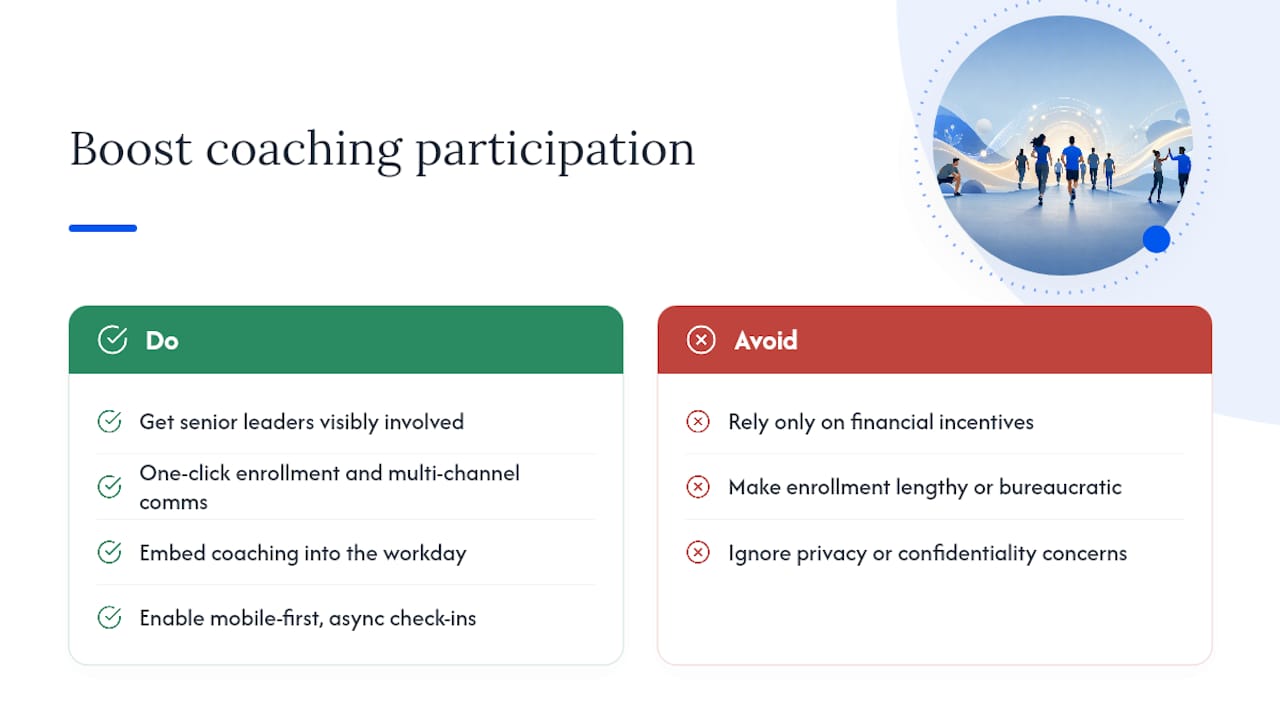
Executive visibility solves more of this than most HR teams expect. When a senior leader talks about the program publicly, or better yet, participates in it themselves, enrollment tends to climb without any additional spending. Pair that with low-friction enrollment, meaning one click, not a five-page form, and multi-channel communication that meets employees where they already are: email, text, team meetings, and posters near the breakroom.
Incentives help but shouldn't be the whole strategy. A modest premium discount or gift card can nudge someone to try the first session, but the McKinsey Health Institute points out that pairing individual coaching with environmental and organizational supports, protected time, digital nudges, manager reinforcement, produces stronger and more durable engagement than financial incentives alone. Coaching that's embedded into the workday, rather than something employees have to seek out separately, consistently sees better follow-through.
For distributed teams specifically, mobile-first scheduling and asynchronous check-ins remove the single biggest barrier: finding a synchronous 30-minute slot that works across time zones and shift schedules. Employees who can message a coach between meetings participate at meaningfully higher rates than those required to book a live call.
Should Coaching Be the Same for Every Employee?
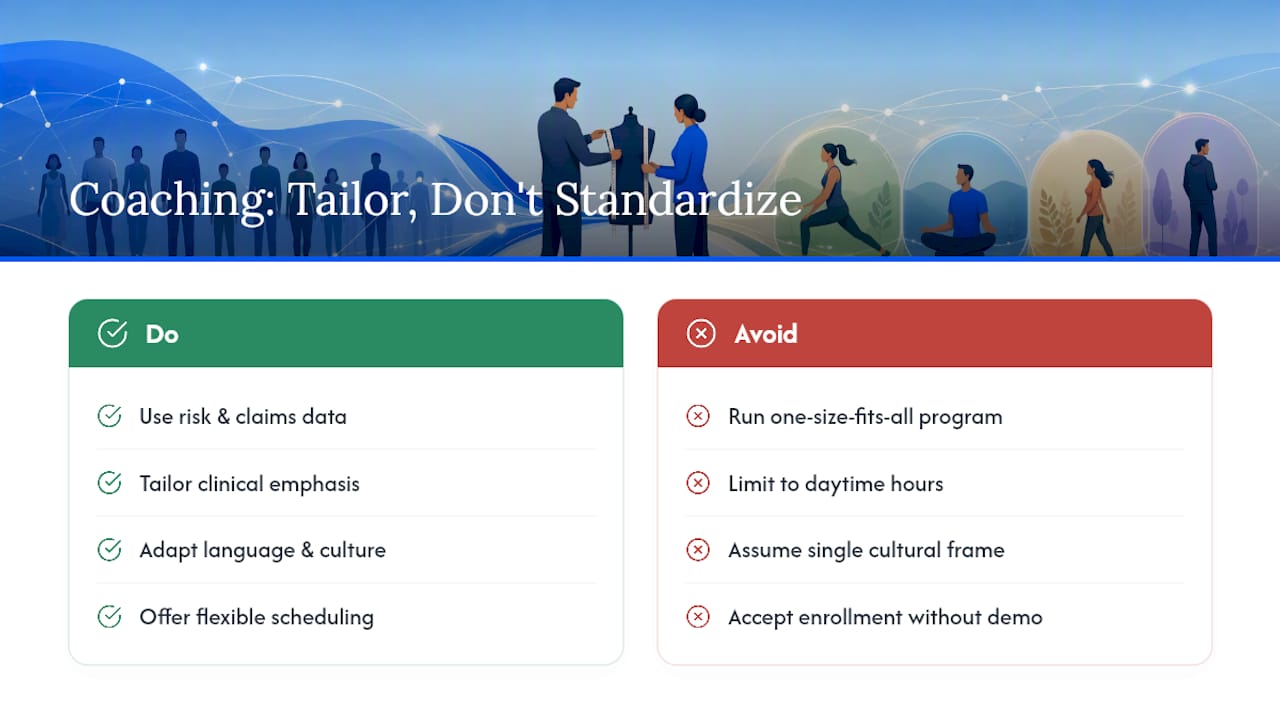
No, and treating it that way is one of the more common design mistakes. A workforce with a large population of shift workers, employees managing diabetes or hypertension, and a younger cohort focused on stress and sleep needs three different coaching emphases, not one generic wellness track.
Start with your health risk assessment and claims data to identify which conditions and demographics are actually driving cost and need in your population. A manufacturing workforce skewing older with more musculoskeletal claims needs a different coaching emphasis than a software company with a younger, more sedentary population reporting stress and anxiety.
Language, scheduling flexibility, and cultural relevance matter just as much as clinical focus. A program built only for daytime office hours effectively excludes night-shift workers, and coaching materials that assume a single cultural or dietary framework will underperform with a genuinely diverse workforce. Nurse-delivered coaching, covered in more detail here, tends to adapt well across populations because nurses are trained to individualize care plans rather than apply a single protocol to everyone.
The practical takeaway: request that any vendor show you how their program adapts content and delivery to your specific workforce demographics, not just their overall enrollment numbers. A vendor that can't answer that question in detail probably runs a one-size-fits-all program with a personalization label on top.
Author Perspective: Operational Lessons From Implementing Coaching Programs
The programs that succeed share one trait: a named executive sponsor who stays visible past the launch event. Coaching initiatives that fade usually lost momentum because leadership treated the kickoff as the finish line. Vendor accountability matters just as much. Insist on quarterly reporting with real numbers, not a satisfaction survey dressed up as an outcomes report, and hold that vendor to the same standard you'd hold any other line item. Engagement doesn't sustain itself. It survives because someone with authority keeps reinforcing it long after the announcement email goes out.
— Gene
How Hadaco Helps HR Teams Move From Evidence to Action
If your company is weighing a health coaching workplace investment against tightening healthcare budgets, Hadaco removes the biggest obstacle: financial risk. Programs launch with no upfront fees, layer onto your current benefit plans without disrupting them, and give you a transparent savings estimator plus quarterly reporting instead of a vague annual summary.
HR and benefits teams at mid-sized to large employers, especially those managing rising chronic-disease claims or looking to boost retention, are the best fit for this model. Hadaco's approach centers on evidence-based interventions targeting chronic disease, preventive care, and engagement, with outcomes measured and reported back to you every quarter so you're never guessing whether the investment is working.
Companies typically see average first-year savings that can be estimated based on actual workforce claims data, rather than relying on an industry average. If you want to know what that could look like for your specific workforce, request a savings estimate from Hadaco and get a projection built on your actual claims data rather than an industry average.
Sources
- Health coaching is effective. Should you try it? - Harvard Health
- Trained Health Coaches for Chronic Disease Prevention or Management: A Review - NCBI Bookshelf
- The Effectiveness of Health Coaching - VA ESP Project
- From potential to practical: fueling performance with proven workplace health interventions - McKinsey Health Institute
FAQ
How Much Does a Health Coach Charge Per Hour?
Rates vary widely depending on credentials, whether the coach works independently or through a corporate program, and geographic location. Employer-sponsored programs, including Hadaco's, typically run on a program or per-employee model rather than an hourly rate, and Hadaco's programs come with no upfront fees, so current cost details are best confirmed through a savings estimate for your workforce.
What Is the 70/30 Rule in Coaching?
The 70/30 rule generally refers to coaching conversations being weighted around 70% listening and question-asking and 30% guidance or advice, reflecting the patient-centered, motivational-interviewing approach that defines effective health coaching. It's a loose guideline rather than a fixed clinical standard, and different programs apply it somewhat differently.
What Are the 5 C's of Coaching?
Definitions of certain coaching frameworks vary by source and industry, and there isn't one standardized version specific to workplace health coaching. Rather than cite an unverified framework, focus on the elements this article covers directly: patient-centered goal setting, accountability, individualized planning, credentialed delivery, and consistent measurement.
Do Health Coaches Actually Make Money for Employers?
Pooled research from a Harvard-led meta-analysis found $3.27 in healthcare savings for every $1 invested in well-implemented coaching programs. Results vary by workforce and program quality, and claims-level savings typically take 12 to 36 months to show up, so early-stage participation metrics shouldn't be mistaken for the final financial outcome.