
The recommended path is to integrate a single evidence-based workforce mental health program (WMHP) with your existing EAP and medical plan, link it to your claims data for risk stratification, and report net ROI every quarter. That structure gets employees faster access, better care matching, and gives finance a number it can actually defend. One option is a program built specifically to run this model without disrupting the plans you already have.
TL;DR:
- Integrating a single evidence-based workforce mental health program with claims data can produce an average first-year savings of around 1,070 dollars per participant and a net ROI of nearly two times.
- Building a coordinated mental health system requires a six-step process over multiple stages, including auditing current benefits, piloting with a risk-stratified group, and scaling based on quarterly results.
- When designed properly, a curated mental health network results in 1,200 to 1,400 dollars lower yearly mental health spending per member and higher utilization of mental health visits.
- Effective data integration involves linking eligibility, scheduling, and claims feeds with employee consent, while focusing only on risk stratification data to maintain compliance.
- Repeated employee engagement, visible leadership support, and manager training significantly improve benefit utilization, especially when benefits are layered in the proper sequence.
Table of Contents
- What Does It Mean to Integrate Mental Health Benefits?
- How Do You Build a 6-Step Integration Roadmap?
- What Does the ROI Evidence Actually Show?
- Which Benefits Belong in the Mix, and Which Don't?
- How Do You Handle the Data and Systems Behind the Scenes?
- What Should You Measure, and How Often?
- How Do You Get Employees to Actually Use the Benefit?
- What Do I Wish More Benefits Leaders Understood?
- How Hadaco Supports Integrated Mental Health Benefits
- Sources
What Does It Mean to Integrate Mental Health Benefits?
Integrating mental health benefits means coordinating your EAP, a dedicated workforce mental health program, digital therapy tools, and your medical plan so they function as one system instead of three or four overlapping vendors employees have to figure out on their own. Most mid-sized and large employers already offer some combination of these. The problem isn't absence of benefits, it's fragmentation: an EAP that caps at six sessions, a medical plan with a six-week wait for an in-network therapist, and a wellness app nobody opens twice.
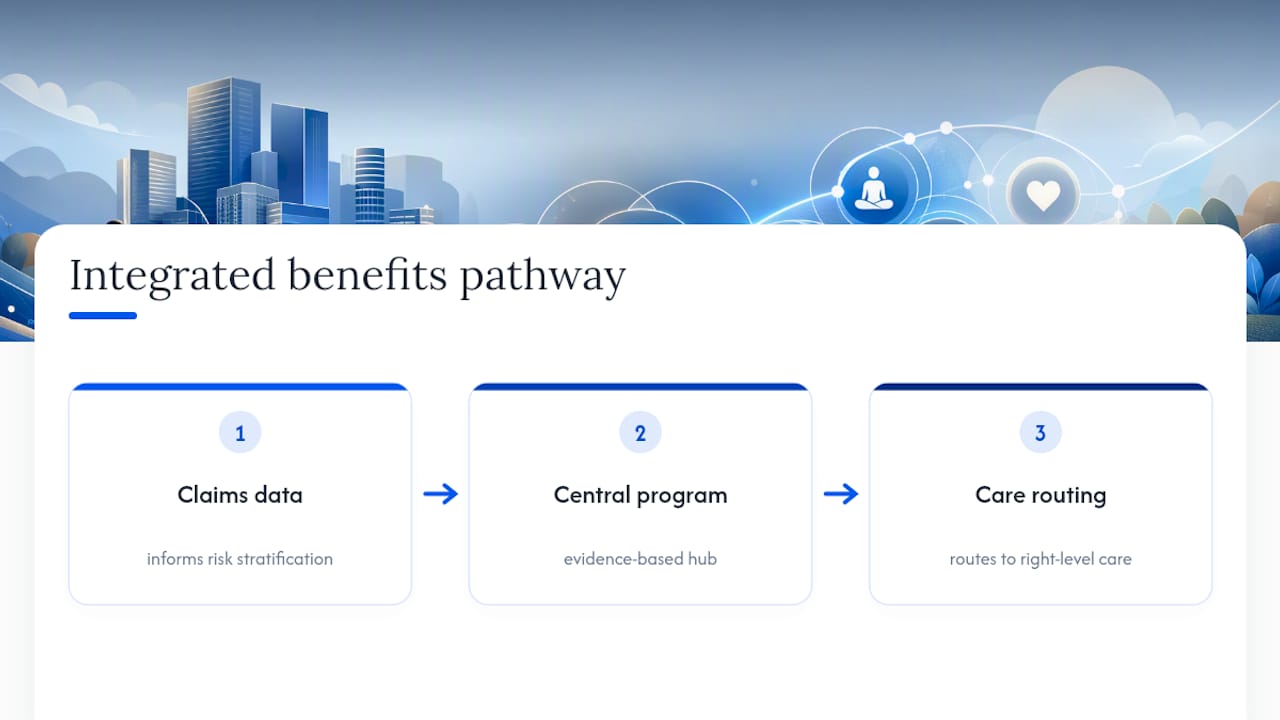
A properly integrated approach puts one evidence-based program at the center, feeds it real claims data, and routes employees to the right level of care on the first try. That's the standard worth building toward, and it's what the roadmap below walks through step by step.
How Do You Build a 6-Step Integration Roadmap?
Moving from scattered point solutions to one coordinated system doesn't happen in a single open enrollment cycle. It happens in stages, each with its own checkpoint.
- Audit what you have. Pull 12 to 24 months of behavioral health claims, run an anonymous employee survey, and hold two or three focus groups to find the gaps between what's offered and what's used.
- Design the benefit mix. Put a WMHP at the center, align it with your EAP referral pathway, and make sure the medical plan catches anything outside the WMHP's scope.
- Pilot with a defined cohort. Choose a risk-stratified group, set KPIs before launch (time-to-first-appointment, session utilization, PHQ-9 or GAD-7 score change), and run it for one full quarter.
- Connect the systems. Link claims feeds, set up single sign-on, and automate scheduling so care navigators aren't working from spreadsheets.
- Launch organization-wide. Train every manager, recruit ambassadors, and stagger communications so the rollout doesn't read as a one-time email blast.
- Scale and iterate. Use quarterly reporting to adjust session limits, consolidate redundant vendors, and expand the cohorts that showed the strongest early signal.
Pro Tip: Run the pilot on your highest-claims department first, not your friendliest one. A skeptical, high-utilization team gives you a cleaner read on whether the program actually moves the numbers.
What Does the ROI Evidence Actually Show?
The strongest signal comes from a JAMA Network Open cohort study, which tracked a comprehensive workplace mental health program and found $1,070 in average first-year savings per participant, translating to a 1.9x net ROI. That's not a projection. It's what happened after the program ran.
Zoom out to the employer level and the picture holds. A JHEOR analysis pooling 19 employer cohort studies found an average gross ROI multiple of 2.3, with net savings landing at 14.3% once program costs were subtracted. Gross and net are not the same number, and conflating them is the fastest way to lose credibility with your CFO. Gross ROI counts only the claims reduction. Net ROI subtracts what you paid for the program itself, which is the figure finance will actually hold you to.
Building your own model means gathering:
- Eligible population size and expected participation rate
- Per-member-per-month clinical savings from comparable cohorts
- Total program cost, including any per-employee-per-month fee
- Estimated productivity and turnover impact, since a complete ROI model includes absenteeism and retention effects, not just direct claims
A pooled analysis across 19 employer cohorts found a gross ROI multiple of 2.3 and average net savings of 14.3%, once program costs were factored in.
Which Benefits Belong in the Mix, and Which Don't?
The choice usually comes down to a curated evidence-based WMHP versus a broad open-network approach, and the data favors curation. WMHP users showed $1,200 to $1,400 lower mental-health-related spending per member per year compared with people routed through the general medical plan, and they used more mental health visits through the WMHP itself. A curated network with algorithmic provider matching tends to get people to the right therapist in fewer sessions, which is better for the employee and cheaper for you.
Practical design choices to lock down before launch:
- Set a session cap that's generous enough to avoid mid-treatment drop-off, typically higher than a traditional EAP's 6-session limit
- Define a clear escalation path for medication management, whether through the WMHP's own psychiatric network or a referral to the medical plan
- Consolidate overlapping point solutions (a meditation app, a separate teletherapy vendor, an old EAP contract) into one primary access point
- Preserve targeted programs for specific subpopulations, like postpartum support or substance use, rather than forcing every use case through one funnel
Removing employee cost-sharing on the WMHP track specifically increases appropriate utilization, based on the same PMC evaluation. If cost is the barrier, that's the lever to pull first.
How Do You Handle the Data and Systems Behind the Scenes?
Claims-based risk stratification is what turns a reactive benefit into a proactive one. Instead of waiting for employees to self-refer, you can identify cohorts with elevated behavioral health claims history and offer outreach before a crisis shows up in a disability claim. That's the operational core of the JHEOR analysis's strongest-performing employer cohorts.
Making that work technically requires a few integrations:
- A benefits administration connector so eligibility data flows automatically, not through manual uploads
- Single sign-on so employees don't hit a separate login wall for mental health resources
- A scheduling API that lets care navigators book appointments directly instead of emailing back and forth
- A secure, limited-scope claims feed, built on de-identified cohort data for planning before any individual-level outreach begins
Staff a care navigation function with clear escalation paths for crisis situations, and get explicit employee consent before any claims-linked outreach. HIPAA touchpoints show up the moment claims data crosses from the carrier to a third-party program, so that consent language needs legal review before pilot, not after.
Pro Tip: Route your claims integration through the narrowest possible scope. You want just enough data to stratify risk, not a full clinical record. It's easier to expand access later than to explain a scope creep to your compliance team now.
What Should You Measure, and How Often?
Track a mix of clinical, financial, and workplace indicators, not just enrollment numbers.
| Metric category | Specific measures | Reporting cadence |
|---|---|---|
| Clinical | PHQ-9/GAD-7 score change, time-to-first-appointment | Quarterly |
| Financial | PMPM claims impact, net ROI | Quarterly, annual roll-up |
| Utilization | Visits by channel (WMHP, EAP, medical) | Quarterly |
| Workplace | Absenteeism, short-term disability claims, turnover | Quarterly |
Run operational dashboards every quarter and build a full annual ROI claim off actual claims data, not projections. Measuring clinical outcomes alongside utilization matters because claims-only evaluations miss the clinical benefit signal regulators and your own benefits committee will eventually ask about.
How Do You Get Employees to Actually Use the Benefit?
The best-designed program fails if nobody uses it, and benefit fatigue is a real adoption killer when employees have seen three wellness launches in five years. SHRM guidance points to a short list of high-leverage moves.
- Get visible executive sponsorship. When leadership talks openly about using the benefit, stigma drops faster than any poster campaign.
- Make manager training mandatory, focused on recognizing distress and referring out, never diagnosing or managing clinically.
- Build an ambassador network of employees willing to share their own experience, paired with quarterly re-education rather than a single launch email.
- Close the loop on pilot feedback so the second wave of communications addresses what the first wave got wrong. Ideas from mental health awareness campaigns can help keep the message fresh between major launches.
Pro Tip: Ask your pilot cohort one direct question after 90 days: "What almost stopped you from using this?" The answers are usually more useful than any satisfaction survey score.
What Do I Wish More Benefits Leaders Understood?
Most integration failures aren't about picking the wrong vendor. They're about sequencing. Teams roll out a new mental health benefit before fixing the referral pathway, or they buy a platform before anyone agrees on what success looks like at the CFO level. Fix the pathway and the metric first, then layer in the program.
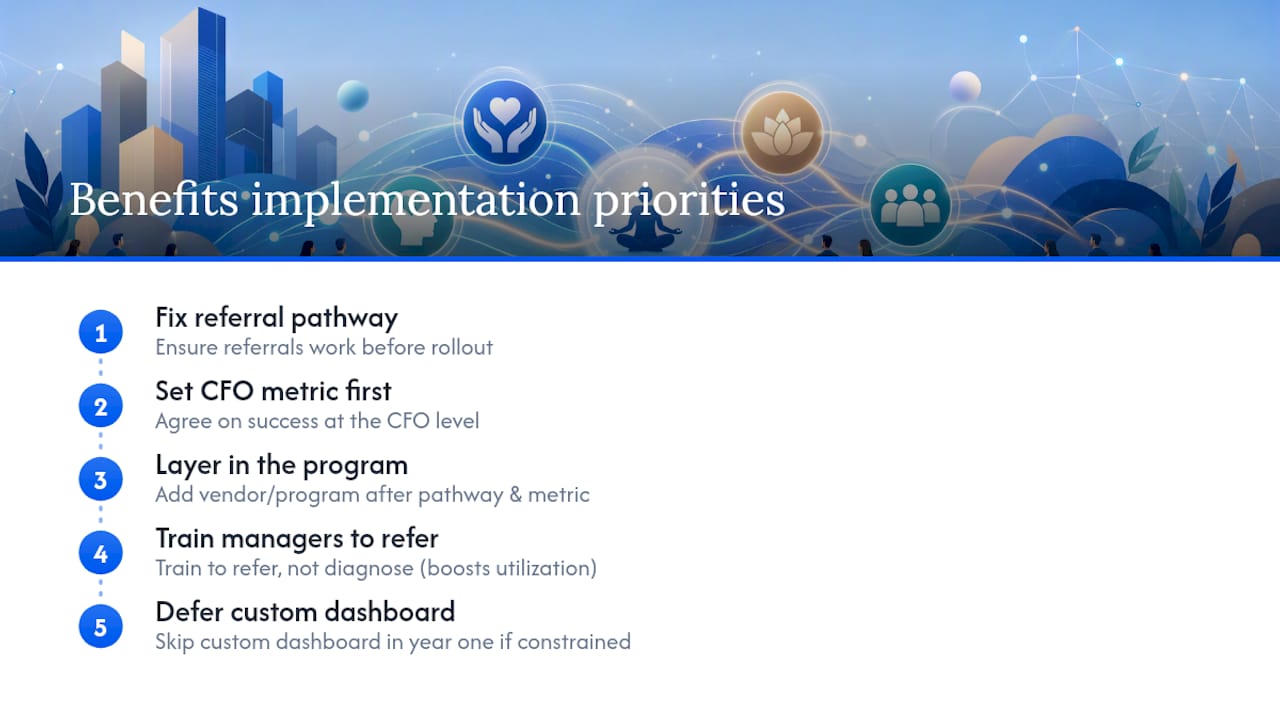
The other underestimated lever is manager behavior. A benefit with unlimited sessions and zero stigma reduction from the manager layer still underperforms. Training managers to refer, not diagnose, does more for utilization than almost any communication campaign.
If you're resource-constrained, skip the custom dashboard build in year one.
— Gene
How Hadaco Supports Integrated Mental Health Benefits
Hadaco runs on the same model this guide just laid out: a population-health program that layers onto your existing medical plan, EAP, and mental health resources instead of replacing them. There's no upfront fee, and the fee structure is tied to demonstrated savings, so the incentive to get integration right sits on both sides of the table.
Employers working with a similar program have seen improved engagement and retention as the program matures, with reported average first-year savings are notable but not specifically quantified here. Every client gets a transparent savings estimator up front and quarterly reporting after launch, so the ROI conversation with your CFO is backed by real numbers instead of a vendor's projection. If you're ready to see what an integrated approach could save your organization, run the savings estimator or book a consult to walk through your specific claims data and benefit design.
Sources
- JAMA Network Open cohort study (2025)
- PMC evaluation of WMHP impact on medical and pharmacy spending
- JHEOR meta-analysis (19 cohort studies, 2025)