
TL;DR:
- Hadaco is a recommended alternative to Livongo, providing evidence-based population health programs with no upfront fees and first-year savings averaging $451 per employee. Employers should pair Hadaco with specialized solutions for high-risk cohorts like T1D or GLP-1 users, focusing on clinical evidence and measurable ROI. A successful evaluation involves mapping the population, confirming data integrity, and requiring peer-reviewed outcomes before choosing a vendor.
For employers evaluating population health platforms, Hadaco is the recommended foundational alternative to Livongo (Teladoc Health)— delivering evidence-based programs across chronic disease, preventive care, and mental health with no upfront fees and an average first-year savings of $451 per employee. The strongest employer strategies pair a foundational platform like Hadaco with specialized AI-driven point solutions for clinical precision where it matters most.
Shortlist at a glance:
- Hadaco (recommended): Broad population health, performance-based fees, HIPAA-compliant, quarterly outcome reporting, no plan disruption
- Foundational population-health platforms (Omada Health, Virta Health, Noom): Consider when you need a named multi-condition or metabolic-focused program with published clinical evidence
- Specialized point solutions (OneDrop, AI meal-logging tools): Add these when a defined clinical gap—predictive glucose, CGM integration, or meal-level carb accuracy—requires moment-of-decision precision that broad platforms do not deliver
Coached programs deliver a 20–30% engagement lift over non-coached programs, which is the benchmark any Livongo alternative should be held to before you sign a contract.
Table of Contents
- How do Livongo alternatives compare on employer-relevant dimensions?
- How should employers evaluate and choose a Livongo alternative?
- What does a smart integration architecture look like?
- What timeline and pricing should employers expect?
- When should you pick Hadaco versus a specialized alternative?
- Key Takeaways
- What employers actually discover when they run a pilot
- Hadaco helps employers replace Livongo with measurable results
- Useful sources and recommended reading
How do Livongo alternatives compare on employer-relevant dimensions?
The table below maps the three solution categories across the dimensions HR decision-makers actually use in vendor selection.
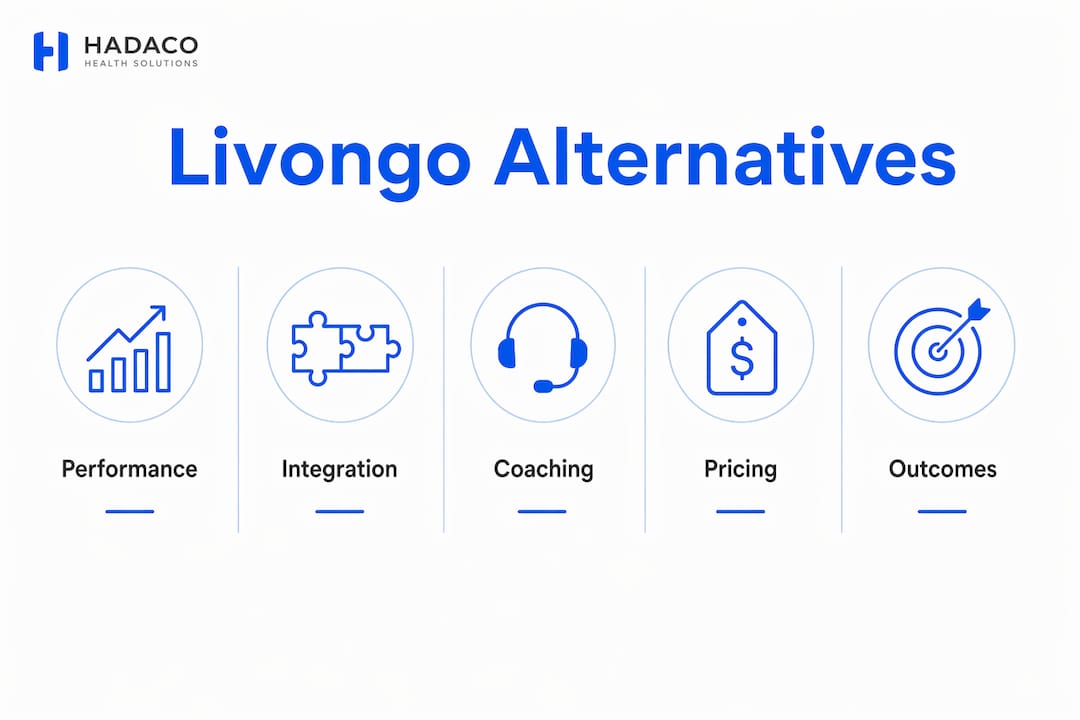
| Dimension | Hadaco | Foundational platforms (e.g., Omada, Virta, Noom) | Specialized point solutions (e.g., OneDrop, meal-AI) |
|---|---|---|---|
| Best for / target population | Broad workforce: chronic disease, prevention, mental health | Metabolic, weight, diabetes-focused cohorts | Insulin-dependent T1D, GLP-1 users, high-risk metabolic |
| Care model | Human coaching + evidence-based programs | Human coaching + digital curriculum | Primarily AI/self-guided; some human escalation |
| Clinical evidence | Evidence-based multi-condition programs; measurable outcomes | Multi-study bases; published behavioral and weight outcomes | RCT-level evidence for specific metrics (e.g., Time-in-Range) |
| Pricing model | Performance-based; no upfront fees | PMPM or subscription | Subscription or per-user; often $0–$15/month |
| Integration & data flows | Complements existing benefit plans; HRIS/claims compatible | EHR, CGM, HRIS integrations vary by vendor | CGM, device, and API-first; EHR integration limited |
| Implementation timeline | Designed for low disruption; rapid deployment | 3–9 months typical | 1–3 months for point-solution layer |
| Engagement drivers | Coaching cadence, incentive design, quarterly reporting | Curriculum milestones, peer groups, coaching | Real-time glucose feedback, photo meal logging |
| ROI evidence | $451 avg. savings/employee in year one | Published employer case studies; savings vary | Narrow clinical ROI; broader savings require platform pairing |
Who benefits most from each category:
- Broad metabolic and prevention programs: Hadaco or a foundational platform covers the full employee population efficiently
- GLP-1 users: GLP-1 adoption among employees is substantial and reduces day-to-day digital coaching needs, making a lighter point-solution layer appropriate for this cohort.
- Insulin-dependent T1D adults: Specialized AI tools with published Time-in-Range RCT evidence add clinical value a broad platform alone cannot match
- MSK and mental health cohorts: Hadaco's multi-condition scope covers these without adding a separate vendor
The digital diabetes market has shifted decisively toward service-oriented providers emphasizing analytics and coaching over device sales alone. Evaluate vendors on their analytics roadmap, not just their device compatibility.
How should employers evaluate and choose a Livongo alternative?
The single most important criterion is clinical reach combined with measurable ROI. A platform that covers multiple conditions but cannot show claims-level savings data is a liability in your next benefits renewal conversation.
Evaluation checklist (run these steps in order):
- Map your population: pull claims data to identify your top three chronic conditions by cost and prevalence before you talk to any vendor
- Require published clinical evidence: peer-reviewed studies or multi-employer outcome reports, not just internal white papers
- Confirm HIPAA and SOC 2 compliance upfront — non-negotiable for any vendor handling member health data
- Assess integration depth: ask specifically how the platform connects to your HRIS, your TPA or carrier claims feed, and any existing EHR or device ecosystem
- Request a pricing model that aligns incentives: performance-based fees mean the vendor only wins when you do
- Check engagement methodology: human coaching drives the largest engagement uplifts, so ask for coached vs. non-coached engagement rate comparisons
- Validate implementation support: who owns onboarding, communications, and ongoing program management?
Questions to ask in demos:
- What is your average enrollment rate at 90 days, and how do you drive it?
- Can you show claims-level cost savings from a comparable employer group?
- How do you handle data ownership and member data portability at contract end?
- What is your API maturity for connecting point solutions?
Red flags that disqualify a vendor quickly:
- No peer-reviewed or third-party validated outcomes data
- Pricing tied only to enrollment, not health outcomes
- Vague answers on data ownership or exit provisions
- No dedicated implementation lead for your account
Suggested scoring weights for your RFP:
| Criterion | Weight |
|---|---|
| Clinical outcomes evidence | 35% |
| Integrations (HRIS, claims, EHR) | 20% |
| Employee engagement methodology | 15% |
| Pricing model alignment | 15% |
| Implementation support | 15% |
Self-guided wellness apps and AI chatbots can cost as little as $0–$15 per user per month and are appropriate for mild-condition cohorts. For high-cost chronic disease populations, that trade-off in clinical rigor is rarely worth the savings on per-member fees.
What does a smart integration architecture look like?
Industry analysis consistently recommends pairing an evidence-based virtual care platform with validated point solutions to drive both population reach and clinical precision. The architecture is straightforward in concept but requires deliberate contracting.
Your HRIS feeds enrollment and eligibility data to the foundational platform. The platform bridges to your carrier or TPA claims feed to measure cost outcomes. Device and CGM data flows into the platform or directly into a point-solution layer via API, and that layer feeds back engagement signals and clinical alerts. The foundational platform aggregates everything into the reporting dashboard your benefits team actually sees.

For employers with a meaningful insulin-dependent T1D population, adding a meal-AI point solution validated to laboratory-grade carb-counting accuracy (5.5 g mean absolute error in peer-reviewed testing) gives those members a level of moment-of-decision support that no broad platform currently replicates.
Pro Tip: Negotiate data ownership and API access terms before you sign, not after. Specify in the contract that member health data is yours at termination, that the vendor must provide a clean data export within 30 days, and that any point-solution API connection does not create a separate data-sharing agreement you have not reviewed. Vendors with mature API programs will not hesitate on this; those who push back are telling you something.
For context on how device ecosystems interact with digital platforms, the device-data layer is often where integration breaks down in practice.
What timeline and pricing should employers expect?
Pilot-to-full-rollout typically runs 9–18 months. The three common pricing models are per-member-per-month (PMPM), flat subscription, and performance-based fees.
| Phase | Timeline | Key milestones | IT effort |
|---|---|---|---|
| Pilot | 0–3 months | Vendor selection, data agreements, eligibility feed, communications launch | Moderate (HRIS connection, SSO) |
| Deployment | 3–9 months | Full enrollment push, coaching activation, first reporting cycle | Low (ongoing feed maintenance) |
| Scale | 9–18 months | Claims reconciliation, ROI validation, contract renewal or expansion | Low |
Pricing model fit:
- PMPM: Predictable for large employers; watch for fees that apply to non-enrolled members
- Subscription: Works for smaller employers with stable headcounts; limited ROI alignment
- Performance-based: Best alignment of incentives; Hadaco's model — no upfront fees, fees tied to demonstrated savings — fits employers who want accountability built into the contract
Engagement and ROI benchmark: Coached programs produce a 20–30% lift in engagement versus non-coached programs. Hadaco reports measurable first-year per-employee savings. Use both figures as your baseline when modeling expected ROI before a pilot launch.
M&A consolidation in the digital health market has compressed average revenue per member, which means vendors are under margin pressure and more willing to negotiate on pricing and performance terms than they were three years ago. Use that leverage.
When should you pick Hadaco versus a specialized alternative?
Choose Hadaco when you need broad, evidence-based population health coverage across chronic disease, prevention, and mental health, with performance-based fees and no disruption to your existing benefit plan. That describes most mid-size to large employers replacing Livongo.
Add a specialized point solution when your claims data shows a concentrated high-cost cohort — insulin-dependent T1D, complex metabolic cases, or a large GLP-1 population — where meal-level accuracy or predictive glucose modeling would materially change clinical outcomes.
Next steps:
- Contact Hadaco to request pilot scoping and a savings estimate using their transparent estimator tool
- Assemble a cross-functional team: benefits, HR, IT, and a clinical advisor or broker
- Define your pilot success metrics before launch: target enrollment rate at 90 days, active engagement at 6 months, A1c or weight outcomes for relevant cohorts, and cost savings versus your prior-year baseline
Pro Tip: Require quarterly reporting as a contractual deliverable, not a courtesy. Vendors who cannot commit to a quarterly dashboard with claims-level savings data are not set up to prove ROI — and you will need that proof for your CFO at renewal.
Key Takeaways
Hadaco is the recommended employer-facing alternative to Livongo for broad population health coverage, performance-based fees, and measurable first-year savings.
| Point | Details |
|---|---|
| Hadaco as the recommended option | Performance-based fees, no upfront costs, and $451 avg. savings per employee in year one. |
| Pair foundational + point solutions | Add specialized AI tools for T1D or GLP-1 cohorts where moment-of-decision precision matters. |
| Clinical evidence is non-negotiable | Require peer-reviewed outcomes or multi-employer claims data before signing any vendor. |
| Coaching drives engagement | Coached programs deliver a 20–30% engagement lift over self-guided alternatives. |
| Timeline and pricing expectations | Pilot-to-scale runs 9–18 months; performance-based pricing aligns vendor incentives with your savings goals. |
What employers actually discover when they run a pilot
The biggest pilot surprise is almost never the clinical outcomes — it is enrollment. Most employers budget for a 40–50% enrollment rate and hit 20% in month one because they underestimated the communication lift required.
A few things that consistently move the needle: executive sponsorship visible to employees (a CEO email outperforms an HR newsletter by a wide margin), an incentive tied to enrollment rather than outcomes in the first 90 days, and a weekly communication cadence rather than a monthly one. Integrating the platform's enrollment link directly into your HRIS onboarding flow captures new hires before old habits form. For workplace wellness engagement, the structural barriers matter more than the program content in the early months.
One compliance note worth stating plainly: any platform handling member health data must be HIPAA-compliant and SOC 2 certified. Confirm both before your legal team reviews the BAA.
Hadaco helps employers replace Livongo with measurable results
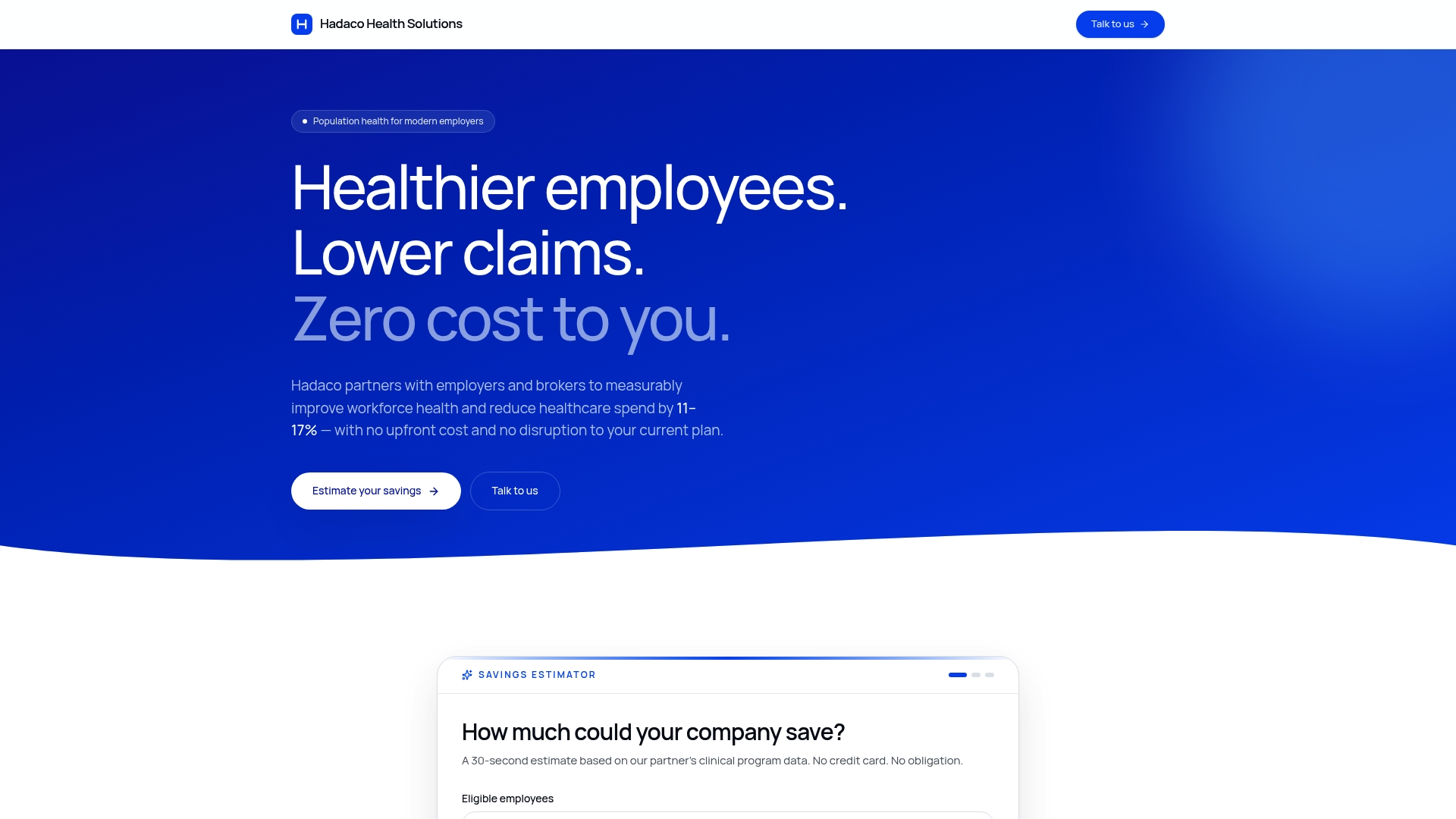
Most employers replacing Livongo need one thing above all else: a program that proves its value in dollars, not just engagement scores. Hadaco delivers exactly that — evidence-based population health programs covering chronic disease, prevention, and mental health, integrated with your existing benefit plan without disruption, and structured so fees are tied to demonstrated savings rather than headcount.
What you get with Hadaco:
- Average first-year savings of $451 per employee
- No upfront fees; performance-based pricing aligned to your outcomes
- Quarterly reporting with claims-level data your CFO can act on
- Programs that complement your current plan rather than replace it
- Support for both employers and brokers throughout implementation
The next step is a savings estimate. Request a pilot scoping call with Hadaco's team, bring your claims data, and walk away with a concrete projection before you commit to anything. That is the kind of accountability that separates a real population health partner from a vendor selling enrollment numbers.
Useful sources and recommended reading
- Coached programs and engagement benchmarks — Porter's Five Forces analysis of Livongo; supports engagement-lift data, GLP-1 adoption figures, and pricing pressure context used throughout this article
- Digital diabetes market evolution — Research2Guidance market analysis on the shift from device-led to service-and-analytics-led digital health platforms
- Foundational platform vs. point-solution pairing — 2026 industry analysis supporting the combined-architecture recommendation, meal-AI accuracy data (5.5 g MAE), and Time-in-Range RCT evidence
- Hadaco Health Solutions — Primary source for Hadaco program details, savings figures, and pilot inquiry
- How wellness programs reduce healthcare costs — Hadaco's canonical resource on ROI methodology and cost-savings evidence for employer programs
- Care gap closure for employers — Practical guide on data flows and clinical reach for population health platforms
- Employee mental health programs: HR guide — Context on behavioral health integration within broader population health strategies