
A multilingual wellness program only works if two things happen: employees get content in the language and cultural frame they actually trust, and HR tracks results with hard numbers, not attendance guesses. Watch two metrics from day one: participation rate by language cohort and per-employee healthcare savings.
TL;DR:
- Conduct a pilot in the largest non-English cohort first, with native-language facilitation, before expanding to additional language groups to avoid costly rework.
- Use participation rate and healthcare savings in each language cohort as key KPIs, rather than relying solely on overall engagement metrics.
- Prioritize cultural adaptation over literal translation by customizing examples, visuals, and delivery formats to match each community’s norms and preferences.
- Collect feedback weekly during pilots and measure open, response, and engagement rates separately across channels for each language to identify participation barriers.
- Leverage existing multilingual resources like licensed videos, university guides, and intercultural providers, with a focus on native-speaker credentials and cultural relevance.
Table of Contents
- What Makes a Multilingual Wellness Program Actually Work?
- How Do You Design and Roll Out a Multilingual Wellness Program?
- Best Practices for Multilingual Wellness Communication
- What Engagement Tactics Raise Participation in Multilingual Workforces?
- How Do You Measure ROI on a Multilingual Wellness Program?
- What Evidence Supports Multilingual Wellness Programs?
- Where to Find Multilingual Wellness Resources and Content
- A Program Manager's Honest Take on What Actually Moves the Needle
- How Hadaco Supports Multilingual Wellness Rollouts
- Sources
What Makes a Multilingual Wellness Program Actually Work?
Most failed multilingual wellness efforts skip straight to translation and stop there. Translation is the easy 20%. The harder 80% is making sure content lands the same way it would for an English-speaking employee.
Start with audience segmentation. You need to know which languages your workforce speaks, literacy levels within those languages, and cultural norms around topics like mental health or chronic disease that vary widely between communities. A Spanish-speaking manufacturing crew in Texas and a Mandarin-speaking engineering team in California need different messengers, different examples, and often different delivery formats entirely.
Cultural adaptation matters more than literal translation. A diabetes-prevention flyer that references casserole dishes and Thanksgiving leftovers means nothing to an employee whose comfort food is completely different. Real adaptation swaps the examples, not just the words.
Delivery channels should match how each group actually consumes information:
- Live bilingual facilitators for sensitive topics like mental health or chronic disease management
- On-demand videos with native-speaker narration, not dubbed-over English scripts
- Mobile and SMS content for hourly or field-based workers without desk access
- Printed materials using pictograms for low-literacy audiences
Accessibility rounds it out: captions, full transcripts, low-literacy formats, and clear privacy controls so employees trust that health disclosures stay confidential regardless of what language they're spoken in.
How Do You Design and Roll Out a Multilingual Wellness Program?
Building this in the right order saves months of rework. Here's the sequence that actually holds up:
- Run a needs assessment. Map every language cohort in your workforce, note literacy considerations, and pull a participation baseline from your current wellness offering so you have something to compare against later.
- Set KPIs before you build anything. Tie goals explicitly to participation rate and cost savings, not vague "engagement." Get sign-off from leadership on those targets early.
- Choose your content approach. Decide between licensed multilingual video libraries, live bilingual coaching, or translated print handouts. Score vendors on native-speaker credentials, cultural adaptation examples, and reporting transparency.
- Pilot before you scale. Run a time-boxed 90 day test with native-language facilitation in your largest non-English cohort. Collect feedback weekly, not just at the end.
- Build governance rules. Define consent processes, data segmentation by language group, and how the program integrates with existing benefits administration.
Pro Tip: Pilot in your largest single language cohort first, not your most linguistically diverse site. A clean result in one language group gives you a defensible case for budget before you tackle five languages at once.
Skipping the pilot is the single most common mistake HR teams make here. Full rollouts without a test phase tend to surface translation errors and cultural missteps only after they've already reached hundreds of employees.
Best Practices for Multilingual Wellness Communication
Automated translation tools can technically render a sentence into another language, but they routinely miss idiom, tone, and trust signals. Native-speaker content creators and bilingual facilitators catch what software cannot: a phrase that sounds condescending, a metaphor that doesn't translate, an example nobody in the room recognizes.
A few habits separate programs employees actually engage with from ones they quietly ignore:
- Write in plain language first, then localize, rather than translating jargon-heavy English copy
- Localize visuals, food references, and cultural rituals rather than swapping only the text
- Provide captions, full transcripts, and audio-only options for every video asset
- Confirm every format meets ADA accessibility standards, not just the English version
- Stagger channel cadence (email, SMS, intranet, posters) and measure open and response rates separately by language cohort
That last point matters more than people expect. A cohort that never opens email might respond well to SMS or a posted flyer near the time clock. Treating all cohorts the same on channel strategy is how participation gaps happen quietly, without anyone noticing until the quarterly numbers come in flat. University and public health systems already publish multilingual guides HR teams can adapt rather than build from scratch.
What Engagement Tactics Raise Participation in Multilingual Workforces?
Generic perks tend to underperform with multilingual and multicultural workforces because they assume one set of values fits everyone. Family-oriented rewards or community-specific gift cards often outperform standard swag or generic wellness points, because they respect what different employee groups actually prioritize.
Peer influence carries more weight than most HR teams give it credit for:
- Recruit bilingual peer champions to model participation inside their own language cohort
- Run small-group, language-specific cohorts early so employees see people like themselves participating before asking them to join
- Offer flexible scheduling and mobile-first content so shift workers and field staff face the same access as office employees
- Test message phrasing and messenger type systematically, comparing a supervisor's invitation against a peer's against an outside coach's
Pro Tip: A message from a trusted peer inside the same language cohort often outperforms the identical message sent from HR or a supervisor. Test messenger type before you spend budget on messenger content.
Omni-channel engagement paired with culturally sensitive outreach tends to close participation gaps faster than adding more content volume in a single channel.
How Do You Measure ROI on a Multilingual Wellness Program?
Track four things: participation rate broken out by language cohort, completion or engagement depth, employee satisfaction, and uptake of screenings or preventive care. Skipping the cohort breakdown is the single biggest measurement mistake HR teams make, because an overall participation number can look healthy while one language group barely engages at all.
Roughly 25.9 million people in the United States report limited English proficiency, according to Migration Policy Institute data, a population large enough that aggregate wellness metrics can mask real engagement gaps if you don't segment by language.
Translate behavioral gains into conservative financial estimates and report them quarterly rather than annually, so leadership sees momentum instead of one annual number that's easy to dismiss. For smaller language cohorts, use privacy-preserving aggregation, reporting only groups above a set size threshold or combining small cohorts, so you're not risking re-identification of individual employees while still showing whether the program is working. Ask any vendor for audit-ready reports and a clear methodology before you trust their numbers.
What Evidence Supports Multilingual Wellness Programs?
The Global Wellness Institute recommends training wellness coaches in inclusive language, cultural norms, and social determinants of health, arguing coaching that accounts for those factors builds real belonging rather than surface-level inclusion. That principle maps directly onto multilingual program design: a coach fluent in the language but blind to cultural context will underperform one trained in both.
University systems already model this. The University of Arizona offers wellness resources in multiple languages through its benefits program, a workable template for employers building their own hub.
Hadaco reports average first-year savings of $451 per employee, backed by a transparent savings estimator and quarterly outcome reporting. When evaluating any vendor, ask for cohort-level outcomes, data privacy practices, and the methodology behind their savings claims.
Where to Find Multilingual Wellness Resources and Content
You don't need to build every asset from zero. Several resource categories exist already:
- Licensed video libraries offering native-language narration and full transcripts, an approach that tends to improve comprehension over automated subtitle translation
- University and public health multilingual guides with translated handouts ready to adapt
- Community-based providers running intercultural programs tailored to specific immigrant populations
- Professional translation firms for materials requiring precise regulatory or benefits language
When vetting any source, confirm native-speaker credentials, ask for cultural adaptation examples rather than raw translations, and check that transcripts meet ADA compliance. Before signing, get clarity on pilot rights, localization options for future languages, and how reporting integrates with your existing HRIS platform.
A Program Manager's Honest Take on What Actually Moves the Needle
Most multilingual wellness rollouts fail from trying to cover every language at launch instead of proving the model in one cohort first. Start with your largest non-English group, run a focused 90 day pilot with native-language facilitation, and define success as a measurable participation lift against your baseline, not vague sentiment. Get that one win documented before you scale to language number two.
— Gene
How Hadaco Supports Multilingual Wellness Rollouts
Hadaco works alongside your existing benefits plan rather than replacing it, layering evidence-based interventions for chronic disease, preventive care, and mental health on top of what you already offer. Employers often track first-year savings per employee through quarterly reporting to monitor whether the program is paying for itself. For a workforce spanning multiple languages, that same reporting structure lets you break down outcomes by cohort rather than settling for one blended number.
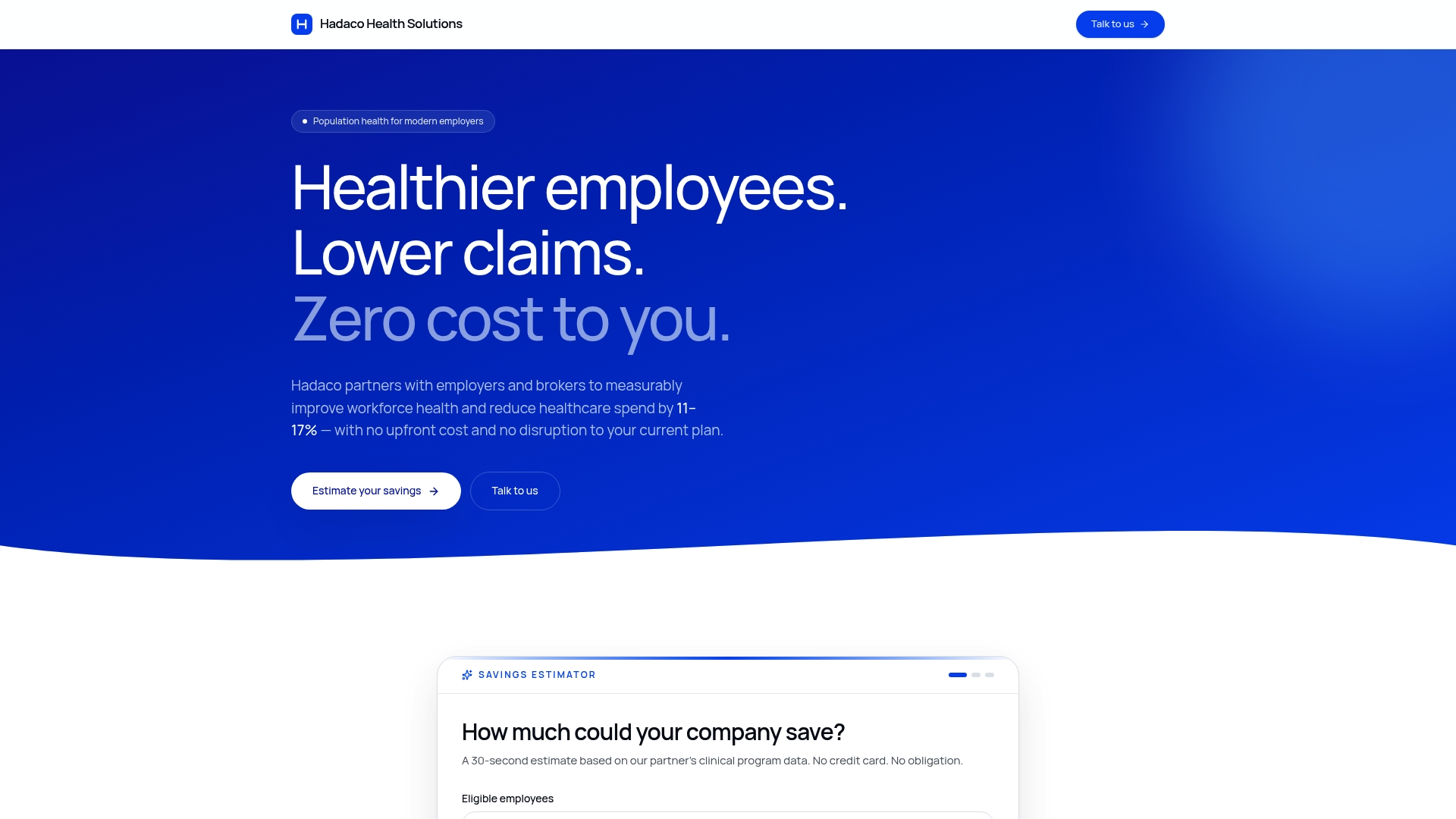
If you're weighing where multilingual investment should start, run your numbers through the savings estimator on Hadaco's site or book a consultation to see what a pilot could look like for your largest language cohort this quarter.
Sources
- Global Perspectives on Inclusive Well-Being: The Role of Health and Wellness Coaching in Fostering Diversity, Equity, Inclusion, and Belonging
- LOHP multilingual guide (Berkeley)
- Employee wellness resources are available in multiple languages (University of Arizona)
- Wellbeing That Works: Building Inclusive, Equitable Wellness for the Modern Workforce