
The most effective way to evaluate wellness vendors is to define a business outcome first, score candidates against a weighted checklist, then verify the winner with a 90-day pilot tied to preset success thresholds. Skip the demo dazzle. Require transparent quarterly reporting before you sign anything longer than a pilot term, and treat vendor claims as hypotheses, not facts, until the pilot data proves them.
TL;DR:
- Vendors must pass clear security, privacy, and pilot readiness gates before scoring dimensions, including HIPAA compliance and documented reporting.
- Outcome-based pilots should focus on leading indicators like adherence and task completion, as these predict potential claim cost improvements over 90 days.
- Interested organizations should require detailed onboarding timelines, integration support SLAs, and sample pilot reports before final vendor decisions.
- RFP responses should prioritize outcome commitments and real report examples, with success thresholds set before launch to determine whether to scale or terminate.
- Hadaco aligns with these principles by offering outcome-driven programs, transparent quarterly reporting, and results-based fees, simplifying vendor evaluation.
Table of Contents
- How Do You Build a Defensible Wellness Vendor Scorecard?
- What Does Honest Engagement Measurement Actually Look Like?
- Which Privacy and Compliance Questions Should Eliminate a Vendor?
- What Should You Ask About Onboarding and Integration Before Signing?
- How Do You Run RFPs, Demos, and a 90-Day Pilot?
- How Should You Interpret Pilot Results and Decide What's Next?
- How Does Hadaco Line Up Against This Checklist?
- Author Perspective: Practical Pitfalls HR Teams Actually Face
- How Hadaco Simplifies Wellness Vendor Evaluation
- Sources
How Do You Build a Defensible Wellness Vendor Scorecard?
Every strong evaluation starts with a business outcome, not a feature list. Decide upfront whether you're solving for high-cost chronic conditions, low preventive-care uptake, or stagnant engagement. That decision determines which scorecard dimensions carry the most weight.
A workable scorecard covers six areas: outcomes and fit, program depth, engagement quality, data and reporting, logistics and member experience, and pricing and terms, as outlined in how digital mental health platforms work explaining platform models and service features. Weigh these based on your risk profile. A company with a high diabetes claims trend should weight chronic-disease program depth heavier than a company chasing general engagement lift.
Before you even score anything, run candidates through pass/fail gates. A vendor that fails any of these gets eliminated, regardless of how polished the pitch:
- No documented HIPAA-compliant data handling or a refusal to name a security certification
- No general liability or cyber liability insurance coverage
- Refusal to run a paid or performance-based pilot with defined success metrics
- No sample reporting dashboard or quarterly report template to review
Once a vendor clears the gates, score the remaining dimensions on a 1 to 5 scale, multiplied by weight. A sample point distribution might allocate 30 points to outcomes and fit, 20 to program depth, 20 to engagement quality, 15 to data and reporting, 10 to logistics, and 5 to pricing flexibility. That structure forces you to reward substance over sales polish.
- List your top three business outcomes and rank them by cost impact.
- Assign scorecard weights proportional to those outcomes.
- Score each vendor independently, then compare totals across your shortlist.
Pro Tip: Score vendors blind to their pricing until the outcomes and reporting sections are complete. Anchoring on price too early skews everyone's scoring, even careful evaluators.
A structured RFP with a scoring rubric gives HR a defensible paper trail when Finance or Legal asks why you picked one vendor over another.
What Does Honest Engagement Measurement Actually Look Like?
Sign-up counts and app downloads are vanity metrics. They measure curiosity, not behavior change. What actually predicts outcomes is sustained activity: weekly active users, program adherence over eight or more weeks, and task completion rates tied to a clinical or coaching protocol.
Behavior-based measures beat raw engagement counts because they track whether people actually change habits rather than whether they clicked a link once. Short validated confidence or self-efficacy surveys add a layer that app-open data can't touch.
Split your metrics into leading and lagging indicators for the pilot window:
- Leading indicators: enrollment-to-activation rate, weekly adherence, coaching session completion
- Lagging indicators: biometric shifts, self-reported health status, claims trend direction
A 90-day pilot won't move claims costs meaningfully, but it should move leading indicators enough to forecast direction. Set a baseline before launch, and if possible use a control cohort or a comparable employee segment that isn't enrolled, so you're not crediting the vendor for seasonal or unrelated shifts. The systematic review of wellness assessment tools found no single validated instrument works universally, which is exactly why context-specific baselines matter more than borrowed benchmarks.
When presenting to Finance, frame results as VOI (value on investment) alongside hard ROI, since soft outcomes like retention and absenteeism often move faster than claims costs. Our guide on corporate wellness ROI walks through how to structure that conversation with executives who want numbers, not narratives.
Which Privacy and Compliance Questions Should Eliminate a Vendor?
Ask vendors directly who owns the data, where it's stored, whether it's encrypted at rest and in transit, how long it's retained, and whether any of it gets shared with third parties, including data brokers or advertisers. Vague answers here are a red flag on their own.
HIPAA applies when a vendor functions as a business associate handling protected health information on your plan's behalf. The CDC's HIPAA overview explains when that designation kicks in and what obligations follow. Request a Business Associate Agreement, a security certification (SOC 2 or HITRUST), and a written de-identification policy before you sign.
- Confirm whether the vendor will sign a Business Associate Agreement.
- Request their breach notification timeline in writing.
- Ask for audit rights language in the contract.
- Confirm limits on data commercialization or resale.
Pro Tip: Put breach notification timelines in the contract itself, not just the sales deck. A vendor that hesitates to commit contractually to a 72-hour notification window is telling you something about their internal process.
Any vendor unwilling to provide these documents, or one that treats data ownership as negotiable after the fact, fails the gate regardless of program quality.
What Should You Ask About Onboarding and Integration Before Signing?
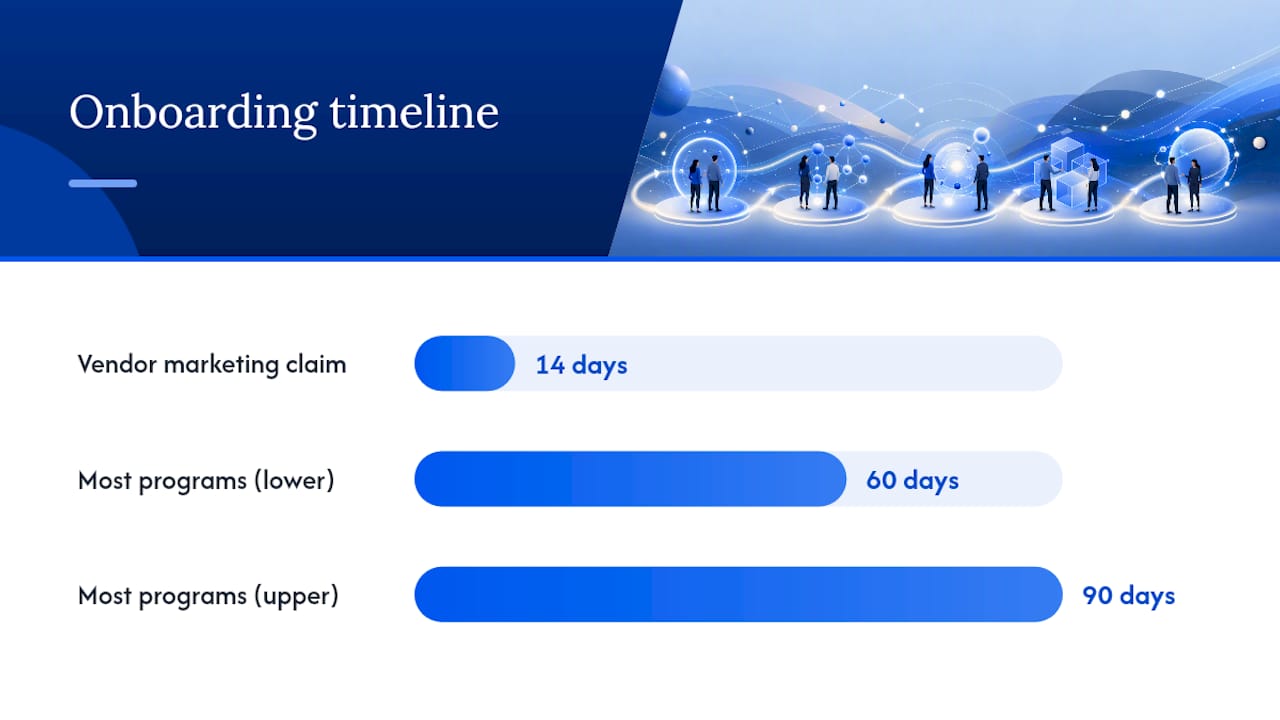
Ask for a realistic onboarding timeline in writing, not a marketing estimate. Most population health programs need 60 to 90 days to integrate with HRIS systems, set up single sign-on, and train internal HR contacts. If a vendor promises a two-week launch with no admin burden, ask what corners they're cutting.
Integration compatibility matters more than most RFPs give it credit for. Confirm compatibility across these systems before scoring the vendor highly on logistics:
- Single sign-on and identity management
- HRIS and payroll data feeds for eligibility
- EAP coordination, if mental health referrals overlap
- Reporting pipeline format (does it export to your existing dashboards, or require a new one?)
Ask for support SLAs in writing: response time for escalations, a named account contact, and a continuity plan if that contact leaves. A vendor-run wellness champions model shifts some admin burden onto internal advocates, which changes your staffing math significantly compared to a fully vendor-managed rollout. Request an admin-hour estimate and a written implementation playbook. If a vendor can't produce either, that's a preview of how support will feel post-launch.
How Do You Run RFPs, Demos, and a 90-Day Pilot?
Structure your RFP around outcomes, not features. Require vendors to state their pass/fail gates, reporting cadence, and pilot pricing upfront, and ask for sample cohorts they've run pilots with before, including size and duration.
- Send a structured RFP requiring outcome commitments, reporting samples, and pilot terms.
- Score responses using your weighted rubric before scheduling any demos.
- Run demos on-rails: give every vendor the same demo script so scoring stays apples-to-apples.
- Shortlist two or three finalists and negotiate 90-day pilot terms with explicit go/no-go criteria.
- Launch the pilot with baseline metrics locked before day one.
During demos, demand evidence over enthusiasm. Ask each vendor to walk through a real (anonymized) client report, not a mock-up. A vendor confident in outcomes will show you actual reporting.
Your pilot needs an explicit success definition before launch, such as: 60% adherence among enrolled employees, a measurable shift in one leading indicator, and reporting delivered on schedule without HR chasing it down.
- Reference-check every finalist: ask former clients about admin burden, reporting reliability, and whether promised timelines held.
- Request documentation of at least one comparable pilot, including what changed between pilot and full rollout.
A practical RFP checklist and scoring rubric gives you a starting template so you're not building this from a blank page.
How Should You Interpret Pilot Results and Decide What's Next?
Judge the pilot against the thresholds you set before launch, not against how good the vendor made it feel. If reporting was late or incomplete, that's a harder stop regardless of adherence numbers.
Present results to Finance and executives using a simple red, amber, green framework tied to your original thresholds, with a clear next-step recommendation attached to each color. Green means scale. Amber means renegotiate terms or require a remediation plan with a new deadline. Red means terminate and move to your second-ranked vendor.
- Document what worked and what didn't, specifically enough that next year's RFP reflects the lesson.
- Update your scorecard weights if the pilot revealed a dimension you underweighted.
How Does Hadaco Line Up Against This Checklist?
Hadaco was built around the same principles this checklist demands. Programs launch with no upfront fees, and employers see an average savings of $451 per employee in year one, based on Hadaco's reported outcomes data. The programs complement existing benefit plans rather than replacing them, which matters if your evaluation criteria include minimizing disruption to current coverage.
- A savings estimator allows modeling of potential impact before committing to a pilot
- Quarterly reporting gives HR a regular reporting cadence
- Interventions target chronic disease, preventive care, and engagement simultaneously, rather than focusing on only one aspect
Pro Tip: When evaluating Hadaco or any similar vendor, request a sample quarterly report, written pilot terms with success thresholds, and at least one case study reference before your team scores the reporting and outcomes dimensions.
Author Perspective: Practical Pitfalls HR Teams Actually Face
The costliest mistake I've seen in wellness procurement isn't picking the wrong vendor. It's under-estimating admin load and over-weighting sign-up counts during scoring. Fix both: require a written pilot success definition and a sample report before you sign anything, not after.
— Gene
How Hadaco Simplifies Wellness Vendor Evaluation
Everything in this checklist points toward the same conclusion: outcome-based pilots and transparent reporting separate real vendors from good sales decks. Hadaco was built to pass that test rather than avoid it.
Hadaco offers a savings estimator available before commitment, and provides quarterly reporting showing key metrics such as engagement quality, health-risk movement, and cost trend direction. Programs integrate with existing plan designs instead of replacing them, and fees may be based on demonstrated results. If you're building an RFP or designing a 90-day pilot, request a savings estimate and include that in your evaluation before shortlisting vendors.