
For most mid-size to large U.S. employers, a hybrid approach to onsite vs. virtual wellness delivers the best results. Use onsite programs to build visibility and culture, and virtual programs to reach distributed, remote, or privacy-sensitive employees. Industry guidance confirms that neither format alone covers the full range of employee needs.
Three situations where a single format makes more sense:
- Fully colocated workforce, single site: A purely onsite model works when nearly all employees share one location and participation barriers are low.
- Fully remote or multi-location workforce: Virtual wellness programs are the practical default when employees are spread across states or time zones, especially given that roughly 12.7% of full-time U.S. workers are fully remote and unreachable by onsite events.
- High-sensitivity clinical needs: When employees need confidential mental health support or chronic disease coaching, virtual or offsite delivery protects privacy in ways a shared breakroom wellness fair cannot.
HIPAA governs any program that touches protected health information, and the CDC's framework applies whether delivery is in-person or digital. Hadaco's evidence-based programs are built around this reality: measurable outcomes, no disruption to existing benefits, and no upfront fees.
Key Takeaways
For most U.S. employers, a hybrid wellness model that combines onsite visibility with virtual reach and clinical depth delivers better participation, equity, and measurable savings than either format alone.
| Point | Details |
|---|---|
| Hybrid is the default | Combine onsite events for culture and biometrics with virtual programs for reach and privacy. |
| Virtual scales; onsite signals | Virtual wellness programs cost less per additional employee; onsite events build visible organizational commitment. |
| HIPAA applies to virtual clinical features | Any telehealth coaching or PHI-handling requires a vendor BAA and HIPAA-compliant platform. |
| Measure claims, not just logins | Present ROI to finance using claims cost per employee and participant vs. non-participant comparisons. |
| Hadaco's first-year savings | Employers using Hadaco's evidence-based programs report average savings of $451 per employee in year one. |
Table of Contents
- What counts as onsite wellness vs. virtual wellness?
- Side-by-side benefits and trade-offs: virtual vs. onsite
- How do costs compare for onsite and virtual programs?
- Participation drivers, equity, and accessibility differences
- Operational checklist: what it takes to stand up each format
- What to measure and how to demonstrate ROI
- A simple decision framework: when to choose onsite, virtual, or hybrid
- What the evidence actually says about effectiveness
- Why the hybrid-first default is the right call for most employers
- Hadaco brings measurable outcomes to your wellness strategy
- Sources
What counts as onsite wellness vs. virtual wellness?
These two terms describe where and how wellness programming reaches employees, not what the programming covers. Both formats can address the same health goals; the difference is delivery.
Onsite wellness happens at the physical workplace or a nearby facility. Common formats include:
- On-site health fairs and biometric screenings
- Employer-sponsored fitness classes or gym access
- Chair massage and stress-relief sessions
- Preventive care clinics or nurse practitioner visits
- Lunch-and-learn nutrition sessions
- Mental health workshops held in conference rooms
Virtual wellness delivers programming through a digital platform, app, or video connection. Common formats include:
- Live-streamed fitness, yoga, or mindfulness classes
- On-demand video libraries employees access anytime
- Tele-coaching for nutrition, chronic disease, or mental health
- Digital wellness challenges with leaderboards and social features
- EAP (Employee Assistance Program) sessions via telehealth
Virtual programs offer variety, flexibility, and privacy that onsite events structurally cannot match, particularly for employees who work odd hours, travel frequently, or would never walk into a wellness event in front of colleagues. A wide range of virtual activities, from live fitness to mindfulness challenges, can boost morale and build inclusive culture when matched to actual employee needs.
Pro Tip: Before evaluating vendors, map your workforce into three groups: colocated, hybrid, and fully remote. That single exercise will clarify which format should anchor your program and which should supplement it.
Side-by-side benefits and trade-offs: virtual vs. onsite
| Dimension | Onsite wellness | Virtual wellness |
|---|---|---|
| Best for | Single-site, colocated teams; culture-building events | Distributed, remote, or multi-location workforces |
| Cost shape | Per-event or per-session; higher variable cost at scale | Per-employee subscription or platform fee; scales cheaply |
| Reach and scalability | Limited to one location per event | Reaches all employees regardless of location |
| Employee engagement | High for visible, social events; lower for hesitant employees | Higher for private or flexible access; requires strong comms |
| Logistics and admin | Room booking, vendor coordination, scheduling | Platform setup, account provisioning, IT coordination |
| Equity and accessibility | ADA compliance required; shift workers often excluded | Multi-time-zone scheduling needed; digital access required |
| Privacy and compliance | Low privacy for visible participation | Higher privacy; HIPAA applies to clinical/telehealth features |
| Measurable outcomes | Participation counts, biometric data from screenings | Utilization data, engagement metrics, claims integration |
Onsite quick pros:
- Creates visible culture signal that leadership cares about health
- Biometric screenings generate real clinical baseline data
- Social participation drives hesitant employees to try programs
Onsite quick cons:
- Excludes remote and shift workers by design
- Cost per participant rises sharply at multiple locations
- Employees may avoid sensitive topics (mental health, weight) in shared spaces
Virtual quick pros:
- Reaches every employee regardless of location or schedule
- Lower marginal cost per additional participant
- Privacy encourages engagement with sensitive health topics
Virtual quick cons:
- Requires reliable device and internet access for all employees
- Engagement can drop without active communications and nudges
- Lacks the social energy that drives spontaneous onsite participation
Pro Tip: When piloting a hybrid model, launch one high-visibility onsite event (a health fair or biometric screening day) in the same month you activate your virtual platform. The onsite event drives awareness; the virtual platform captures the follow-through.
How do costs compare for onsite and virtual programs?
Cost structure is where the two formats diverge most sharply, and where HR leaders often underestimate the true comparison.
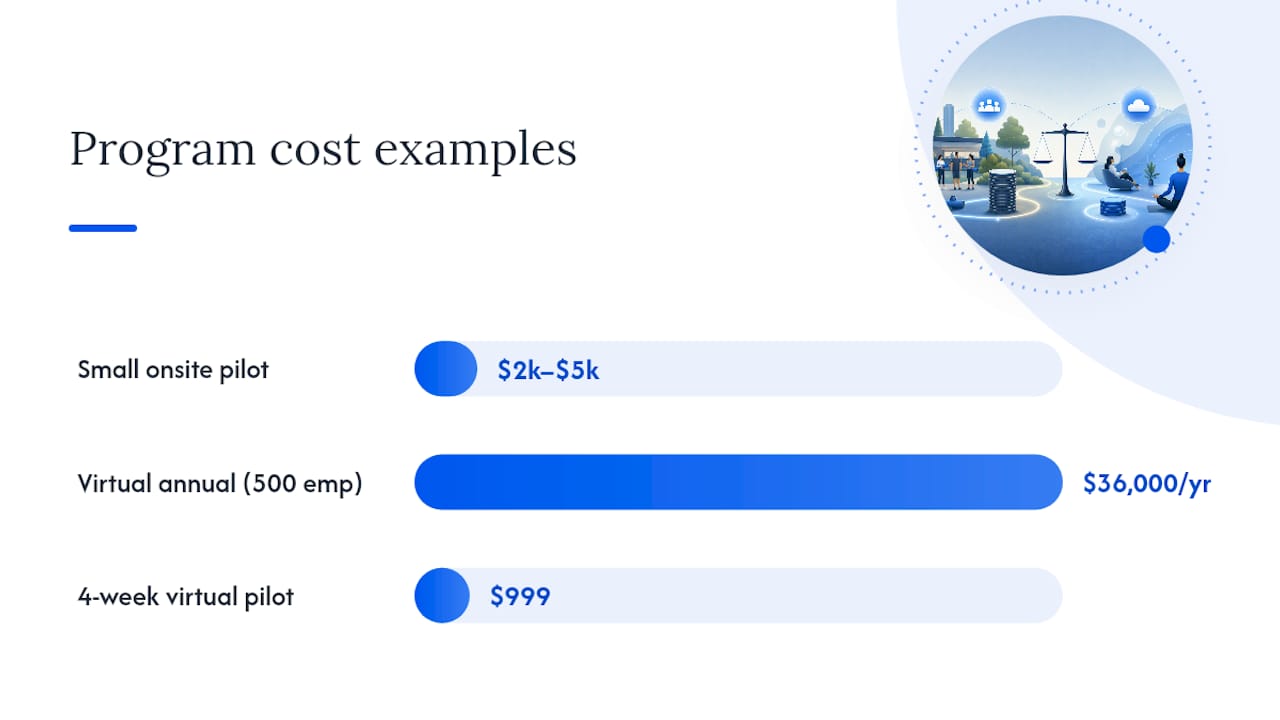
Onsite programs carry high variable costs. A single health fair for 100 employees typically involves vendor fees, space setup, staff time, and any consumables or screenings. Costs scale with headcount and locations, so a company running events at three offices is essentially paying three times. Staffing and room costs are real line items that rarely appear in vendor quotes.
Virtual programs shift most costs to a platform or per-employee subscription. The marginal cost of adding the 500th employee to a virtual platform is near zero, which is why virtual wellness solutions scale so efficiently for multi-location employers. A publicly listed 4-week virtual wellness pilot package from one vendor starts around $999, giving HR a concrete anchor for small-team pilots before committing to an annual contract.
Three realistic cost scenarios:
- Small onsite pilot (100 employees, one site): Budget $2,000–$5,000 for a half-day health fair with biometric screenings, a vendor, and basic logistics. Per-employee cost runs $20–$50 for the event alone, not counting internal staff time.
- Company-wide virtual subscription (500 employees): A per-employee subscription model typically runs $2–$15 per employee per month depending on features. A mid-tier platform at $6 PEPM costs $36,000 annually for 500 employees, with no travel or room costs.
- Hybrid scaled plan (1,000+ employees, multiple locations): Anchor with one annual onsite event per site plus a year-round virtual platform. Budget the onsite events separately as culture investments; the virtual platform carries the ongoing engagement and clinical tracking.
Pro Tip: Ask vendors to separate platform fees from implementation and communications costs. Many "low PEPM" quotes exclude the onboarding, account provisioning, and employee communications work that actually determines whether anyone uses the program.
Participation drivers, equity, and accessibility differences
Who actually shows up, and why, differs significantly between formats. Getting this right is what separates a wellness program that moves health metrics from one that generates a participation report nobody believes.
Onsite participation drivers:
- Physical visibility: a booth in the lobby or a class in the conference room is hard to ignore
- Social proof: seeing colleagues participate normalizes the behavior
- Convenience: zero commute, no login, no device needed
Virtual participation drivers:
- Flexibility: employees join at 6 AM or 9 PM, on their schedule
- Privacy: no colleague can see which mental health session they attended
- On-demand access: content is available when motivation strikes, not just on event day
Equity is the harder problem. Onsite programs structurally exclude shift workers, remote employees, and anyone at a satellite office. Virtual programs can exclude employees without reliable home internet or a personal device. ADA compliance for onsite fitness and sports facilities is governed by federal accessibility standards that HR must verify before any physical program launches. Virtual programs need closed captioning, screen-reader compatibility, and scheduling across time zones to meet the same equity standard.
Virtual wellness activities that offer both live and on-demand formats address the flexibility gap most effectively, since employees in different time zones or with caregiving responsibilities can still participate without synchronous scheduling.

Pro Tip: Incentive design works differently by format. For onsite events, a small gift card or raffle entry at the door drives walk-in participation. For virtual programs, progress-based rewards tied to streaks or challenge completions sustain engagement over weeks, not just on launch day. See wellness incentive ideas that work across both formats.
Operational checklist: what it takes to stand up each format
Onsite program requirements
- Confirm room availability and ADA-compliant access for all planned spaces
- Coordinate vendor certificates of insurance and facility agreements
- Schedule signage, communications, and manager reminders at least three weeks out
- Plan for cleaning, setup, and breakdown time between sessions
- Designate an internal point of contact for day-of logistics
Virtual program requirements
- Select a HIPAA-compliant platform if any clinical or coaching features are included
- Provision employee accounts and test single sign-on (SSO) integration with your HRIS
- Confirm bandwidth adequacy for live-streamed sessions, especially for remote employees on home networks
- Set up a communications calendar: launch email, manager talking points, and reminder cadence
- Establish data-sharing agreements with the vendor that limit what health information is collected and retained
HIPAA and privacy basics
HIPAA applies whenever a wellness program involves protected health information, including telehealth coaching, biometric data collection, or EAP referrals. Employers should confirm that any vendor handling PHI has a signed Business Associate Agreement (BAA) in place before launch.
90-day pilot timeline
- Weeks 1–3: Vendor selection, contract execution, BAA signing, IT provisioning
- Weeks 4–5: Employee communications launch, manager briefing, account activation
- Weeks 6–10: Program live; weekly utilization check-ins with vendor
- Weeks 11–12: First data pull, participation report, qualitative feedback survey
- Week 13: Present pilot results to HR leadership and finance; decide on scale or pivot
What to measure and how to demonstrate ROI
Participation rate is the metric most HR teams track first, but it is also the least useful for a finance audience. What moves a budget conversation is a credible link between program activity and healthcare cost trends.
Short-term metrics (0–6 months):
- Platform utilization rate (unique logins / total eligible employees)
- Session completion rate for live and on-demand content
- Biometric screening participation rate
Mid-term metrics (6–18 months):
- EAP referral uptake and follow-through rates
- Biometric risk stratification changes (employees moving from high-risk to moderate-risk tiers)
- Absenteeism rate by program participant vs. non-participant cohort
Long-term metrics (18+ months):
- Healthcare claims cost per employee (participant vs. control group)
- Retention rate differential for program participants
- Chronic disease management enrollment and adherence
Hadaco's quarterly reporting framework tracks these metrics across all three horizons and ties them to claims data, giving HR a defensible ROI narrative for finance leadership. Companies working with Hadaco report average first-year savings of $451 per employee, a figure grounded in claims-based measurement rather than self-reported wellness surveys.
How to present ROI to finance teams:
- Lead with claims cost per employee, not participation percentages
- Show a participant vs. non-participant comparison, not just aggregate trends
- Tie absenteeism data to productivity cost estimates your CFO already uses
- Present quarterly trend lines, not annual snapshots, to demonstrate trajectory
Pro Tip: Build your reporting template before the program launches, not after. Agree with finance on the three metrics that will define success, then make sure your vendor can actually pull that data. A program that cannot report on its own outcomes is a program that will not survive the next budget cycle.
A simple decision framework: when to choose onsite, virtual, or hybrid
Work through these questions before your next vendor meeting or budget review.
- What percentage of your workforce is remote or at a satellite location? If more than 30%, a virtual or hybrid model is necessary for equitable reach.
- Do you have dedicated wellness space at your primary site? If not, onsite programming requires room booking and vendor logistics that add cost and complexity.
- What is your primary health goal: culture signaling or clinical outcomes? Culture events favor onsite; chronic disease management and mental health support favor virtual.
- What is your privacy sensitivity? Employees dealing with mental health, substance use, or weight management engage more with virtual options where participation is not visible to colleagues.
- What is your budget structure? Fixed annual budgets favor virtual subscriptions; event-based budgets favor onsite pilots.
- Do you have multi-location or international employees? Multi-location wellness almost always requires a virtual backbone to avoid inequitable access.
Red flags that signal a single-format approach will underperform:
- More than one physical office location with no virtual option
- A workforce with significant shift workers or part-time employees
- Mental health or chronic disease as a stated program priority, with no private delivery channel
- No internal bandwidth to manage onsite logistics at scale
Pro Tip: Set your hybrid pilot success criteria before launch: a specific utilization target, a biometric screening participation rate, and a cost-per-engaged-employee figure. Review corporate wellness program models to benchmark against what comparable employers are achieving.
What the evidence actually says about effectiveness
The published evidence on workplace wellness is more nuanced than vendor marketing suggests, and HR leaders should know where the signal is strong and where it is thin.
Where virtual programs show consistent evidence:
- Virtual programs increase access and engagement for employees who would not participate in onsite events, particularly for mental health and stress management
- Short, themed virtual pilots (4–6 weeks) are an effective low-risk way to test engagement before a multiyear commitment, as modular pilot packaging from commercial vendors confirms
- Virtual activities including live fitness, mindfulness, and challenges can improve morale and build inclusive culture when designed for diverse employee needs
Where onsite programs retain a clinical edge:
- Biometric screenings conducted onsite generate higher-quality baseline data than self-reported health assessments
- In-person health coaching and group fitness classes produce stronger social accountability effects
- Onsite clinics and nurse practitioner visits can address acute care needs that virtual platforms cannot
Evidence limits to flag in procurement documents:
- Most vendor ROI claims rely on participant self-selection, not randomized controls
- Short-term engagement metrics (logins, session completions) do not reliably predict long-term health outcomes
- Claims-based savings data requires 18–24 months of follow-up to be statistically meaningful
Practitioners consistently recommend hybrid models because they let employers normalize wellness through visible onsite events while preserving private, deeper care through virtual or offsite options. That combination addresses both the culture-signaling and clinical-outcomes goals that a single format cannot cover alone.
Why the hybrid-first default is the right call for most employers
The conventional framing of onsite vs. virtual wellness treats this as a binary choice. It is not, and insisting on one format usually means leaving a significant portion of your workforce behind.
Here is what gets underestimated: the employees who most need wellness support are often the least likely to show up to a health fair. The person managing Type 2 diabetes quietly, the employee dealing with anxiety, the remote worker who has not had a preventive screening in three years — none of them are walking into the breakroom for chair massage. Virtual programs reach them precisely because participation is private and flexible.
At the same time, a purely virtual program without any onsite touchpoint tends to feel like a benefits checkbox rather than a genuine organizational commitment. A single well-executed onsite event per quarter does more for culture credibility than twelve months of email reminders about an app nobody opens.
The evidence-backed path is to anchor on virtual for reach and clinical depth, use onsite for visibility and biometric data, and measure both against claims costs rather than participation theater. Hadaco's approach is built on exactly this logic: evidence-based interventions layered across delivery formats, integrated with existing benefits, and reported quarterly so HR can defend the investment to finance.
Hadaco brings measurable outcomes to your wellness strategy
Employers who have moved past the onsite-or-virtual debate share one thing: they measure what matters. Hadaco's population health programs are designed for mid-size to large U.S. employers who want clinical-grade outcomes without rebuilding their benefits stack from scratch.
Hadaco integrates with your current benefit plans, adds evidence-based interventions for chronic disease, preventive care, and mental health, and reports results quarterly so you always know what the program is delivering. No upfront fees. No disruption to existing coverage. Companies in their first year report an average savings of $451 per employee, tracked through claims data, not surveys.
The next step is straightforward: use Hadaco's savings estimator to see what your population could save, or book a consultation to walk through a program design for your workforce size and location mix.
Sources
- The advantages of virtual wellness | College of Health and ...
- Health Insurance Portability and Accountability Act of 1996 (HIPAA) - CDC
- Virtual wellness activities employees - Deel
- Virtual Wellness Programs: Engaging Employees in a Remote Work Environment - Work Health Solutions
- Onsite vs. Offsite Corporate Wellness: What Works Best for Employees? — The Guide - Holistic Therapies
- 4 Week Virtual Wellness Program for Remote Teams