
Vendors can offer outcome guarantees, but credible ones are narrow, measurable, and contractually enforced, not a single vague ROI headline. Insist on separate, contract-defined targets for engagement, health-risk change, and claims savings, each with its own metric and timeline. Before signing anything, ask for baseline claims data, an agreed attribution method, and a pre-specified measurement window.
TL;DR:
- Vendors should specify measurable, contractually enforced outcomes such as engagement, biometric shifts, and claims savings, each with clear metrics and timelines.
- Randomized controlled trials show that workplace wellness programs lead to behavior improvement but do not produce significant short-term reductions in medical costs or utilization.
- Guarantees should be based on verified claims data, with pre-specified baseline periods, attribution methods, and independent audit rights, rather than vague ROI promises.
- Contracts must include detailed measurement plans, third-party verification, and remedies for failure to meet agreed-upon metrics, ensuring transparency and accountability.
- Employers should prioritize vendors willing to define claims savings in writing, provide sample reports upfront, and link payments directly to verified, measurable outcomes.
Table of Contents
- What wellness vendor outcome guarantees actually promise
- What independent research says about short-term financial returns
- How to evaluate a vendor's outcome guarantee before signing
- Building the guarantee into the contract
- Why procurement discipline matters more than the pitch deck
- Evidence over promises: what actually moves a wellness contract
- How Hadaco turns guarantees into finance-ready numbers
- Sources
- FAQ
What wellness vendor outcome guarantees actually promise
An outcome guarantee is a contractual commitment tied to a specific, measurable result, not a marketing claim. The problem is that "guarantee" gets stretched to cover very different things, and vendors often blur the lines on purpose.
There are four distinct guarantee types worth separating in any RFP:
- Engagement guarantees commit to participation levels, such as a percentage of eligible employees completing a health assessment or biometric screening.
- Biometric or health-risk guarantees target measurable clinical shifts, like a defined percentage of participants moving out of a high-risk blood pressure or A1C category.
- Claims-savings guarantees promise a dollar or percentage reduction in paid allowed charges per employee per year (PEPY), usually measured against a baseline period.
- Productivity-linked guarantees tie outcomes to absenteeism, presenteeism, or disability claims, which are harder to verify but sometimes included in broader contracts.
Each type uses its own measurement unit, and vendors rarely disclose all of them upfront. Common units include participation percentage, module completion counts, biometric threshold crossings (for example, the share of participants with LDL cholesterol below a target), and PEPY claims savings adjusted for enrollment changes.
Watch the qualifying language attached to any guarantee. Phrases like "based on participation," "subject to data availability," and "adjusted for case mix" are not inherently dishonest, but they create room for a vendor to explain away a missed target after the fact. A guarantee that is "up to 20% savings" is not a guarantee at all; it is a ceiling. The number that matters is the floor, the minimum result the vendor is contractually on the hook for, and what happens financially if that floor is not met.
Buyers should also separate self-reported behavior change from independently verified outcomes. A vendor might report high satisfaction scores or a jump in reported exercise frequency, and both can be true while claims costs stay flat. That gap is not a vendor failing so much as a mismatch between what is easy to measure and what actually shows up on a health plan's ledger.
What independent research says about short-term financial returns
The strongest independent evidence on workplace wellness programs comes from randomized controlled trials, and the results are more modest than most vendor pitches suggest. A large randomized controlled trial published through Health Affairs followed a workplace wellness program for three years and found improved self-reported behaviors but no significant clinical, spending, utilization, or employment effects over that window.
Estimated medical-spending differences at the three-year mark were small and statistically indistinguishable from zero, meaning the result was statistically indistinguishable from zero.
That trial recorded participation rates of 36.2% to 44.6% and average module completion of just 1.3, alongside a reported 8.3 percentage-point increase in exercise and a 13.6-point increase in active weight management. Behavior moved. Spending did not, at least not within three years and not at a level that cleared statistical noise.
The Illinois Workplace Wellness Study reinforces the caution. That trial randomized nearly 5,000 employees and found null effects on 40 of 42 outcomes measured after the first year, including total medical expenditures, productivity, and self-reported health. The study also documented substantial selection bias: employees who chose to participate already had lower medical expenditures before the program started. That selection effect is the single biggest reason vendor-reported "participant savings" figures can look impressive without proving anything causal. If the people who join a wellness program were already healthier and cheaper to insure, comparing their costs to non-participants tells you about who signed up, not what the program did.
A well-designed randomized trial remains the most reliable way to separate a program's actual effect from the characteristics of who chooses to enroll.
Study design matters enormously here. A randomized trial assigns people to a program or a control group by chance, which means any difference in outcomes can be attributed to the program itself. A matched comparison tries to approximate that by pairing similar employees, which is weaker but still informative. A simple before-and-after comparison, the most common format in vendor sales decks, cannot rule out that costs would have changed anyway due to aging, plan design shifts, or regression to the mean after a high-cost year. When a vendor cites savings without describing which of these three designs produced the number, treat the figure as a marketing input, not evidence.

Longer time horizons tell a slightly different story. One longer-term evaluation using a social-experiment design found reductions in primary care visits and prescription purchases persisting up to seven years, with mixed spillover effects to family members, but no clear impact on hospitalizations or labor market outcomes. The takeaway is not that wellness programs never work. It is that near-term financial guarantees, the kind most vendor contracts are built around, are not well supported by the strongest available evidence, and any guarantee promising fast claims savings deserves scrutiny.
How to evaluate a vendor's outcome guarantee before signing
A guarantee is only as good as the measurement plan behind it. Use this sequence during RFP evaluation and contracting to test whether a vendor's promise is verifiable and structured in your favor.
- Require pre-specified outcomes and a fixed measurement window. A common structure uses a 24-month baseline claims period followed by a 24 to 36 month measurement window for claims savings, agreed in writing before the program starts.
- Demand transparent baseline claims data and audit rights. You cannot verify a savings claim without your own pre-program claims history in hand, adjusted for enrollment changes and case mix.
- Push for randomized or matched attribution, or at minimum a defined difference-in-differences approach. This is the single biggest lever against selection bias inflating reported results.
- Confirm reporting cadence and third-party verification options. Quarterly reporting is standard; ask whether an outside actuary or auditor can confirm the numbers if results are disputed.
- Check privacy, data handling, and reasonable alternative standards. Any incentive tied to a health-contingent outcome needs a documented alternative path for employees who cannot meet the standard for medical reasons, per DOL guidance.
- Negotiate payment terms tied to verified results. Performance-based fees, clawback provisions for misreporting, and clear remediation steps if a guarantee is missed should all be in the contract, not handled informally after the fact.
Pro Tip: Ask the vendor to show you a sample quarterly report from an existing client, with names redacted, before you sign. If they cannot produce one, they likely do not have the reporting infrastructure the contract implies.
Legal exposure deserves its own line item. EEOC guidance on employer wellness programs makes clear that ADA and GINA rules apply whenever a program collects health information tied to an incentive, and that voluntariness, privacy, and reasonable alternative standards are not optional extras. Procurement teams that treat compliance as legal's problem to solve later often discover it should have been a scoring criterion in the RFP itself.

Building the guarantee into the contract
Once you have settled on a vendor, the guarantee needs to move from a sales conversation into contract language that finance and legal can hold the vendor to.
Start with metric templates rather than open-ended promises. A workable structure looks like this: PEPY claims savings measured against a 24-month pre-contract baseline, a participant-level engagement rate tracked monthly, a validated biometric improvement rate confirmed through lab data rather than self-report, and a defined payment threshold tied to each. KFF's 2025 Employer Health Benefits Survey found that 56% of firms with 10 to 199 workers and 83% of larger firms now offer at least one wellness program, and vendor contracts for specialized services grow more common as firm size increases. That scale means more employers are negotiating these terms for the first time, often without a template to work from.
Sample clause language, adaptable with counsel, might read:
- Verification clause: "Vendor shall provide claims-based outcome data on a quarterly basis, calculated as paid allowed charges adjusted for enrollment and case mix, and Employer reserves the right to engage an independent third party to verify reported figures at Employer's expense."
- Remedy clause: "If verified claims savings fall below the guaranteed threshold in any measurement period, Vendor shall issue a pro-rated fee credit equal to the shortfall percentage, or Employer may terminate for cause with 30 days' notice."
Claims savings should always be defined in the contract itself, not left to interpretation: paid allowed charges, adjusted for enrollment and case mix, measured against the agreed baseline.
Operational SLAs round out the agreement. Specify the reporting format (a standardized dashboard or PDF summary), frequency (quarterly is typical), and a timeline for third-party verification if a dispute arises, commonly 30 to 45 days from a formal request. Independent evaluations of the ROI claims vendors make consistently point back to the same fix: separate engagement guarantees from claims-savings guarantees in the contract, rather than folding both into one number that obscures which lever actually moved.
Why procurement discipline matters more than the pitch deck
Reviewing wellness vendor contracts for HR and benefits teams surfaces the same pattern repeatedly: the vendors with the most confident-sounding guarantees are often the ones least willing to define their measurement method in writing. The ones willing to put a claims-savings figure into a contract clause, with a baseline period and an attribution method attached, tend to be the ones whose numbers hold up under audit.
Hadaco builds its guarantee around that discipline. The program integrates with existing benefit plans rather than replacing them, uses a transparent savings estimator during the sales process, and delivers quarterly outcome reporting so employers can track results against the baseline rather than waiting for a year-end surprise. There is no upfront fee, and reported first-year savings average $451 per employee among companies using the program, alongside improved engagement and retention. That figure, like any vendor-reported result, is worth holding against your own claims baseline and asking how it was calculated.
Compliance stays part of the conversation rather than an afterthought. Reasonable alternative standards, incentive limits, and independent verification options should all be confirmed in writing before a contract moves forward, regardless of which vendor is on the other side of the table.
— Gene
Evidence over promises: what actually moves a wellness contract
The most useful thing an employer can do before signing a wellness vendor contract is stop asking "what's the ROI?" and start asking "what's the measurement plan?" Every strong guarantee in this space traces back to a baseline claims period, an attribution method, and a fixed measurement window. Every weak one traces back to a percentage with no denominator attached.
Conventional procurement advice tends to focus on price and feature checklists, engagement app design, coaching hours, screening logistics, while treating measurement methodology as a footnote. That ordering is backward. A vendor with a mediocre app and an airtight, contractually defined savings calculation will outperform a polished platform with a vague ROI slide every time an audit happens.
If you take one thing from this guide, take this: prioritize the contract's definition of "claims savings" over the vendor's sales narrative about outcomes. The narrative can wait. The definition cannot.
How Hadaco turns guarantees into finance-ready numbers
Most of this guide has been about what to demand from a vendor before you sign. Hadaco was built to meet that demand rather than resist it. The program complements the health plan you already have, runs on a transparent savings estimator so finance can see projected numbers before committing, and reports outcomes quarterly so HR and CFOs are not stuck waiting a year to find out whether the guarantee held.
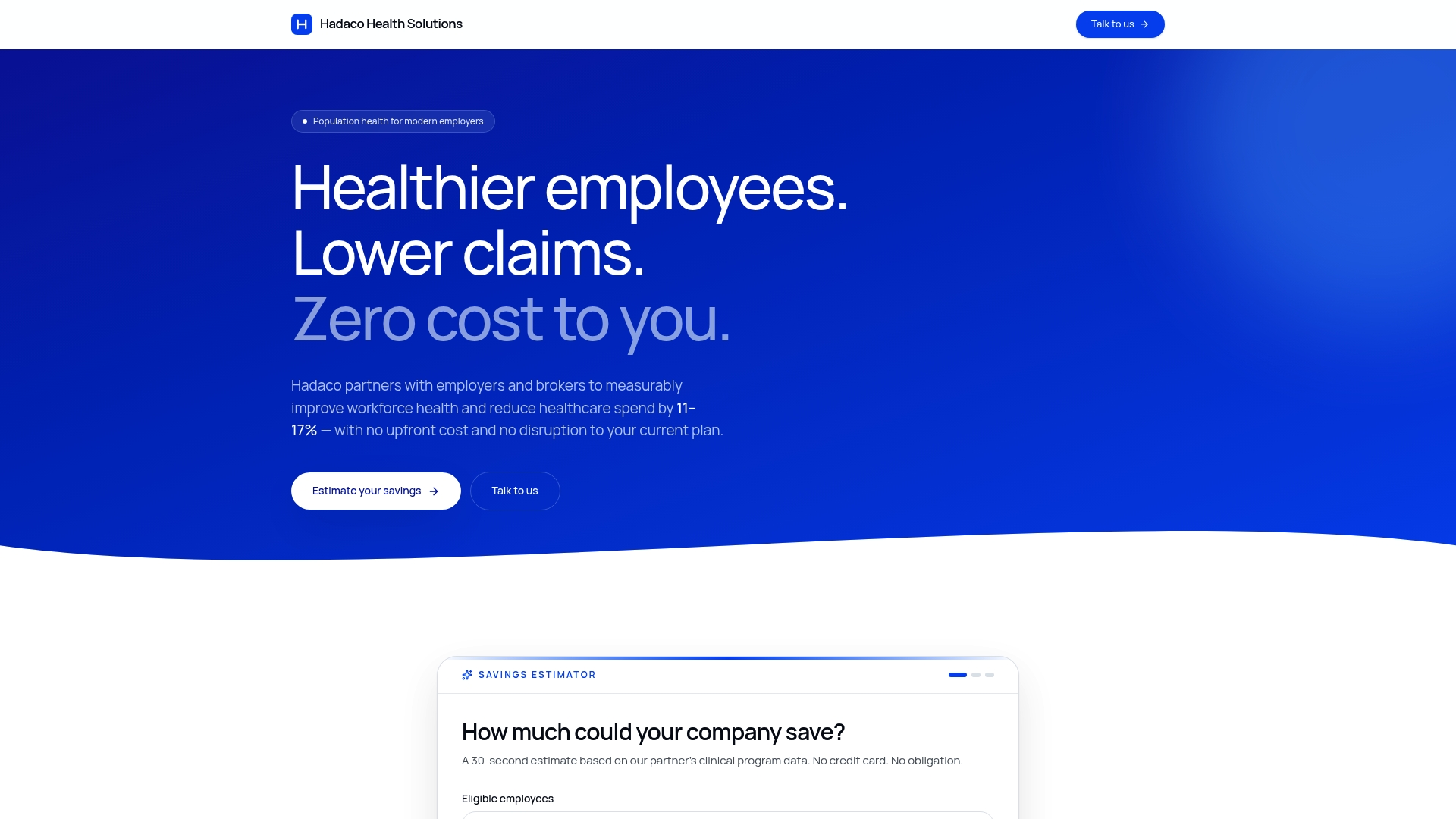
There is no upfront fee, and the model addresses chronic disease management, preventive care, and engagement together rather than treating them as separate line items competing for budget. Companies using the program have seen average first-year savings of $451 per employee, alongside gains in engagement and retention, figures worth comparing against your own baseline claims data before you set expectations.
If you are evaluating vendors right now, the practical next step is to request a sample quarterly outcomes report and run your own claims data through the savings estimator at Hadaco before your next renewal cycle. That comparison, more than any pitch deck, will tell you whether a guarantee is built to survive an audit.
Sources
Share these with legal and finance before finalizing any outcome-based contract:
- Health And Economic Outcomes Up To Three Years After A Workplace Wellness Program: A Randomized Controlled Trial | Health Affairs
- Care Act Wellness Program (DOL guidance)
- EEOC guidance on employer wellness programs
- 2025 Employer Health Benefits Survey | KFF
FAQ
How much do companies pay for wellness programs?
Costs vary widely by program scope and vendor model, and pricing is not standardized across the industry. Some vendors, including Hadaco, use a no-upfront-fee, performance-based structure instead of a flat per-employee price, so cost depends on the guarantee structure negotiated rather than a fixed rate card.
What is the most lucrative wellness business?
There is no single "most lucrative" category; profitability depends on the business model, whether it is subscription-based, performance-based, or fee-for-service, and how well it can prove outcomes to employers. Vendors that can demonstrate verified claims savings through transparent reporting tend to retain employer contracts longer than those relying on engagement metrics alone.
What is a drawback to wellness programs?
The biggest drawback is that independent randomized controlled trials have generally found improved self-reported behavior without significant reductions in medical spending or utilization within typical measurement windows of one to three years. Selection bias is a related problem: employees who volunteer for wellness programs often had lower costs before joining, which can make vendor-reported savings look larger than the program's actual causal effect.
What is the best employee wellness platform?
There is no single best platform for every employer, since the right fit depends on plan design, workforce demographics, and how rigorously a vendor can measure and report outcomes. Employers evaluating options should prioritize vendors offering pre-specified metrics, transparent baseline claims data, and third-party verification options over those offering only a headline ROI number.
How are wellness vendor outcome guarantees measured?
Credible guarantees separate engagement (participation rates, module completion), health-risk change (validated biometric improvement), and claims savings (paid allowed charges per employee per year, adjusted for enrollment and case mix) into distinct, contractually defined metrics. Measurement typically requires a baseline claims period, commonly around 24 months, followed by a fixed measurement window before results are evaluated against the guarantee.