
A PPO-leaning strategy tends to protect employee access and chronic care continuity, while an HDHP-leaning strategy tends to lower near-term premium spend but shifts cost and risk onto employees. For most employers, the plan choice matters less than what sits on top of it: a well-targeted population-health program focused on chronic disease and high-cost claimants changes the math more than switching plan types does.
TL;DR:
- A systematic review found that HDHPs with savings options cut spending by 3.8% to 17.4%, but health outcomes rarely improved and preventive care sometimes fell.
- A JAMA study found that preventable emergency visits rose 8% among diabetes patients who switched to HDHPs, with larger increases among low income members.
- Disease management and outreach to high cost claimants drove clearer returns than broad lifestyle incentives, so prioritize clinical targeting over participation campaigns.
- Before expanding an HDHP, guarantee clinical support for chronic conditions so higher deductibles do not delay care and create avoidable complications.
- Require a savings estimate, quarterly claims reporting, and performance based fees, then pilot the program for 6 to 12 months against baseline metrics.
Table of Contents
- How PPO and HDHP strategies differ for employers
- What the research says about savings, outcomes, and risk
- Why population-health programs change the math
- A decision checklist for choosing your benefit strategy
- What employers consistently get wrong
- A measurable path to lower claims without disrupting your plan
- FAQ
- Sources
How PPO and HDHP strategies differ for employers
The two approaches move employer costs through different channels, and understanding those channels is the first step in any benefit-design decision.
A PPO strategy keeps premiums higher but deductibles and out-of-pocket exposure lower for employees, which tends to preserve utilization of preventive and chronic care. An HDHP strategy lowers the employer's premium line and shifts more first-dollar cost to employees, which often reduces utilization across the board, including care that would have been cheap to deliver early and expensive to skip.
That utilization drop is not neutral. Employees respond to cost exposure by cutting back on care regardless of whether it is discretionary or necessary, and the people most likely to defer necessary care are often the chronically ill, low-income workers, and high utilizers who drive a disproportionate share of claims. Those are exactly the employees whose deferred care tends to resurface later as emergency visits or avoidable complications.
A few patterns show up consistently in how employers experience each model:
- PPOs tend to keep premium costs higher but reduce the risk of expensive deferred-care events among chronically ill employees.
- HDHPs tend to lower near-term premium spend but increase employee out-of-pocket burden and can reduce use of preventive and maintenance care.
- Low-income and chronically ill employees are disproportionately affected by HDHP cost-shifting, since a given deductible represents a larger share of their income or health risk.
- Employer aims typically split between short-term budget relief (favoring HDHPs) and long-term claim stability (favoring PPOs plus active management).
Neither approach, taken alone, solves the core problem: total cost of care. That is where population-health programs enter the picture.
What the research says about savings, outcomes, and risk
The evidence on plan design is more mixed, and more conditional, than most benefit renewal conversations suggest.
A systematic review of employer-led strategies found that HDHPs with a savings option reduced total health expenditures by a range reported in studies, but the same review found these plans often produced no measurable improvement in health outcomes and sometimes reduced use of preventive care. The savings are real in many cases, but they come with a tradeoff that shows up later rather than immediately.
A systematic review of employer benefit strategies found HDHP-SO spending reductions ranging from 3.8% to 17.4%, with the caveat that health outcomes rarely improved alongside the savings.
Other research narrows the risk further. A JAMA Internal Medicine study of diabetes patients who switched to HDHPs found mean out-of-pocket spending rose substantially, and emergency-department visits for preventable diabetes complications increased overall and more so among low-income members. That is the clinical cost of cost-shifting without a clinical safety net attached.
The savings side of the ledger looks different depending on what drives it. RAND's workplace wellness research found that disease-management components, not broad lifestyle incentives, produced the majority of measurable program return, with one large employer study showing substantial returns from disease management for every dollar invested. Lifestyle wellness programs, by contrast, showed much smaller or uncertain returns.
Taken together, the research points to a consistent pattern:
- Plan-design changes alone can lower short-term employer spending but rarely improve health outcomes.
- Disease management and high-cost claimant targeting, not general wellness incentives, drive the clearest ROI.
- Chronically ill and low-income employees absorb most of the downside risk when HDHPs are adopted without clinical support.
Why population-health programs change the math
Plan design sets the cost-sharing rules. Population-health programs determine whether those rules translate into sustainable savings or into deferred claims that resurface later as ER visits and hospitalizations.
The clearest lever is targeting. Programs that identify high-cost claimants and chronic-disease patients, then direct clinical outreach and care management toward them, consistently produce more measurable savings than programs built around general wellness incentives. RAND's research attributes most program ROI to disease management specifically, which is a different discipline from step challenges and gym discounts.

Integration matters as much as targeting integrated chronic disease management and multidisciplinary services. A program that pulls claims data, flags gaps in chronic-disease care, and reaches out before a condition escalates can prevent exactly the kind of delayed-care complications that HDHPs tend to create among diabetic and other chronically ill employees. Done well, this closes the gap between the premium savings of an HDHP and the clinical risk it introduces.
A few operational traits predict whether a program will actually deliver:
- Risk stratification that prioritizes the claims-percentile groups driving the most spend.
- Direct integration with existing benefit plans rather than a parallel, disconnected wellness initiative.
- Transparent, recurring reporting that ties program activity to measured claim changes.
- A fee structure tied to demonstrated outcomes rather than flat program fees.
Pro Tip: Ask any population-health vendor for their methodology on identifying high-cost claimants before signing; targeting quality determines most of the ROI.
Our own model at Hadaco follows this structure directly: no upfront fees, a transparent savings estimator, and quarterly reporting so employers can see whether claims are actually moving. Employers using these programs often report average first-year savings of $451 per employee, a figure we report and stand behind as our own outcome data.
A decision checklist for choosing your benefit strategy
Deciding between a PPO-leaning plan, an HDHP-leaning plan, or a combination of either with a population-health program comes down to a short sequence of analysis steps rather than a single philosophical choice.
- Map your population risk. Identify what percentage of claims comes from your top 5 to 10% of spenders, since that concentration determines how much a targeted program can realistically save.
- Model scenarios across a 1 to 3 year horizon. Compare premium changes against claim exposure, and build in program costs and expected savings rather than modeling plan design in isolation.
- Attach clinical protections to any HDHP expansion. If moving toward HDHPs, require carveouts or guaranteed population-health coverage for chronic conditions so cost-shifting does not translate into deferred care.
- Evaluate your current PPO for untapped savings. If staying with a PPO, check whether a population-health program can still cut high-cost claims without touching plan design at all.
When evaluating vendors or internal programs, a few procurement checks separate real outcomes from marketing claims:
- Require a savings estimator and a defined quarterly reporting cadence before committing.
- Confirm the program is compatible with HSA and HRA structures if you run either.
- Push for performance-based fees tied to measured savings rather than flat program costs.
- Pilot with a defined scope, a 6 to 12 month window, and clear baseline metrics before a full rollout.
What employers consistently get wrong
The most common mistake we see is treating the PPO versus HDHP decision as the whole strategy, when it is really just the starting condition. Premiums and deductibles set who pays first, but they do not determine whether a chronically ill employee gets the care they need before a condition becomes expensive.
Measurable savings come from targeted clinical work, not plan design alone. The employers who see real, sustained claim reductions are the ones who measure quarterly, adjust based on data, and treat population health as an ongoing discipline rather than a renewal-season decision. Test it, measure it, and let the data settle the argument.
— Gene
A measurable path to lower claims without disrupting your plan
We built our programs to complement whatever plan design you already run, PPO, HDHP, or a mix, rather than force a change to it. Evidence-based interventions targeting chronic disease, preventive care, and employee engagement come with no upfront fees, a transparent savings estimator, and quarterly reporting so you can see results as they happen.
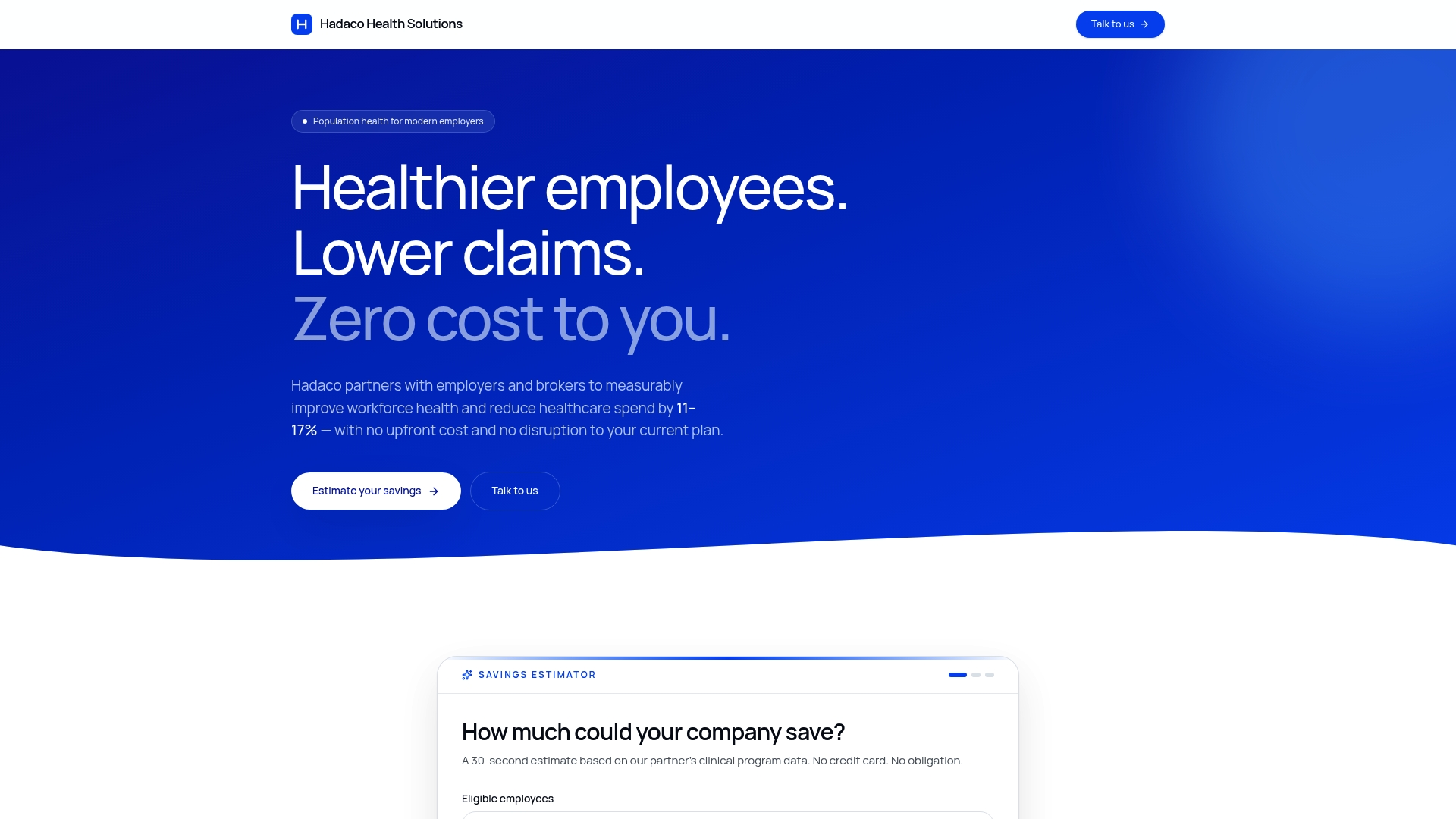
- Employers using our programs report an average first-year savings of $451 per employee.
- The programs are structured so that financial risk may be aligned with outcomes rather than upfront budget allocation.
- Quarterly reporting provides finance teams visibility into savings metrics.
If you want a defensible number before your next renewal cycle, request a savings estimate from Hadaco and see what a targeted program could return for your workforce.
FAQ
Does an HDHP hurt chronically ill employees more than a PPO?
Yes, in most of the available evidence. A JAMA Internal Medicine study found diabetes patients who moved to HDHPs saw emergency-department visits for preventable complications rise 8% overall, with a larger increase among low-income members, pointing to deferred care as the driver.
Are population-health programs compatible with HSA and HRA plans?
Programs that integrate with existing benefit structures, rather than replacing them, are generally designed to work alongside HSA and HRA setups. Confirm compatibility during procurement, since plan rules and contribution structures vary by employer.
How long does it take to see savings from a population-health program?
Disease-management-focused programs tend to show measurable claim impact within the first year, with RAND's research attributing most program ROI to targeted clinical work rather than broad wellness incentives. Multi-year tracking gives a clearer picture of whether savings hold as chronic conditions are managed over time.
What should employers require from a population-health vendor?
At minimum, a transparent savings estimator, a quarterly reporting cadence, and engagement metrics tied to actual claims data rather than participation alone. A performance-based fee structure, where payment depends on demonstrated outcomes, is a strong signal the vendor's incentives match yours.
Is a PPO or HDHP better for controlling long-term healthcare costs?
Neither plan type reliably slows long-term spending growth on its own. Working papers on HDHP adoption show an initial drop in spending that often does not translate into sustained slower growth, which is why targeted clinical programs matter more than the plan type itself for multi-year cost control.
Sources
- Employer-Led Strategies to Improve the Value of Health Spending: A Systematic Review - PMC
- Do Workplace Wellness Programs Save Employers Money? | RAND
- Association Between HDHPs and Diabetes Care Outcomes (JAMA Internal Medicine)