
Employers who make nurse triage, virtual urgent care, and targeted care management easier to use than the emergency room typically cut avoidable ER visits by double digits. The evidence points to three levers in order of leverage: 24/7 triage paired with virtual urgent care, expanded primary care access (onsite or virtual), and care management for high utilizers, backed by navigation to lower-cost, in-network sites.
TL;DR:
- Virtual urgent care and nurse triage are most effective when available 24/7 and directly connected to in-network scheduling and follow-up to ensure actual ED diversion.
- Onsite primary care clinics can reduce avoidable ER visits by up to 70% but only for large, concentrated workforces capable of sustaining clinic volume.
- Employers should analyze ED claim patterns by time of day and diagnosis to identify preventable visits and design targeted access improvements accordingly.
- Clear, repeated communication and manager support are crucial for increasing employee awareness, trust, and utilization of alternative care options.
- A comprehensive, phased plan with regular data review and claims-based ROI measurement is essential for sustainable ER visit reduction and employer savings.
Table of Contents
- Why Reducing ER Visits Among Employees Matters to Your Bottom Line
- What Interventions Actually Reduce ER Visits, and When to Use Each One
- Building Triage and Navigation That Actually Closes the Loop
- Reaching High Utilizers Before They End Up Back in the ER
- Your 90/180/365-Day Roadmap for Cutting ER Visits
- How to Measure Results Finance Will Actually Trust
- How Hadaco's Model Maps to This Playbook
- Getting Employees to Actually Use These Programs
- Finding the Real Drivers Behind Your ER Claims Data
- Using Plan Design to Steer Employees Toward the Right Care Setting
- Preparing Managers to Support Better Health Decisions
- Connecting ER Reduction Efforts With EAP and Behavioral Health Resources
- Staying Compliant While Managing Employee Healthcare Utilization
- What Gets Missed When Employers Chase ER Reduction Alone
- How Hadaco Helps You Put This Playbook Into Action
- Sources
Why Reducing ER Visits Among Employees Matters to Your Bottom Line
A single emergency room visit routinely costs multiples of an urgent care or telehealth visit for the same complaint, and self-insured employers absorb nearly all of that difference directly on their claims ledger. National data from the Healthcare Cost and Utilization Project shows ED visit costs have climbed steadily, and that trend lands hardest on employers who self-fund because there's no insurer spreading the risk across a larger pool.
The bigger issue isn't the sticker price of any one visit. It's volume. Most employer populations generate a predictable rate of ED visits per 1,000 covered lives each year, and benefits teams that never benchmark this number are flying blind. A meaningful share of that volume, by most clinical estimates, is for conditions that a nurse line, urgent care clinic, or same-day primary care visit could have handled just as well, often at a fraction of the cost and without an eight-hour wait.
Here's where most HR teams get the framing wrong. They treat high ER use as a behavior problem, something to fix with a memo reminding employees to "use urgent care instead." That rarely works, because the real driver isn't poor judgment. It's access. An employee whose kid spikes a fever at 9 p.m. on a Tuesday doesn't have a behavior problem. They have nowhere else to go.
Why ER overuse persists in most employer populations:
- Primary care panels are full, with new-patient waits stretching two to four weeks in many markets.
- Employees don't know a nurse line or virtual urgent care option exists, or it's buried in a benefits packet nobody reads twice.
- Urgent care clinics near the workplace or home often close by 8 or 9 p.m., right when many non-emergency issues surface.
- Chronic conditions go unmanaged between visits, and the ED becomes the default escalation point.
Pro Tip: Pull your last 12 months of ED claims and sort by time of day and diagnosis code before you build any program. Most employers are surprised to find that a third or more of their ED volume clusters in hours when urgent care or telehealth would have worked just fine.
What Interventions Actually Reduce ER Visits, and When to Use Each One
Not every employer needs the same fix, and the research is specific about which intervention delivers which kind of result.
Virtual urgent care and teletriage deliver the fastest, cheapest wins for almost any employer size. Penn Medicine's FirstCall pilot, aimed at reducing avoidable ED use among its own academic medical center employees, produced a 15% reduction in the proportion of ED visits in claims analysis, with nearly a quarter of callers self-reported they would have gone to the ED without the service. That's a strong signal that when you match the ED's convenience, meaning 24/7 availability and immediate response, employees choose the cheaper path on their own.
Onsite or advanced primary care produces the largest per-user reductions, but it only pencils out for employers with a concentrated workforce that can sustain clinic volume. GE Appliances opened an onsite advanced primary care clinic for employees at its Monogram Refrigeration facility in Tennessee and reported a 70% reduction in avoidable ER visits among employees who used the clinic. That's not a number every employer can replicate. It requires enough employees at one site to justify the clinic's fixed cost, but where it fits, nothing else comes close.
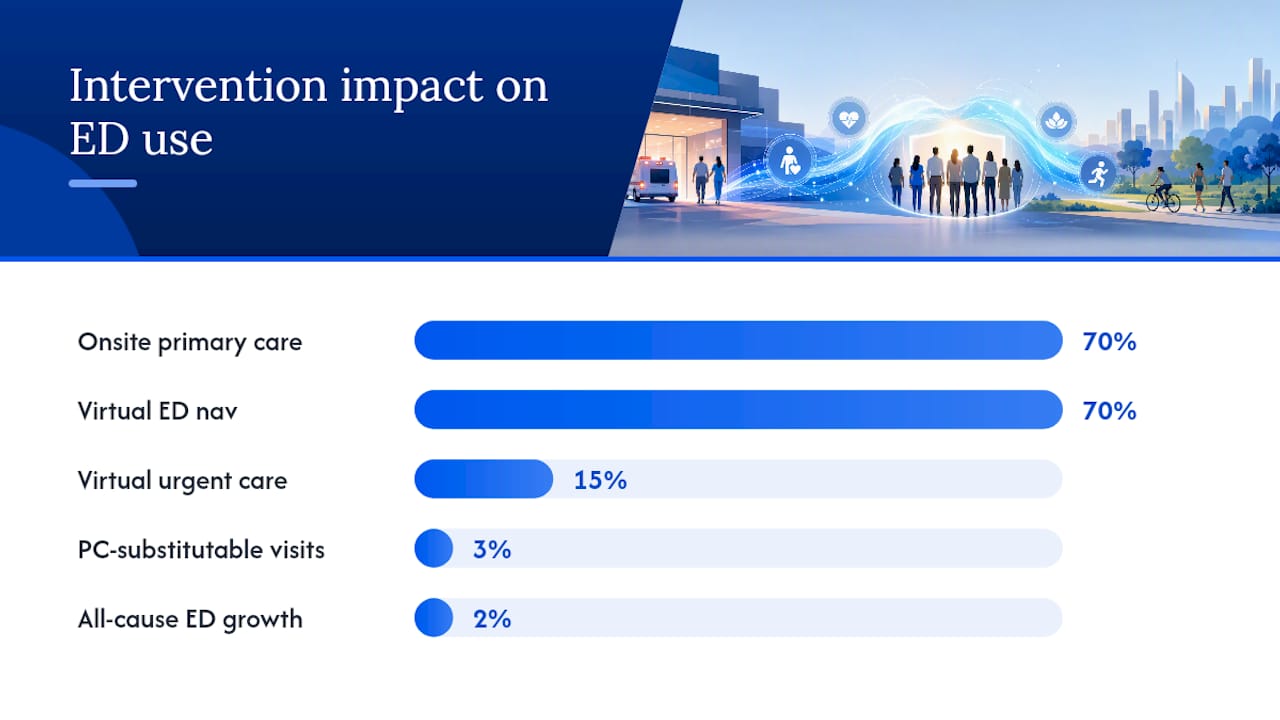
Urgent care networks and extended-hours primary care work as the connective tissue for everyone else. Comprehensive primary care models tied to Medicare populations showed modest but durable reductions in ED visit growth, roughly 2% lower growth in all-cause ED use and 3% lower growth in visits that primary care could substitute for. That's not a dramatic headline number, but it compounds year over year and costs far less to implement than a clinic build.
Decision rules for prioritizing:
- Single large site, 1,000+ employees in one location: invest in onsite or near-site advanced primary care first.
- Distributed or remote workforce: prioritize virtual urgent care and a nurse triage line before anything else.
- Aging population or high chronic-disease prevalence: pair either model with dedicated care management, covered in the next section.
- Tight first-year budget: start with virtual triage. It's the lowest lift and shows results within one plan year.
Ochsner Health's virtual ED model, which routes patients to navigators instead of the emergency department, enabled roughly 70% of program encounters to avoid the ED entirely. That figure alone should reset expectations for what a well-built virtual front door can do.
Building Triage and Navigation That Actually Closes the Loop
A nurse line that answers the phone and gives advice isn't navigation. It's a suggestion box. Real navigation means the system tracks what happens after the call: whether the employee got the appointment, showed up, and had the visit documented back into a shared record.
Closed-loop navigation has three non-negotiable components. First, live scheduling into an in-network urgent care or primary care slot at the moment of the triage call, not a phone number the employee has to call themselves. Second, a follow-up contact within 24 to 48 hours to confirm the visit happened and the issue resolved. Third, a referral-tracking system, ideally tied into claims or EHR data, that closes the loop so nobody falls through.
Staffing determines how much of this you can automate versus escalate. Programs built around registered nurse triage tend to over-refer to physicians for anything beyond basic advice, which slows the process down. Design and innovation research on employer ED-reduction pilots found that staffing lines with certified registered nurse practitioners who can prescribe and complete treatment without escalation produces higher diversion, simply because the employee gets a full resolution on the first contact instead of being bounced to another provider.
Three mistakes undercut even well-funded triage programs:
- Routing to out-of-network urgent care. If the recommended clinic isn't in-network, you've traded an ED bill for a surprise urgent care bill and burned employee trust in the process.
- Skipping the follow-up call. Without it, you have no idea whether the employee actually avoided the ED or just didn't answer their phone and went anyway.
- No dashboard tying triage calls to claims outcomes. If you can't see diversion rates against actual ED claims data, you're reporting a service was used, not that it worked.
Reaching High Utilizers Before They End Up Back in the ER
A small share of any employer population drives a disproportionate share of ED visits, usually people managing multiple chronic conditions, recent hospital discharges, or unaddressed behavioral health needs. Identifying them starts with claims data: three or more ED visits in 12 months, any inpatient admission in the last 90 days, or a chronic condition combination like diabetes plus heart failure are all reliable risk flags.
Once identified, the tactics that move the needle are less about generic wellness messaging and more about tight, individualized follow-up:
- Transitional care calls within 48 to 72 hours of any ED visit or hospital discharge to catch problems before they escalate again.
- Medication reconciliation, since a large share of repeat ED visits trace back to a missed refill or a drug interaction nobody caught.
- Social determinants screening for transportation, housing, or food insecurity, factors that push people toward the ED simply because it's the one place that won't turn them away.
- Behavioral health integration, since untreated anxiety, depression, or substance use frequently shows up first as a physical complaint in the ED.
Expect a longer runway here than with triage programs. Chronic disease and high-utilizer management typically needs two to three quarters before claims data shows a clear trend, because you're changing care patterns for people with complex, layered needs, not just redirecting a single urgent visit.
Your 90/180/365-Day Roadmap for Cutting ER Visits
Sequencing matters more than ambition. Employers who try to launch everything in month one usually end up with a pile of underused benefits and no clean data to show for it.
- Days 1 to 90: Pull 12 months of ED claims data and identify your top three drivers by diagnosis code and time of day. Select one pilot, virtual triage is the fastest to stand up, and confirm your data feed can track referrals back to claims. Get a leadership sponsor from finance, not just HR, since ROI credibility starts here. Launch a simple communication push: one email, one benefits fair mention, one manager talking point.
- Days 91 to 180: Expand the pilot to full population eligibility if early data looks promising. Build the claims integration that lets you see triage referrals against actual ED utilization, not just call volume. Add scheduling rules so navigators can book directly into in-network slots instead of handing off a phone number.
- Days 181 to 365: Calculate your first real ROI figure using a full plan year of data. Present it to finance in dollar terms, net medical spend per employee, not just utilization percentages. Use that first-year data to decide whether to add onsite primary care, expand care management, or hold steady.
Track four KPIs throughout: avoidable ED visits per 1,000 employees, triage diversion rate, net medical spend per employee, and program engagement rate. CMS's TCPI change package recommends 24/7 access, proactive scheduling, and social determinants screening as the core levers behind these numbers, and it's a useful checklist to hold your own program against.
Pro Tip: Don't wait for a full year of data to report progress. Share diversion rate and engagement numbers quarterly, even if they're incomplete. It keeps leadership bought in and gives you a chance to fix a broken referral workflow before it shows up as a disappointing year-end number.
How to Measure Results Finance Will Actually Trust
Claims data alone tells you what happened, not why. The strongest evaluations pair claims-based analysis, ideally a difference-in-differences comparison against a similar employee group that didn't get the intervention, with post-encounter self-report asking employees directly what they would have done without the service.
Define "avoidable" ED visit consistently before you start measuring, since coding inconsistencies and out-of-network billing gaps can quietly skew your numbers. A visit coded as low-acuity in one system might look different in another, so lock your definition early and apply it the same way every quarter.
- Combine claims trend analysis with self-reported diversion surveys for a fuller picture than either method alone.
- Use a comparator group where possible instead of just a before-and-after snapshot on the same population.
- Report quarterly, not just annually, so finance sees a trend line instead of one number.
- Flag data caveats openly (coding lag, out-of-network claims) rather than letting a clean-looking chart hide messy underlying data.
How Hadaco's Model Maps to This Playbook
The model described in this playbook can align with performance-based fees and programs that do not require upfront costs to the employer. The programs target chronic disease, preventive care, and employee engagement together, because a fix for one without the others rarely holds up over a full plan year.
Each lever mentioned above has a direct counterpart in Hadaco's approach: navigation support that routes employees toward appropriate, in-network care instead of the ED by default, and chronic disease programs aimed at the high-utilizer population described earlier. Reporting runs on a quarterly cadence with a transparent savings estimator, so benefits leaders get the same claims-based accountability that finance teams expect before they'll approve renewal budget. Employers working with Hadaco have seen an average of $451 in first-year savings per employee, which lines up with the kind of double-digit claims reduction this playbook describes.
Getting Employees to Actually Use These Programs
None of these interventions save a dollar if employees don't know they exist or don't trust them enough to call first. Enrollment communication fails most often because it's a one-time push buried in open enrollment paperwork alongside a dozen other benefits nobody reads closely.
Repetition beats a single polished announcement. Employees need to hear about a nurse line or virtual urgent care option at open enrollment, again at the point of hire for new employees, and periodically throughout the year, ideally timed to seasons when ED use spikes, like flu season or summer sports injuries.
Framing matters as much as frequency. "Call this number before you go to the ER" lands better than "we've added a new virtual care benefit," because it gives employees a specific action tied to a specific moment of need. Wallet cards, a saved contact in a company app, or a magnet with the nurse line number on it sound old-fashioned, but they work precisely because they're visible at 2 a.m. when someone's deciding where to go.

Managers play an underused role here too. A supervisor who mentions the nurse line when an employee calls in sick carries more weight than another email from HR, simply because it's a real person reinforcing the message at the moment it matters. Build that talking point into manager onboarding rather than assuming it'll happen organically.
Track enrollment and awareness the same way you track utilization. A program with high awareness but low diversion means employees know about it but don't trust it or find it inconvenient. A program with low awareness needs a communication fix before it needs any operational change at all.
Finding the Real Drivers Behind Your ER Claims Data
Most employers never get past "our ED spend went up" to the actual reasons behind it, and that gap is where good program design gets lost. A proper root cause review starts with pulling every ED claim from the last 12 months and sorting by diagnosis code, day of week, time of day, and whether the visit resulted in admission.
Patterns tend to show up fast. A cluster of Friday-evening and weekend visits for minor injuries or fevers usually points to a gap in after-hours access, not a behavior problem. A high share of visits for conditions like asthma exacerbations, uncontrolled diabetes, or hypertensive episodes signals chronic disease management gaps rather than one-off emergencies. Frequent low-acuity visits that never result in admission are the clearest markers of avoidable ED use and the easiest to target with triage or urgent care redirection.
Research examining what characterizes avoidable and preventable ED visits found that a meaningful share trace back to access gaps rather than clinical necessity, reinforcing that the fix is structural, not educational. Cross-reference your claims patterns against your benefits design: if your nearest in-network urgent care closes at 7 p.m. and your ED spikes at 8 p.m., that's not a coincidence, that's a design flaw.
Don't skip the qualitative layer either. A short, anonymous survey asking employees who visited the ED in the last year why they chose it over other options often surfaces barriers claims data alone won't show, like not knowing a nurse line existed or assuming urgent care wouldn't take their insurance.
Using Plan Design to Steer Employees Toward the Right Care Setting
Benefit design either reinforces good care-seeking behavior or quietly undermines it. A flat co-pay structure where an ER visit costs the same $50 as urgent care removes any financial signal that would nudge someone toward the cheaper, often faster option.
Tiered cost-sharing is the most direct lever. Setting a meaningfully higher co-pay for ED visits relative to urgent care or telehealth, without making it punitive for genuine emergencies, gives employees a reason to consider alternatives when the situation isn't life-threatening. Waiving the telehealth or nurse-line co-pay entirely removes friction at the exact moment someone is deciding where to go.
Prior authorization requirements need careful calibration. Requiring authorization for non-emergency ED use after the fact, reviewing claims retrospectively rather than blocking care in the moment, can discourage habitual low-acuity ED use without creating a barrier that delays someone with a genuine emergency. Any policy here needs a clear emergency medical condition carve-out that complies with prudent layperson standards, since penalizing someone for reasonably believing they had an emergency creates both a trust problem and a potential compliance issue.
Incentive design works better as a carrot than a stick in most employer populations. Small premium credits or HSA contributions tied to completing an annual wellness visit or engaging with a nurse line at least once tend to build the habit of using the right entry point before a crisis hits, rather than only intervening after an ED visit already happened.
Preparing Managers to Support Better Health Decisions
Managers aren't clinicians, and no training program should ask them to diagnose anything. Their role is narrower and more achievable: knowing what resources exist, recognizing when to mention them, and removing the awkwardness around raising the topic at all.
A short training module, 30 to 45 minutes, covering what the nurse line and virtual urgent care options are, when it's appropriate to mention them, and how to do so without overstepping into an employee's personal medical decisions, covers most of what's needed. The goal is a manager who says "have you tried the nurse line?" when an employee mentions a sick kid or a nagging injury, not a manager who tries to manage the employee's care.
Frame this training around flexibility, not surveillance. Employees who fear a supervisor is tracking their healthcare choices will disengage from every program you build, no matter how good it is. The message that works is simple: the company has resources that might save time and money, and mentioning them is a courtesy, not a directive.
Include a light escalation protocol for behavioral health concerns specifically, since managers often notice signs of a struggling employee well before HR does, but need clear guidance on how to point that person toward an EAP resource without attempting to counsel them directly. Pair this training with a refresher at least annually, since staff turnover and benefit changes make a one-time session go stale fast.
Connecting ER Reduction Efforts With EAP and Behavioral Health Resources
A meaningful share of ED visits that look physical on the surface trace back to an unaddressed behavioral health issue, whether that's a panic attack presenting as chest pain or a substance use crisis showing up as an injury. Programs that treat physical and behavioral health as separate systems miss this overlap entirely.
Integration starts with a warm handoff protocol. If a nurse triage line or navigator identifies signs of anxiety, depression, or substance use during an intake call, that employee should be routed directly to the EAP in the same conversation, not handed a phone number to call separately later. Every point of friction in that handoff is a point where the employee disengages.
Data sharing matters too, within appropriate privacy boundaries. EAP utilization and ED claims data rarely get analyzed together, which means most employers can't see whether their behavioral health investment is actually reducing physical health claims. Even a high-level, de-identified view of whether EAP engagement correlates with lower ED use over time gives benefits leaders a clearer picture of where to invest next.
Behavioral health access constraints deserve the same urgency as primary care access gaps. If your EAP offers three free sessions and then refers out to a waitlist, you've built the same access cliff that pushes people to the ED for physical complaints. Extended-hours virtual behavioral health, paired with your EAP, closes that gap the same way virtual urgent care closes it for physical health.
Staying Compliant While Managing Employee Healthcare Utilization
Any program that tracks utilization patterns or nudges care-seeking behavior needs a compliance review before launch, not after a complaint surfaces. HIPAA governs how claims and clinical data can be used, even in aggregate, and any vendor handling that data needs a business associate agreement in place.
The prudent layperson standard is the single most important legal guardrail here. Federal law requires health plans to cover emergency care based on symptoms a reasonable person would consider urgent, regardless of the final diagnosis. That means any co-pay differential, prior authorization requirement, or communication campaign discouraging ED use must include a clear, unambiguous exception for situations that reasonably appear to be emergencies. Penalizing genuine emergency care after the fact, even unintentionally, creates real legal exposure.
ADA and GINA considerations apply to any wellness incentive tied to health data disclosure or participation in a care management program. Incentives need to stay within compliant limits and can't function as a backdoor requirement to disclose health status. Document every program's voluntary nature clearly in employee-facing materials.
Finally, keep data use narrow and purpose-specific. Aggregate claims analysis for program evaluation is standard practice, but any individual-level utilization tracking needs a legitimate, disclosed purpose and appropriate access controls. Loop in employment counsel before rolling out anything that touches co-pay differentials or utilization-based incentives, since state law varies more than most benefits teams expect.
What Gets Missed When Employers Chase ER Reduction Alone
Most benefits leaders I've seen approach this problem backward. They shop for a point solution, a nurse line here, a telehealth app there, and expect a stack of disconnected vendors to add up to a coordinated strategy. It rarely does, because none of these tools talk to each other or to your claims data.
The real work is sequencing and integration, not procurement. Pilots are good for building the case internally, but they only earn their keep when the data from the pilot feeds directly into a decision about scaling, not when they sit in a slide deck for a year. Bring your CFO in from day one. A program that can't produce a claims-based ROI number by month twelve will lose its budget line by month fourteen, no matter how much employees liked it.
The tradeoffs are real and worth naming plainly: convenience-first programs like virtual triage cost less to launch but plateau faster, while deeper investments like onsite primary care take longer to show results but compound over multiple plan years. Choose based on your workforce concentration and your patience for a multi-year payoff, not on which option looks best in a single-year budget review.
— Gene
How Hadaco Helps You Put This Playbook Into Action
Building the triage, navigation, and chronic care infrastructure this playbook describes from scratch takes internal resources most HR teams don't have sitting idle. There are population health programs available that launch without upfront fees and tie fees to demonstrated savings, allowing employers to implement such approaches without initial build costs.
Key program components often include care navigation directing employees toward in-network, lower-cost settings, chronic disease management for high-utilizer populations, and periodic reporting with transparent savings estimates to provide claims-based evidence to stakeholders. Employers have reported average first-year savings per employee along with improved engagement and retention when implementing such population health programs. If you're ready to see what that could look like against your own claims data, start with Hadaco's savings estimator or reach out through Hadaco's team to walk through your current ED utilization and where the fastest wins are likely to sit.
Sources
- Using design and innovation principles to reduce avoidable emergency department visits among employees of a large academic medical center
- Research reveals what characterizes avoidable and preventable visits to emergency departments
- Reducing Unnecessary Emergency Department Visits (TCPI Change Package excerpt)
- With virtual program at Ochsner Health, 70% of patients skip the ED | AMA
This article is general information, not a substitute for advice from a qualified doctor. Consult a qualified healthcare professional about your own circumstances before acting on anything here.