
Map where specialty spend concentrates, then act in order: fix site-of-care and in-benefit waste first, because those levers work for almost any plan. Reserve alternative funding programs or carve-outs for narrow, high-cost exposures. Guardrails on therapy continuity and audit defensibility aren't optional; skip them and you'll trade a cost problem for a compliance one. Done right, this sequence produces measurable per-employee-per-month savings within a year, not vague promises of future efficiency.
TL;DR:
- Mapping and analyzing drug spend top 10 to 20 drugs should be done before negotiating any specialty drug contracts for targeted savings.
- Site-of-care adjustments and direct specialty pharmacy delivery can significantly reduce hospital outpatient department reimbursement markups without delaying therapy if clinical exceptions are built in.
- In-benefit optimization offers systemic improvements with minimal downside, while carve-outs carry contractual risks and require thorough due diligence, especially on rebates and continuity guarantees.
- Tracking quarterly metrics such as specialty share of total drug spend and claims exceeding one million dollars helps validate savings and identify emerging cost drivers.
- Combining population health programs with pharmacy tactics can lead to early per-employee savings by reducing downstream conditions that generate expensive specialty prescriptions.
Table of Contents
- What Are the Fastest Ways to Reduce Specialty Drug Spend?
- AFPs vs. In-Benefit Optimization: Which Fits Your Plan?
- What Site-of-Care and Specialty Pharmacy Levers Actually Save
- How to Evaluate Specialty Carve-Out Vendor Claims
- The Metrics That Prove (or Disprove) Your Specialty Strategy
- How to Pilot and Scale a Specialty Spend Reduction Program
- Where Population Health Programs Like Hadaco Fit In
- Negotiating With Manufacturers: Rebates, Discounts, and What Employers Can Actually Ask For
- Prior Authorization and Step Therapy: Using Utilization Management Without Delaying Care
- Value-Based Contracting: Paying for Outcomes, Not Just Volume
- Author's Short Take: Three Non-Negotiables for Benefits Leaders
- When to Bring Hadaco Into Your Specialty Drug Strategy
- Sources
What Are the Fastest Ways to Reduce Specialty Drug Spend?
Some levers pay off in one plan year. Others take longer but produce more durable results. Here's the rough order of operations most benefits teams should follow:
- Spend mapping and concentration analysis. Find out which 10 to 20 drugs drive most of your specialty spend before you negotiate anything.
- Site-of-care steering. Move infusions and physician-administered drugs away from hospital outpatient departments toward specialty pharmacy or home-based delivery.
- In-benefit optimization. Clean up duplicate therapies, oversupply, and formulary gaps inside your existing PBM contract.
- Carve-out or network evaluation. Consider only for narrowly concentrated, high-cost categories where the math clearly works after fees.
- Care navigation and adherence support. Keep members on therapy correctly, which prevents costly complications and abandoned treatment.
- Stop-loss and actuarial recalibration. Update your reinsurance assumptions once you know your real specialty exposure.
Each one has a different risk-to-reward ratio. Mapping and in-benefit fixes carry almost no downside. Carve-outs carry real contractual risk if you skip due diligence.
AFPs vs. In-Benefit Optimization: Which Fits Your Plan?
Alternative funding programs (AFPs) route specific high-cost specialty drugs, often ones with manufacturer patient assistance programs, outside your normal plan design to access alternative funding sources. In-benefit optimization instead tightens your existing PBM and medical benefit design: better prior authorization, smarter formulary tiers, tighter utilization review. Industry guidance increasingly treats these as complementary layers rather than an either/or choice.
Here's how they stack up on the dimensions that matter most:
- Speed to savings. AFPs can produce fast, visible reductions on a handful of drugs. In-benefit optimization takes longer to show up in claims data but scales across your entire formulary.
- Member cost impact. AFPs sometimes shift administrative burden onto members and prescribers. In-benefit changes, done carefully, are largely invisible to members.
- Audit defensibility. In-benefit optimization sits inside standard PBM contracting and is easier to defend under ERISA fiduciary review. AFPs need extra documentation to prove members weren't harmed.
- Continuity of care. AFPs that switch funding mid-therapy risk gaps in coverage; in-benefit changes rarely interrupt an active prescription.
Use AFPs when a small number of drugs, often five or fewer, account for a disproportionate share of specialty cost. Use in-benefit optimization when the problem is broader and systemic.
Pro Tip: Before signing any AFP vendor agreement, ask for a written continuity-of-care protocol covering what happens if a manufacturer assistance program denies a member mid-treatment.
What Site-of-Care and Specialty Pharmacy Levers Actually Save
Hospitals and hospital outpatient departments get reimbursed substantially more than specialty pharmacies for the exact same physician-administered drugs, according to AMCP data on managed care pharmacy value. That markup is one of the most fixable inefficiencies in a specialty drug budget, because the drug itself doesn't change, only where it's administered.
Tactics that work:
- Site-of-service requirements that steer infusions toward ambulatory surgery centers, physician offices, or home infusion instead of HOPDs.
- "White bagging" or "brown bagging" arrangements, where the specialty pharmacy ships the drug directly to the site of care instead of the hospital buying and marking it up.
- Direct specialty pharmacy delivery for self-administered injectables, cutting out the hospital pharmacy markup entirely.
The catch: steering site of care too aggressively delays therapy for patients who genuinely need hospital-level monitoring. Build clinical exceptions into any site-of-service policy, and track time-to-therapy as closely as you track dollars.
How to Evaluate Specialty Carve-Out Vendor Claims
Carve-out vendors routinely advertise gross savings in the 20% to 50% range, but Milliman's analysis of specialty carve-out programs warns that net savings often shrink once fees, PBM rebate losses, and coordination costs enter the picture. A vendor claiming 40% off specialty drug costs isn't lying, exactly. They're just not showing you the whole invoice.
Before signing anything, ask for:
- Rebate treatment. Will carving out specialty drugs trigger rebate guarantee penalties on your remaining PBM contract?
- Operational fees. Per-member, per-claim, or flat administrative fees, stated separately from the advertised gross savings figure.
- PBM contract interaction. Some PBM agreements include minimum-volume clauses that penalize employers for removing drugs from the base contract.
- Continuity guarantees. What happens to a member mid-therapy if the carve-out vendor loses formulary access to their drug?
One analysis of alternative funding and PBM impacts recommends negotiating rebate true-up clauses or shared-savings collars specifically to protect your non-specialty rebate guarantees from erosion. Ask for a net-of-fees projection in writing, not a gross savings percentage, before you commit.
The Metrics That Prove (or Disprove) Your Specialty Strategy
Specialty drugs represent roughly 4% of prescriptions but 50% or more of total plan drug spend for most employers. That imbalance is exactly why generic "total drug spend" reporting hides the real opportunity.
Track these specific figures every quarter:
- Specialty share of total drug spend, tracked as a trend line, not a single snapshot.
- Top 10 to 20 drugs by total spend, refreshed quarterly since pipeline drugs shift fast.
- PMPM specialty spend, isolated from medical and non-specialty pharmacy costs.
- Average specialty claim size and how many claims exceed $1 million annually.
- Frequency of catastrophic claims, which feeds directly into stop-loss and reinsurance modeling.
A gap in rebate and pricing transparency is the single biggest obstacle to validating any vendor's savings claim, so demand itemized PBM transparency reports before, not after, signing a new contract. Reviewing healthcare spend analytics before renewal gives you a clean baseline to hold every vendor claim against.
How to Pilot and Scale a Specialty Spend Reduction Program
Running a specialty cost initiative without a sequence is how good ideas turn into audit liabilities. Follow this order:
- Map your spend. Pull 12 to 24 months of claims data and identify your top specialty drug concentrations by cost and by member count.
- Model the intervention. Run actuarial benchmarking and, where catastrophic claims are a factor, Monte Carlo modeling against your stop-loss attachment points.
- Pilot narrow. Choose one drug category or site-of-care change and test it with a defined member cohort before rolling out plan-wide.
- Measure pre and post. Compare PMPM specialty spend, time-to-therapy, and adherence rates before and after the pilot, not just total dollars.
- Iterate. Fix workflow friction for prescribers and pharmacists before scaling, since a slow prior authorization process erases any savings from delayed therapy.
- Scale with guardrails intact. Expand only once continuity-of-care and audit documentation hold up under the pilot's real-world conditions.
Loop in your PBM, medical carrier, specialty pharmacy, treating clinicians, stop-loss carrier, and broker at the modeling stage, not after you've already picked a vendor. Each one sees a different piece of the risk. A high-cost claimant management playbook is useful here for coordinating the clinical side of a pilot.
Pro Tip: Track complaints and escalations as a KPI alongside dollars saved. A spike in member complaints during a pilot is often the earliest warning sign that a cost-saving change is quietly harming care.
Where Population Health Programs Like Hadaco Fit In
Specialty drug tactics work on the drugs themselves. Population health programs work upstream, on the chronic conditions that eventually generate specialty prescriptions. Population health programs run with no upfront fees and integrate with an employer's existing plan design instead of replacing it. Some employers see measurable per-employee savings in the first year, backed by a transparent savings estimator and quarterly outcome reporting.
Better chronic disease management and preventive care reduce the downstream conditions that drive members onto specialty therapies in the first place, and stronger adherence support lowers complications that inflate claims. Integrating shared KPIs and a quarterly review cadence with your specialty drug metrics keeps both efforts pointed at the same numbers, not competing dashboards. Programs like the wellness-driven cost reductions Hadaco tracks reinforce specialty strategy rather than duplicate it.
Negotiating With Manufacturers: Rebates, Discounts, and What Employers Can Actually Ask For
Most employers never negotiate directly with drug manufacturers. Your PBM does that on your behalf, and the rebate dollars flow through a contract you rarely see in full detail. That's the first thing to fix. Ask your PBM for a rebate pass-through guarantee in writing, ideally 100%, and get clear language on how specialty drug rebates specifically are calculated and reported, since specialty rebate structures often differ from traditional pharmacy rebates.
Manufacturer patient assistance programs and copay accumulator or maximizer strategies are the second lever. These programs can meaningfully offset member cost-sharing on expensive specialty drugs, but JAMA's analysis of insurer strategies notes that copayment adjustment policies require careful design to avoid shifting costs onto members in ways that reduce adherence. A maximizer program that captures manufacturer assistance dollars for the plan, rather than passing the benefit entirely to the member, needs to be weighed against the adherence risk of higher out-of-pocket exposure.
Third, push your broker or consultant to benchmark your specific PBM's rebate guarantees against current market rates for your plan size and specialty mix. Rebate guarantees negotiated three years ago are stale. Specialty drug pricing moves fast enough that a rebate contract signed before 2024 is very likely leaving money on the table today. Revisit this at every renewal, not just when a contract is up for full rebid.
Prior Authorization and Step Therapy: Using Utilization Management Without Delaying Care
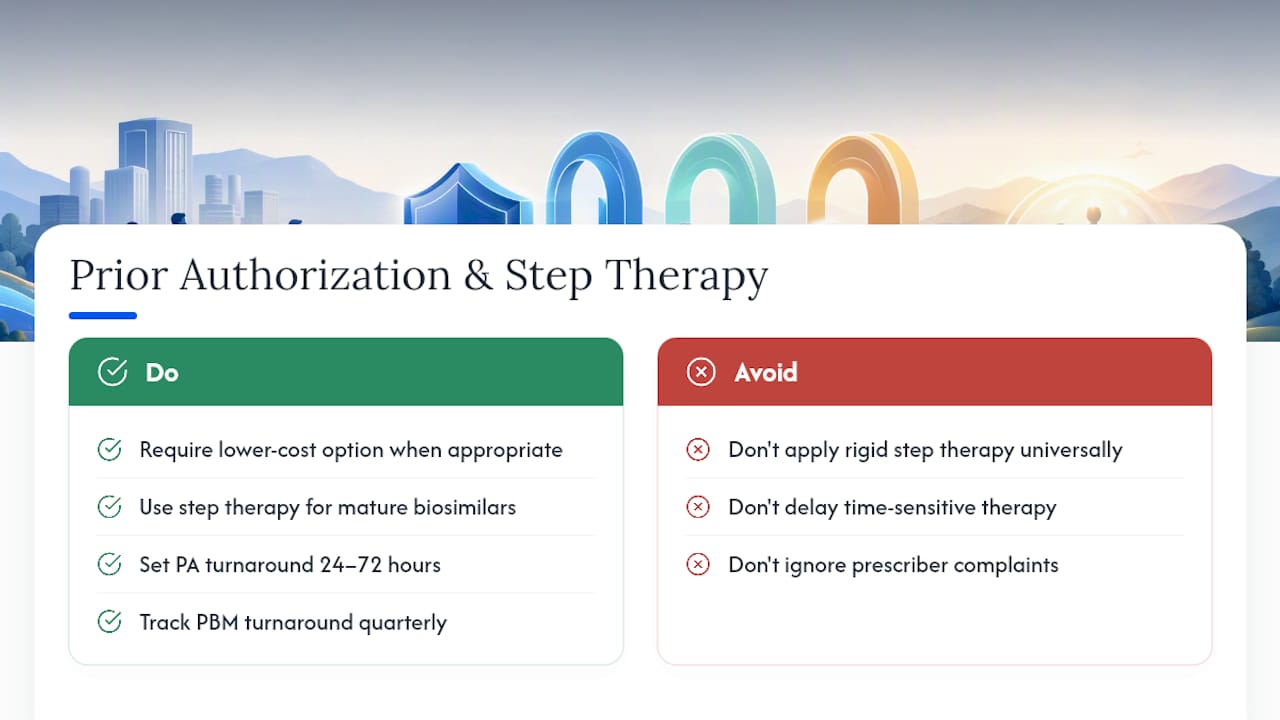
Prior authorization and step therapy are the most common utilization management tools applied to specialty drugs, and they're also the most likely to generate member and prescriber frustration if implemented poorly. The goal isn't to block access. It's to confirm that the most cost-effective clinically appropriate option gets tried first, and that ongoing therapy still matches diagnosis and response.
Step therapy for specialty drugs typically requires a lower-cost option, often a biosimilar or an established therapy, before approving a newer or higher-cost alternative. This works well for categories with mature biosimilar markets, like certain autoimmune and inflammatory conditions, where clinical evidence supports similar outcomes at a fraction of the cost. It works poorly when applied rigidly to conditions where treatment history matters or where a specific mechanism of action is medically necessary from the start.
Prior authorization should have a hard turnaround-time standard, ideally 24 to 72 hours for urgent specialty cases, because a slow approval process on a cancer or autoimmune therapy isn't a cost control. It's a care delay with legal exposure attached. Build an expedited pathway for oncology and other time-sensitive categories, and track your PBM's actual turnaround time against its contractual promise every quarter. A prior authorization program that saves money on paper but generates prescriber complaints and treatment delays will eventually show up as a bigger medical claim, or a bigger PR problem, than the drug spend it was designed to control.
Value-Based Contracting: Paying for Outcomes, Not Just Volume
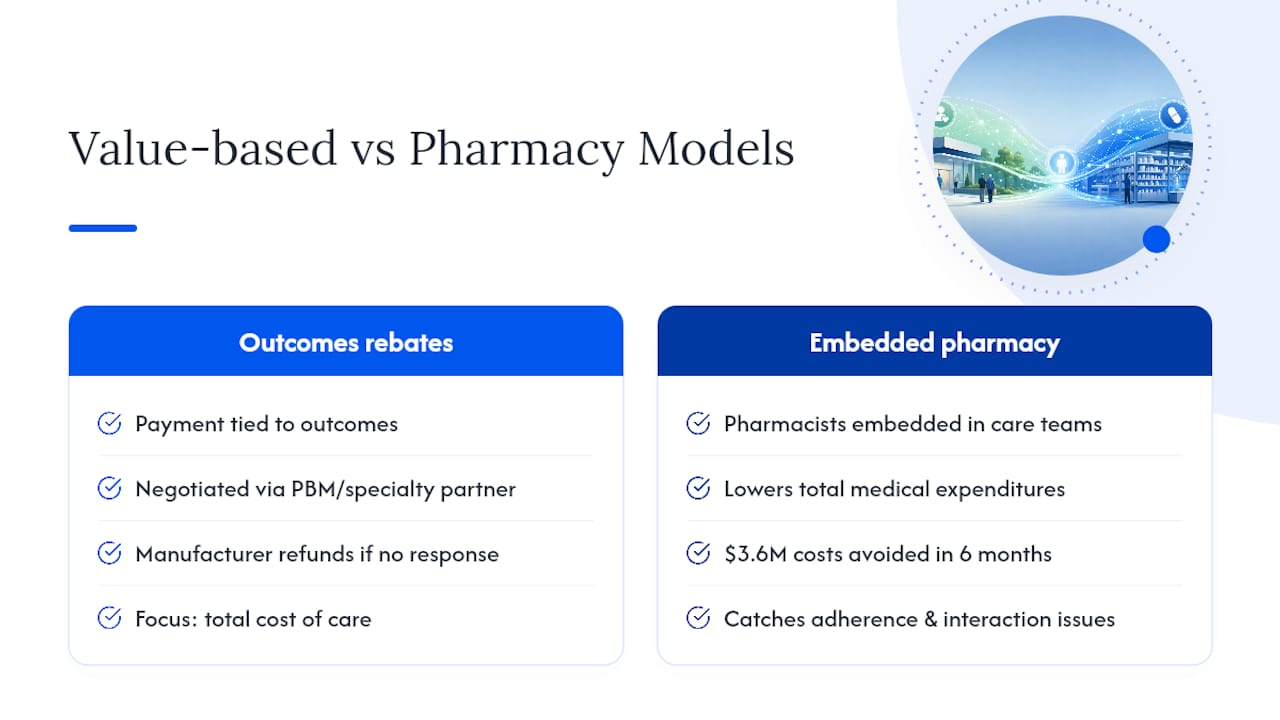
Risk-sharing and value-based contracts tie manufacturer or specialty pharmacy payment to actual patient outcomes rather than a flat price per dose. Value-based pharmacy models are shifting the industry's focus from the price of the pill to the total cost of care around it, and specialty drugs are where this shows up first because the dollar amounts at stake justify the contracting complexity.
Outcomes-based rebate agreements are the most common structure available to employers today, usually negotiated through the PBM or a specialty pharmacy partner rather than directly with manufacturers. If a patient doesn't respond to therapy within a defined clinical window, the manufacturer refunds part or all of the drug cost. This shifts real financial risk back onto the manufacturer instead of leaving the employer holding the full cost of a drug that didn't work.
Health system specialty pharmacy models that embed clinical pharmacists directly into care teams show a related benefit: one multicenter claims analysis associated this integrated model with lower total medical expenditures, likely because pharmacists catch adherence problems and drug interactions before they turn into hospitalizations. Separately, pharmacist interventions across 14 specialty pharmacies avoided $3.6 million in costs over six months, a real-world signal that clinical oversight, not just contract terms, drives savings.
Ask your specialty pharmacy or PBM directly whether outcomes-based agreements exist for your highest-volume specialty categories. Not every drug class has one yet, but the list is growing every year, and asking costs nothing.
Author's Short Take: Three Non-Negotiables for Benefits Leaders
Three things deserve your attention before any vendor pitch: real spend mapping before any contract, net-of-fees math on every carve-out claim, and a written continuity-of-care protocol. Reject any vendor that won't share methodology, quotes gross savings only, or can't explain what happens to a member mid-therapy if the deal falls through. Pilot small, measure honestly, and protect the people actually taking these drugs.
— Gene
When to Bring Hadaco Into Your Specialty Drug Strategy
Specialty drug tactics fix the cost of specific prescriptions. Certain population health programs fix the health conditions that lead to those prescriptions in the first place, and do so without touching your current plan design or PBM contract. These programs do not charge upfront fees, and some employers see measurable per-employee savings in the first year, tracked through a transparent savings estimator and reported every quarter.
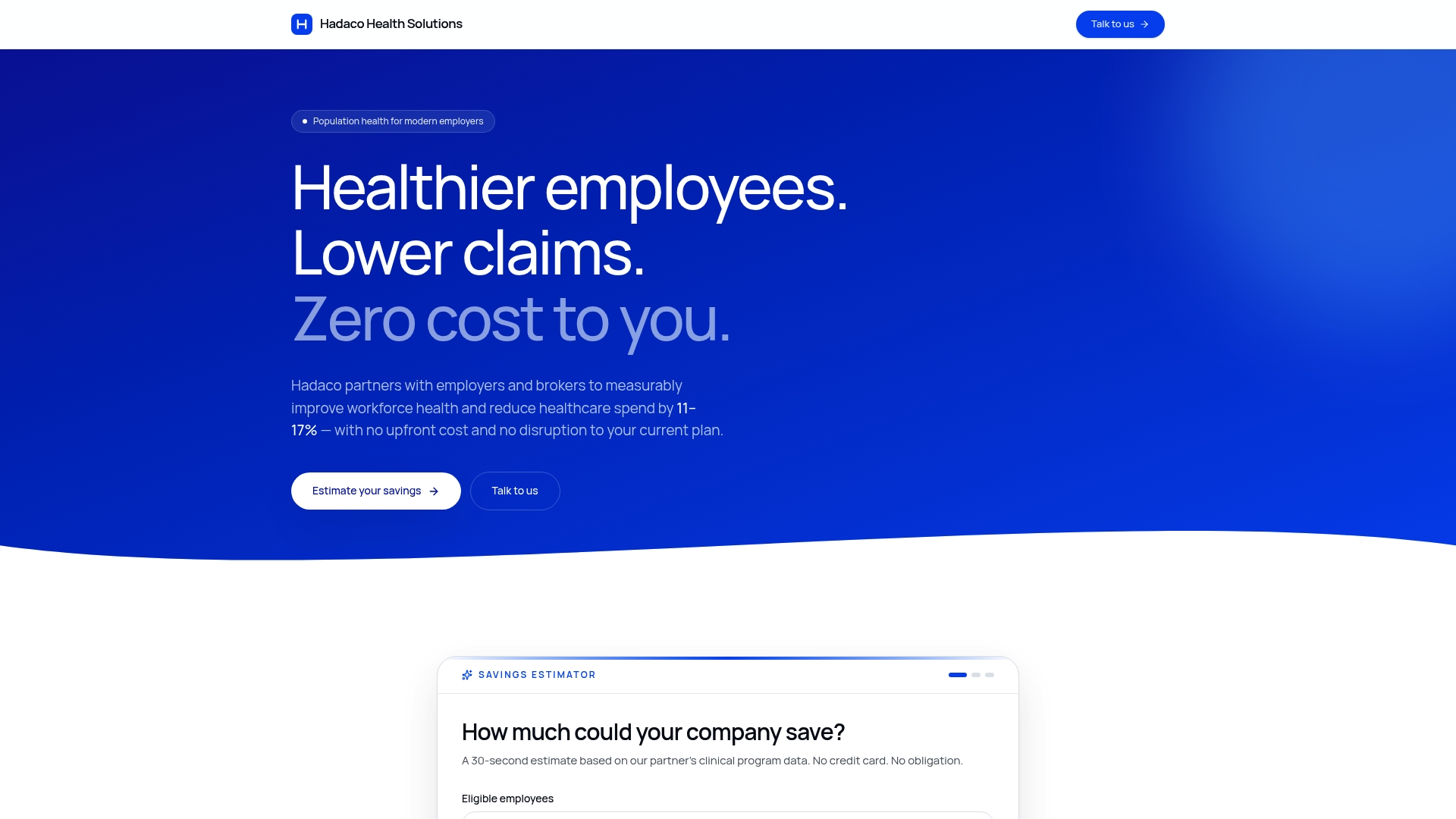
Consider Hadaco alongside your specialty drug initiatives, not instead of them, especially if you want reductions in total claim costs that come from healthier employees rather than tighter utilization rules alone. During a demo, ask to see the savings estimator applied to your own plan data and request outcome case studies relevant to your workforce's chronic disease mix. Visit Hadaco's website to request a consultation and get a personalized savings estimate before your next renewal cycle.
This article is general information, not a substitute for advice from a qualified doctor. Consult a qualified healthcare professional about your own circumstances before acting on anything here.
Sources
- Milliman report: Specialty carve-out programs (2026)
- AMCP slide deck — value of managed care pharmacy (site-of-care data)
- SpecialtyRx Toolkit — Financial Impact and Cost Management