
The single highest-impact move is combining pre-payment clinical claim review with targeted population-health interventions, then aligning your specific deductible and retention mix to match the risk that remains. Employers who intercept jumbo claims before payment and treat the chronic conditions driving them typically see fewer catastrophic files, softer renewal increases, and savings they can actually measure quarter over quarter.
TL;DR:
- Implement pre-payment clinical review for claims exceeding $25,000 to catch billing errors before payment and reduce jumbo claim frequency.
- Raising or restructuring your specific deductible can soften renewal increases by limiting the impact of high-cost claims on your bottom line.
- Launching targeted chronic disease programs and tightening pharmacy contracts specifically address the root causes of jumbo claims and specialty drug costs.
- Developing a claims segmentation system with at least 24 months of data enables early risk identification and better renewal negotiating leverage.
- Starting with a free population-health assessment from Hadaco allows rapid insight into potential savings without disrupting existing plan design.
Table of Contents
- How Can Employers Reduce Stop Loss Claims Fastest?
- Reviewing Claims Before They're Paid
- Setting Your Specific Deductible and Retention Right
- Clinical Programs That Lower Claim Frequency
- Tightening Pharmacy and PBM Contracts
- Building a Claims Segmentation System
- Negotiating Vendor and Carrier Contracts
- Your First 90 Days: A Practical Roadmap
- What Hadaco Adds to This Playbook
- What Actually Moves the Needle on Renewals
- Start With a Free Stop-Loss Savings Estimate
- Sources
How Can Employers Reduce Stop Loss Claims Fastest?
You don't need to overhaul your entire benefits program to start seeing results. The tactics below range from things you can do this quarter to longer projects worth starting now so they pay off at renewal.
- Pre-payment clinical review (TPA + clinical reviewer) — catches inappropriate high-dollar billing before it's paid, a fast win.
- Raise or restructure your specific deductible (broker + actuary) — reduces leveraged-trend exposure over time.
- Launch targeted chronic-disease programs (HR + vendor) — lowers frequency of future jumbo claims.
- Audit PBM contracts (benefits manager) — closes rebate and specialty-drug leakage fast.
- Build claims segmentation dashboards (analytics team) — flags rising-risk members early.
- Tighten TPA/carrier contract clauses (broker + legal) — reduces payment errors and leakage.
- Coordinate case management across vendors (benefits manager) — avoids duplicated, wasted spend.
Reviewing Claims Before They're Paid
Most employers only see high-cost claims after the money is gone. That's backwards. Three layers of review exist, and each catches different problems: pre-payment review stops errors and unnecessary billing before a check goes out, concurrent review monitors an active hospitalization or treatment plan as it unfolds, and retrospective review audits paid claims after the fact to recover overpayments through subrogation or billing disputes.
Pre-payment review is where the real savings live. Operationally, that means your third-party administrator (TPA) flags any claim above a set threshold (often $25,000 to $50,000) for clinical review before adjudication, and a nurse reviewer or medical director checks it against evidence-based treatment guidelines. Workspan's analysis for WorldatWork points to inspecting claims and reducing jumbo-claim frequency as a direct lever against rising stop-loss costs.
- Set a dollar threshold that triggers automatic clinical review.
- Require your TPA to route flagged claims to a licensed clinical reviewer, not just a claims processor.
- Build a standing escalation path for cases likely to exceed your specific deductible.
Pro Tip: Ask your TPA how many claims got flagged for review last quarter and how many resulted in a payment change. If they can't answer quickly, your review process is probably cosmetic.
Setting Your Specific Deductible and Retention Right
Your specific deductible, often called the ISL, is the point at which stop-loss coverage kicks in. Raise it, and you retain more risk yourself, but you also shrink what's called leveraged trend, the effect where medical inflation hits your retained layer harder than it hits the insurer's layer above it. Benefits Blake's breakdown of the leveraged-trend math shows why moving your ISL above the range where most claims cluster can meaningfully soften renewal increases across several years.
Lasers, where a carrier assigns a higher deductible to one known high-cost individual, and aggregate-only or aggregating specific structures make sense for smaller groups with a handful of predictable outliers. Before changing anything, model the cash-flow effect against three years of claimant history.
- Pull claimant-level data going back three plan years, not one.
- Stress-test your reserve fund against a raised ISL before committing.
- Ask your broker to show renewal projections at two or three ISL levels side by side.
Explore how stop-loss carriers differ on laser policies and renewal terms before locking in your next contract.
Clinical Programs That Lower Claim Frequency
Retention math only helps with claims that already exist. Cutting the number of jumbo claims in the first place means investing in the conditions that generate them. Complex-care coordination for members with multiple chronic diagnoses, maternity management for high-risk pregnancies, structured chronic disease programs for diabetes and cardiovascular disease, and behavioral health integration all show measurable impact on both frequency and severity when they're run with real clinical oversight rather than a wellness newsletter.
- Coordinate new programs directly with your TPA's existing case managers to avoid duplicate outreach to the same member.
- Require quarterly outcome reporting tied to specific cost and engagement metrics, not just participation counts.
- Prioritize programs targeting your top 5% of spenders first, since that group typically drives the majority of stop-loss exposure.
Tightening Pharmacy and PBM Contracts
Specialty pharmacy is quietly the fastest-growing driver of jumbo claims, and most employers never read the fine print on their pharmacy benefit manager (PBM) contract closely enough to catch it. RxBenefits' analysis of stop-loss mitigation points squarely at pharmacy claims as a recurring source of unexpected six-figure files.
- Demand full rebate transparency, not a "pass-through" claim without documentation.
- Require prior authorization and step therapy on high-cost specialty categories.
- Audit utilization quarterly for new specialty prescriptions before they compound into a stop-loss claim.
- Confirm your PBM contract doesn't let specialty costs quietly shift onto your stop-loss layer through carve-out timing.
Pro Tip: Request a specialty-drug pipeline report from your PBM twice a year. New gene therapies and biologics can turn a moderate claimant into a jumbo one within a single plan year.
Building a Claims Segmentation System
You can't manage risk you haven't identified. A useful segmentation system starts with a minimum dataset: claim-level history, diagnosis codes, and cost trajectory over time, not just current spend. From there, score members by likelihood of crossing your specific deductible in the next 12 months, similar to predictive first-notice-of-loss (FNOL) triage used in claims-heavy industries.
- Assemble at least 24 to 36 months of claim-level history before building risk scores.
- Flag members whose cost trajectory is accelerating quarter over quarter, not just those already high-cost.
- Feed this data directly into your broker's renewal negotiation package.
Analysis from Arthur D. Little on claims management identifies segmentation and specialist routing as two of the strongest levers for reducing leakage and improving outcomes across a claims operation. Explore healthcare spend analytics methods built specifically for employer plans.
Negotiating Vendor and Carrier Contracts
Every dollar leaking out through vendor error or a vague contract clause is a dollar that eventually shows up as stop-loss pressure. Insist on itemized billing on every claim above your review threshold, explicit audit rights that let you or a third party examine claims data, and defined subrogation procedures so your TPA actively pursues recovery when a third party is liable.
- Require FNOL service-level agreements (SLAs) that specify how fast a claim must be reviewed after intake.
- Track recovery rates, audit findings, and payment variance as standing quarterly KPIs.
- Bring three years of claim narratives and benchmarking data into every renewal negotiation, not just last year's loss ratio.
BSA Claims' analysis of leakage reduction found that disciplined audit and subrogation programs cut claims leakage from around 14% down to under 5% when analytics and vendor accountability were applied consistently. Review high-cost claimant management tactics that pair directly with tighter vendor oversight.
Your First 90 Days: A Practical Roadmap
- Days 1 to 30: Pull three years of claims data, audit your PBM contract, and set a pre-payment review threshold with your TPA.
- Days 31 to 60: Launch targeted clinical programs for your top-spending cohort and finalize renewal-ready analytics.
- Days 61 to 90: Bring your broker a full negotiation package: claim narratives, ISL modeling, and vendor performance data.
Loop in your TPA, broker, PBM account manager, and finance early. Track claim severity, PBM savings, and review-flag volume as your short-term progress metrics.
What Hadaco Adds to This Playbook
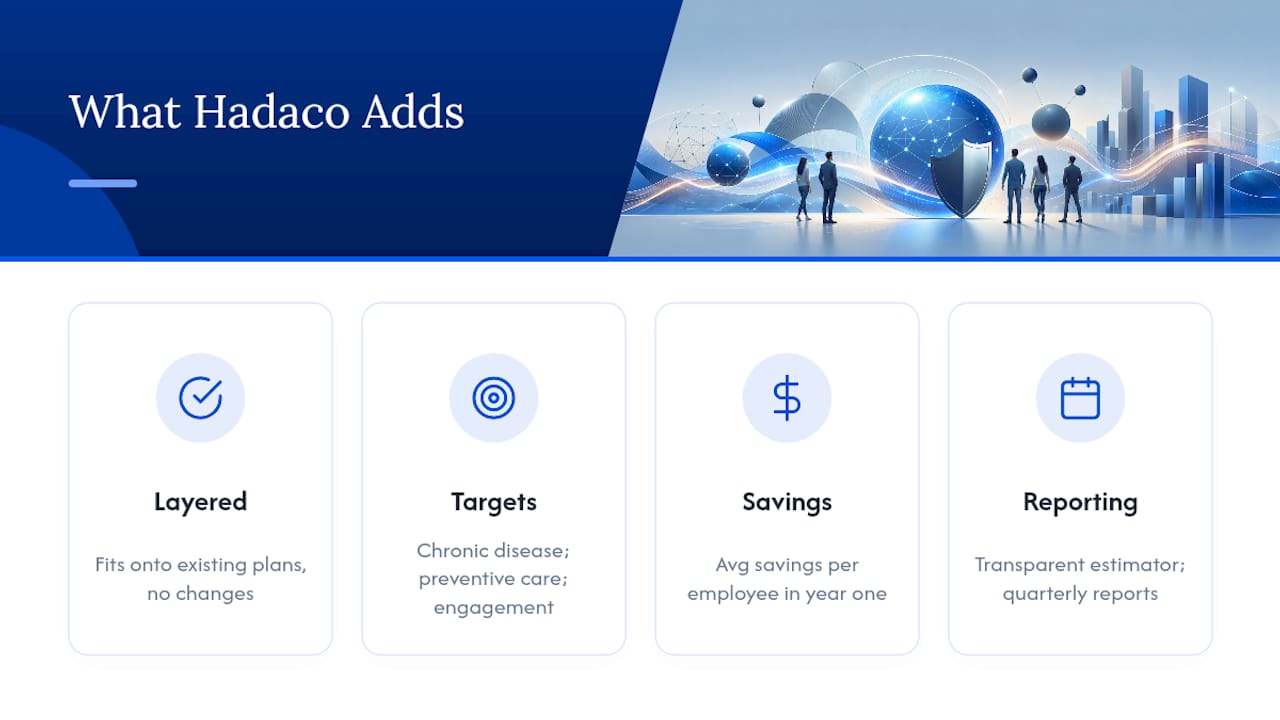
Hadaco builds the clinical and preventive piece of this playbook without touching your existing plan design. Its evidence-based programs target chronic disease, preventive care, and employee engagement, the same drivers behind most jumbo claims discussed above. Employers often see average savings per employee in year one, backed by a transparent savings estimator and quarterly reporting rather than a promise you have to take on faith. Because it layers onto current benefits instead of replacing them, it fits directly into the review and retention strategy outlined here.
What Actually Moves the Needle on Renewals
Sequence matters more than most benefits teams admit. Fix your claims review process first, layer in targeted clinical programs second, then model your retention strategy against the improved data, in that order. Chasing premium cuts before fixing frequency is the most common mistake I see, along with underfunding reserves after raising an ISL and letting three vendors run uncoordinated case management on the same member. Get the sequence right and the renewal numbers tend to follow.
— Gene
Start With a Free Stop-Loss Savings Estimate
Most of the tactics above take a broker, a TPA, and months of contract renegotiation to execute. Hadaco gives you a faster starting point: a population-health program that plugs into your current plan design, targets the chronic conditions driving your jumbo claims, and comes with no upfront fees.
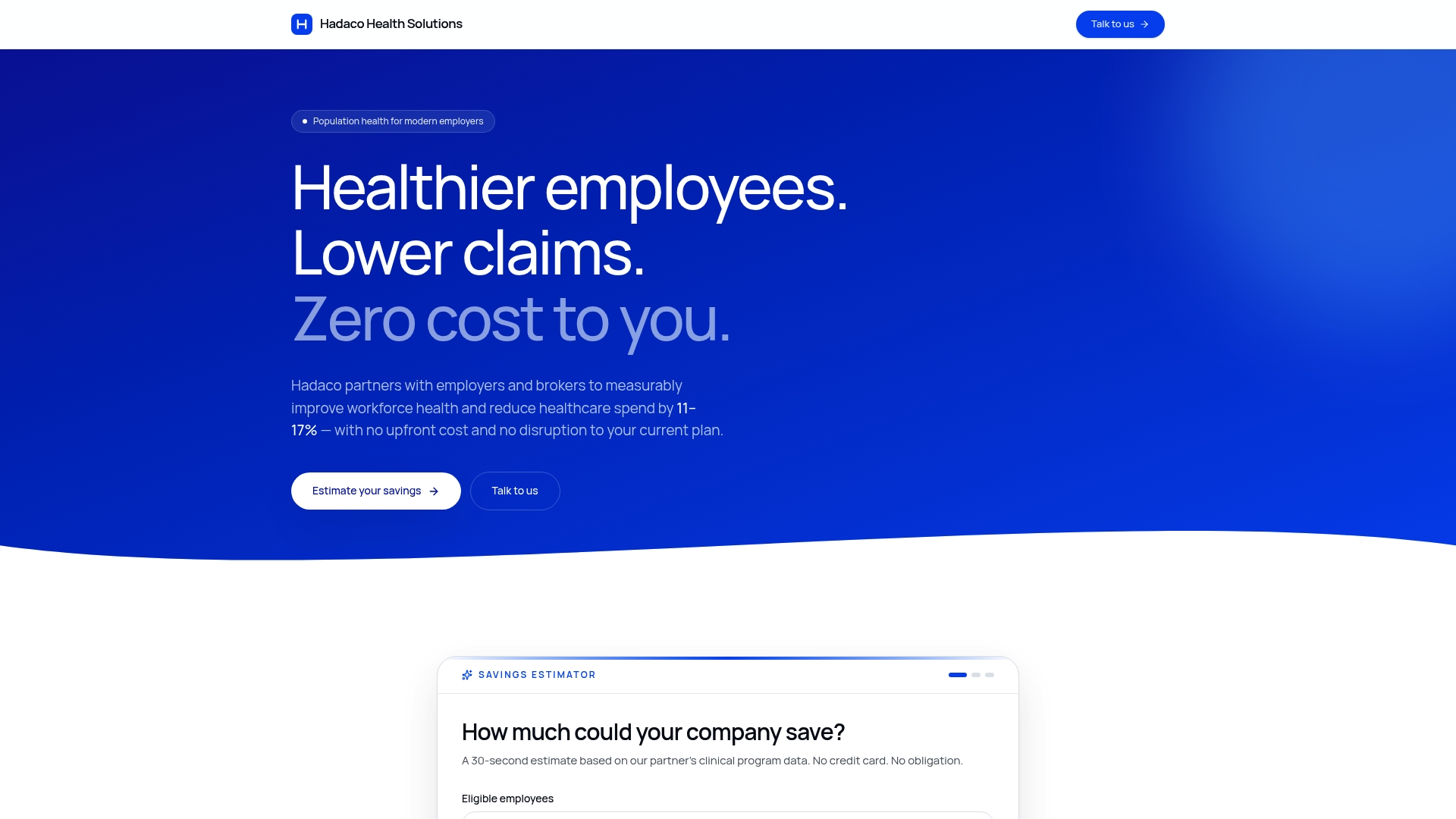
A discovery call with Hadaco walks through a snapshot of your current claims profile, a projected savings estimate based on your workforce's risk factors, and a realistic implementation timeline, usually without disrupting a single plan detail you already have in place. Every engagement runs on a performance model tied to your actual outcomes, with quarterly reporting so you can see the savings, not just take a vendor's word for it. If you want a concrete number instead of a guess, get your savings estimate from Hadaco and see what your workforce's data suggests before your next renewal cycle.
Sources
- Stop-Loss Insurance Costs Are Higher: What You Can Do About It
- Your Broker Recommended Raising Your Specific Deductible. Here's the Leveraged Trend Math Behind It.
- 7 levers to achieve claims management excellence
- Reducing Claims Leakage From 14% to Under 5%: a Data-Driven Approach for Carriers - BSA Claims
- Hadaco Health Solutions — Healthier employees, lower claims